
A tree does not have legs to regain its balance, arms to push itself upright or muscles to pull its body back into position. Yet, when its trunk bends under the weight of snow, strong winds or an unstable slope, something remarkable happens. Over time, the tree can actively correct its posture.
For decades, scientists have known that trees produce specialised wood to help them overcome gravity and mechanical stress. But exactly how they coordinate this process to straighten an already curved trunk has remained an intriguing scientific question.
Now, researchers have uncovered an important part of the mechanism.

A study published in New Phytologist on September 2, 2026, has demonstrated that trees can sense the curvature of their own stems and produce specialised wood on the opposite side to pull themselves back towards a straight position.
The discovery, involving researchers from France’s National Research Institute for Agriculture, Food and Environment (INRAE) and Université Clermont Auvergne, reveals something extraordinary about plant biology.
Trees do not simply grow towards sunlight or respond to gravity. They can also monitor their own physical shape and use specialised tissues to correct it.
Scientists describe this process as a form of plant proprioception — an internal awareness of body position and shape.
And the biological material responsible for much of this movement behaves remarkably like a muscle.
The hidden biological muscles inside a tree

The secret lies in a specialised tissue known as reaction wood.
Unlike ordinary wood, which primarily provides structural support and helps transport water and nutrients, reaction wood develops in response to mechanical demands. It generates internal forces that help a tree adjust the position of its trunk and branches.
There are two principal forms:
-
Tension wood: Usually produced by broad-leaved trees, including poplars. It develops on the upper side of a leaning stem and generates pulling forces that help lift it.
-
Compression wood: Common in conifers such as pines and spruces. It develops on the lower side of a leaning stem and generates pushing forces that help reposition it.
These tissues achieve a similar objective through different mechanical strategies.
In simple terms, tension wood pulls a leaning stem upwards, while compression wood pushes it back towards a more upright position.
This is why scientists often compare reaction wood to biological muscles. It is not muscle tissue in the animal sense, but it produces active mechanical forces through the formation and maturation of specialised wood cells.
Researchers have studied reaction wood for decades. What remained less clear was how trees could coordinate these forces when a trunk had already become curved.
That is where the new investigation becomes particularly interesting.
How can a tree sense that it is leaning?
Animals have proprioceptors that help the brain understand where different body parts are positioned, even without looking at them.
For example, you can close your eyes and still know whether your arm is raised or lowered.
Trees have no nervous system or brain, but they possess biological mechanisms that allow them to detect changes in their orientation and shape.
One important mechanism involves specialised plant cells called statocytes.
Inside these cells are tiny, dense structures known as statoliths, often formed by starch-rich amyloplasts. Their movement in response to gravity helps plants determine which direction is down.
This information contributes to gravitropism — the growth response through which plants adjust their orientation relative to gravity.
Trees also respond to light through photoreceptors, helping their shoots grow towards favourable sources of illumination.
But these are not the only signals involved.
The latest research demonstrates that trees can also detect their own curvature. This ability is called proprioception.
In effect, a tree has access to information about its surroundings and information about its own physical shape. By combining these signals, it can regulate where specialised wood develops.
The remarkable part is that this response does not require a brain, nerves or conscious decision-making.
The experiment that revealed the tree’s secret
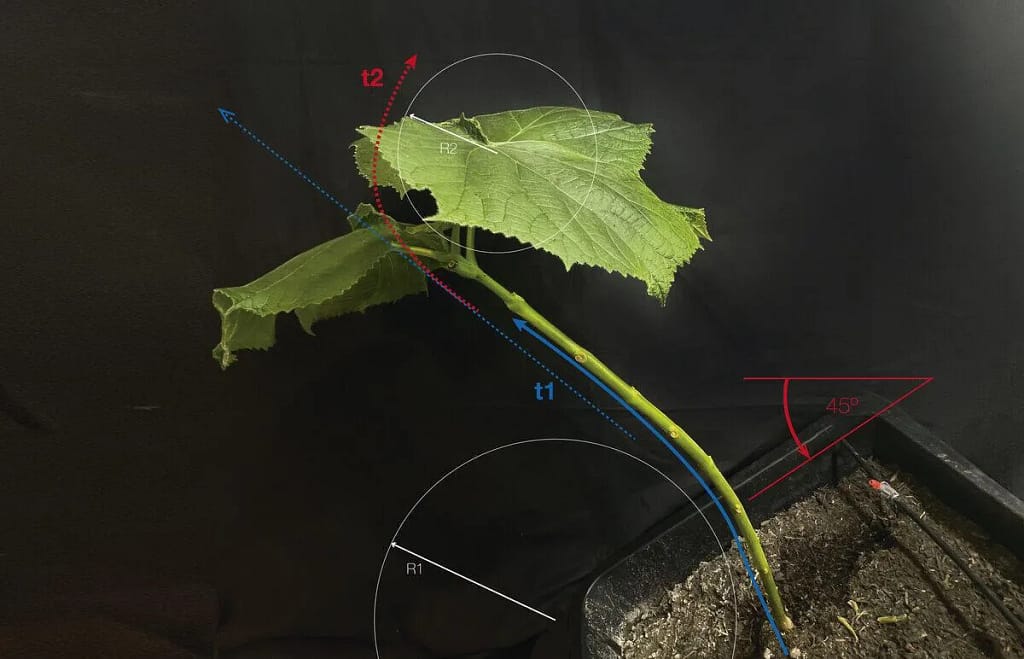
To understand how trees use their internal sense of shape, researchers designed an unusual experiment involving young poplar trees (Populus tremula × alba).
They wanted to separate the tree’s ability to sense its own curvature from its responses to gravity and light.
That was not easy. Under normal conditions, a tree receives several signals simultaneously. It responds to gravity, sunlight and mechanical forces acting on its trunk.
How could scientists determine whether the tree was correcting its shape independently of those external signals?
They developed a special experimental arrangement.
The researchers initially positioned young poplar trees horizontally. As they grew, their stems gradually curved upwards, attempting to return towards a vertical position.
This initial bending involved the formation of tension wood.
After approximately ten days, the researchers transferred the curved trees into a specially designed rotating apparatus. The platform rotated around its axis inside a sphere illuminated from multiple directions.
The arrangement disrupted consistent directional signals from gravity and light, allowing researchers to investigate the contribution of the tree’s own curvature sensing.
What happened next was remarkable.
Over the following weeks, the previously curved stems gradually straightened.
The trees were correcting their own shape even when the usual directional environmental signals were effectively neutralised.
When researchers examined the newly formed wood, they discovered that tension wood production had shifted to the opposite side of the stem.
Rather than continuing to pull in the original direction, the tree was producing specialised tissue capable of generating a counteracting force.
The newly formed wood effectively behaved like an opposing muscle, helping the stem return to a straighter position.
This provided direct experimental evidence that proprioception can drive active straightening in trees.
Why trees need opposing biological forces
Imagine bending a flexible metal ruler.
If you release it, its natural elasticity helps it return towards its original shape.
Trees face a more complicated problem.
Their trunks become increasingly rigid as they grow, and simply releasing an external force does not necessarily restore their original position.
They need to produce new tissue capable of generating mechanical forces.
That is where opposing reaction wood becomes important.
When a stem bends, specialised wood forms in a particular region, generating forces that change its curvature. But if the tree continues producing force in the same direction after sufficient correction, it could potentially bend too far.
The newly discovered mechanism helps explain how trees avoid that problem.
By sensing their own curvature, they can adjust where new tension wood develops. The resulting forces oppose the existing bend, gradually bringing the stem towards a straighter position.
This resembles how opposing muscle groups in animals work together to maintain posture.
The tree is not consciously deciding when to stop bending. Instead, biological feedback regulates the formation of new wood.
Could this explain how trees survive powerful storms?

The discovery could have important implications for understanding forest resilience.
Trees regularly encounter mechanical disturbances. Strong winds, heavy rainfall, landslides and shifting soil can alter their position.
Some trees recover their posture, while others remain permanently bent or eventually collapse.
Their ability to detect changes in their own shape and generate corrective forces may be an important part of their long-term survival.
However, this does not mean trees can always recover from storm damage. A broken trunk, severely damaged roots or structural failure may be beyond the capabilities of reaction wood.
The research instead reveals an additional biological mechanism that helps trees maintain their posture and respond to certain forms of mechanical disturbance.
With extreme weather events becoming an increasing concern for forest management, understanding these mechanisms could become particularly valuable.
Could scientists use this discovery to grow stronger trees and crops?
The research has applications beyond understanding forests.
One possibility is developing better methods for selecting trees that naturally maintain straighter trunks.
Timber quality is influenced by how wood develops internally. Poorly coordinated reaction wood formation can create unwanted mechanical stresses, affecting the properties of harvested timber.
Understanding how trees regulate their posture could help forestry researchers identify varieties that produce more uniform wood.
There may also be agricultural benefits.
Farmers sometimes face a problem called lodging, in which cereal crops such as wheat and barley bend or collapse before harvest.
This can reduce yields, complicate harvesting and increase crop losses.
If researchers can better understand the biological mechanisms responsible for maintaining plant posture, they may eventually identify crop varieties with stronger natural resistance to lodging.
The findings could also contribute to breeding programmes designed to produce plants better equipped to withstand environmental stress.
These are potential applications, not technologies already demonstrated by the experiment.
The bigger mystery: How much do trees actually sense?
Perhaps the most fascinating aspect of this research is what it reveals about plant intelligence and biological organisation.
Trees do not have brains, but they are far from passive organisms.
They detect gravity, respond to light, sense physical disturbances, communicate chemically with their environment and continuously adjust their growth.
The new research adds another ability to this picture: monitoring their own physical curvature and actively correcting it through specialised tissue formation.
It also raises further questions.
Do different tree species have significantly different abilities to detect and correct their own curvature?
How quickly can these biological muscles respond to sudden mechanical changes?
Can scientists identify the molecular signals that tell a tree where to produce opposing reaction wood?
And could understanding these mechanisms help researchers develop crops and forests that are more resilient to increasingly unpredictable environmental conditions?
These questions will require further investigation.
Final thoughts: Trees are more active than we imagined
For centuries, we have understood trees primarily as organisms that grow, absorb sunlight, produce oxygen and provide structural habitats for countless species.
But their biology is considerably more sophisticated.
A tree can detect that its trunk is curved, regulate the production of specialised wood and generate internal forces that gradually restore its posture.
It does not need a nervous system to perform this remarkable feat.
The 2026 research provides direct evidence that trees use their own sense of shape to coordinate these corrective movements.
Perhaps the next time you see a tree growing at an unusual angle and gradually bending back towards the sky, remember that something extraordinary may be happening inside its trunk.
It is not simply growing.
It is actively rebuilding its own posture, one layer of wood at a time.




