
For a few tense weeks in early 2025, a chunk of rock roughly the size of a fifteen-story building had a genuine, mathematically calculated chance of hitting Earth. Not a hoax. Not internet exaggeration. An actual number, published by NASA, that kept climbing every time astronomers pointed a telescope at it. This is the story of asteroid 2024 YR4 — how close the odds really got, how scientists talked the risk back down, and why the story isn’t quite finished even now.
The Discovery That Started With a Routine Scan
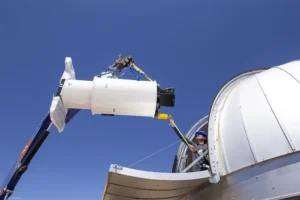
On December 27, 2024, a telescope system called ATLAS — the Asteroid Terrestrial-impact Last Alert System, run out of Chile — picked up a faint moving object nobody had seen before. It got the unglamorous name 2024 YR4, and at first, it looked like just another entry on the long list of near-Earth objects astronomers track every year.
Then someone ran the numbers on where it was headed. The asteroid’s orbit crosses Earth’s path, and its trajectory pointed toward a close encounter on a very specific date: December 22, 2032. Early calculations gave it roughly a 1% chance of actually hitting us. That was enough to trigger something that had never happened before — the International Asteroid Warning Network issued its first-ever formal risk notification, flagging 2024 YR4 as a real, watch-list threat.
That’s usually where these stories fizzle out. Most newly discovered asteroids get an initial scare estimate, then quietly drop to zero risk within days once more observations come in. This one didn’t do that. It did the opposite.
When the Odds Kept Going Up, Not Down
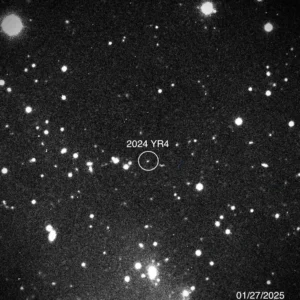
Through January and into February 2025, something unusual happened: the impact probability climbed. NASA’s Jet Propulsion Laboratory reported the odds rising to 1.5%, then astronomers watched it tick further upward. By February 18, 2025, the number hit 3.1% — the highest impact probability ever recorded for an object of this size, and enough to make 2024 YR4 briefly the most dangerous asteroid on record.
To put that 3.1% in perspective: it meant that if you ran the exact same set of orbital circumstances roughly 32 times, once, on average, the asteroid would actually hit Earth. That’s not a coin flip, and it was never something to lose sleep over on its own. But for context, most near-Earth objects that make headlines get downgraded to a small fraction of a percent within days. This one kept climbing for weeks, and that’s what made astronomers pay real attention.
The asteroid itself was estimated at somewhere between 130 and 330 feet across based on early observations — roughly building-sized, and squarely in the range scientists sometimes call “city-killer” territory, since an impact from an object that size wouldn’t be an extinction event, but could level a metropolitan area with a force comparable to hundreds of Hiroshima-scale bombs if it happened to hit a populated region directly.
Then, Just as Quickly, the Risk to Earth Collapsed
Here’s the part of the story that rarely gets the same headline treatment as the scary number, even though it’s arguably the more important half: within days of that 3.1% peak, the odds cratered.
As more observations came in and astronomers refined the asteroid’s orbit with greater precision, the calculated chance of an Earth impact dropped essentially to nothing — down to about 0.004%, according to NASA’s updated figures. For context, that’s roughly the same as your odds of flipping a coin and having it land on its edge instead of heads or tails. NASA’s own assessment went further, stating there was no significant potential for the asteroid to impact Earth for at least the next century.
This wasn’t luck or a lastminute save — it’s simply how asteroid risk assessment actually works. Early orbital calculations are based on limited data, which means a wide range of possible future paths the asteroid could take. As telescopes gather more observations over time, that range of possibilities narrows dramatically, like slowly bringing a blurry photo into focus. Most of the time, that narrowing process pushes Earth outside the danger zone entirely — which is exactly what happened here, just more dramatically and more publicly than usual because the early numbers had climbed so unusually high first.
Wait — So Then Why Did the Story Keep Making Headlines All Year?
Because the story wasn’t actually over. It just moved to a different target: the Moon.
Once Earth was effectively ruled out, astronomers noticed something else in the refined trajectory data — a small but real chance that 2024 YR4 could strike the Moon on that same December 22, 2032 date. And unlike the Earth-impact odds, this number didn’t collapse right away. It actually climbed for a while, following an eerily similar pattern to the original scare.
By mid-2025, NASA’s updated tracking, aided by a fresh look from the James Webb Space Telescope, put the lunar impact probability at 4.3% — a small but genuinely nontrivial figure for anyone tracking planetary defense news. That’s the point where this story stopped being purely about Earth safety and became something almost more interesting: astronomers using humanity’s most powerful space telescope to figure out whether a building-sized rock might crater the Moon in front of the entire world, in real time, seven years in advance.
Enter JWST: Precision From 170 Million Miles Away
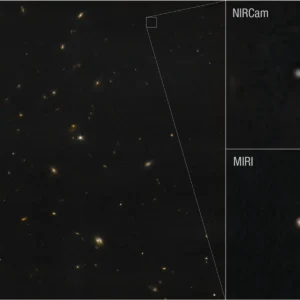
This is where the story becomes a genuine showcase for what modern space telescopes can actually do. As 2024 YR4 moved farther from Earth, it became too faint for ground-based telescopes to track — but the James Webb Space Telescope, with its far greater sensitivity, could still see it clearly.
A research team led by Andy Rivkin at the Johns Hopkins Applied Physics Laboratory used JWST’s Near-Infrared Camera to pin down both the asteroid’s size and its trajectory with far more precision than ground telescopes could manage. Those 2025 observations refined the asteroid’s estimated diameter to about 60 meters, give or take 7 meters — considerably more precise than the original 40-to-90-meter range from initial ground-based sightings.
Then, in February 2026, JWST took one more look — its last realistic opportunity before the asteroid becomes unobservable from any telescope until 2028. By extending the observational timeline by eight months and tightening the trajectory data by more than a factor of ten, that final round of measurements delivered the answer astronomers had been chasing for over a year.
The Verdict: The Moon Is Safe Too
The result, confirmed through observations taken on February 18 and 26, 2026, closed the book on this particular chapter of the story: astronomers ruled out the possibility of a lunar impact entirely. Updated orbital calculations now show 2024 YR4 will pass the Moon at a distance of more than 20,000 kilometers — over 12,000 miles — comfortably clear of any collision course.
That’s a genuinely satisfying resolution to a story that had been quietly building tension for more than a year. An object that once carried the highest recorded impact probability for its size, that briefly threatened Earth, then threatened the Moon, has now been definitively cleared on both counts through the highest-precision tracking humanity has available.
There’s one small catch: because the asteroid is now too distant and faint to observe again until 2028, this is essentially the final word for the next couple of years. Barring any dramatically unexpected orbital surprise — which, given how precisely JWST just measured its path, would be a significant shock — 2024 YR4 is considered a closed case for December 2032.
Why This Story Matters More Than the Scary Headline Ever Did
It would be easy to read this whole saga as a false alarm and move on. That would miss the actual point. What just happened with 2024 YR4 is planetary defense working exactly as it’s designed to — a real early warning system catching a genuine object of concern, tracking it with rigorous, transparent, constantly updated math, and correctly ruling out the danger well over a decade before the date in question, using nothing but patient observation and increasingly powerful telescopes.
This was also, in a very real sense, a live rehearsal. NASA’s own assessment noted that 2024 YR4 provided an invaluable real-world test of planetary defense science and public notification systems — the kind of dry run that matters enormously, because the next object that gets flagged might not have its odds drop so cleanly. Having a system that can calmly track, refine, and communicate risk in real time, without public panic outrunning the actual science, is exactly the infrastructure you want in place before a genuinely dangerous object ever gets discovered.
Objects the size of 2024 YR4 — building-scale, regionally destructive if they ever did hit — are estimated to strike Earth only once every few thousand years on average. That’s rare enough that most people will never see one in their lifetime. But “rare” isn’t the same as “impossible,” which is exactly why an early-warning system that works — one that can take an object from a genuine 3.1% impact probability down to a scientifically confirmed “no threat” verdict, using real data instead of guesswork — is one of the more quietly reassuring stories to come out of space science in the past two years.
For now, 2024 YR4 is filed away as a near-miss that never actually was one. But the tracking data, the JWST imagery, and the math behind it all remain public — a rare case where you can check the actual science behind a “the world almost ended” headline yourself, and find that the real story is even more interesting than the scare.
Sources:
 NASA
NASA