
Cloud-9: The ‘Ghost Galaxy’ Made Entirely of Dark Matter That Shouldn’t Exist
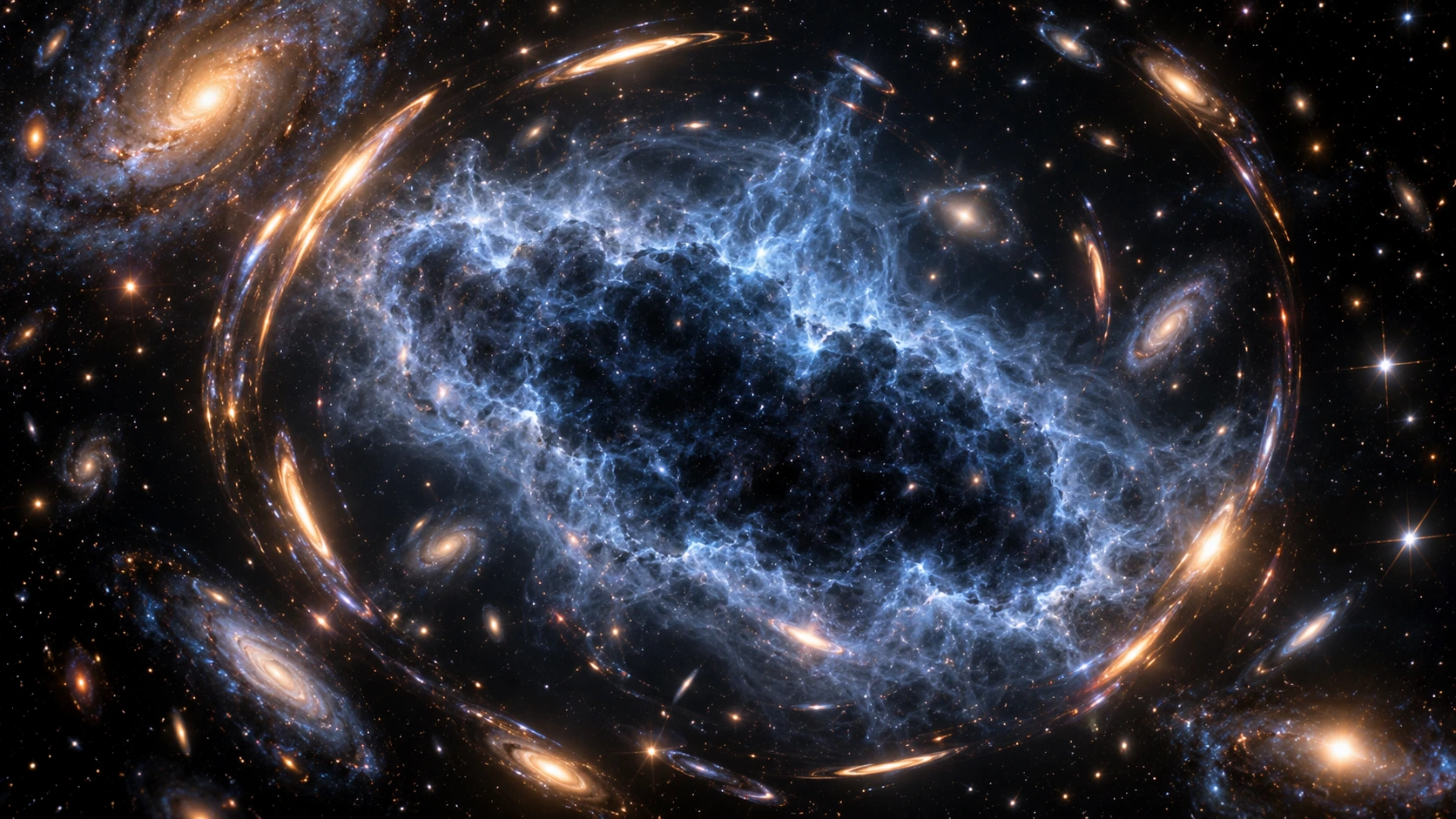
Imagine discovering a cosmic object that weighs billions of times more than our Sun but contains no detectable stars. There is no brilliant galactic core, no familiar spiral arms, and no glittering population of suns illuminating its surroundings. Instead, astronomers have found a faint cloud of hydrogen gas that appears to be embedded in an enormous reservoir of invisible dark matter.
Its name is Cloud-9, and it may represent something astronomers have searched for for decades: a galaxy that never managed to become a galaxy in the conventional sense.
The discovery has attracted attention because it offers a rare opportunity to investigate dark matter without the glare of a normal galaxy. Located approximately 14 million light-years from Earth near the spiral galaxy Messier 94, Cloud-9 appears to be a relic of the early universe, preserving a stage of cosmic evolution that most galaxy-forming structures eventually passed through.
In January 2026, researchers announced that observations from the Hubble Space Telescope had confirmed the absence of a detectable stellar population inside the cloud. Rather than revealing a hidden collection of faint stars, Hubble found an object that appears to have remained starless. The findings support the interpretation that Cloud-9 is a reionization-limited neutral hydrogen cloud, known as a RELHIC. https://science.nasa.gov/missions/hubble/nasas-hubble-examines-cloud-9-first-of-new-type-of-object/
That distinction matters. Cloud-9 is not a completely invisible object made only of dark matter. It contains ordinary matter in the form of hydrogen gas. The extraordinary part is that the cloud appears to be dominated by dark matter without having formed a significant population of stars.
Could this be a missing piece in our understanding of how galaxies are born? And if Cloud-9 exists, how many other failed galaxies might be hiding in the universe?
What Is Cloud-9, the Ghost Galaxy?
Cloud-9 is a compact cloud of neutral hydrogen associated with a dark matter halo. Astronomers use the nickname “ghost galaxy” because it resembles a potential galaxy in the making but lacks the stars that would normally make such a system visible. The more precise scientific description is a candidate RELHIC, short for Reionization-Limited H I Cloud. In this terminology, H I refers to neutral atomic hydrogen, while the RELHIC classification describes a gas cloud that may have survived from the early universe without developing a significant stellar population. The concept is important because cosmological models predict that not every dark matter halo will become a luminous galaxy. Some halos may capture gas but never gather enough suitable material under the right conditions to trigger sustained star formation. Cloud-9 appears to fit that prediction.A Cosmic Object Without a Galaxy's Familiar Glow
Most galaxies are recognized through the light emitted by their stars, the radiation produced by gas, or the combined effects of both. Astronomers can also infer their properties by studying their motion and gravitational influence. Cloud-9 presents a different challenge. Researchers detected it through radio observations of neutral hydrogen rather than through a visible collection of stars. The cloud was initially identified in observations made with China's Five-hundred-meter Aperture Spherical Telescope, or FAST. Subsequent observations with the Green Bank Telescope and the Very Large Array helped confirm the hydrogen cloud and characterize its properties. The Hubble Space Telescope then provided a crucial follow-up observation. Its sensitive cameras searched for the faint stars that might have revealed Cloud-9 to be an ordinary dwarf galaxy whose stellar population was simply too dim for earlier observations. The search came up empty. Researchers found no detectable stellar population consistent with a conventional dwarf galaxy within the cloud. This absence strengthened the case for interpreting Cloud-9 as a starless, dark-matter-dominated structure. https://esahubble.org/news/heic2601/ Cloud-9 is therefore not a case of astronomers spotting a dark patch through a telescope. It is a case of researchers detecting ordinary gas, measuring its properties, and finding evidence that a much more massive invisible structure may be holding it together.Why Dark Matter Matters—and Why Cloud-9 Is So Strange
Dark matter is one of the biggest unresolved questions in modern cosmology. Unlike ordinary matter, dark matter does not emit, absorb, or reflect light in ways that allow astronomers to observe it directly with conventional telescopes. Its presence is inferred from gravitational effects, including the motion of stars and gas in galaxies, the bending of light, and the growth of large-scale cosmic structures. Current cosmological estimates indicate that dark matter accounts for roughly 85 percent of all matter in the universe. This does not mean it accounts for 85 percent of the universe's total energy content, which also includes dark energy and ordinary matter. According to the leading cosmological model, dark matter played a fundamental role in building the universe's structure.Dark Matter as the Scaffold of Galaxies
After the Big Bang, tiny differences in the distribution of matter grew under gravity. Dark matter began collecting into increasingly dense structures, creating gravitational wells that influenced the distribution of ordinary matter. Hydrogen and helium gas could fall into these wells, cool under suitable conditions, and become dense enough to form stars. Over time, these processes produced galaxies containing stars, gas, dust, and other structures. But this process was never guaranteed to happen in every dark matter halo. A halo may be too small to retain enough gas. Radiation from the early universe may heat or prevent gas from cooling efficiently. Other environmental processes can strip gas away before it forms stars. The result can be a dark matter halo that contains little or no detectable starlight. Cloud-9 is exciting because it offers evidence for this predicted category of object.How Much Dark Matter Could Cloud-9 Contain?
The research team estimated that Cloud-9's neutral hydrogen gas has a mass of approximately one million times the mass of the Sun. If the observed gas is in approximate equilibrium within a gravitationally bound dark matter halo, the total dark matter mass may be around five billion solar masses. These figures are estimates based on observations and the physical interpretation of the cloud, not a direct weighing of dark matter. The distinction is essential. Astronomers cannot simply photograph dark matter and count its particles. Instead, they use the observed gas, its motion, and models of the system's dynamics to infer the gravitational mass required to explain the evidence. If the interpretation holds, the invisible component outweighs the observed hydrogen by thousands of times. Cloud-9 is therefore not empty. It contains ordinary matter, but its gravitational structure may be dominated overwhelmingly by something that cannot be seen directly.How Astronomers Found a Galaxy That Has No Stars
Cloud-9 demonstrates how modern astronomy combines different instruments to investigate objects that cannot be understood through visible light alone. Its discovery did not begin with Hubble. Radio telescopes identified the hydrogen cloud first, and later observations tested whether it contained a faint stellar system.Step 1: Detecting Neutral Hydrogen With Radio Telescopes
Neutral hydrogen emits radiation at a wavelength of approximately 21 centimeters. Radio telescopes can detect this emission and use it to map hydrogen clouds across the universe. FAST observations identified Cloud-9 as a compact hydrogen cloud in the vicinity of Messier 94. Follow-up observations with the Green Bank Telescope and the Very Large Array independently helped establish the reality and properties of the object. The cloud's measured velocity and other characteristics indicated that it was associated with the same general distance range as Messier 94. This first stage established the presence of an unusual concentration of gas. It did not yet prove that the object lacked stars.Step 2: Testing Whether It Was a Faint Dwarf Galaxy
An ordinary dwarf galaxy can contain relatively few stars. If those stars are faint enough, ground-based observations may fail to detect them against the background of more distant galaxies and foreground objects. This created an important alternative explanation: perhaps Cloud-9 was simply a very faint galaxy. To investigate that possibility, astronomers needed observations sensitive enough to detect a stellar population if one existed.Step 3: Hubble Searches for the Missing Stars
The Hubble Space Telescope observed Cloud-9 using its Advanced Camera for Surveys in February 2025. Researchers examined the region for stars that would be expected if the cloud contained a conventional dwarf galaxy. The observations did not reveal a detectable stellar population that could account for the object as a normal galaxy. This negative result was scientifically valuable. It helped distinguish Cloud-9 from a faint galaxy whose stars had merely escaped earlier detection. The observations instead supported the interpretation of a starless hydrogen cloud embedded in a dark matter halo.Why the Absence of Light Is Evidence
In astronomy, failing to detect something is not automatically proof that it does not exist. A telescope may be insufficiently sensitive, or the object may be too distant. The significance of the Cloud-9 observations lies in the sensitivity of the measurements and the researchers' ability to place limits on any hidden stellar population. The study constrained the possible stellar mass and found the results consistent with the RELHIC interpretation. Cloud-9 therefore offers more than an interesting photograph. It provides observational support for a predicted stage of galaxy formation that has been difficult to identify.Why Scientists Are Excited and Confused
Cloud-9 raises several important questions about how galaxies form and why some dark matter halos never develop stars.1. Can a Galaxy Exist Without Stars?
The answer depends partly on how the word galaxy is defined. In everyday language, a galaxy usually means a large collection of stars, gas, dust, and dark matter. Cloud-9 does not fit that familiar image. Researchers often use the term “failed galaxy” to describe a dark matter halo that never formed a substantial stellar population. The phrase is useful as a shorthand, but it does not mean Cloud-9 was once a normal galaxy that later lost its stars. Current evidence instead supports the possibility that Cloud-9 never formed a significant population of stars in the first place. The object is more precisely described as a starless, dark-matter-dominated gas cloud or a candidate RELHIC.2. Did Cloud-9 Never Form Stars, or Were They Lost?
One possible explanation for a starless system is that it once contained stars that were later removed or destroyed. Gravitational interactions and environmental effects can alter galaxies, and processes such as ram-pressure stripping can remove gas from a system moving through a surrounding medium. However, the evidence for Cloud-9 favors a different explanation: it may have failed to form stars from the beginning. That interpretation fits the theoretical expectation for a gas cloud inside a dark matter halo that never accumulated the right conditions for star formation. Further observations can help determine whether environmental effects played a role and how the cloud has evolved.3. Could Thousands of Similar Objects Exist?
Potentially, yes. Cosmological simulations predict that many low-mass dark matter halos may exist without becoming visible galaxies. Most would be difficult to identify because they contain few stars or none at all. Cloud-9 provides an opportunity to test those predictions. If similar objects are common, astronomers may discover more by combining wide-area radio surveys with sensitive optical observations. Radio surveys can identify neutral hydrogen clouds, while optical telescopes can test whether those clouds contain stars. The number of such objects will help constrain models of galaxy formation and the properties of dark matter.Theories Behind Cloud-9
Cloud-9 is interesting because it appears to fit a theoretical category of object that has been predicted but difficult to confirm. Several explanations and physical processes are relevant to understanding its origin.The Primordial Dark Matter Halo
The leading interpretation is that Cloud-9 is a remnant of early galaxy formation: a dark matter halo containing neutral hydrogen that never developed a significant stellar population. In the early universe, dark matter halos provided the gravitational framework within which gas could collect. But not every halo became a luminous galaxy. The process of reionization, during which radiation from the first generations of stars and galaxies ionized much of the universe's hydrogen, affected how gas behaved in small halos. Heating from the cosmic ultraviolet background could prevent gas from cooling and collapsing efficiently in sufficiently low-mass systems. Some halos may therefore have retained gas without ever triggering star formation. A RELHIC is a theoretical example of this outcome: a relatively stable hydrogen cloud held within a dark matter halo. Cloud-9 appears consistent with this picture, making it an important candidate for studying a predicted population of starless structures.A Stripped Galaxy Remnant
Another possibility researchers must consider is whether environmental processes have altered the object. Gas can be stripped from galaxies by interactions with surrounding material, and gravitational encounters can disrupt stellar systems. These processes are well established in astrophysics. However, the absence of detectable stars does not automatically prove that Cloud-9 is the remnant of a former galaxy. To support that interpretation, researchers would need evidence of a plausible evolutionary history, such as a stellar population, associated debris, or other observable signatures. At present, the starless-halo interpretation is the more compelling explanation of the available observations.Could It Reveal New Physics?
Cloud-9 may help scientists test models of dark matter, but it does not currently demonstrate that new physics is required. The standard cosmological model predicts dark matter halos across a wide range of masses. It also predicts that only some halos will form observable galaxies. If Cloud-9's properties match those predictions, it strengthens the case that the existing framework can explain objects that previously lacked clear observational counterparts. If future observations reveal inconsistencies between its measured properties and theoretical predictions, researchers may need to refine their models. That is how science advances: an unusual object provides a test of existing ideas, rather than automatically proving an entirely new theory.Why Cloud-9 Matters for Cosmology
Cloud-9 may look unremarkable in a conventional telescope image, but its scientific implications could be substantial.It Tests Theories of Galaxy Formation
Astronomers have long predicted that many dark matter halos should remain starless or nearly starless. Finding an object that fits this prediction provides a way to test how gas behaves in low-mass halos and why star formation begins in some systems but not others. The results can help establish the minimum conditions required for a galaxy to become luminous.It Helps Constrain Dark Matter Models
The inferred mass of Cloud-9, combined with measurements of its gas and internal dynamics, provides constraints on the gravitational structure of a low-mass dark matter halo. A growing sample of similar objects could help scientists compare the predicted abundance of small halos with observations. This is important because different dark matter models can produce different patterns of structure on small scales. Cloud-9 alone cannot settle the nature of dark matter. However, it offers an additional test of how dark matter behaves in the environments where galaxies form.It Reveals the Limits of Visible-Light Astronomy
Cloud-9 illustrates a fundamental limitation of studying the universe through starlight alone. If astronomers had searched only for conventional galaxies, the cloud might have remained unidentified. Its detection depended on radio observations of hydrogen, followed by optical observations designed to establish whether stars were present. The discovery demonstrates why astronomers combine radio, optical, infrared, and other observations to understand the universe. Some of the most informative objects may not resemble the galaxies that dominate telescope images.Could There Be Ghost Galaxies Near the Milky Way?
Astronomers expect dark matter halos to exist around and near large galaxies, including the Milky Way. Some halos host dwarf galaxies, while others may contain very few stars. This raises the possibility that additional starless systems remain undetected in our cosmic neighborhood. However, Cloud-9 should not be described as the first evidence that dark matter halos without visible galaxies might exist. Theoretical models and indirect observations have long suggested that such structures should be present. What makes Cloud-9 particularly important is the combination of a detected hydrogen cloud and deep observations that found no corresponding stellar population. Finding more examples will help researchers determine whether Cloud-9 is unusual or represents a larger population of starless structures.How Would Astronomers Find More?
Future searches could combine several methods:- Radio surveys: Identify compact clouds of neutral hydrogen.
- Sensitive optical imaging: Search for faint stars that might reveal an ordinary dwarf galaxy.
- Spectroscopy: Measure gas velocities and investigate the physical conditions within a cloud.
- Numerical simulations: Compare observed objects with predictions for dark matter halos.
- Wide-area surveys: Search large regions of the sky to establish how common these structures are.
Is Cloud-9 Dangerous to Earth?
No known threat to Earth is associated with Cloud-9. The object lies approximately 14 million light-years away, near Messier 94. At that distance, it is a subject of astronomical investigation rather than a practical concern for our planet. Its importance is scientific. By studying Cloud-9, researchers can investigate how matter accumulated in the early universe and why some structures failed to become luminous galaxies. It also provides a reminder that invisible does not mean irrelevant. Dark matter may not produce the light that makes stars and galaxies spectacular to observe, but its gravity has played a central role in shaping the cosmic structures around us.The Bigger Picture: A Universe Full of Invisible Structures
For much of human history, the universe was understood mainly through the objects visible in the night sky: stars, planets, and the hazy bands of distant galaxies. Modern cosmology has transformed that picture. Ordinary matter makes up only a small fraction of the universe's total energy content. Dark matter contributes much of the matter that helps form cosmic structure, while dark energy is associated with the accelerated expansion of the universe. Cloud-9 belongs to the dark matter side of this story. It suggests that the universe may contain structures that are gravitationally significant yet almost completely absent from conventional images of galaxies. The object also highlights a subtle point: the formation of a dark matter halo and the formation of a galaxy are not the same event. A halo may develop without producing a recognizable stellar system. That distinction matters because astronomers have traditionally relied on visible galaxies to map the universe's structure. Starless halos could reveal how incomplete that picture is.What Comes Next for Cloud-9?
Future observations can refine estimates of Cloud-9's gas distribution, internal motions, and gravitational mass. They can also search for subtle signs of a faint stellar population and test whether the cloud remains consistent with the RELHIC interpretation. Astronomers will also look for other candidates using increasingly sensitive radio surveys and optical telescopes. If more examples are found, scientists may be able to measure the abundance of starless halos and compare it with predictions from cosmological simulations. If such objects prove rarer than expected, that result will also be informative. It could indicate that gas retention, environmental effects, or the physics of star formation is more complicated than current models suggest. Either way, Cloud-9 provides a valuable opportunity to study the universe's hidden architecture.Final Thoughts: The Galaxy That Never Became a Galaxy
Cloud-9 is remarkable not because astronomers have discovered a completely invisible universe within our own, but because they have found a plausible example of a structure that theory predicted should exist. A cloud of hydrogen, held within a much more massive dark matter halo, appears to have survived without forming a detectable population of stars. Hubble's observations helped distinguish it from a faint dwarf galaxy and strengthened the case that it is a starless relic of early galaxy formation. The discovery does not overturn cosmology. Instead, it gives scientists a rare opportunity to test an important part of the existing picture. It may also change how researchers search for the universe's smallest and faintest structures. If a system can contain substantial mass without producing a conventional galaxy, then counting visible galaxies alone will never provide a complete inventory of cosmic structure. Perhaps more objects like Cloud-9 remain undiscovered, waiting in radio surveys and faint patches of the sky. Finding them could help reveal why some dark matter halos become galaxies while others never ignite a single star. The universe may be full of structures that do not shine. Cloud-9 offers one of our clearest opportunities yet to understand what those structures can teach us about how the cosmos came to be.Frequently Asked Questions About Cloud-9
What is Cloud-9?
Cloud-9 is a starless, gas-rich cloud near the galaxy Messier 94, approximately 14 million light-years from Earth. Observations suggest that it is embedded in a dark matter halo and may be a reionization-limited neutral hydrogen cloud, or RELHIC.Is Cloud-9 made entirely of dark matter?
No. Cloud-9 contains ordinary matter in the form of neutral hydrogen gas. Its estimated total mass is much greater than the mass of the gas alone, suggesting that dark matter dominates its gravitational structure.How did astronomers discover Cloud-9?
Cloud-9 was first identified through radio observations of neutral hydrogen using China's FAST telescope. Observations with the Green Bank Telescope and the Very Large Array helped confirm it. The Hubble Space Telescope subsequently searched for stars and found no detectable stellar population consistent with a conventional dwarf galaxy.How far away is Cloud-9?
Cloud-9 is approximately 14 million light-years from Earth, near the spiral galaxy Messier 94.Why has Cloud-9 been called a failed galaxy?
The phrase describes a dark matter halo that appears to have failed to form a significant population of stars. The evidence suggests that Cloud-9 may have remained a gas-bearing, dark-matter-dominated structure rather than becoming a conventional luminous galaxy.Does Cloud-9 prove that dark matter exists?
Dark matter is already supported by multiple independent lines of astronomical evidence. Cloud-9 provides an additional opportunity to study a structure whose inferred gravitational mass appears to be dominated by dark matter. It does not, by itself, identify the particle or substance responsible for dark matter.How much dark matter does Cloud-9 contain?
Researchers estimate that Cloud-9's total dark matter halo may have a mass of roughly five billion solar masses, compared with approximately one million solar masses in neutral hydrogen gas. These are model-dependent estimates rather than direct measurements of dark matter.Could Cloud-9 contain hidden stars?
The Hubble observations did not detect a stellar population consistent with a conventional dwarf galaxy and placed limits on any possible stellar component. Extremely faint or unusual stellar populations are always a question for further investigation, but the current evidence supports the starless-cloud interpretation.Are there other ghost galaxies in the universe?
Cosmological models predict that some dark matter halos may never form stars. Cloud-9 is an important observational candidate for this population. More radio and optical surveys will be needed to determine how common similar objects are.Could Cloud-9 change our understanding of the universe?
Cloud-9 could improve our understanding of galaxy formation, the smallest dark matter halos, and the conditions that prevent stars from forming. Its importance lies in testing existing theories and helping researchers identify structures that conventional galaxy surveys might miss.References and Further Reading
- NASA — Hubble Examines Cloud-9, First of a New Type of Object https://science.nasa.gov/missions/hubble/nasas-hubble-examines-cloud-9-first-of-new-type-of-object/
- ESA/Hubble — Cloud-9: A New Celestial Object Found by Hubble https://www.esa.int/Science_Exploration/Space_Science/Cloud-9_a_new_celestial_object_found_by_Hubble
- Anand et al. — The First RELHIC? Cloud-9 Is a Starless Gas Cloud The Astrophysical Journal Letters (2025). https://doi.org/10.3847/2041-8213/ae1584
- NASA — Cloud-9, Starless Gas Cloud https://science.nasa.gov/asset/hubble/cloud-9-starless-gas-cloud/
- NASA — Hubble Space Telescope https://science.nasa.gov/mission/hubble/

How an 18-Million-Year-Old Ape Fossil in Egypt Could Change What We Know About Human Evolution
Read story →
Could Entire Ecosystems Still Exist on Earth That Scientists Have Never Discovered?
Read story →
Trees Have Their Own Biological Muscles. Scientists Discover How They Straighten Themselves
Read story →