
On a barren cliff overlooking the Dead Sea, archaeologists uncovered what appeared to be just another fragment from the ancient world. At first glance, it seemed similar to the dozens of scrolls already being recovered from caves near Qumran. Yet this discovery would prove unlike anything else found among the famous Dead Sea Scrolls.
Most of the scrolls contained religious writings, biblical texts, community rules, and theological reflections. The newly discovered artifact was different. It was not written on parchment or papyrus. It was engraved onto sheets of copper.
Even more surprising was what the text appeared to contain.
Instead of prayers or scripture, it described dozens of locations where enormous quantities of gold, silver, and valuable objects had supposedly been hidden.
More than seventy years after its discovery, the Copper Scroll remains one of archaeology’s greatest mysteries. Was it an authentic inventory of hidden treasure? A coded document meant only for insiders? A symbolic text with no treasure at all? Or could vast riches still be waiting somewhere beneath the deserts and hills of the ancient Holy Land?
The answers remain elusive, but the mystery continues to fascinate historians, archaeologists, treasure hunters, and curious readers around the world.
Discovery in Cave 3
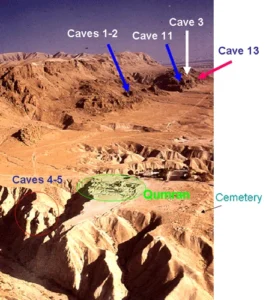
The Copper Scroll was discovered in 1952 in Cave 3 near Qumran, a site located on the northwestern shore of the Dead Sea.
The discovery came during an intense period of archaeological exploration. Since 1947, researchers had been uncovering what became known as the Dead Sea Scrolls, a collection of ancient Jewish manuscripts dating from roughly the third century BCE to the first century CE.
The scrolls revolutionized the study of ancient Judaism and early biblical history.
Yet Cave 3 produced something entirely unexpected.
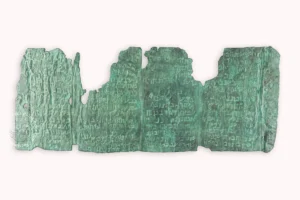
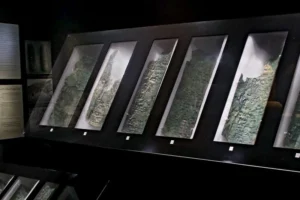
Instead of fragile parchment, archaeologists found two corroded copper rolls. The metal had oxidized over centuries, making the scroll impossible to unroll using conventional methods.
Researchers eventually transported the artifact to England, where specialists carefully cut it into strips to reveal the text inside.
What they discovered sparked one of the most enduring debates in biblical archaeology.
A Treasure List Unlike Any Other
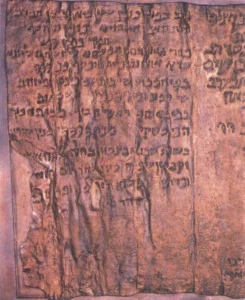
The Copper Scroll does not read like literature.
It contains no stories, no prayers, and no theological discussions.
Instead, it resembles an inventory.
The text lists location after location, often accompanied by specific quantities of treasure allegedly hidden there.
One entry refers to silver buried beneath a particular structure.
Another describes gold hidden near a water channel.
Others mention vessels, sacred objects, and caches concealed in tombs, cisterns, tunnels, and ruins.
In total, scholars estimate the treasure described could amount to dozens of tons of gold and silver.
If the listed quantities are interpreted literally, the treasure would be worth billions of dollars today.
That staggering possibility has fueled speculation ever since.
Why the Copper Scroll Is Different
The Copper Scroll stands apart from every other Dead Sea Scroll for several reasons.
It Was Written on Copper
Ancient texts were usually written on parchment or papyrus.
Copper was expensive, difficult to engrave, and rarely used for lengthy documents.
The decision to use metal suggests the information may have been considered especially important.
Some researchers believe copper was chosen because the contents were intended to survive for generations.
Unlike parchment, metal could endure harsh environmental conditions.
Its Language Is Unique
The Hebrew used in the Copper Scroll differs from many other Dead Sea Scrolls.
Linguistic experts have noted unusual vocabulary, grammar, and terminology.
This has led some scholars to suggest it may have originated from a different community or purpose than other Qumran manuscripts.
It Contains Practical Instructions
Most ancient religious texts focus on beliefs, teachings, or rituals.
The Copper Scroll reads more like a set of directions.
Its references to landmarks, measurements, and buried valuables make it feel remarkably practical.
That practicality is one reason many researchers take the treasure claims seriously.
The Historical Context
To understand the Copper Scroll, it helps to examine the turbulent period in which it may have been created.
The first century CE was marked by political unrest in Judea.
Tensions between Jewish communities and the Roman Empire eventually erupted into the First Jewish-Roman War, which lasted from 66 to 73 CE.
The conflict culminated in the destruction of Jerusalem and the Second Temple in 70 CE.
Many historians believe valuable religious treasures could have been hidden during this chaotic period.
People facing invasion often conceal wealth in hopes of recovering it later.
In this context, the Copper Scroll’s treasure inventory begins to seem plausible.
If individuals or groups feared Roman confiscation, documenting hidden caches might have been a practical necessity.
Could the Treasure Belong to the Second Temple?
One of the most popular theories connects the Copper Scroll to the treasures of the Second Temple in Jerusalem.
The Temple served as the spiritual and economic center of Jewish life for centuries.
It accumulated vast wealth through offerings, donations, and sacred artifacts.
When Roman forces advanced toward Jerusalem, some speculate that priests or officials may have hidden portions of this wealth.
Supporters of this theory point to the immense quantities of treasure described in the scroll.
Such riches might have exceeded the resources of a small community like Qumran.
A connection to the Temple could explain the extraordinary amounts mentioned.
However, evidence remains inconclusive.
No direct link between the Copper Scroll and the Temple has been proven.
The Qumran Community Theory
Another explanation involves the community associated with Qumran itself.
Many scholars believe the Dead Sea Scrolls were connected to a Jewish sect often identified as the Essenes.
According to this theory, the Copper Scroll may document wealth accumulated by that community.
The hidden treasure could have included donations, communal resources, or sacred objects concealed before Roman forces arrived.
Critics argue that the quantities described seem far too large for a relatively isolated desert settlement.
Yet the possibility remains part of ongoing scholarly debate.
Treasure Hunters Enter the Story
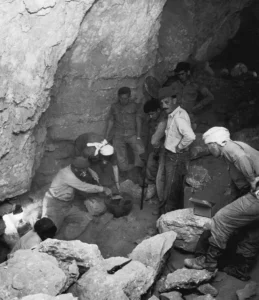
The discovery of the Copper Scroll inevitably attracted treasure hunters.
Over the decades, numerous expeditions have attempted to locate the hidden caches.
Researchers, adventurers, and amateur explorers have searched caves, tunnels, ruins, and archaeological sites across Israel and the surrounding region.
Some claimed they were close to solving the mystery.
Others announced discoveries that later failed verification.
Despite decades of investigation, no confirmed treasure matching the Copper Scroll’s descriptions has been found.
This lack of success raises an important question.
What if the treasure was recovered long ago?
Was the Treasure Already Found?
One possibility is that the treasure once existed but disappeared centuries ago.
The Copper Scroll may have served as a recovery guide for people who knew the hiding locations.
If survivors returned after the Roman invasion, they could have retrieved the valuables and left little evidence behind.
Ancient records contain numerous examples of hidden wealth being recovered after conflicts ended.
Under this scenario, modern searchers would be looking for treasure that vanished nearly two thousand years ago.
The scroll would remain authentic even though the treasure no longer exists.
Could It Be a Code?
Some scholars argue the Copper Scroll should not be interpreted literally.
Instead, they suggest the locations and treasure references may function as coded language.
Ancient groups often used symbolic writing to protect sensitive information.
The listed locations might correspond to people, religious concepts, or hidden messages rather than physical sites.
Supporters of this theory note that some directions appear vague or difficult to reconcile with known geography.
Others argue that coded interpretations become highly speculative and lack convincing evidence.
The debate remains unresolved.
Problems with the Locations
One reason the mystery persists is that many referenced locations are difficult to identify.
Ancient landmarks change over time.
Buildings collapse.
Roads disappear.
Rivers shift course.
Names evolve across centuries.
Even when a location appears recognizable, uncertainty often remains.
A description that seemed obvious in the first century may be nearly impossible to interpret today.
Archaeologists attempting to match the scroll’s directions with modern geography face enormous challenges.
The landscape itself has changed dramatically since the scroll was written.
The Missing Companion Document Theory
Some researchers believe the Copper Scroll was never intended to stand alone.
According to this idea, another document may have existed that explained the listed locations.
The treasure inventory could have functioned as a reference guide, while detailed directions were stored elsewhere.
If such a companion document existed and was later lost, modern readers would be left with only part of the puzzle.
This theory helps explain why some entries seem frustratingly incomplete.
Unfortunately, no companion document has ever been found.
What Modern Technology Reveals
Today’s archaeologists have tools that earlier generations could only imagine.
Ground-penetrating radar, satellite imagery, LiDAR mapping, geographic information systems, and advanced excavation techniques allow researchers to investigate ancient sites with unprecedented precision.
These technologies have transformed archaeology worldwide.
Hidden cities, lost roads, and buried structures have been discovered using methods unavailable just a few decades ago.
Some researchers believe modern technology may eventually provide fresh insights into the Copper Scroll mystery.
Yet technology alone cannot solve every problem.
If the locations cannot be accurately identified, even advanced scanning systems have limited usefulness.
The Cultural Impact of the Copper Scroll
The Copper Scroll has become more than an archaeological artifact.
It occupies a unique place in popular culture.
Documentaries, books, television programs, and online discussions frequently explore its secrets.
The scroll appeals to a broad audience because it combines several powerful themes:
- Ancient mysteries
- Lost treasure
- Biblical history
- Archaeological exploration
- Unsolved puzzles
Few historical artifacts bring together all of these elements so effectively.
The result is a mystery that continues to capture public imagination decades after its discovery.
What Most Scholars Think Today
Academic opinion remains divided.
Some scholars view the treasure inventory as largely authentic.
Others suspect exaggeration, symbolism, or coded meanings.
Few researchers dismiss the scroll entirely because it is undeniably a real ancient artifact with unusual characteristics.
The biggest disagreement concerns how literally its contents should be interpreted.
Most experts agree on several points:
- The Copper Scroll is genuine.
- It differs significantly from other Dead Sea Scrolls.
- It was created for a practical purpose.
- Its treasure references remain unexplained.
Beyond those points, consensus becomes difficult.
The Mystery That Refuses to Disappear
Many archaeological mysteries fade as new discoveries provide answers.
The Copper Scroll has proven remarkably resistant to explanation.
Every proposed solution seems to generate new questions.
If the treasure existed, where is it?
If it was recovered, who recovered it?
If the locations are symbolic, what do they mean?
If the scroll is incomplete, where is the missing information?
Each possibility offers a partial explanation but leaves important details unresolved.
That uncertainty is precisely what keeps the mystery alive.
An Ancient Treasure Map or Something Even Stranger?
Among all the remarkable discoveries found near the Dead Sea, none may be as intriguing as the Copper Scroll.
Unlike ancient scriptures, legal texts, or historical records, it appears to offer something tantalizingly concrete: directions to immense hidden wealth.
Yet decades of investigation have failed to produce definitive answers.
Perhaps the treasure was real and recovered long ago. Perhaps it remains hidden beneath forgotten ruins waiting for discovery. Or perhaps the Copper Scroll conceals a deeper purpose that modern readers have yet to understand.
Until new evidence emerges, the Copper Scroll occupies a unique place in archaeology—a document carved into metal, carrying a message across two thousand years, challenging every generation to decide whether it is a treasure map, a coded archive, or one of history’s most enduring unsolved mysteries.


