Scientists Are Unraveling Why Our Planet Shows So Few Scars From Cosmic Collisions
If an alien civilization arrived in the Solar System and compared Earth with the Moon, it might conclude that something was deeply wrong.
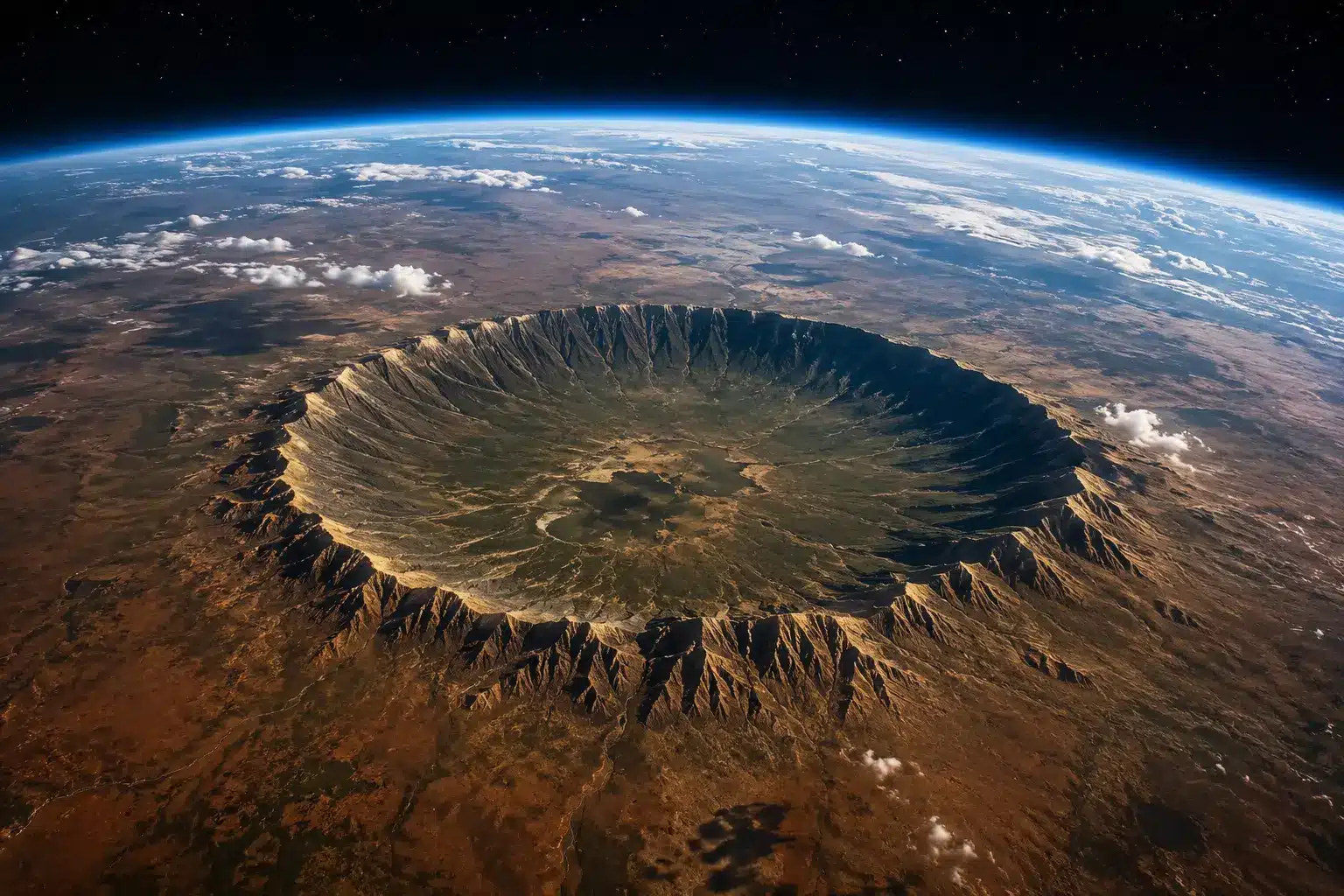
The Moon is covered with millions of impact craters. Giant circular scars stretch across its ancient landscape, preserving a record of billions of years of asteroid and comet bombardment. Earth, meanwhile, appears strangely smooth. Apart from a handful of famous sites such as Arizona’s Meteor Crater and Mexico’s Chicxulub impact structure, there seem to be remarkably few signs that our planet has endured the same cosmic violence.
Yet scientists know this cannot be true.
Earth and the Moon have occupied the same cosmic neighborhood for roughly 4.5 billion years. Both have been exposed to asteroid impacts throughout their history. In fact, Earth’s larger size and stronger gravity make it a bigger target for incoming space rocks. So why does the Moon display millions of craters while Earth has only around 200 confirmed impact structures?
The answer has become one of planetary science’s most fascinating geological mysteries. Researchers say Earth’s missing craters have not disappeared because impacts were rare. Instead, our planet has spent billions of years systematically erasing its own history.
Earth Should Have Far More Craters
Scientists estimate that countless asteroids, comets, and meteoroids have struck Earth since its formation.
Every major rocky body in the Solar System bears evidence of these collisions. Mercury is heavily cratered. Mars contains hundreds of thousands of impact craters. The Moon alone possesses more than two million visible craters larger than one kilometer across. By comparison, Earth has only about 190 to 200 confirmed impact structures.
At first glance, that number appears impossibly low.
Because Earth and the Moon have experienced similar bombardment histories, scientists expected our planet to preserve far more impact evidence. The apparent shortage sparked decades of debate among geologists and astronomers attempting to determine whether the craters had vanished or whether they were simply hidden.
Today, most researchers agree that Earth’s missing craters are largely the result of geological processes that continuously reshape the planet’s surface.
The Planet That Refuses to Stay Still
Unlike the Moon, Earth is alive with geological activity.
The planet’s crust is broken into massive tectonic plates that slowly move across the globe. Over millions of years, these plates collide, separate, sink beneath one another, and recycle vast portions of Earth’s surface.
According to planetary scientists, plate tectonics is one of the primary reasons so many impact craters have vanished. Oceanic crust, which covers most of Earth’s surface, is continuously created and destroyed. While some continental rocks are billions of years old, the oldest ocean floor is generally less than 200 million years old because older crust has been recycled back into the mantle.
Any impact crater that formed on oceanic crust hundreds of millions of years ago may no longer exist at all.
It was effectively swallowed by Earth’s geological machinery.
This process has no equivalent on the Moon, where tectonic activity essentially ceased billions of years ago. As a result, lunar craters remain preserved for immense periods of time.
Weather: Nature’s Eraser
Even when tectonic forces spare a crater, another powerful enemy awaits.
Earth’s atmosphere.
Rain, rivers, glaciers, wind, vegetation, and chemical weathering constantly attack the planet’s surface. These processes gradually wear down mountains, transport sediment across continents, and reshape landscapes.
Impact craters are particularly vulnerable.
Most craters begin as relatively shallow depressions. Over millions of years, erosion can soften their rims, fill their basins with sediment, and eventually erase nearly all visible traces of the original impact. Researchers note that many craters become so altered that only specialized geological investigations reveal their true origins.
The contrast with the Moon is dramatic.
The lunar surface lacks flowing water, weather systems, vegetation, and significant atmospheric activity. A crater formed hundreds of millions—or even billions—of years ago may still look remarkably fresh today.
Earth, by comparison, is constantly rewriting its surface.
Hidden Beneath Oceans and Sediment
The mystery deepens when scientists consider how much of Earth remains concealed.
Roughly 71% of the planet is covered by oceans. Many impact craters likely formed beneath the sea or now lie buried beneath marine sediments.
Others have been hidden beneath deserts, forests, volcanic deposits, or layers of younger rock.
One of the most famous examples is the Chicxulub crater in Mexico. The impact structure linked to the dinosaur extinction event remained undiscovered for decades because it was buried beneath younger geological layers and partly submerged beneath the Yucatán Peninsula. Today, much of the crater is invisible at the surface despite being approximately 180 kilometers wide.
Scientists suspect numerous additional impact structures remain hidden beneath sedimentary basins, offshore regions, and remote parts of the world.
Modern technologies such as satellite imaging, airborne geophysics, seismic surveys, and gravity mapping are increasingly helping researchers locate these buried scars.
Some Craters No Longer Look Like Craters
One reason impact structures remained undiscovered for so long is surprisingly simple.
Many ancient craters no longer resemble craters.
Take South Africa’s Vredefort impact structure, the largest confirmed impact site on Earth. Created roughly two billion years ago, the original crater may have measured hundreds of kilometers across. Yet billions of years of erosion have transformed the site so thoroughly that only fragments of its geological structure remain visible today.
Similarly, Germany’s Ries crater was long thought to be volcanic in origin before scientists identified definitive evidence of an asteroid impact. Weathering had obscured many of the classic crater features that researchers expect to find.
In some cases, the only clues are microscopic.
Researchers search for shocked quartz, high-pressure minerals, melt rocks, and other impact-generated signatures that can survive long after the crater’s visible form disappears. New guidelines published by impact-cratering experts continue to refine how scientists confirm whether a geological structure was truly formed by a cosmic collision.
Have Scientists Found Them All?
Perhaps surprisingly, researchers believe they may have discovered most of Earth’s largest surviving craters.
A major study examining the global crater inventory concluded that impact structures larger than roughly six kilometers in diameter are probably close to fully cataloged at the surface. However, many smaller craters likely remain undiscovered. Scientists estimate that hundreds of impact structures between a few hundred meters and several kilometers across may still be waiting to be found.
This suggests Earth’s crater record is still incomplete.
Every year, new candidate structures emerge from satellite observations and geological investigations. Some are later confirmed as impact sites, while others are revealed to have volcanic or tectonic origins.
The search continues across deserts, polar regions, forests, and ocean basins.
A Surprising Twist in the Story
Recent research has introduced an unexpected complication to the missing-crater mystery.
For decades, many scientists assumed Earth’s lack of ancient craters was primarily due to erosion and tectonic destruction. However, comparisons between lunar crater records and terrestrial impact histories suggest another possibility.
Some researchers argue that the rate of asteroid impacts may not have been constant throughout geological history. Analyses of lunar craters indicate that large impacts increased significantly during certain periods, particularly within the last few hundred million years. This means that at least part of Earth’s crater shortage may reflect genuine variations in impact rates rather than solely geological erasure.
The finding remains an active area of investigation, but it highlights how much scientists still have to learn about the Solar System’s collision history.
Why Missing Craters Matter
To many people, impact craters may seem like little more than geological curiosities.
For scientists, they are historical archives.
Each crater preserves information about asteroid populations, planetary evolution, Earth’s climate history, and even the evolution of life itself. The Chicxulub impact, for example, is widely linked to the mass extinction that ended the age of dinosaurs and reshaped the future of life on Earth.
Studying ancient impacts also helps researchers assess future risks from near-Earth asteroids. Understanding how often large collisions occurred in the past improves estimates of how frequently they might happen again.
In many ways, impact craters are pages from a planetary diary—pages that Earth has spent billions of years trying to erase.
The Lost History Beneath Our Feet
The mystery of Earth’s missing meteor craters is not really a mystery of disappearance. It is a story of transformation.
Our planet is unlike most worlds in the Solar System. It breathes through plate tectonics, reshapes itself through erosion, buries evidence beneath oceans, and recycles vast portions of its crust. These processes have made Earth uniquely capable of supporting life, but they have also erased much of its ancient record.
Somewhere beneath forests, deserts, oceans, and mountains, countless forgotten impact scars likely remain hidden. They are relics of a violent past when asteroids and comets regularly battered the young Earth.
With every new discovery, scientists recover another fragment of that lost history. And each recovered crater serves as a reminder that the seemingly calm world beneath our feet has survived a far more chaotic cosmic journey than its smooth surface suggests.