Earth's Missing Nitrogen Mystery: Where Did It Go?
Scientists are investigating Earth's missing nitrogen mystery. Discover how planetary formation, asteroid impacts and the deep mantle may explain where Earth's nitrogen went.
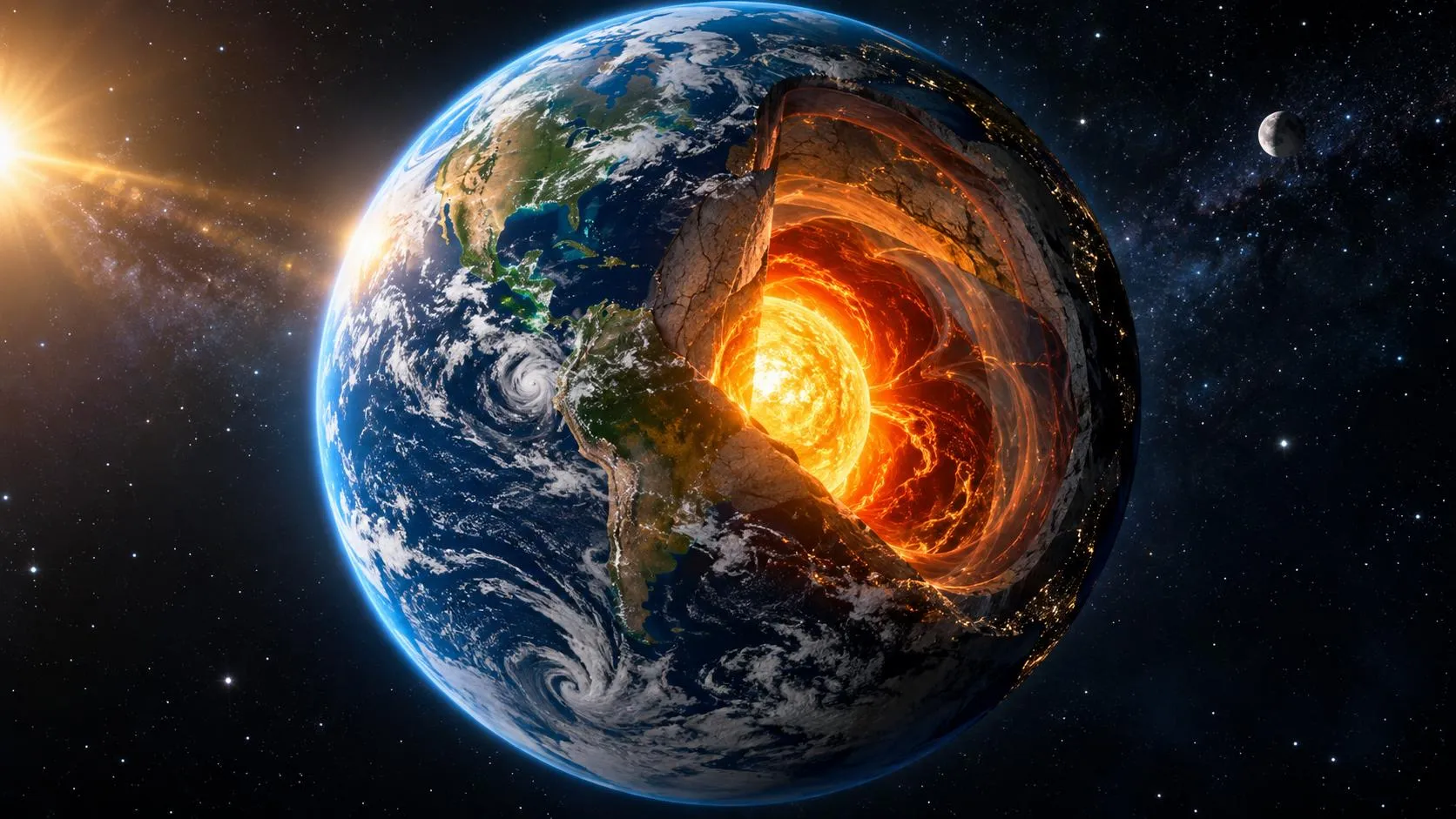
The Missing Earth's Nitrogen Mystery: Where Did the Planet's Original Nitrogen Go?
Scientists have discovered that Earth's nitrogen is distributed very differently from what planetary formation models might predict. Some may be hidden deep inside the planet, trapped in its metallic core or mantle, while other portions may have been lost before Earth fully formed.
Earth's atmosphere contains something remarkable: nitrogen makes up approximately 78 per cent of the air surrounding our planet. Every breath we take contains it, although the human body cannot use atmospheric nitrogen directly without the help of biological processes that convert it into usable compounds.
Nitrogen is also essential for life. It forms part of DNA, RNA, proteins and several other molecules that allow living organisms to function.
Yet there is a scientific puzzle hidden beneath this familiar element. When researchers compare Earth's nitrogen inventory with the composition of certain primitive meteorites believed to resemble the materials from which planets formed, they find that the amount of nitrogen in Earth's accessible rocky material appears unexpectedly low.
Where did the nitrogen go?
Did enormous quantities escape into space during Earth's violent formation? Was some of it pulled into the planet's metallic core? Or did Earth simply acquire less nitrogen than scientists originally expected?
The answer is more complicated than a single missing reservoir. Research published in recent years suggests that Earth's nitrogen history may be closely connected to the collisions, melting and chemical changes that shaped the planet more than four billion years ago.
Why Earth's nitrogen presents a planetary mystery
Nitrogen is a volatile element, meaning it can readily enter gases or fluids under planetary conditions. Its behaviour depends strongly on temperature, pressure and the chemical environment in which it exists.
This makes nitrogen particularly useful when scientists investigate how planets formed.
Researchers compare the chemical composition of Earth with meteorites called chondrites. These ancient rocky materials preserve information about the early Solar System and provide clues about the ingredients available when planets were developing.
However, Earth's nitrogen abundance does not fit neatly into every comparison.
The puzzle becomes clearer when scientists examine the ratio of carbon to nitrogen. Relative to certain primitive meteorites, Earth's silicate portion appears enriched in carbon compared with nitrogen. This suggests that nitrogen was either delivered in smaller quantities, removed during planetary formation or redistributed into places that are difficult to measure.
The phenomenon has become known as the missing nitrogen problem.
A comprehensive review published in National Science Review in June 2024 examined Earth's nitrogen reservoirs, isotope measurements and possible origins. It concluded that important questions remain about how nitrogen was acquired and distributed during Earth's formation.
Read the scientific review: The Origin and Evolution of Earth's Nitrogen.
Could Earth's original nitrogen be hiding inside its core?
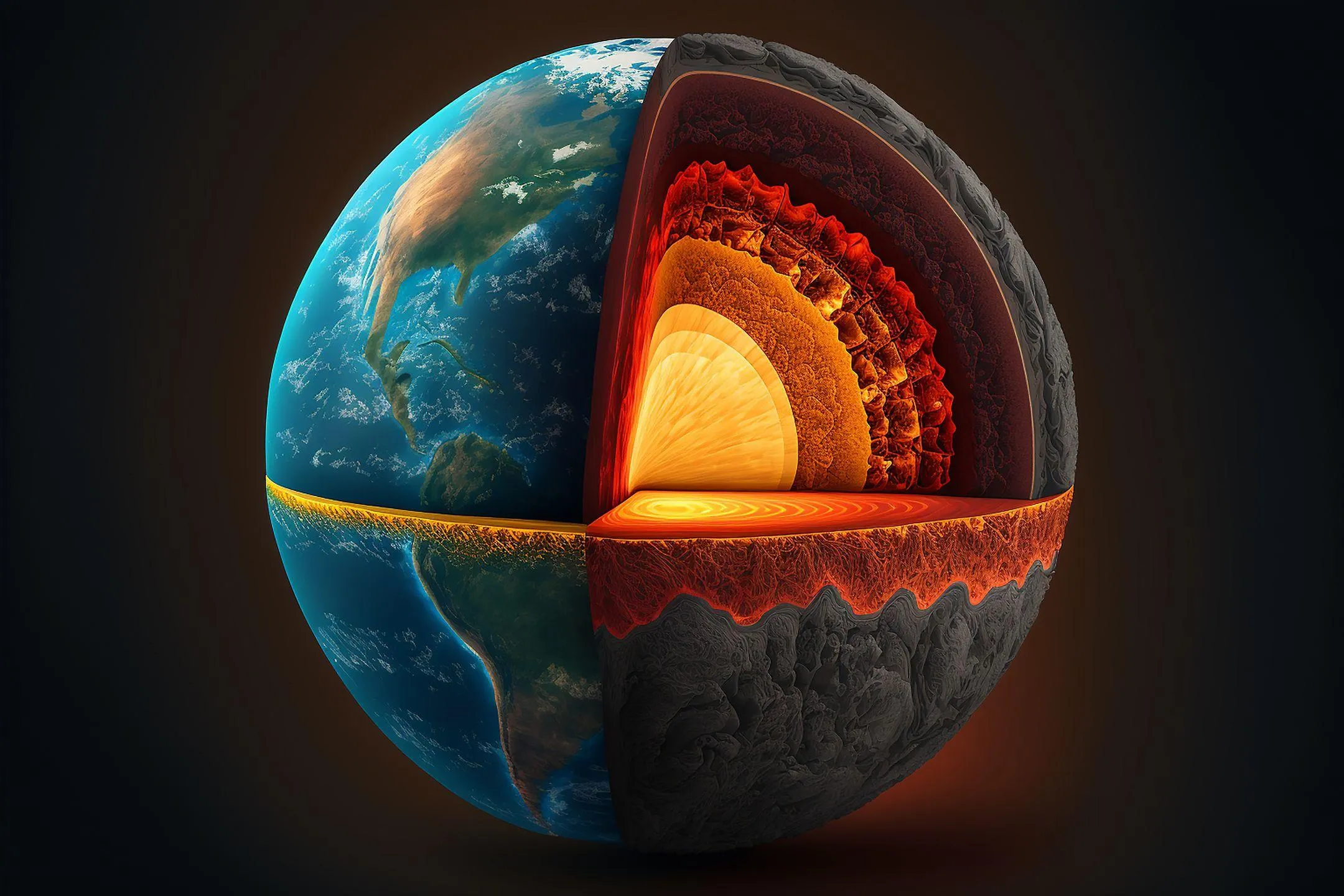
One possibility is that a significant portion of Earth's nitrogen became trapped deep inside the planet while its metallic core was forming.
Early Earth was extremely hot. Repeated collisions with large planetary bodies released enormous amounts of energy, melting substantial portions of the growing planet. Dense iron-rich metal separated from lighter silicate material and gradually descended towards the centre, creating Earth's core.
Scientists call this process planetary differentiation.
During this period, nitrogen could have behaved differently depending on the chemical conditions surrounding it. Under certain conditions, nitrogen can dissolve in molten iron and become incorporated into metallic material. Under others, it may remain preferentially in the surrounding silicate material or escape as gas.
This creates an important question: how much nitrogen followed the iron into Earth's core?
Researchers investigate this by recreating extreme pressures and temperatures in laboratory experiments. Some use diamond-anvil cells, which squeeze tiny samples between diamonds while lasers generate temperatures comparable to those found deep inside planets.
A 2024 study published in Geochimica et Cosmochimica Acta examined nitrogen behaviour under megabar pressures relevant to Earth's early differentiation.
Its findings challenged the idea that core formation and atmospheric loss alone could explain Earth's nitrogen depletion. The researchers argued that Earth may have accumulated nitrogen-poor planetary building blocks from the beginning.
Read the 2024 research: Nitrogen Sequestration in the Core at Megabar Pressure.
This is an important development because it shifts attention away from simply asking where Earth's nitrogen disappeared and towards asking how much nitrogen was present in the material that built the planet.
Did enormous asteroid impacts remove nitrogen from early Earth?
Another possible explanation involves the violent collisions that shaped the young Solar System.
Earth did not form in a single event. It grew through repeated collisions involving smaller rocky bodies called planetesimals and larger planetary embryos.
These impacts generated tremendous heat. Some were energetic enough to melt extensive regions of the growing planet and create temporary atmospheres containing vaporised rock and volatile compounds.
Under certain conditions, gases could escape into space, particularly during major impacts when atmospheric material was heated, displaced or accelerated.
The Moon-forming impact is especially relevant.
Scientists generally believe that an enormous collision between the early Earth and a planetary body commonly called Theia produced the material that eventually formed the Moon.
The event transformed the early Earth, potentially creating a global or extensive magma ocean and dramatically changing the distribution of volatile elements.
Nitrogen may have been lost during this period, but the exact amount remains uncertain.
There is also another possibility: some nitrogen may have escaped before the final Earth formed.
A 2022 review in Nature examined how volatile elements, including nitrogen, were distributed across the early Solar System. It discussed how different planetary building blocks acquired different chemical compositions and how early volatile losses influenced the materials that eventually formed terrestrial planets.
Explore the Nature review: Origin of Life-Forming Volatile Elements in the Inner Solar System.
Meteorites may hold clues to Earth's original nitrogen supply
One of the most useful ways to investigate this mystery is to study meteorites.
Meteorites are fragments of ancient Solar System material that have survived long enough to reach Earth. Some preserve chemical and isotopic information dating back to the earliest stages of planetary formation.
Scientists pay particular attention to two groups: enstatite chondrites and carbonaceous chondrites.
Enstatite chondrites formed under relatively reducing conditions, meaning their chemical environment had limited available oxygen. Their isotopic characteristics make them especially interesting when researchers investigate the possible composition of Earth's original building material.
Carbonaceous chondrites, on the other hand, generally contain higher concentrations of volatile elements and preserve evidence of water-related alteration.
These meteorites may have delivered some of the nitrogen and other life-essential elements that Earth eventually acquired.
A particularly important 2022 study published in Nature Communications investigated nitrogen isotopes and how nitrogen behaves between molten metal and silicate material.
The researchers found that Earth's volatile inventory could be explained by a changing mixture of planetary building blocks: initially more reduced, enstatite-chondrite-like material, followed by increasingly oxidised impactors and relatively small contributions from carbonaceous-chondrite-like material.
Read the research: Nitrogen Isotope Evidence for Earth's Heterogeneous Accretion of Volatiles.
This suggests that Earth's nitrogen supply may have been established through several stages rather than delivered through one enormous event.
Nitrogen isotopes reveal clues about the planet's history
Scientists do not rely only on measuring how much nitrogen exists in a rock. They also examine its isotopes.
Nitrogen has two stable isotopes: nitrogen-14 and nitrogen-15. Both behave chemically in broadly similar ways, but their relative proportions can change during physical and chemical processes.
These differences provide a useful record of where nitrogen originated and how it moved.
For example, nitrogen trapped inside certain mantle rocks may have a different isotopic signature from nitrogen found in atmospheric or sedimentary reservoirs.
By comparing these signatures, researchers can investigate whether nitrogen entered Earth's interior during its formation or was transported there much later.
The distinction matters because the two explanations imply very different histories for Earth's atmosphere.
A mantle nitrogen reservoir inherited from planetary formation would suggest that some of Earth's original nitrogen remained trapped deep underground. Nitrogen transported downwards through tectonic processes would point towards a much longer exchange between the surface and the interior.
The 2024 review by Yuan Li in National Science Review examines these competing interpretations and explains why nitrogen isotope measurements remain central to understanding the planet's chemical evolution.
Earth's mantle may contain a hidden nitrogen reservoir
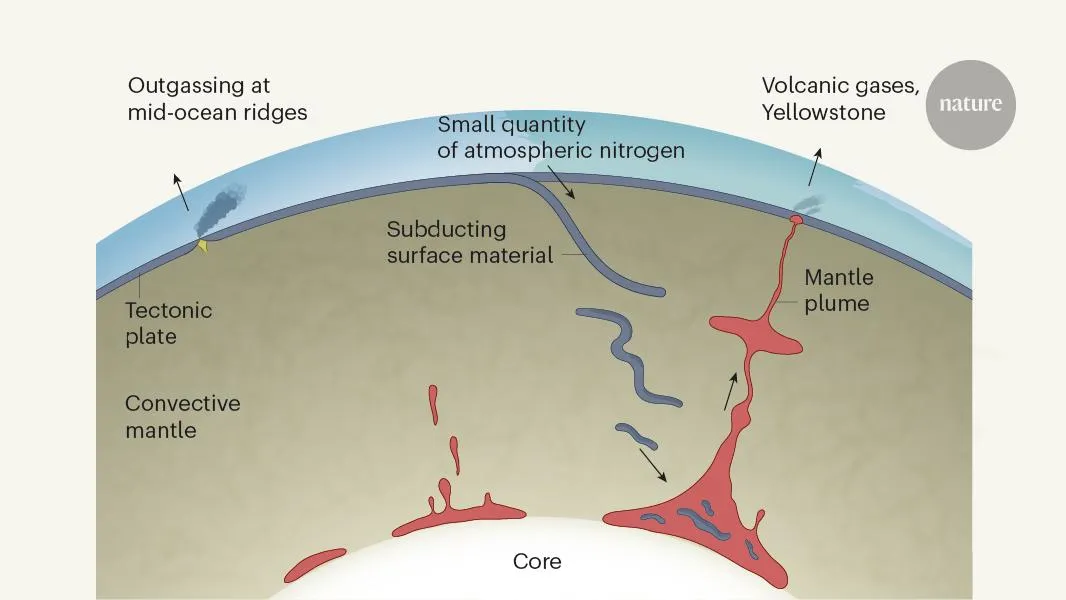
Even today, nitrogen moves between the atmosphere, oceans, crust and deep interior through geological and biological processes.
One important mechanism is plate tectonics.
When an oceanic plate moves beneath another plate in a process called subduction, it carries sediments and altered oceanic rocks into Earth's interior. These materials can contain nitrogen that was originally captured from the atmosphere or incorporated into biological material.
Some of that nitrogen can remain trapped in minerals and eventually enter the mantle.
Other portions may return towards the surface through volcanic activity.
This creates a long-term nitrogen cycle connecting Earth's atmosphere with its deep geological reservoirs.
A 2015 study by researchers Ben Johnson and Colin Goldblatt, published in Earth-Science Reviews, estimated that the bulk silicate Earth could contain approximately seven times the amount of nitrogen currently present in the atmosphere, although the uncertainty around this estimate is substantial.
Their work suggested that the majority of Earth's nitrogen may actually be stored in solid planetary material rather than in the air.
In other words, nitrogen that appears missing from the atmosphere may be hiding inside the planet.
Read the research: The Nitrogen Budget of Earth.
Has the mystery finally been solved?
Not quite.
Scientists have developed several explanations, but there is no universally accepted model that completely reconstructs Earth's original nitrogen inventory.
Different studies produce different estimates because researchers must work with incomplete samples of the deep Earth, uncertain meteorite comparisons and experimental measurements conducted under extreme conditions.
A particularly interesting contribution came from a 2022 study published in Geochemistry, Geophysics, Geosystems. Its modelling suggested that only around 10 per cent of Earth's nitrogen could have been trapped in the solidifying mantle under the particular conditions examined. The researchers explored whether a much larger initial nitrogen inventory could explain the present distribution.
Read the study: The Origin of Earth's Mantle Nitrogen.
Meanwhile, the 2024 research on nitrogen sequestration at extreme pressures proposed that nitrogen-poor planetary building blocks may have played a more important role than previously assumed.
These findings do not necessarily contradict one another. They investigate different parts of a complicated planetary history, using different experimental conditions, models and assumptions.
The most likely explanation may involve several processes working together:
-
Earth's original building blocks contained different amounts of nitrogen.
-
Some nitrogen entered the metallic core during planetary differentiation.
-
Some may have escaped during early atmospheric loss and giant impacts.
-
Additional nitrogen became stored in the mantle and crust.
-
Geological and biological processes continued redistributing nitrogen over billions of years.
Understanding the relative importance of each process remains an active area of research.
Why understanding Earth's nitrogen matters for the search for life
The mystery extends far beyond Earth's geological history.
Nitrogen is one of the essential ingredients for life as we know it. Without nitrogen, organisms could not build the genetic material and proteins required for biological activity.
Its availability also influences atmospheric chemistry, climate and the long-term habitability of a planet.
This makes Earth's nitrogen history particularly valuable when scientists investigate potentially habitable worlds beyond our Solar System.
Imagine discovering an Earth-sized planet with an atmosphere containing very little nitrogen. Would that mean the planet never acquired enough nitrogen during formation? Could its nitrogen be trapped in the mantle? Or might its atmosphere have experienced substantial losses over geological time?
These are questions that planetary scientists may eventually investigate using atmospheric observations, meteorite comparisons and improved models of planetary interiors.
Understanding where Earth's nitrogen went could therefore help researchers determine which distant planets have the right chemical ingredients to support life.
The missing nitrogen may never have disappeared
Earth's nitrogen mystery offers a fascinating lesson about planetary science: what appears to be missing from a planet's surface may still exist deep beneath it.
The atmosphere contains an enormous quantity of nitrogen, but it represents only one part of a much larger planetary system. The mantle, crust and possibly the metallic core all contribute to the element's complicated history.
Scientists are still working to establish how much nitrogen Earth inherited, how much it lost and how much became trapped inside its interior.
The answer could reshape our understanding of how terrestrial planets acquire the ingredients necessary for life.
Perhaps the most interesting possibility is that Earth's nitrogen was never truly missing. We may simply have been looking in the wrong place.
Can Rocks Produce Electrical Signals Before Earthquakes?
Read story →
How an 18-Million-Year-Old Ape Fossil in Egypt Could Change What We Know About Human Evolution
Read story →
Could Entire Ecosystems Still Exist on Earth That Scientists Have Never Discovered?
Read story →