
Imagine boarding a passenger aircraft knowing that even if several critical systems failed thousands of feet above the ground, the plane would have multiple independent ways to protect the people inside. Its computers could detect structural damage, identify the safest emergency route, help the pilots regain control and, if a crash became unavoidable, activate systems designed to improve the chances of survival.
It sounds like science fiction. Yet many of the technologies needed to move aviation closer to this vision already exist in some form. Others are being tested in laboratories, explored by aerospace engineers or imagined as more radical solutions to one of flight’s most difficult problems: what happens when an aircraft can no longer fly normally?
Recent events have brought that question back into sharp focus. On November 1, 2026, a Learjet 60 crashed in Florida, killing all nine people aboard. Investigators said the crew had reported icing and moderate turbulence before the aircraft entered a rapid descent. The National Transportation Safety Board also reported preliminary evidence suggesting the aircraft may have begun breaking apart before impact. The investigation is ongoing, and no cause has been established.
The tragedy is not evidence that a particular technology would have prevented the crash. It is a reminder that aviation safety must address more than routine flight operations. Engineers must also consider the rare, rapidly developing emergencies in which pilots have very little time and several failures may occur together.
What if future passenger aircraft were designed not only to avoid accidents, but also to give people a better chance of surviving when prevention fails?
1. An aircraft that can diagnose itself before a failure becomes critical
Modern aircraft already contain sophisticated monitoring systems. Sensors track engine performance, temperature, pressure, vibration, fuel flow and the condition of many important components. Pilots receive warnings when readings move outside expected limits.
But the next generation of aircraft could take this concept much further.
Imagine a plane covered in thousands of miniature sensors embedded in its wings, tail, fuselage, engines and control surfaces. Instead of simply warning pilots after a problem appears, these sensors would continuously compare the aircraft’s actual condition with a detailed digital model of how it should behave.
This could create a real-time picture of the aircraft’s structural and mechanical health.
For example, if a section of a wing began experiencing unusual stress, the system could detect subtle changes in vibration, temperature or strain. It could compare those readings with previous flights, identify a developing fault and alert the crew before the problem reached a dangerous level.
Engineers could also use a technology known as a digital twin: a continuously updated virtual model of the aircraft. It could combine sensor readings, maintenance history, flight conditions and engineering simulations to estimate how components are ageing and how they might respond to unusual stresses.
The most advanced version would not simply say, “A problem has been detected.” It could explain which systems might be affected, what secondary failures could follow and which operating changes could reduce the risk.
There is an important distinction, however. Sensors and predictive maintenance are realistic extensions of existing aviation technology. A system that can repair a major structural failure in mid-flight is a much more speculative idea. Detecting damage is one challenge; restoring the strength of a damaged wing or fuselage under flight loads is another entirely.

2. Artificial intelligence that helps pilots find a safe way out
When an aircraft encounters a serious emergency, pilots may have to make several decisions within seconds.
They might need to respond to an engine failure, avoid dangerous weather, manage a damaged control system, communicate with air traffic control and identify a suitable airport. These tasks become particularly difficult when several problems occur simultaneously.
Artificial intelligence could become an important additional source of support.
A future aircraft could have an independent emergency decision-support system that continuously evaluates the plane’s condition. It could analyse engine performance, airspeed, altitude, weather radar, terrain, nearby airports, fuel reserves and available flight-control systems.
If an emergency developed, it could rapidly calculate possible courses of action.
For example, if one engine failed while the aircraft was approaching a region of severe weather, the system could compare several possible routes. It might identify an airport with a long runway, favourable wind conditions and suitable emergency services, while avoiding dangerous terrain and storm cells.
The system could then present pilots with a ranked set of options, explaining the risks and benefits of each.
This should not mean replacing pilots with an unpredictable machine. Aviation depends on human judgement, training and clear command responsibilities. The more practical approach would be an AI assistant that reduces the time needed to understand a complicated emergency.
It would also need to be independently tested, carefully certified and designed to remain useful if its own sensors or software became unreliable.
3. Emergency autoland that can take control when necessary
One of the most promising safety concepts is automated emergency landing.
Some smaller aircraft already offer systems that can take control, select a suitable airport, communicate an emergency declaration and land without the pilot manually flying every stage. These systems demonstrate that automated emergency landing is not purely theoretical.
The challenge is bringing comparable capabilities to large passenger aircraft, where the aircraft is heavier, faster and carries far more people.
Imagine a future passenger jet in which the emergency landing system is permanently available but normally remains in standby mode. If the pilots became incapacitated, or a serious medical or operational emergency made manual control impossible, the system could take over under defined conditions.
It would need to do much more than follow a pre-programmed route.
The aircraft would have to identify suitable runways, assess weather, calculate its remaining fuel, coordinate with air traffic control, avoid other aircraft and manage the approach. It would also need to respond to changing conditions during descent and landing.
A more advanced version could handle certain combinations of failures, such as an engine problem alongside degraded navigation equipment.
However, autonomous landing is not a universal solution. A plane with major structural damage, unreliable flight controls or insufficient control authority may not be able to follow even the best computer-generated plan.
The goal should be to give pilots another layer of support, not to suggest that automation can overcome every physical limitation.
4. Wings that detect dangerous icing before it becomes a threat
Ice is a serious aviation hazard because it can alter the shape of an aircraft’s wings and other aerodynamic surfaces.
Even a relatively thin layer of ice can affect airflow, increase drag and reduce lift. Ice can also interfere with sensors and affect the performance of certain aircraft components.
Aircraft already use anti-icing and de-icing systems, including heated surfaces and other methods designed to prevent or remove ice. But future systems could become more predictive.
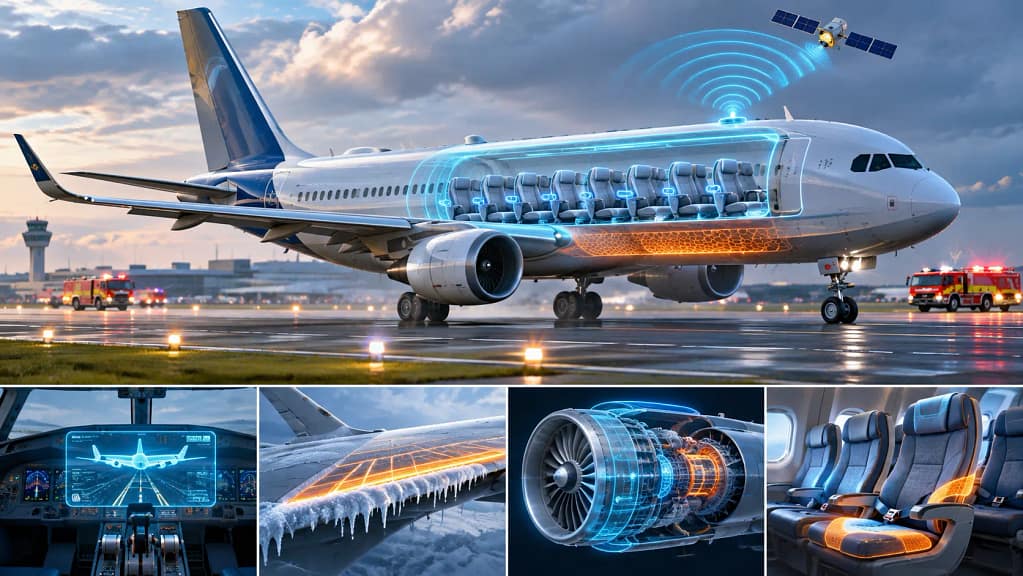
Imagine a network of sensors capable of detecting the earliest signs of ice formation across the wings, tail and engine inlets. These sensors could combine information about temperature, moisture, airflow and the aircraft’s changing aerodynamic performance.
Rather than waiting for ice to accumulate, the system could predict where it is likely to form and activate appropriate protective measures.
An intelligent icing-management system could also recommend changes in altitude or route when conditions become unfavourable. It might warn pilots that a particular combination of temperature, precipitation and airflow is creating a higher risk than the aircraft’s current protection can comfortably manage.
The most important improvement would be coordination. Weather radar, atmospheric data, onboard sensors, aircraft performance measurements and air traffic information could work together to provide a more complete picture of the conditions ahead.
No system can make every storm safe to fly through. But better detection, earlier warnings and more informed route decisions could help crews avoid dangerous conditions before they become emergencies.
5. Flight controls with independent backup systems
Modern aircraft are designed with redundancy. Critical functions often have backup components or alternative ways of receiving power and information.
But redundancy is not simply about installing two copies of the same device.
If both systems depend on the same electrical supply, sensor input, software fault or vulnerable physical location, one failure could affect both. Engineers call this a common-cause failure.
Future aircraft could be designed with more independent layers of flight-control protection.
For example, the primary flight-control system might operate using one set of computers and power sources, while an emergency system uses separate processors, independent electrical supplies and alternative sensor inputs.
If the main system became unreliable, the backup could provide a limited but dependable set of functions. Depending on the nature of the failure, it might help maintain stable flight, reduce extreme manoeuvres or guide the aircraft towards an emergency landing.
This would require careful engineering. A backup system must not unexpectedly fight the primary controls or create confusion in the cockpit. It must know when to activate, what authority it has and how pilots can override it.
A particularly important design principle would be to avoid relying on a single central computer to manage every emergency function. The system intended to save an aircraft should not itself become a single point of failure.
6. An aircraft that can recognise structural damage in flight
Aircraft structures are designed to withstand demanding conditions, including turbulence, repeated pressurisation cycles and the forces experienced during take-off and landing.
However, unexpected damage can still occur.
A future aircraft could use distributed structural sensors to monitor the condition of its wings, tail, fuselage and major attachment points. These sensors could detect abnormal strain, vibration or changes in structural behaviour.
The information could be processed by onboard computers to estimate whether the aircraft remains within safe operating limits.
If a serious problem were detected, the aircraft could automatically recommend a more conservative flight profile. Depending on the aircraft’s design and the damage detected, this might involve limiting speed, avoiding sharp manoeuvres, changing altitude or directing the pilots towards a suitable airport.
Engineers could also explore materials that indicate damage through changes in electrical resistance, optical signals or other measurable properties.
Some advanced materials research investigates self-healing behaviour, but that does not mean a passenger aircraft could currently repair a cracked wing or replace a broken structural component during flight. Any future self-healing material would need to demonstrate that it could restore meaningful strength under real aircraft conditions.
The nearer-term opportunity is earlier detection and better-informed decisions, not miraculous mid-air repairs.
7. A whole-aircraft parachute for passenger jets

One of the most dramatic ideas in aviation safety is a parachute capable of lowering an entire aircraft towards the ground.
Whole-aircraft ballistic parachute systems already exist in some smaller aircraft. They are designed to deploy a large parachute that can bring the aircraft down during certain emergencies.
Could the same principle work for a commercial passenger jet?
In theory, a sufficiently powerful parachute system might slow an aircraft’s descent and improve the chances of survival in some situations. But scaling the technology up presents enormous engineering problems.
A passenger aircraft can weigh tens or even hundreds of tonnes. Its parachute would need to withstand extraordinary forces during deployment. The aircraft would also need a structure capable of absorbing those forces without tearing apart.
There are other complications.
A parachute might be ineffective at certain speeds or altitudes. It could become dangerous if deployed after the aircraft had already suffered severe structural damage. It might also be impossible to deploy safely over a densely populated area.
Engineers would need to consider where the parachute would be stored, how it would be released, how the aircraft would remain stable during descent and how passengers would be protected during impact.
For these reasons, a whole-aircraft parachute for a large passenger jet remains a highly speculative concept rather than a practical near-term safety feature.
Nevertheless, it raises an important question: could future aircraft be designed with entirely new ways of slowing down when conventional flight is no longer possible?
8. A detachable passenger cabin: the radical emergency escape concept
What if the passenger cabin could separate from the rest of an aircraft during an extreme emergency?
This idea has appeared in futuristic aviation concepts, but it is far more complicated than it first sounds.
In a hypothetical design, the passenger section would be engineered as a reinforced module. If the aircraft became uncontrollable and a safe landing was no longer possible, the cabin might detach from the wings, engines and cockpit structure.
A combination of stabilising systems, parachutes and energy-absorbing landing equipment could then attempt to bring the cabin down.
The concept sounds appealing because it separates passengers from a potentially failing aircraft. But the technical obstacles are enormous.
A passenger cabin is not designed to fly independently. Separating it could create violent aerodynamic forces, unpredictable rotation and dangerous changes in pressure. The separation mechanism itself would need to work perfectly at exactly the right moment.
There would also be questions about the pilots, the engines, fuel tanks, emergency exits, passenger restraints and the cabin’s ability to remain structurally intact after separation.
A detachable cabin could introduce new failure modes rather than eliminate existing ones.
For now, it belongs in the category of speculative engineering research. It is an idea worth examining through simulations and safety studies, but it should not be presented as a technology that could soon be installed on ordinary passenger aircraft.
9. Passenger seats and cabins designed to protect people during impact
Aviation safety is not only about keeping an aircraft in the air. It is also about protecting people if an emergency landing or crash occurs.
The passenger cabin could become a much more sophisticated safety environment.
Future seats might use improved energy-absorbing materials designed to reduce the forces transferred to a passenger during a hard landing. Seat structures and restraints could be optimised to manage different directions of impact.
Cabin interiors could also be designed to reduce the risk of injuries caused by loose objects, falling panels and damaged overhead compartments.
Other improvements might include:
-
Stronger seat attachment points and improved restraint systems.
-
Fire-resistant materials that reduce the spread of flames and toxic smoke.
-
Better emergency lighting that remains visible in smoke or darkness.
-
More accessible exits and improved evacuation guidance.
-
Cabin sensors that identify smoke, heat or dangerous changes in air quality.
-
Clearer instructions that help passengers respond quickly during an evacuation.
An especially interesting possibility is intelligent emergency lighting. Instead of simply illuminating the nearest exit, a future system could use sensors to identify which escape routes are safe.
If smoke or fire blocked one side of the cabin, the system could guide passengers towards another usable exit.
Such a system would need to be extremely reliable. It must not direct passengers towards a route that becomes dangerous moments later, and it should never replace crew instructions.
The aim would be to reduce injuries and make evacuation faster when every second matters.
10. A permanent emergency communication and rescue network
After an aircraft accident, finding the aircraft and understanding what happened can be critical for rescue teams and investigators.
Modern aircraft already use communication, navigation and tracking systems, but future designs could provide more independent emergency capabilities.
Imagine an aircraft equipped with multiple tracking devices that do not all depend on the same electrical supply or communication link.
If the main aircraft systems failed, an independent emergency transmitter could continue sending the aircraft’s position, altitude, speed and other essential information.
A more advanced system could automatically transmit information about the nature of the emergency, including whether the aircraft had lost an engine, experienced a major electrical failure or detected structural damage.
Emergency responders could receive this information before the aircraft reached the ground.
The aircraft could also deploy independent emergency beacons designed to remain operational even if the main fuselage was severely damaged.
In a difficult search environment, accurate location data could help rescue teams reach the site more quickly.
This would not guarantee that people could be rescued after every accident. Terrain, weather, fire and the severity of an impact would still matter. But a more resilient emergency communication network could reduce uncertainty and improve the speed of the response.

Could an aircraft have a central survival intelligence system?
The ten technologies above could become even more powerful if they were designed to work together.
This leads to a broader concept: an Aircraft Survival Intelligence System, or ASIS.
It would be a dedicated safety architecture that continuously monitors the aircraft and coordinates its emergency response.
It would not be a single computer responsible for everything. Instead, it would connect several independently protected systems, each with a specific role.
The system might work in five stages:
-
Detect: Identify unusual weather, icing, engine problems, structural stress or failures in flight-control systems.
-
Assess: Determine which systems are affected and how the problem could develop.
-
Recommend: Present pilots with the safest available options, including route changes and emergency landing choices.
-
Assist: Activate approved backup functions or emergency automation when required.
-
Protect: Support cabin safety, passenger evacuation, emergency communications and rescue location.
A crucial requirement would be independence. The survival system must not depend entirely on the same power, sensors or computers it is supposed to protect. It would need separate backup resources, strict testing and clear rules governing when it can intervene.
It should also be designed to fail safely. If its own information becomes unreliable, it must alert the pilots rather than make an unsafe decision with false confidence.
Why can’t we install all these technologies tomorrow?
If these ideas could improve aircraft safety, why are they not already standard?
The answer is that aviation is one of the most demanding engineering environments in the world.
A technology cannot be installed on a passenger aircraft simply because it works in a laboratory or during a successful demonstration. It must be tested under a wide range of conditions, including failures, extreme temperatures, vibration, electrical interference and unexpected combinations of problems.
There are several major obstacles.
Weight and space: Every additional sensor, computer, power source or safety mechanism adds weight. More weight can increase fuel consumption and affect aircraft performance.
Certification: Aviation regulators require extensive evidence that a new system is safe, reliable and compatible with existing aircraft systems.
Cybersecurity: Connected aircraft systems must be protected against unauthorised access, malicious interference and software vulnerabilities.
Human factors: Pilots must understand what an automated system is doing. Poorly designed automation can increase confusion rather than reduce workload.
Cost: New safety technologies must be developed, tested, maintained and eventually integrated into aircraft fleets. Airlines and manufacturers must balance these costs against measurable safety benefits.
Unpredictable emergencies: A system designed to handle one failure may behave differently when several failures occur at once. Engineers must test not only individual components but also how the entire aircraft responds to complicated emergencies.
The challenge is not simply inventing new technology. It is proving that the technology will work when it is needed most.
The future of aviation may be built around survival, not just prevention
Commercial aviation has become remarkably safe through decades of engineering improvements, pilot training, maintenance standards, air traffic management and accident investigation.
But safety cannot stand still.
Aircraft are becoming more connected, software-driven and capable of processing enormous amounts of information. These developments create opportunities to detect danger earlier, support pilots during emergencies and protect passengers if an accident cannot be avoided.
The most realistic improvements may not be dramatic inventions such as detachable cabins or enormous parachutes. They may be less visible: better sensors, independent backup power, more intelligent weather avoidance, stronger cockpit decision support, improved emergency landing systems and cabins designed to reduce injuries.
The future could also involve a shift in how aircraft are designed. Instead of treating safety as a collection of separate features, manufacturers could build it into every layer of the aircraft, from its materials and wiring to its flight controls, passenger seats and emergency communications.
No aircraft can be guaranteed to save everyone in every conceivable accident. Some combinations of damage, speed, altitude and impact forces may remain unsurvivable.
But that should not prevent engineers from asking a more ambitious question.
What if a passenger aircraft could recognise that something was going wrong before its pilots did? What if it could independently help them find a way out? And what if, even when a safe landing was no longer possible, the cabin itself was designed to give passengers a better chance?
The next great leap in aviation may not be an aircraft that flies faster or carries more people.
It may be an aircraft designed to keep fighting for the lives inside it, even when everything else begins to fail.




