
The numbers refuse to make sense.
Every year, rivers, coastlines, fishing operations, wastewater systems, and urban runoff carry enormous quantities of plastic into the world’s oceans. Scientists can estimate how much enters the marine environment with reasonable accuracy. Yet when researchers go looking for that plastic, they consistently find far less than expected.
For decades, this discrepancy has puzzled oceanographers.
Millions of tons of plastic appear to be missing.
Not removed. Not cleaned up. Not destroyed.
Simply missing.
The mystery has become known as the “missing plastic problem”—one of the most intriguing environmental puzzles in modern science. Researchers know plastic is entering the oceans at a staggering rate, but measurements of floating debris account for only a fraction of the expected total. Somewhere between the source and the open ocean, vast amounts of plastic seem to vanish from sight.
The reality is even stranger than it sounds.
Recent studies suggest the missing plastic may not have disappeared at all. Instead, it could be hiding in places scientists only recently began exploring, from deep-sea sediments thousands of meters below the surface to invisible clouds of microscopic particles suspended throughout the water column. Some researchers now argue that the mystery is not where the plastic went, but whether scientists were looking in the wrong places all along.
The Plastic Accounting Problem
Imagine depositing $10 million into a bank account and discovering only $500,000 remains when you check the balance.
That is essentially the problem ocean scientists encountered.
For years, estimates suggested that millions of metric tons of plastic were entering marine environments annually through rivers and coastal sources. Yet surveys of ocean surfaces consistently detected only a small percentage of that amount.
The discrepancy became one of the most debated topics in marine pollution research.
Ocean gyres such as the Great Pacific Garbage Patch attracted public attention because they visibly accumulate floating debris. But even when scientists combined measurements from all major accumulation zones worldwide, the numbers still fell far short of expectations.
Some estimates suggested that less than 1% of the expected plastic load was visible floating on the ocean surface.
So where was the rest?
The Rise of Microplastics
Part of the answer lies in size.
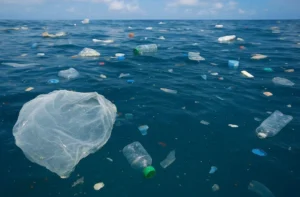
Most people picture ocean plastic as bottles, fishing nets, food containers, and shopping bags. While these items are certainly present, sunlight, waves, saltwater, and physical abrasion continuously break larger plastics into smaller fragments.
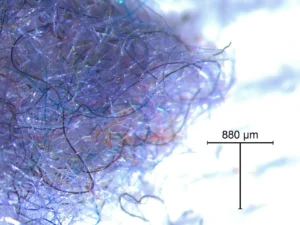
Eventually, many become microplastics—particles smaller than five millimeters.
Some continue degrading into even smaller particles known as nanoplastics.
As plastic shrinks, it becomes dramatically harder to detect.
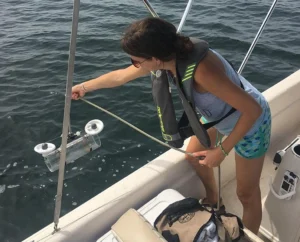
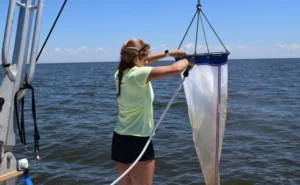
Traditional ocean surveys often relied on surface nets designed to capture larger debris. Tiny particles could easily pass through these systems unnoticed. As a result, researchers may have underestimated how much plastic was actually present.
The discovery of widespread microplastic contamination transformed the field.
Scientists began finding plastic particles in Arctic ice, deep-sea trenches, coral reefs, coastal sediments, seafood, and even remote regions far from major human activity.
The plastic had not vanished.
Much of it had simply become nearly invisible.
The Ocean’s Hidden Plastic Cloud
One of the most important discoveries emerged when researchers started sampling beneath the ocean surface rather than just at the top.
For decades, scientists focused heavily on floating debris because it was easiest to observe.
The ocean, however, is not a two-dimensional surface.
It is a three-dimensional world extending thousands of meters deep.
Research in the Atlantic Ocean revealed surprisingly large concentrations of microplastics suspended below the surface. Scientists detected tiny plastic particles distributed throughout the upper ocean layers, creating what some researchers describe as a hidden marine plastic cloud.
This finding challenged a key assumption.
If significant amounts of plastic were suspended throughout the water column rather than floating on top, surface surveys would inevitably underestimate total pollution levels.
In other words, part of the missing plastic was never missing at all.
Researchers simply weren’t looking deep enough.
Sinking Without Sinking
A natural question follows.
Many plastics are designed to float. So why are they leaving the surface?
The answer involves biology.
Once plastic enters seawater, it rapidly becomes colonized by microscopic organisms including algae, bacteria, and other marine life. This process, known as biofouling, gradually increases the weight of plastic particles.
Eventually, some fragments lose their buoyancy.
Rather than remaining on the surface, they begin sinking toward deeper waters.
This process transforms floating pollution into deep-ocean pollution.
A plastic fragment may spend months or years drifting near the surface before descending into regions that are rarely sampled.
Scientists increasingly believe biofouling plays a major role in redistributing plastic throughout marine ecosystems.
The Deep-Sea Graveyard
If biofouling causes plastics to sink, where do they ultimately end up?
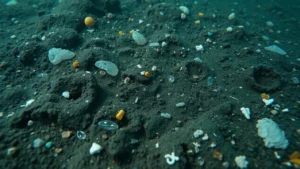
Evidence increasingly points toward the seafloor.
Deep-sea sediments appear to be one of Earth’s largest plastic reservoirs.
Researchers investigating sediments from the Atlantic Ocean, Mediterranean Sea, and Indian Ocean discovered concentrations of microplastics far greater than those observed in surface waters. Some studies found microplastic fibers up to four orders of magnitude more abundant in deep-sea sediments than in contaminated surface waters.
That discovery fundamentally changed scientific thinking.
Rather than accumulating primarily in floating garbage patches, much of the world’s plastic may be settling onto the ocean floor.
The deep ocean covers more than 300 million square kilometers. Even relatively modest concentrations spread across such an immense area translate into staggering quantities of plastic.
Recent analyses estimate that marine sediments may contain hundreds of millions of tons of accumulated plastic debris, potentially making them the largest long-term sink in the global ocean.
Rivers May Be Part of the Confusion
Another surprising possibility emerged in recent years.
What if scientists overestimated how much plastic was reaching the ocean in the first place?
A major study published in Science reexamined widely used estimates of river-borne microplastic transport and concluded that some previous calculations may have been exaggerated by two to three orders of magnitude. If true, the apparent plastic deficit would shrink dramatically.
This does not mean plastic pollution is a minor issue.
Far from it.
Instead, it suggests that part of the mystery may stem from uncertainties in the input numbers themselves.
If less plastic enters the ocean than previously assumed, then less plastic needs to be accounted for.
The implication is profound.
The missing plastic problem may involve both hidden reservoirs and imperfect estimates.
Marine Snow: Nature’s Plastic Elevator
One of the most fascinating mechanisms for transporting microplastics involves something called marine snow.
Despite its name, marine snow is not frozen water.
It consists of organic debris constantly drifting downward through the ocean. Dead plankton, fecal pellets, mucus, and biological particles combine into tiny clumps that slowly sink toward the seabed.
Microplastics frequently become trapped within this material.
Once attached, they effectively hitch a ride downward.
Researchers have estimated that marine snow and related biological processes may transport enormous quantities of microplastics from surface waters into the deep ocean.
In essence, the ocean may be continuously packaging plastic pollution and delivering it to the seafloor.
Coastlines Are Catching More Plastic Than Expected
The open ocean receives most of the attention, but coastlines may be intercepting much of the plastic before it ever reaches offshore waters.
Beaches, estuaries, mangroves, wetlands, and coastal sediments can act as temporary or long-term storage zones.
Recent research suggests that substantial quantities of plastic become trapped close to shore rather than dispersing into distant ocean gyres.
This finding helps explain why offshore measurements often appear lower than expected.
Many plastics may never complete the journey to the middle of the ocean.
Instead, they become stranded much closer to their source.
The Nanoplastic Frontier
Even microplastics may not be the end of the story.
Scientists increasingly suspect that enormous quantities of plastic have fragmented into particles so small they are difficult to detect using existing techniques.
These nanoplastics can measure less than one micrometer across.
To put that into perspective, a human hair is roughly 70 times wider.
Tracking nanoplastics remains extraordinarily challenging.
Many environmental monitoring programs were never designed to measure particles at such tiny scales.
As detection technologies improve, researchers expect to discover that significant amounts of the supposedly missing plastic exist in forms that were previously invisible to scientific instruments.
Is There Really a Missing Plastic Problem?
The answer depends on whom you ask.
Some researchers continue to view the discrepancy as a genuine scientific puzzle requiring further investigation.
Others argue that the mystery is steadily disappearing as better measurements become available.
Studies over the past decade have identified substantial plastic reservoirs in deep waters, marine sediments, coastal environments, and subsurface layers. At the same time, revised estimates of plastic inputs have reduced the size of the apparent imbalance. Some researchers now argue that there may be no missing sink at all—only incomplete observations and earlier measurement limitations.
The debate remains active, but one conclusion is increasingly clear.
The ocean is storing far more plastic than surface surveys once suggested.
Why This Mystery Matters
The search for missing plastic is not simply an accounting exercise.
Its outcome has real-world consequences.
Marine organisms interact differently with floating plastics, suspended microplastics, buried sediments, and nanoplastic particles. Understanding where plastic accumulates helps scientists predict ecological impacts, identify vulnerable ecosystems, and develop effective mitigation strategies.
If the majority of plastic resides in deep-sea sediments, cleanup approaches focused solely on surface debris may address only a fraction of the problem.
If nanoplastics dominate the future burden, entirely new monitoring methods may be required.
In other words, solving the mystery is essential for solving the pollution crisis itself.
The Ocean Still Holds Secrets
The popular image of ocean plastic pollution often centers on floating islands of trash drifting across the sea.
Reality is proving far more complicated.
The world’s oceans appear to contain hidden plastic clouds, microscopic particles suspended below the surface, buried reservoirs within sediments, and biological transport systems carrying debris into the abyss. What once looked like a disappearance may instead be a story of redistribution.
The missing plastic has not necessarily evaporated.
It has scattered, fragmented, sunk, drifted, and concealed itself within one of the most complex environments on Earth.
And as scientists continue exploring the deep ocean, they are discovering that the greatest mystery was never where the plastic went.
It was how much of the ocean we had yet to search.

