
A photographer stared at the glass negative and realized something was wrong.
The image he had just captured was clearer than the cloth itself.
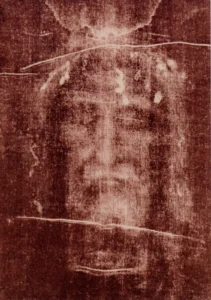
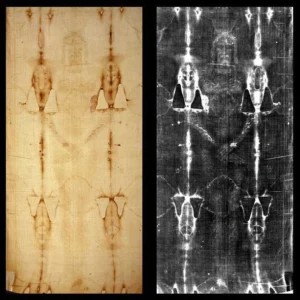
In 1898, Italian photographer Secondo Pia photographed the Shroud of Turin during a public exhibition in Italy. When he developed the photographic plates, the faint markings on the linen appeared as a remarkably detailed positive image. What seemed almost invisible to the naked eye suddenly revealed the face and body of a man bearing wounds consistent with crucifixion.
That moment transformed an ancient religious artifact into one of the most studied objects in the world.
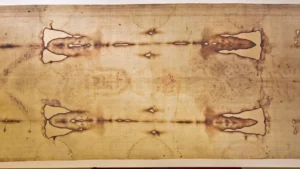
More than a century later, scientists, historians, chemists, physicists, archaeologists, and forensic specialists are still debating what the Shroud actually is. Some believe it is a medieval creation. Others argue it could be much older. A few researchers suggest it may preserve evidence of an event that science cannot yet fully explain.
What makes the Shroud of Turin fascinating is not that everyone agrees about it. The opposite is true. Despite decades of analysis and advances in modern technology, the evidence continues to point in different directions.
What Is the Shroud of Turin?
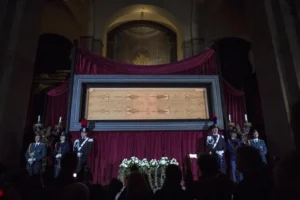
The Shroud of Turin is a rectangular linen cloth measuring approximately 14 feet (4.4 meters) long and 3.5 feet (1.1 meters) wide. It bears the faint front and back image of a man who appears to have suffered severe injuries.
Visible marks on the cloth include wounds on the wrists, feet, head, back, and side. These injuries resemble descriptions found in Christian accounts of the crucifixion of Jesus.
The cloth is preserved at the Cathedral of Saint John the Baptist in Turin, Italy, where it remains one of Christianity’s most famous relics.
Yet the Shroud’s significance extends beyond religion.
Scientists have been drawn to it because the image does not behave like a conventional painting, drawing, or print. Even after years of study, researchers have struggled to explain exactly how the image was created.
That mystery has fueled one of the longest-running scientific debates of modern times.
Why the Image Is So Unusual
At first glance, the image appears surprisingly faint.
Viewed up close, it lacks many of the characteristics researchers would expect from artwork. There are no obvious brush strokes. No visible outlines. No thick layers of pigment covering the fabric.
More intriguingly, the image becomes clearer when viewed from a distance or through photographic processing.
Researchers who examined the cloth discovered that the image exists only on the outermost fibers of the linen. The discoloration penetrates only a tiny fraction of a millimeter into the threads.
This finding immediately raised questions.
If the image was painted, why doesn’t it behave like paint?
If it was produced by some chemical reaction, what caused it?
And if it was created naturally, why has nobody successfully reproduced all of its characteristics?
These questions remain at the center of the debate today.
The Scientific Investigation That Changed the Discussion
Before the late twentieth century, many discussions about the Shroud were dominated by religious arguments.
That changed dramatically in 1978.
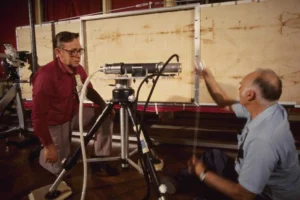
A team of American scientists known as the Shroud of Turin Research Project (STuRP) was granted extensive access to the cloth. Their goal was not to prove or disprove religious claims but to study the artifact using scientific methods.
The team included physicists, chemists, engineers, imaging specialists, and other experts.
Over several days, they conducted detailed examinations using advanced instruments for the time.
Their conclusions surprised many observers.
The researchers reported that they found no convincing evidence that the image had been created using traditional artistic techniques. They also concluded that the image was not simply painted onto the linen.
At the same time, the team did not claim the Shroud was authentic or miraculous.
Instead, they reached a more cautious conclusion: the mechanism responsible for producing the image remained unknown.
In science, “unknown” does not mean supernatural. It simply means there is insufficient evidence to explain a phenomenon completely.
That conclusion would shape future research for decades.
The Carbon Dating Test That Seemed to Settle the Question
In 1988, scientists conducted what many believed would be the definitive test.
Small samples of the cloth were sent to three independent laboratories located in the United Kingdom, Switzerland, and the United States for radiocarbon dating.
The results appeared remarkably consistent.
All three laboratories concluded that the tested material dated to between 1260 and 1390 AD.
The announcement made headlines around the world.
If the dating was correct, the Shroud could not be the burial cloth of Jesus, who lived during the first century.
For many scientists, the debate seemed over.
The artifact appeared to be a medieval object rather than an ancient relic.
Yet the story did not end there.
Instead, the carbon dating results became the beginning of a new controversy.
Why Some Researchers Question the Carbon Dating Results
Most mainstream scholars continue to regard the 1988 radiocarbon dating as strong evidence for a medieval origin.
However, some researchers argue that the samples tested may not represent the entire cloth.
Their concerns stem from the location where the samples were removed.
The tested material came from a corner of the Shroud that had been handled extensively over centuries. Critics argue that repairs, contamination, or later-added fibers could potentially have influenced the results.
Several studies have proposed that the sampled section may differ from the rest of the cloth.
Others point to centuries of exposure to smoke, fire damage, handling, and environmental contamination.
Not all scientists accept these objections.
Many experts maintain that contamination would need to be extraordinarily significant to shift the carbon date by more than a thousand years.
As a result, disagreement persists.
The radiocarbon dating remains one of the strongest pieces of evidence for a medieval origin, yet questions about the sampling process continue to fuel debate.
The Fire That Complicated Everything
One major event frequently discussed in Shroud research occurred in 1532.
A fire broke out in the chapel where the cloth was stored.
Molten silver from a container reportedly dripped onto the folded fabric, creating symmetrical burn marks that remain visible today.
The Shroud survived, but the fire introduced additional complications.
Heat exposure can alter textiles in various ways.
Some researchers have suggested that extreme temperatures might have affected certain chemical properties of the cloth.
Others argue that the fire could not reasonably explain the age differences required to invalidate the carbon dating results.
Nevertheless, the incident remains part of the broader discussion surrounding the Shroud’s history and preservation.
The Bloodstain Debate
Another major point of disagreement involves the reddish stains visible on the cloth.
Supporters of authenticity argue that these marks are consistent with human blood.
Several studies have reported findings compatible with blood components, including traces associated with hemoglobin.
Critics, however, caution that identifying ancient biological material is difficult.
Over centuries, substances degrade, environmental contamination accumulates, and chemical signatures become harder to interpret.
Some researchers believe the evidence supports the presence of blood.
Others remain unconvinced that the available data conclusively proves the stains originated from a human body.
The debate illustrates a recurring theme in Shroud research: evidence that appears persuasive to one group often remains insufficient for another.
Could a Medieval Artist Have Created It?
Skeptics often ask a straightforward question.
If the Shroud is medieval, how was it made?
This question has proven surprisingly difficult to answer.
Various theories have been proposed over the years.
Some suggest pigments were applied and later faded.
Others propose rubbing techniques, chemical reactions, heated sculptures, or early photographic processes.
Several researchers have successfully recreated images that resemble certain aspects of the Shroud.
However, reproducing every characteristic simultaneously has proven far more challenging.
For example, many reproductions fail to match the image’s superficial depth, tonal properties, or microscopic features.
This does not mean a medieval artist could not have produced the image.
It simply means that no proposed method has achieved universal acceptance among researchers.
As a result, critics and supporters alike continue to debate the most plausible explanation.
The 3D Image Mystery
One of the most intriguing discoveries emerged during image analysis in the 1970s.
Researchers using image-processing technology found that the brightness levels within the Shroud image appeared to contain information related to body shape and distance.
When processed through certain systems, the image generated a three-dimensional representation that differed from ordinary photographs.
This finding sparked widespread interest.
Some researchers argued that the image encoded spatial information in an unusual way.
Others cautioned against overstating the significance of the result, noting that various images can produce three-dimensional effects under specific conditions.
Even today, the so-called “3D characteristics” of the Shroud remain part of ongoing discussions about how the image formed.
What Do Historians Say?
Scientific questions are only one part of the puzzle.
Historians also examine the documented history of the cloth.
The clearest historical records place the Shroud in France during the mid-fourteenth century.
Before that period, the documentary trail becomes far less certain.
Some researchers argue that references to similar cloths appear in earlier historical sources.
Others contend that the evidence linking those artifacts to the modern Shroud is inconclusive.
This gap in the historical record is significant.
If the cloth truly originated in the first century, historians would ideally expect stronger evidence documenting its existence across the centuries.
The absence of such evidence does not prove the Shroud is medieval, but it remains one of the strongest historical arguments against ancient origin claims.
New Technologies, Old Questions
Modern technology continues to provide fresh insights.
Researchers have employed high-resolution photography, digital imaging, spectroscopy, textile analysis, forensic methods, and advanced chemical testing.
Some studies suggest characteristics consistent with ancient linen manufacturing techniques.
Others reinforce arguments supporting a medieval date.
What is striking is how rarely new findings eliminate uncertainty.
Instead, they often deepen the complexity of the debate.
Each new study adds information while simultaneously generating new questions.
This pattern is one reason the Shroud continues to attract scientific interest.
Why Scientists Reach Different Conclusions
People often assume that science always produces immediate consensus.
In reality, complex questions can remain unresolved for decades.
The Shroud of Turin is a perfect example.
Scientists examining the same artifact may prioritize different types of evidence.
A radiocarbon specialist may focus on dating results.
A textile historian may emphasize weaving techniques.
A chemist may study fiber composition.
An imaging expert may concentrate on image formation.
Because different disciplines approach the problem from different angles, they sometimes reach different conclusions.
This does not mean science is failing.
It means researchers are attempting to understand an unusually complicated artifact using multiple lines of evidence.
The Current Scientific Position
Among many historians and scientists, the 1988 radiocarbon dating remains the strongest evidence regarding the Shroud’s age.
For this reason, a substantial number of researchers consider the cloth most likely to be medieval.
At the same time, some scientists continue to challenge aspects of that conclusion and advocate for additional testing using modern techniques.
Importantly, there is no universally accepted explanation for how the image itself formed.
The absence of consensus on image formation is separate from questions about the cloth’s age.
These two issues are often confused in public discussions.
A person can accept the carbon dating results while still acknowledging that the image remains scientifically unusual.
Likewise, questioning the dating does not automatically establish authenticity.
The evidence remains complex, and researchers continue to evaluate it from multiple perspectives.
A Mystery That Refuses to Disappear
Most scientific controversies gradually fade as new evidence settles old questions.
The Shroud of Turin has done the opposite.
Every major investigation seems to reveal another layer of complexity. A carbon date points one way. Image analysis raises new questions. Historical records provide clues but not complete answers. Chemical studies produce findings that continue to be debated.
More than a hundred years after a photographer accidentally revealed the image’s startling detail, the Shroud remains suspended between certainty and uncertainty.
Whether future research ultimately confirms a medieval origin, uncovers new evidence of greater antiquity, or reveals an entirely unexpected explanation, the artifact has already secured its place in scientific history.
Not because it has been solved.
But because it hasn’t.
And in science, some of the most valuable discoveries begin with questions that refuse to stay answered.

