For centuries, the Moon has shown Earth a familiar face. Its dark patches, bright highlands and enormous impact craters have become part of our view of the night sky. Yet spacecraft have revealed something surprising: the hemisphere we rarely see looks like it belongs to a very different world.
The Moon’s far side is rougher, more heavily cratered and covered by far fewer dark volcanic plains than the side facing Earth. Its crust is also substantially thicker in many regions. Scientists have known about these differences for decades, but explaining how they developed has remained one of lunar science’s most persistent challenges.
Now, newly reported research is offering a possible explanation. By comparing rocks returned from the Moon’s far side with samples collected from the near side, researchers have developed a model in which ancient heat differences and enormous movements of molten rock helped shape the Moon’s two contrasting hemispheres.
The findings, reported on October 14, 2026, draw on material collected by China’s Chang’e-6 mission. Rather than revealing two fundamentally different moons, the research suggests that a shared early history may have produced dramatically different outcomes at the surface.
The proposal is significant, but it is not the final word. Understanding how the Moon became so uneven will require more samples, further analysis and continued testing of competing explanations.
Why Does the Moon Have Two Different Faces?
The scientific name for the Moon’s hemispheric contrast is lunar dichotomy. It describes the pronounced differences between the near side, which faces Earth, and the far side, which generally points away from our planet.
The contrast becomes obvious when the two hemispheres are compared.
The near side contains extensive dark plains called lunar maria. The word maria means “seas” in Latin, a name early observers gave these regions because they resembled bodies of water. They are actually broad deposits of basalt, a volcanic rock that formed when molten material erupted onto the lunar surface and cooled.
The far side is dominated by ancient highlands, rugged terrain and countless impact craters. Dark volcanic plains exist there too, but they cover a much smaller proportion of the landscape.
There are differences beneath the surface as well. Measurements from lunar orbiters have shown that the crust is generally thicker on the far side, although thickness varies considerably from one region to another. Scientists have also identified chemical differences between the hemispheres, including the distribution of elements associated with heat-producing radioactive materials.
These are not merely cosmetic variations. They preserve evidence of how the Moon cooled, how its interior evolved and why volcanic activity continued in some areas long after it diminished in others.
NASA’s Moon exploration resources provide an overview of the lunar surface, its geological history and the spacecraft that have helped scientists map its unusual terrain.
The “Dark Side” of the Moon Is Not Actually Dark
Before examining the mystery, one common misconception needs correcting: the Moon’s far side is not permanently dark.
The Moon rotates on its axis at approximately the same rate that it orbits Earth. This condition, known as synchronous rotation or tidal locking, means that nearly the same hemisphere always faces our planet.
However, both sides receive sunlight during the lunar day. The far side experiences its own periods of daylight and night, just as the near side does.
We could not see the far side directly from Earth until spacecraft began photographing it. The Soviet Luna 3 mission captured the first images in 1959, revealing terrain that looked strikingly different from the familiar near side.
The discovery transformed a simple astronomical observation into a geological puzzle. If both hemispheres belong to the same natural satellite, why did one develop extensive volcanic plains while the other remained dominated by highlands?
The answer appears to lie in events that took place billions of years before humans looked up at the Moon.
A World Once Covered by a Sea of Molten Rock
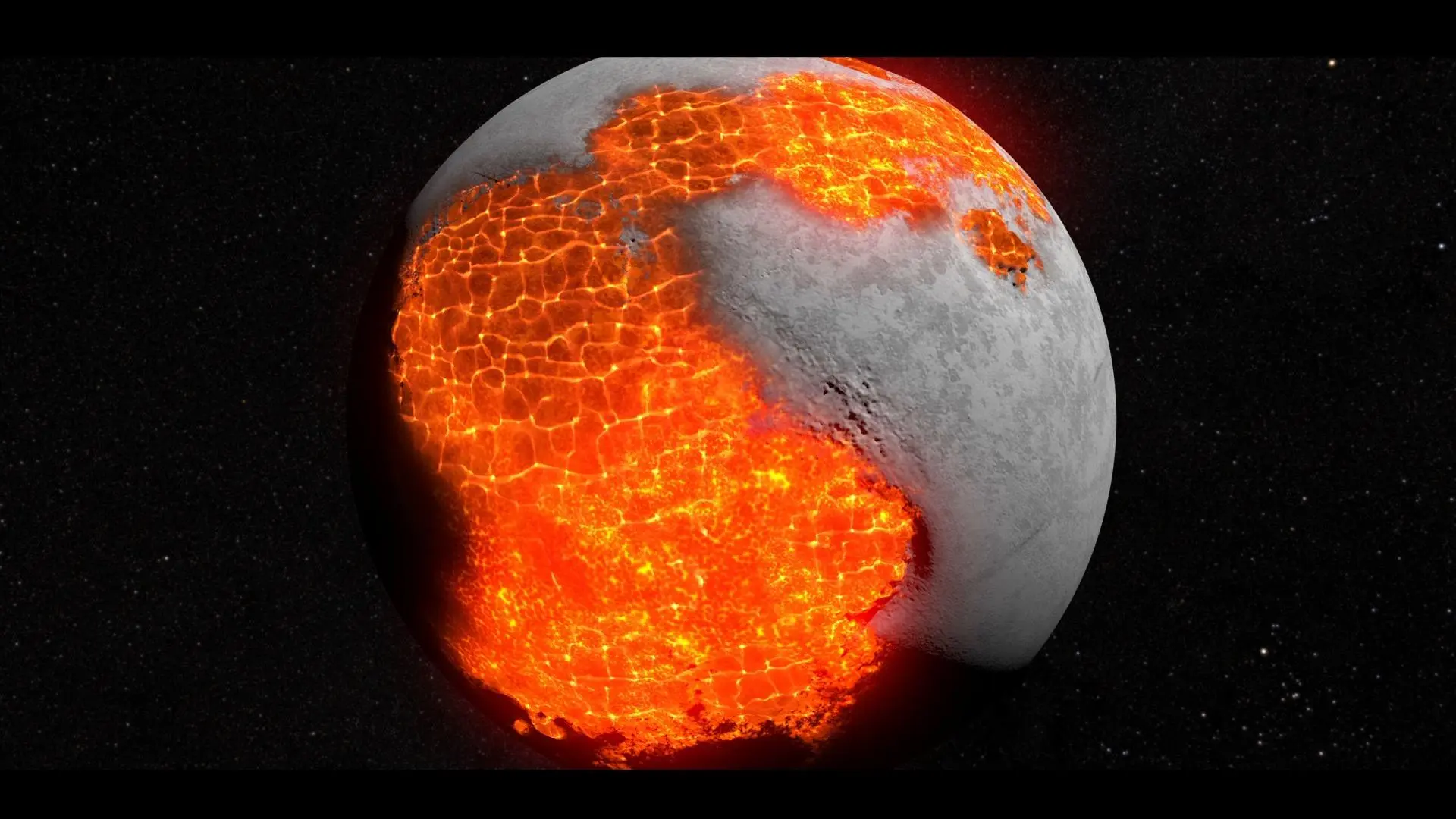
The leading explanations begin with the Moon’s earliest history.
The widely accepted giant-impact hypothesis proposes that the Moon formed from debris produced by a colossal collision involving the early Earth and another planetary body. The precise details of that event remain under investigation, but the resulting Moon was initially extremely hot.
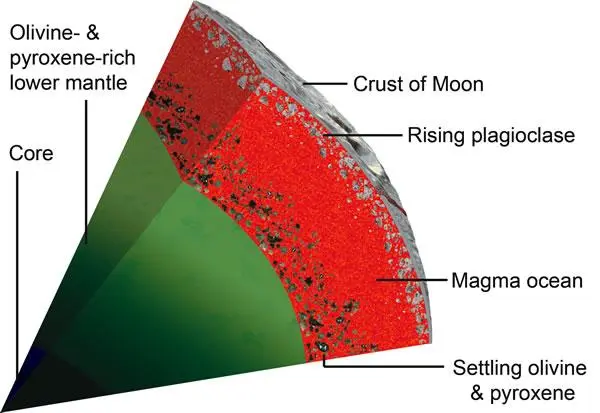
Much of its early surface and interior may have consisted of a vast ocean of molten rock known as the lunar magma ocean.
As this ocean cooled, minerals crystallized at different temperatures. Some dense minerals sank deeper into the interior, while lighter minerals rose and contributed to the formation of the lunar crust.
One important product of this process was anorthosite, a light-colored rock rich in plagioclase feldspar. The abundance of anorthosite helps explain why the lunar highlands appear bright compared with the dark basaltic plains.
The magma ocean did not simply freeze into a uniform shell. Its minerals crystallized, separated and accumulated, creating layers with different compositions and physical properties.
Some elements, including potassium, uranium and thorium, became concentrated in late-stage melts. Scientists often refer to a chemically distinctive assemblage enriched in potassium, rare-earth elements and phosphorus as KREEP.
Uranium and thorium are particularly important because radioactive decay releases heat over geological time. Where heat-producing elements became concentrated, they could help keep portions of the lunar interior warm enough for melting to occur.
This process provides one explanation for the Moon’s uneven volcanic history. But it leaves another question: why were these materials distributed so differently between the two hemispheres?
What Chang’e-6 Revealed About the Far Side
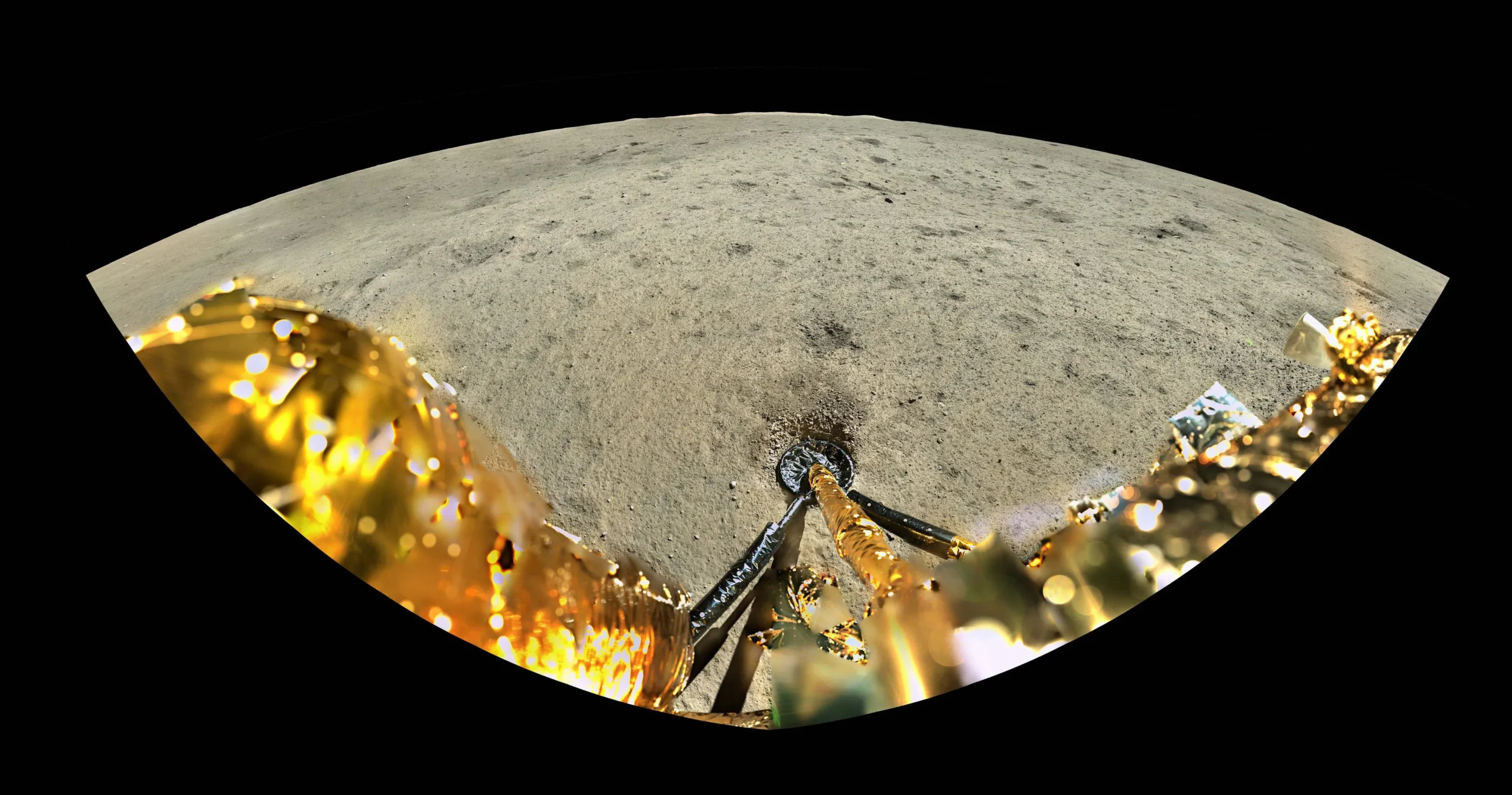
For decades, researchers had a serious limitation: they possessed lunar samples from the near side, but no material had been returned directly from the far side.
Astronauts from NASA’s Apollo missions collected rocks and soil from several near-side locations. China’s Chang’e-5 mission later returned additional samples from the near side in 2020.
The situation changed in June 2024, when China’s Chang’e-6 mission returned approximately 1.9 kilograms of lunar material collected from the far side’s South Pole–Aitken Basin, one of the largest known impact basins in the Solar System.
This was the first successful return of samples directly from the lunar far side. Scientists could finally compare its rocks with material collected from the hemisphere facing Earth.
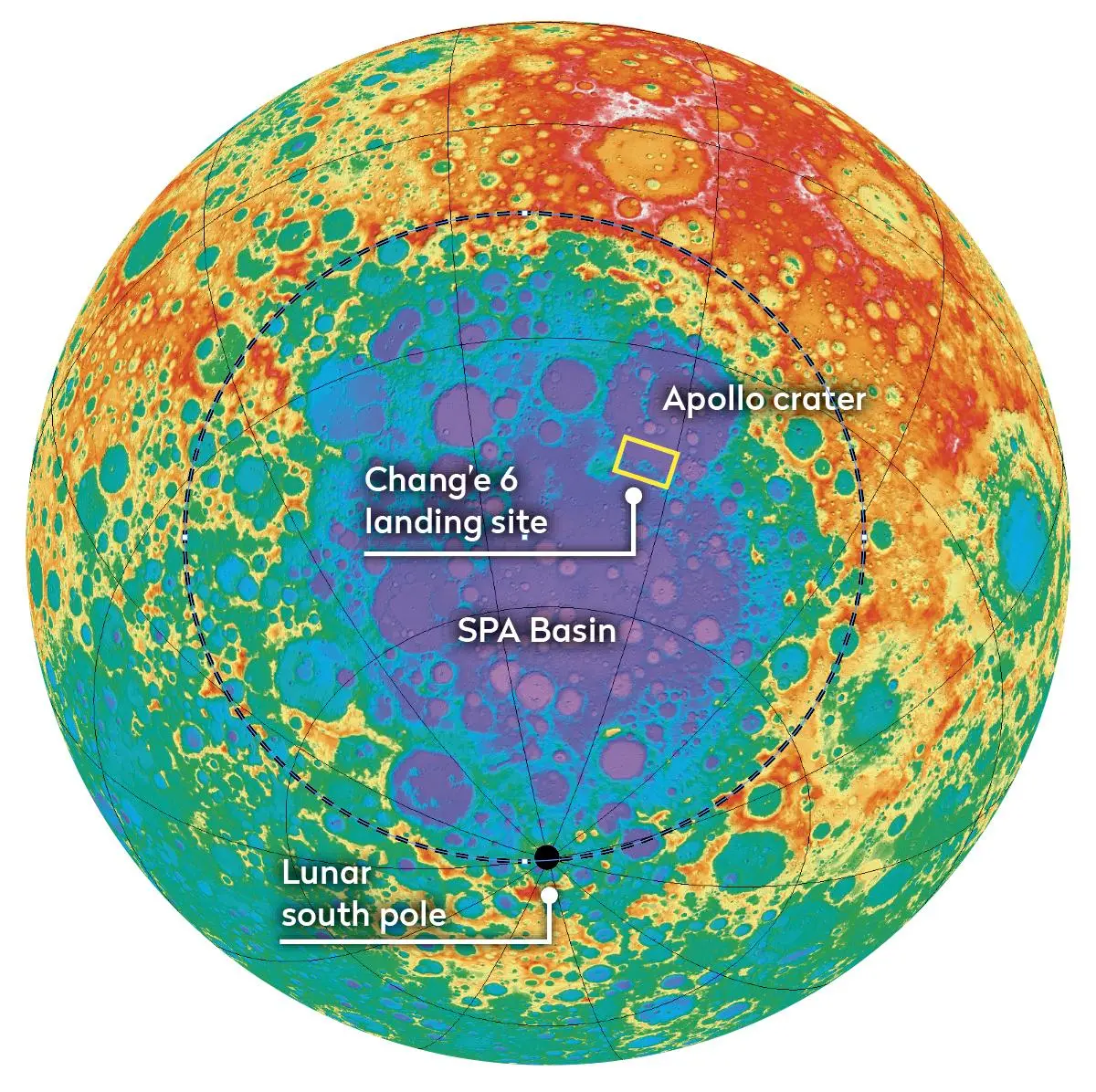
The returned samples have already produced important findings.
A study published in Nature identified two episodes of basaltic volcanism in Chang’e-6 material, including an eruption approximately 2.8 billion years ago and a much older basalt dated to about 4.2 billion years ago. The results showed that volcanic activity on the far side had a more complex history than researchers could establish from remote observations alone.
Read the original research: Lunar farside volcanism 2.8 billion years ago from Chang’e-6 basalts — Nature.
Another study, published in Nature Geoscience in September 2025, examined far-side basalt samples and estimated that the mantle source was roughly 100 degrees Celsius cooler than comparable near-side material. This offered direct evidence that the thermal differences between the two hemispheres extend beneath the surface.
Read the study: A relatively cool lunar farside mantle inferred from Chang’e-6 basalts and remote sensing — Nature Geoscience.
Together, these studies established an important point: the Moon’s two faces differ not only in appearance but also in their geological and thermal histories.
The newer research takes that investigation a step further by proposing how some of these differences may have developed.
The New Explanation: Ancient Heat May Have Moved the Moon’s Interior
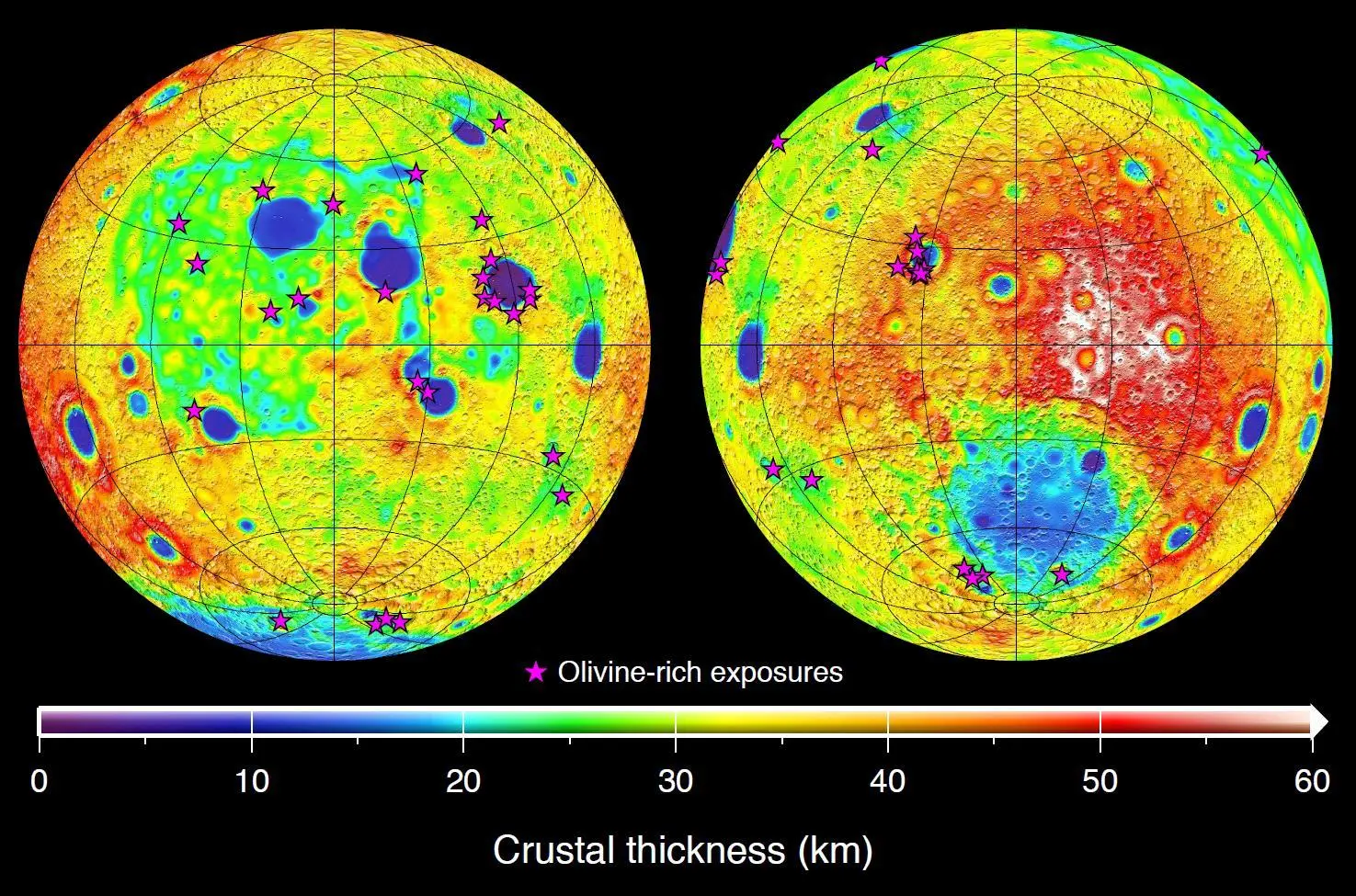
Research reported by Science China Press on October 14, 2026, describes a model developed by a team led by Hejiu Hui of Nanjing University. The researchers compared three broad groups of lunar rocks: anorthosites, magnesium-rich Mg-suite rocks and volcanic mare basalts.
Their results suggest that the Moon’s mantle may have retained broadly similar underlying characteristics on both sides, even as the crust developed more pronounced chemical differences.
That distinction is crucial. It points toward a Moon whose two faces were shaped partly by the way material moved and accumulated during its early evolution, rather than by an entirely different starting composition for each hemisphere.
The researchers propose that tidal heating associated with Earth may have created temperature differences within the young Moon. These differences could have driven large-scale circulation in the still-hot interior.
In this model, warmer material on the near side would have helped drive movements of molten rock toward the far side. Such circulation could have redistributed material during the period when the lunar magma ocean was solidifying and the crust was taking shape.
Over time, the movement of magnesium-rich material could have contributed to the development of a thicker far-side crust. Meanwhile, some of the late-stage material containing KREEP-related elements may have become more concentrated beneath the near side.
This offers a potential explanation for several features at once: the far side’s thicker crust, its relative scarcity of volcanic plains and the uneven distribution of certain chemical elements.
The research is described in the paper “Lunar farside-nearside asymmetry formation during magma ocean solidification,” published in National Science Review.
It is important to interpret the findings carefully. The proposed circulation is a model of events in the ancient Moon, reconstructed from the chemistry of surviving rocks and other geological evidence. Scientists cannot watch those events directly, and the precise history remains open to further testing.
How Could Earth’s Gravity Have Influenced the Moon?
Earth’s influence on the Moon is already visible in its rotation. Tidal forces helped slow the Moon’s original rotation until it became synchronized with its orbit.
The new model considers whether Earth’s gravitational influence could also have contributed to uneven heating during an early stage of lunar development.
In the young Solar System, the Moon’s orbit and interior conditions differed from those today. Tidal forces can deform a celestial body and dissipate energy as heat. The amount of heating depends on factors such as orbital distance, internal structure and how the body responds to deformation.
If heating was uneven across the early Moon, it could have created temperature differences large enough to influence the movement and crystallization of molten material.
Imagine a slowly cooling mixture in which minerals form, separate and move as temperature and density change. Even modest differences in the conditions across a planetary body can affect where minerals accumulate and where later melting occurs.
The Moon’s history was vastly more complicated than this simple analogy, but it illustrates the underlying idea: a difference in heating could produce a difference in geological development.
The new model links that possibility to the chemistry of far-side samples. It does not mean that Earth’s gravity alone explains every lunar feature, or that all details of the Moon’s early thermal history are settled.
Why the Near Side Developed More Volcanic Plains
The dark lunar maria are among the clearest signs of the Moon’s uneven evolution.
They formed when basaltic lava flooded large impact basins and other low-lying areas. Much of this volcanism occurred billions of years ago, after the Moon’s initial magma ocean had largely solidified.
For lava to reach the surface, however, several conditions must align. Portions of the mantle must become hot enough to melt, magma must be generated and pathways must allow it to rise through the crust.
A thicker crust can make that journey more difficult. Differences in the temperature and composition of the mantle can also influence how much magma forms.
The far side’s thicker crust and cooler mantle therefore offer a plausible part of the explanation for its smaller volcanic plains. The near side, by comparison, had geological conditions that permitted more extensive basaltic flooding.
The distribution of KREEP-related materials may also have played a role. Because some of these materials contain heat-producing radioactive elements, their concentration could have affected how long parts of the mantle remained capable of generating magma.
Nevertheless, no single factor should be treated as a complete explanation. Crustal thickness, mantle temperature, composition, impact history and the movement of molten material may all have contributed to the final pattern.
Could an Ancient Collision Have Created the Moon’s Two Faces?
The tidal-heating model is not the only explanation scientists have considered.
One longstanding idea proposes that the Moon experienced a major impact that altered the structure of one hemisphere. A sufficiently large collision could have excavated enormous quantities of crust, changed local temperatures and affected the distribution of material in the lunar interior.
Another hypothesis suggests that Earth may once have had a smaller companion moon that eventually collided with the Moon we know today. In this scenario, the collision could have deposited material on one side, helping create a thicker highland crust.
These ideas are not interchangeable, and each faces scientific challenges. The companion-moon scenario, for example, requires a plausible account of how the smaller body formed, remained near Earth and collided with the Moon in the required way.
Impact events undoubtedly shaped lunar terrain. The South Pole–Aitken Basin itself is evidence of an enormous ancient collision. But showing that impacts occurred is not the same as proving that a particular impact created the global near-side/far-side difference.
The newer magma-circulation model provides another mechanism that can be compared with the geological record. Future work will need to determine how well it fits the complete range of lunar observations and whether it can coexist with effects from ancient impacts.
What Scientists Still Need to Find Out
The Chang’e-6 samples are a major advance, but they represent a limited collection of material from a specific landing region. The far side covers a vast area with many geological environments, and one sample site cannot represent every part of it.
Researchers need additional samples from different locations, especially areas that could help establish how the crust and mantle vary across the Moon.
They also need to refine estimates of the Moon’s early temperature distribution, the timing of tidal locking and the way minerals crystallized and moved as the magma ocean cooled.
Computer simulations can test whether proposed flows are physically plausible under different early lunar conditions. Geophysical measurements from orbiters and future landers can provide independent constraints on crustal thickness, gravity, composition and the structure beneath the surface.
NASA’s Lunar Reconnaissance Orbiter mission has mapped the Moon in extraordinary detail, while the Gravity Recovery and Interior Laboratory (GRAIL) mission has helped researchers understand variations in lunar gravity and crustal structure.
Combining those observations with returned samples is essential. A successful explanation must account for the chemistry of the rocks, the thickness of the crust, the pattern of volcanic plains and the Moon’s broader thermal evolution.
Why the Moon’s Two Faces Matter Beyond the Moon
Solving the lunar dichotomy is not simply an exercise in explaining an unusual landscape.
The Moon preserves a record of the early Solar System that has been partly erased on Earth by erosion, plate tectonics and geological recycling. Its rocks offer clues about how rocky worlds cool, how planetary crusts form and how impacts reshape their surfaces.
Understanding the Moon’s early interior could also help scientists interpret other worlds. Mercury, Mars and several icy or rocky moons display their own geological contrasts, although the processes responsible for them differ.
If heat-driven circulation helped produce the Moon’s asymmetry, it would demonstrate how internal dynamics and a nearby planet’s gravitational influence can interact to shape a world over billions of years.
The research also shows why sample-return missions are so valuable. Orbital instruments can measure surface properties across an entire world, but laboratory analysis can reveal mineral compositions, isotopic signatures and formation temperatures that are difficult to determine remotely.
Chang’e-6 has given researchers something they lacked for more than half a century: rocks collected directly from the lunar hemisphere hidden from Earth.
Those samples are helping transform an old visual mystery into a testable geological question.
The Moon May Have One History, but Two Very Different Outcomes
The Moon’s familiar face and rugged far side are reminders that a world does not need to have two different origins to develop two different landscapes.
The latest research points to an intriguing possibility: differences in heating and the movement of molten material during the Moon’s early history may have helped distribute crust-forming minerals unevenly, setting the stage for the volcanic contrast we see today.
The findings do not establish that every part of the mystery has been solved. They provide a new explanation grounded in samples from the far side and offer a framework that future missions and laboratory studies can test.
For now, the Moon’s two faces remain a record of a turbulent beginning. One hemisphere became marked by broad volcanic plains, while the other preserved a more rugged landscape of ancient highlands and craters.
The next generation of lunar exploration may reveal just how much of that difference was written into the Moon while its interior was still hot enough for continents of rock to move beneath its surface.