Imagine waking up to breaking news unlike anything humanity has ever witnessed.
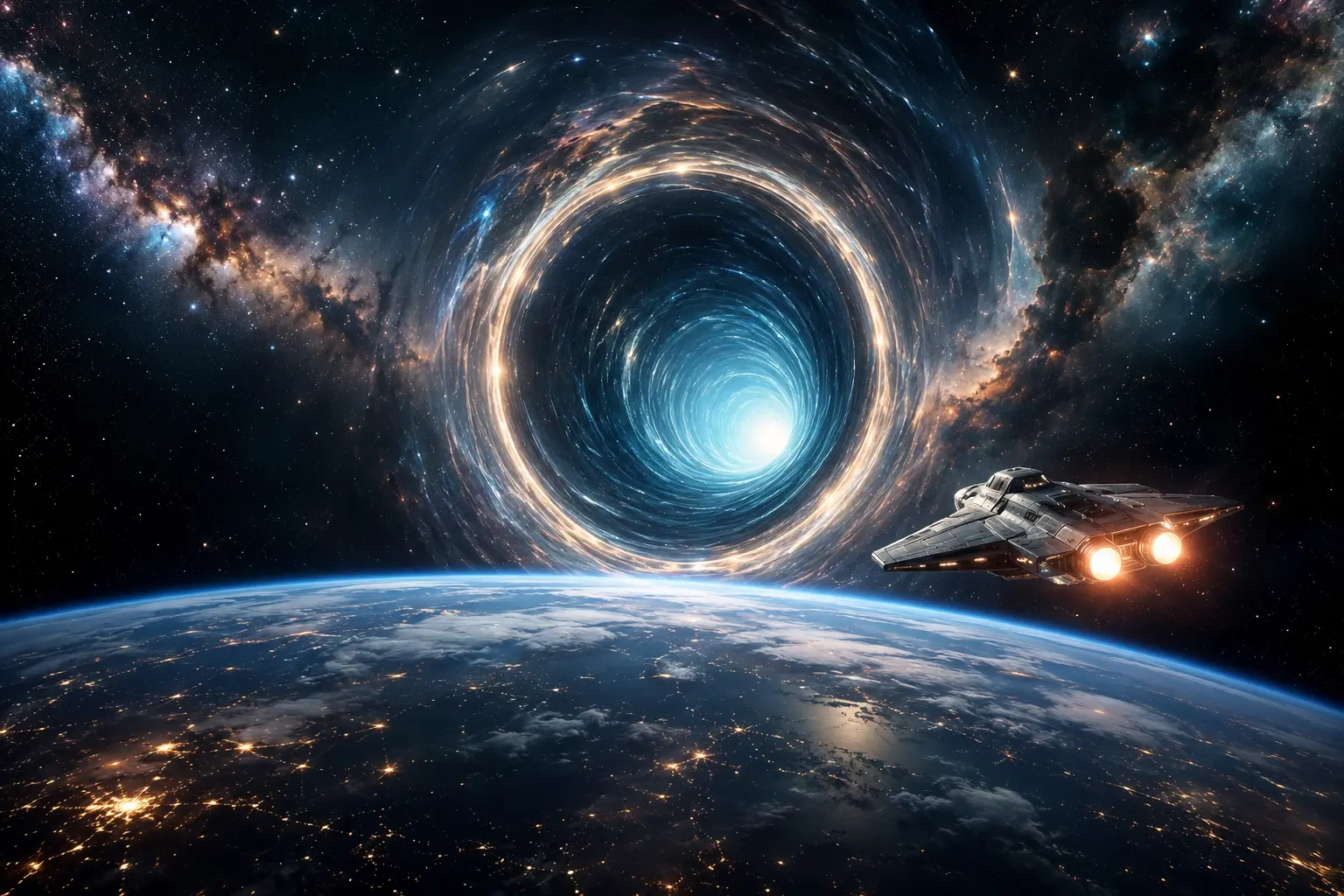
Scientists announce that they have successfully opened a stable wormhole just beyond Earth’s atmosphere.
At first, it appears as nothing more than a shimmering circle floating silently in space. But within hours, telescopes around the world confirm the impossible—light entering one side emerges from another location millions of kilometers away.
The implications are staggering.
Is it a shortcut through space? Could it become humanity’s first portal to distant galaxies? Or, more astonishingly, could it allow people to travel through time itself?
While no real wormhole has ever been created, the concept is rooted in genuine physics. The possibility has fascinated scientists, science fiction writers, and dreamers for decades because wormholes emerge naturally from Albert Einstein’s equations of general relativity.
But if humanity ever succeeds in opening one, the discovery could become the most significant event in human history—and perhaps the most dangerous.
What Exactly Is a Wormhole?
Think of space as a massive sheet of paper.
If you wanted to travel from one corner to another, you’d normally move across the surface.
But what if you folded the paper in half?
Suddenly, two distant points touch each other.
Instead of crossing the entire sheet, you simply step through a tiny opening.
That simple analogy describes what physicists call a wormhole—a tunnel connecting two distant regions of space.
Unlike ordinary travel, which requires moving through every point in between, a wormhole could allow almost instantaneous travel across enormous cosmic distances.
This idea isn’t fantasy. It comes directly from Einstein’s theory of general relativity, which describes gravity as the curvature of spacetime itself.
Einstein’s Vision of Curved Space
Before Einstein, scientists viewed space as an empty stage where events unfolded.
Einstein completely changed that perspective.
According to his theory, massive objects like stars and planets bend the fabric of spacetime.
Imagine placing a bowling ball on a stretched rubber sheet.
The sheet dips under the weight.
Now roll a marble nearby.
Rather than moving in a straight line, the marble curves toward the bowling ball.
Gravity works similarly—not because objects “pull” one another, but because spacetime itself is curved.
If space can bend, twist, and stretch, could it also fold into tunnels?
Mathematically, the answer is yes.
In 1935, Einstein and physicist Nathan Rosen described theoretical structures now known as Einstein-Rosen bridges—the earliest scientific description of wormholes.
Could Scientists Actually Create One?
This is where science meets extraordinary engineering challenges.
Even if wormholes exist naturally, creating one would likely require energies beyond anything humans can currently produce.
Particle accelerators such as the Large Hadron Collider generate enormous energies, yet they remain insignificant compared to what theoretical models suggest would be necessary.
Some physicists believe microscopic wormholes may briefly appear at the quantum level.
These tiny fluctuations would exist for unimaginably short periods before disappearing.
If future technology could somehow capture and enlarge one, it might become the first artificial gateway through spacetime.
That possibility remains speculative, but it continues to inspire research in quantum gravity and cosmology.
The Biggest Problem: Keeping It Open
Finding or creating a wormhole isn’t enough.
Keeping it open is another challenge entirely.
According to current theories, gravity would cause the tunnel to collapse almost instantly.
To prevent this, scientists propose the existence of exotic matter—a hypothetical form of matter possessing negative energy density.
Negative energy sounds impossible because everything we experience has positive energy.
However, quantum physics has revealed unusual effects, such as the Casimir effect, where negative-energy-like conditions can appear under highly controlled circumstances.
Whether enough exotic matter could ever exist to stabilize a wormhole remains one of physics’ greatest unanswered questions.
Could a Wormhole Enable Time Travel?
This is where things become truly fascinating.
Most people imagine time travel as a machine with flashing lights.
Physics suggests the reality, if possible at all, would be much stranger.
Suppose one end of a wormhole stays near Earth while the other travels close to the speed of light.
According to Einstein’s theory of special relativity, time would pass more slowly for the moving entrance.
When it returns, the two ends would no longer share the same point in time.
Walking through the wormhole might allow someone to emerge years—or even decades—in the past or future relative to the other entrance.
This isn’t magic.
It’s a consequence of time dilation, one of the best-tested predictions of relativity.
Whether nature actually permits such a configuration remains uncertain.
The Grandfather Paradox
Time travel immediately creates troubling logical questions.
Imagine traveling back in time and preventing your grandparents from meeting.
If they never met, your parents would never be born.
If your parents were never born, you wouldn’t exist.
So who traveled back in time?
This contradiction is known as the Grandfather Paradox.
Physicists have proposed several possible solutions.
One idea suggests that history cannot be changed because events naturally prevent paradoxes from occurring.
Another proposes branching timelines, where changing the past creates an entirely new universe while leaving the original intact.
Neither idea has been experimentally verified.
Black Holes and Wormholes: Are They Connected?
Black holes are among the Universe’s most mysterious objects.
Formed when massive stars collapse, they possess gravity so powerful that not even light can escape once it crosses the event horizon.
Some theoretical models suggest certain black holes might conceal wormholes inside them.
Rather than ending in a singularity, they could connect to another location—or perhaps another universe.
Unfortunately, most calculations indicate such wormholes would be violently unstable.
Anyone attempting to enter would almost certainly be destroyed by extreme tidal forces long before reaching the other side.
Even so, studying black holes has deepened scientists’ understanding of how wormholes might behave.
Could a Wormhole Lead to Another Universe?
Modern cosmology allows for astonishing possibilities.
Some theories suggest our universe may be only one among countless others.
If that’s true, wormholes might not simply connect distant points in our cosmos.
They could bridge entirely different universes with completely different physical laws.
Imagine entering a universe where gravity is weaker, stars burn differently, or chemistry itself behaves in unfamiliar ways.
Such ideas remain deeply speculative, but they continue to motivate theoretical research into the nature of spacetime.
The Risks Could Be Enormous
Opening a wormhole wouldn’t just be a scientific triumph.
It could become humanity’s greatest security challenge.
Potential risks include:
- Catastrophic gravitational disturbances near Earth.
- Exposure to intense radiation.
- Unpredictable energy releases.
- Collapse of the wormhole while someone is inside.
- Unknown biological or chemical hazards arriving from elsewhere.
Even if stable, governments would almost certainly restrict access.
The first wormhole might become the most heavily guarded scientific facility ever constructed.
Could It Become Humanity’s Ultimate Transportation System?
If the technology proved safe, its benefits could transform civilization.
Travel to Mars could take seconds instead of months.
Interstellar missions that currently require tens of thousands of years might become routine.
Emergency medical supplies could be delivered instantly across continents.
Global transportation, trade, exploration, and communication would enter an entirely new era.
Humanity could become an interstellar civilization far sooner than anyone imagined.
What Would Happen in the First 24 Hours?
Imagine the world’s response.
Financial markets swing wildly.
World leaders hold emergency meetings.
Space agencies coordinate with militaries.
Religious scholars debate its implications.
Social media erupts with theories, excitement, fear, and misinformation.
News channels broadcast around the clock.
Scientists rush to verify every measurement while millions watch livestreams of the mysterious portal.
Within hours, humanity realizes history has changed forever.
Could We Send Robots First?
The safest approach would almost certainly involve robotic exploration.
Before risking human lives, autonomous spacecraft could map the tunnel.
Sensors would measure:
- Gravity
- Radiation
- Atmospheric composition
- Electromagnetic fields
- Stability
- Biological hazards
Only after years of testing might humans attempt the journey.
Even then, the risks could remain immense.
What Would Einstein Think?
Albert Einstein spent much of his life exploring the deepest mysteries of spacetime.
Although he never claimed wormholes existed in reality, his equations made their mathematical possibility unavoidable.
If scientists ever created one, it would represent one of the greatest confirmations of his revolutionary ideas.
Yet Einstein also understood that nature often surprises us.
He would likely insist on extraordinary evidence before accepting such an extraordinary claim.
Could We Ever Build One?
Today’s technology is nowhere near capable of constructing a stable wormhole.
Scientists still lack a complete theory unifying general relativity with quantum mechanics.
Without that breakthrough, the engineering required remains beyond imagination.
Still, history teaches us humility.
Flight once seemed impossible.
Landing on the Moon appeared absurd.
The internet belonged to science fiction.
Every generation expands the boundaries of what humans can achieve.
Perhaps future civilizations will look back at our era the way we look at the earliest dreamers of powered flight.
Separating Science From Speculation
It’s important to distinguish established science from imaginative possibilities.
Supported by modern physics:
- General relativity predicts curved spacetime.
- Einstein’s equations allow mathematical wormhole solutions.
- Time dilation has been experimentally confirmed.
- Black holes unquestionably exist.
Still speculative:
- Stable traversable wormholes.
- Artificial wormhole creation.
- Practical human time travel.
- Travel to parallel universes through wormholes.
Theoretical physics provides intriguing possibilities, but no experimental evidence currently shows that traversable wormholes exist.
Final Thoughts
The announcement that scientists had opened a wormhole near Earth would instantly become the greatest scientific story in human history.
It could redefine travel, reshape our understanding of time, unlock distant galaxies, and challenge everything humanity believes about reality itself.
At the same time, it would raise profound questions about safety, ethics, international cooperation, and the limits of scientific ambition.
For now, wormholes remain extraordinary theoretical ideas supported by fascinating mathematics rather than experimental proof. Yet every major scientific breakthrough begins with curiosity and the courage to ask impossible questions.
Perhaps one day, somewhere in humanity’s future, the impossible doorway imagined by Einstein’s equations will no longer belong only to theory—but become the first step toward a far larger universe than we ever dared imagine.
Frequently Asked Questions
Has anyone ever discovered a real wormhole?
No. Scientists have never observed or created a traversable wormhole. They remain theoretical predictions derived from solutions to Einstein’s equations.
Could wormholes make faster-than-light travel possible?
A traversable wormhole could, in principle, provide a shortcut through spacetime, making journeys appear faster than light without requiring an object to locally exceed the speed of light.
Can black holes become wormholes?
Some theoretical models explore this possibility, but there is currently no observational evidence that real black holes function as traversable wormholes.
Is time travel scientifically possible?
Travel into the future occurs naturally through relativistic time dilation and has been experimentally confirmed in tiny amounts. Traveling into the past remains speculative and raises unresolved paradoxes.
Could opening a wormhole endanger Earth?
If such technology were ever possible, scientists would need to understand and manage potential risks such as intense gravitational effects, radiation, and instability. At present, this remains a hypothetical scenario.