
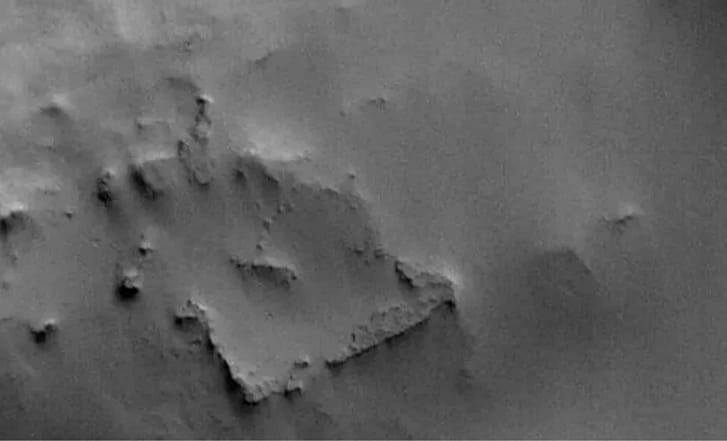
Square Structure on Mars is not a phrase most planetary scientists expected to dominate internet discussions.
Yet that’s exactly what happened when an unusual image from Mars resurfaced online and began spreading across social media.
At first glance, the formation looked startlingly artificial.
The image appeared to show a nearly perfect square shape etched into the Martian landscape. Sharp angles, straight edges, and geometric symmetry immediately caught the attention of viewers. Within hours, theories ranging from ancient ruins to extraterrestrial architecture began circulating across the internet.
For many people, the image seemed too perfect to be natural.
But as the debate grew, planetary scientists pointed to a much more familiar explanation—one rooted not in alien civilizations, but in geology, perspective, and the remarkable tendency of the human brain to find patterns in the unknown.
What Is the Square Structure on Mars?

The image at the center of the controversy was originally captured by NASA’s Mars Global Surveyor mission in 2001.
The photograph shows part of a cratered region on Mars where a feature appears to form an almost square outline. When the image was cropped and shared online, the geometric shape became the primary focus. Many viewers saw what looked like a gigantic foundation, wall system, or artificial enclosure.
The timing of the image’s resurgence played a major role in its popularity.
Social media platforms amplified the discussion, and high-profile figures helped draw attention to the photograph. Soon, millions of people were examining the image and debating whether Mars might contain evidence of an ancient civilization.
The phenomenon closely mirrored previous viral Mars mysteries, including the famous “Face on Mars” and the so-called Martian doorway that captivated internet users in recent years.
Why the Image Looked So Artificial
The reaction was understandable.
Human beings are exceptionally good at recognizing patterns.
Throughout evolution, our ancestors benefited from quickly identifying faces, shelters, animals, and other meaningful shapes in their environment.
Sometimes that skill becomes so powerful that the brain identifies familiar structures where none actually exist.
Psychologists call this phenomenon pareidolia.
It explains why people see faces in clouds, animals in rock formations, and familiar objects in random visual patterns.
The square formation on Mars triggered exactly this response.
The shape appeared to possess features commonly associated with human construction:
- Straight lines
- Sharp corners
- Geometric proportions
- Apparent symmetry
To many observers, those characteristics seemed difficult to explain through natural processes alone.
But nature has a long history of creating structures that look surprisingly engineered.
The Internet’s Alien Theory Explosion
Once the image began circulating, speculation spread rapidly.
Some social media users suggested the structure could be the remains of an ancient Martian city.
Others proposed that it represented a buried alien complex hidden beneath the surface.
A few commentators argued that right angles and square forms are uncommon in nature and therefore deserved further investigation.
Discussion forums quickly filled with competing interpretations.
On Reddit, many users dismissed the feature as another geological formation, while others remained intrigued by its appearance. The debate highlighted the divide between skepticism and curiosity that often accompanies unusual Mars imagery.
The fascination wasn’t necessarily driven by belief in aliens.
Instead, it reflected something deeper.
People are naturally drawn to mysteries.
And Mars, perhaps more than any other planet, has spent more than a century serving as a canvas for human imagination.
Mars Has a Long History of Strange Discoveries

The square structure is only the latest entry in a long catalog of mysterious-looking Martian features.
Over the years, observers have claimed to find:
- Faces
- Pyramids
- Skulls
- Statues
- Doorways
- Towers
- Animal-like shapes
The most famous example remains the Face on Mars.
When NASA’s Viking spacecraft photographed the Cydonia region in 1976, a mesa appeared to resemble a giant human face staring skyward.
The image sparked decades of speculation.
Books were written.
Documentaries were produced.
Theories flourished.
Eventually, higher-resolution images revealed the feature to be an ordinary landform whose face-like appearance resulted from lighting and viewing angles.
The mystery largely disappeared.
But the lesson remained.
Mars has a remarkable ability to generate illusions.
What Scientists Found When They Looked Closer

The most important development in the square-structure story came years after the original image was captured.
NASA’s Mars Reconnaissance Orbiter later photographed the same region using much more advanced imaging technology.
The higher-resolution images told a different story.
What appeared to be a perfect square in the original photograph was revealed to be a far more irregular geological formation. Features that looked like connected walls and corners from a distance appeared much less organized when viewed in greater detail.
NASA researchers noted that one of the apparent corners was actually part of a cliff-like feature unrelated to the rest of the shape. The illusion of a square emerged largely because of perspective, shadows, image resolution, and the way the human brain interprets incomplete visual information.
The more detailed observations significantly weakened arguments that the structure represented an artificial construction.
Why Nature Creates Geometric Shapes
One reason these stories persist is that many people assume geometry is exclusively a product of intelligence.
In reality, nature produces geometric forms all the time.
On Earth, natural processes create:
- Hexagonal basalt columns
- Crystal lattices
- Polygonal rock formations
- Rectangular fractures
- Symmetrical cave structures
The famous Giant’s Causeway in Northern Ireland contains thousands of naturally occurring hexagonal columns.
Certain deserts display nearly perfect polygonal patterns.
Crystals can produce astonishing geometric precision.
Mars experiences many of the same physical principles.
Rock fractures, erosion, volcanic activity, mineral deposition, and ancient groundwater movement can all generate surprisingly structured formations.
Recent NASA investigations of Martian “boxwork” formations demonstrate how groundwater flowing through fractures can leave behind mineral patterns that later become exposed through erosion, producing intricate geometric networks across the landscape.
The existence of geometric shapes alone is not evidence of intelligent design.
The Real Mystery Hidden Inside the Image
Ironically, the most interesting aspect of the square structure may not be the possibility of alien architecture.
It may be what the image reveals about human perception.
When people encounter an ambiguous image, they instinctively search for meaning.
This tendency has helped humanity survive, innovate, and explore.
The same pattern-recognition abilities that allow scientists to discover planets and decode genetic information can also cause us to perceive familiar structures in random data.
The square on Mars demonstrates both sides of that equation.
The image encouraged imagination.
But it also encouraged investigation.
Scientists didn’t dismiss the claim because it sounded unusual.
They examined better data.
They collected higher-resolution images.
They tested explanations.
That process represents science at its best.
Could Mars Have Hosted Ancient Life?
While the square structure itself is unlikely to be an alien ruin, Mars remains one of the most compelling locations in the Solar System for searching for evidence of past life.
Scientists have accumulated substantial evidence that ancient Mars was very different from the cold desert we see today.
Billions of years ago, the planet likely possessed:
- Rivers
- Lakes
- Groundwater systems
- A thicker atmosphere
NASA’s Curiosity rover has spent years investigating regions where water once flowed, while studies of boxwork formations suggest groundwater remained active in some locations later than previously expected. These discoveries help scientists understand whether ancient Mars may once have supported microbial life.
The search continues.
But researchers are looking for signs of ancient microorganisms, not giant square buildings.
Why Stories Like This Keep Going Viral
The square structure on Mars became popular for the same reason many space mysteries do.
It combined three powerful ingredients:
First, it involved NASA.
Second, it featured a striking image.
Third, it raised a question that people desperately wanted answered.
Even after scientists offered geological explanations, many people remained fascinated.
Not because they rejected science.
But because the possibility of discovering evidence of another civilization remains one of humanity’s most compelling ideas.
The image provided a glimpse of that possibility, however unlikely it may be.
The Square That Reminded Us to Keep Looking
The internet may remember the square structure on Mars as another viral alien mystery.
Scientists will likely remember it differently.
To them, it serves as a reminder of how easily visual information can be misunderstood—and how valuable better data can be.
The formation almost certainly isn’t a Martian building.
It isn’t an alien fortress.
And it probably isn’t the ruins of a forgotten civilization.
Yet the image accomplished something important.
For a brief moment, millions of people looked at a distant world and wondered what might be hiding there.
That curiosity is the same force that drives rovers across Martian deserts, launches spacecraft toward distant planets, and pushes humanity to keep exploring.
The square itself may be ordinary geology.
But the question it inspired is anything but ordinary.
Because every major discovery begins the same way:
Someone notices something unusual and asks whether there’s more to the story.