
The Day the Sky Exploded: What Really Happened During the Tunguska Event?
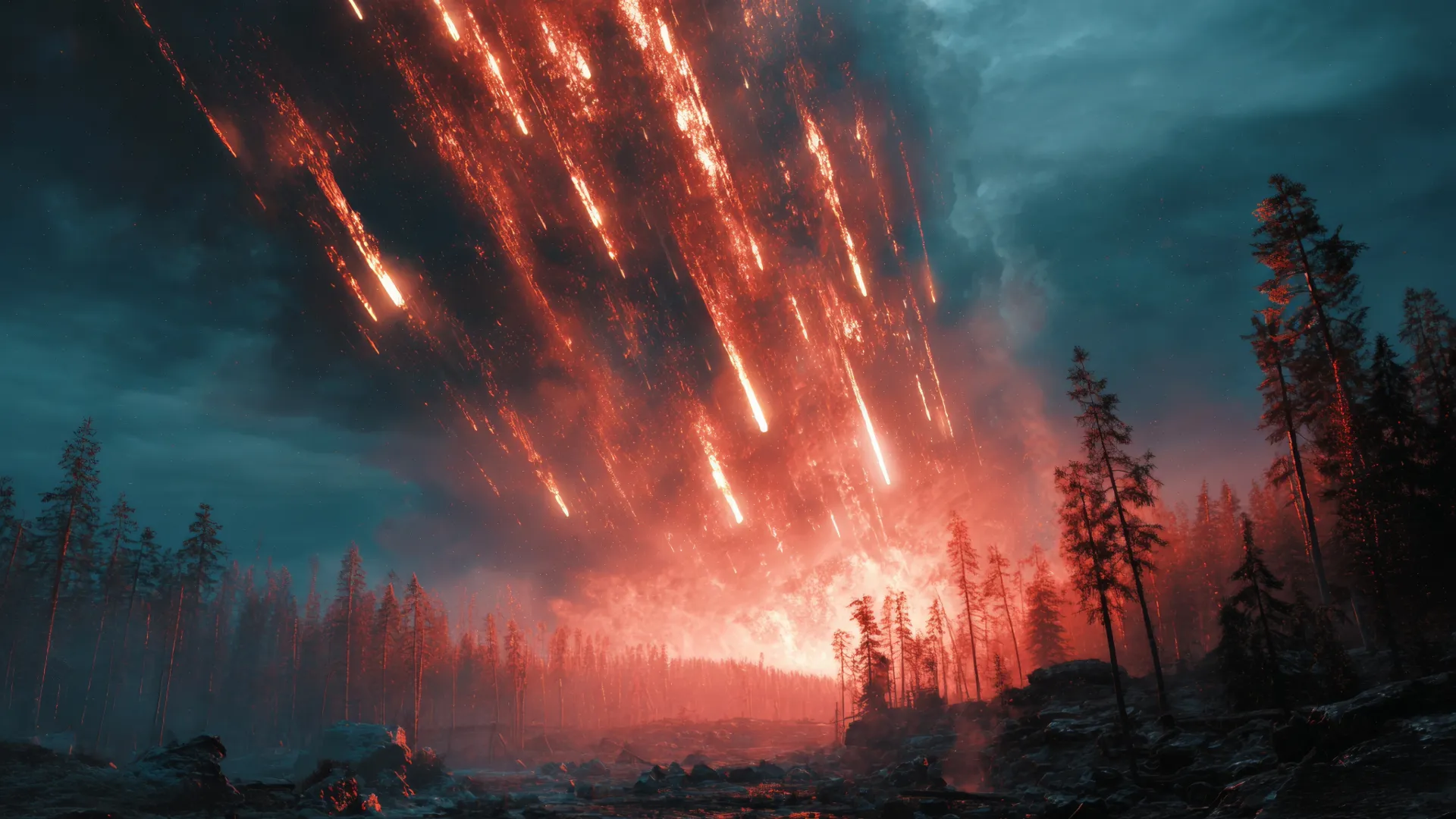
On the morning of June 30, 1908, a tremendous explosion tore through a remote region of Siberia. Witnesses described a brilliant object crossing the sky, followed by a blast powerful enough to flatten an enormous area of forest. The shock wave was detected far beyond the impact zone, and atmospheric effects were reported thousands of kilometres away.
Yet when investigators reached the devastated landscape, they found something astonishing: no confirmed impact crater and no clearly identified large meteorite.
The event became known as the Tunguska event, one of the most powerful cosmic airbursts in recorded history. More than a century later, scientists have a strong explanation for what happened, although important details—including the object's precise size and composition—remain uncertain.
Could an asteroid have exploded before reaching the ground? Why was there no obvious crater? And why has Tunguska inspired so many theories about mysterious objects and unexplained phenomena?
The answers reveal how dangerous even a relatively small object from space can be when it enters Earth's atmosphere at enormous speed.
 The scale of the destruction was extraordinary. Later expeditions documented millions of fallen trees across approximately 2,000 square kilometres of Siberian forest. Many trunks lay flattened outward from the estimated centre of the explosion, creating a pattern consistent with a powerful blast arriving from above.
NASA estimates that the object was probably around 50–100 metres across, although estimates vary according to the assumptions used. The explosion likely released energy equivalent to roughly 10–20 megatons of TNT—comparable to a very large nuclear explosion.
The blast generated a powerful pressure wave and intense heat. Witnesses reported seeing a brilliant fireball and feeling the shock wave at considerable distances. Seismic instruments detected ground vibrations, while atmospheric pressure waves travelled far beyond the devastated forest.
The remoteness of the region meant that the event did not produce the scale of human casualties that a similar explosion over a major city could have caused.
The forest itself became the most striking evidence. Trees were knocked down over a vast area, while some nearer the centre were burned or stripped of branches. This unusual pattern helped researchers reconstruct the event long before modern satellite imaging was available.
The Explosion That Flattened 2,000 Square Kilometres of Forest
Why Was There No Impact Crater?
This is the question that helped turn Tunguska into a lasting mystery. When a large meteorite strikes the ground, it can excavate a crater and leave fragments of the incoming object. At Tunguska, investigators found no confirmed large impact crater attributable to the event and no meteorite fragment conclusively identified as the main body. The leading explanation is that the object exploded in the atmosphere before reaching the ground. As an asteroid enters Earth's atmosphere at tremendous speed, air resistance compresses and heats the air in front of it. The object experiences intense mechanical stress, and if it cannot withstand the forces, it can break apart rapidly. A large portion of its kinetic energy can then be released in an airburst. The resulting shock wave can devastate the ground below even when the main object never makes direct contact with the surface. A 1993 paper in Nature modelled the Tunguska event as the atmospheric disruption of a stony asteroid, estimating that approximately 10–20 megatons of energy was released at an altitude of about 10 kilometres. Read the research, The 1908 Tunguska explosion: atmospheric disruption of a stony asteroid. This model explains how an object from space could cause immense destruction without leaving a conventional impact crater.Was It an Asteroid or a Comet?
Scientists have debated the incoming object's composition for decades. A stony asteroid is a rocky body left over from the formation of the Solar System. A comet contains substantial ice and other volatile materials, often mixed with dust and rock. Both can fragment when they enter a planetary atmosphere. The asteroid explanation is currently widely favoured because models of a rocky object tens of metres across can reproduce many of the observed features of Tunguska. NASA's 2018 workshop, which applied modern modelling techniques to the event, found that the most likely scenarios involved an airburst releasing around 10–20 megatons of energy. However, the exact composition has not been established beyond doubt. Some researchers have continued to investigate cometary explanations and whether the object could have broken into multiple fragments. The lack of a confirmed surviving fragment makes it difficult to settle every detail. The evidence supports a cosmic airburst much more strongly than it identifies the precise object responsible.The Strange Theories: Alien Craft, Antimatter and Secret Weapons
The absence of a crater and a clearly identified meteorite helped fuel extraordinary explanations. Some speculative theories have suggested an alien spacecraft, an antimatter object, or a secret weapon. These ideas have captured public imagination because they offer dramatic answers to an event that initially seemed inexplicable. But there is no credible, verified evidence that an alien craft exploded over Siberia in 1908. Nor is there evidence that an antimatter object or a human-made weapon caused the destruction. The lack of a recovered meteorite is not, by itself, evidence for any of these alternatives. A body that disintegrates at high altitude can disperse much of its material, while the remote location and the delay before systematic scientific investigations made the evidence harder to collect. A scientific explanation does not need to account for every detail with absolute certainty to be more convincing than an unsupported alternative. The airburst model explains the fireball, blast wave, and widespread tree damage without requiring an unverified technology or exotic object.Could Tunguska Happen Again?
Yes. Earth continues to encounter asteroids and other small bodies, and some enter the atmosphere and explode before reaching the ground. A more recent example occurred over Chelyabinsk, Russia, on February 15, 2013. A smaller asteroid exploded in the atmosphere, producing a powerful shock wave that damaged buildings and injured people, many of whom were hurt by shattered glass. Chelyabinsk provided scientists with valuable observations of an atmospheric explosion. Those measurements have helped researchers refine models of airbursts and apply them to historical events such as Tunguska. NASA's review of the Tunguska event discusses how the newer event improved scientists' understanding. The risk depends on the incoming object's size, composition, speed, trajectory, and where it explodes. A similar event over an uninhabited forest could devastate wildlife and vegetation; one over a densely populated region could cause a humanitarian disaster. Planetary defence efforts focus on finding near-Earth objects, calculating their orbits, and determining whether any pose a future impact threat. NASA's DART mission also demonstrated that a spacecraft can deliberately alter the motion of a small asteroid moonlet, providing a real-world test of one potential planetary-defence technique. The lesson from Tunguska is not that Earth faces imminent destruction, but that detecting hazardous objects early is valuable.Conclusion: The Most Likely Explanation Is Also Extraordinary
The Tunguska event remains one of the most dramatic examples of a cosmic object affecting Earth in modern recorded history. On June 30, 1908, an object from space likely entered the atmosphere above Siberia and released an enormous amount of energy in an explosion several kilometres above the ground. Its shock wave flattened a vast area of forest, yet it left no confirmed large impact crater and no conclusively identified main meteorite fragment. Those missing pieces have kept the mystery alive, but the accumulated evidence strongly supports an asteroid airburst, with a comet remaining a less favoured possibility in some research. The precise composition and trajectory may never be known with complete certainty. Nevertheless, the event taught scientists something crucial: a space rock does not need to hit the ground to cause catastrophic damage. More than a century later, Tunguska is not just a story about a mysterious explosion. It is a reminder that the Solar System is dynamic, that Earth is not isolated from it, and that understanding the objects crossing our planet's path is an essential part of protecting our future.
How an 18-Million-Year-Old Ape Fossil in Egypt Could Change What We Know About Human Evolution
Read story →
Could Entire Ecosystems Still Exist on Earth That Scientists Have Never Discovered?
Read story →
Trees Have Their Own Biological Muscles. Scientists Discover How They Straighten Themselves
Read story →