The Largest Explosion Ever Seen in the Universe Was Far Bigger Than Expected
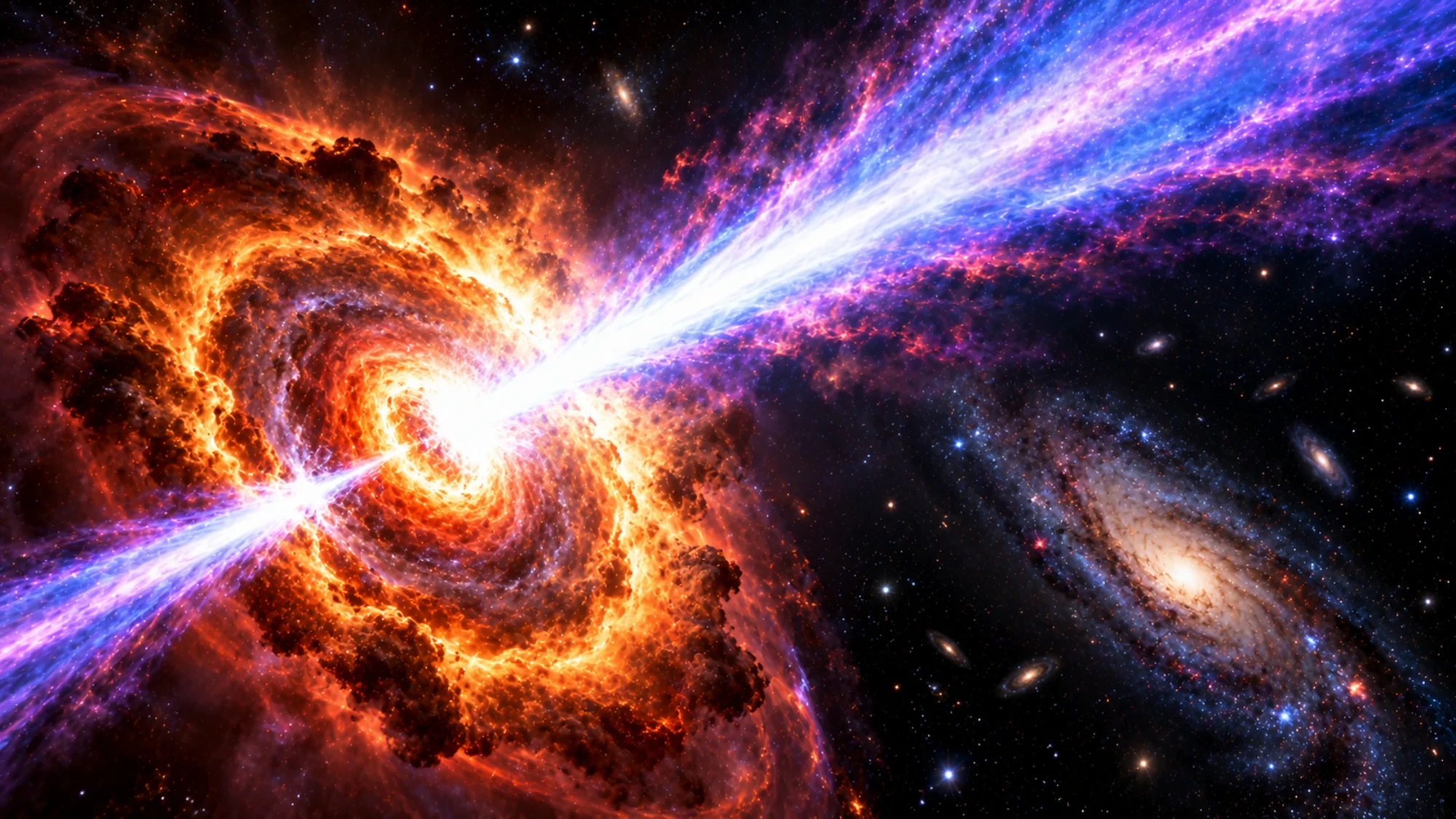
The brightest gamma-ray burst ever observed stunned astronomers in October 2022. Known as GRB 221009A, the extraordinary event offered an unprecedented look at the death of a massive star and challenged some existing models of cosmic explosions.
A Flash That Overwhelmed the Universe
On October 9, 2022, telescopes and space-based observatories detected an extraordinary flash of high-energy radiation arriving from deep space. The signal was so intense that some instruments struggled to measure its full strength immediately. Astronomers quickly recognized that they were witnessing an exceptionally rare event. The explosion became known as GRB 221009A, and scientists nicknamed it the “Brightest Of All Time,” or BOAT. The event was not simply another powerful flash in the night sky. It was the brightest gamma-ray burst ever observed, giving researchers an unusually detailed opportunity to investigate one of the most energetic phenomena known in astronomy. Yet the story behind GRB 221009A is more complicated than the claim that it was the largest explosion imaginable. Its remarkable brightness reflected a combination of its intrinsic power, its distance from Earth and the direction in which its relativistic jet was pointing. The observations nevertheless revealed an event that pushed existing models to their limits and provided a rare window into the final moments of a massive star.What Exactly Exploded?
GRB 221009A was a gamma-ray burst, or GRB: a brief, intense release of high-energy radiation associated with some of the most extreme events in the universe. Long-duration gamma-ray bursts are generally associated with the collapse of massive stars. When a sufficiently massive star reaches the end of its life, its core can collapse, forming a black hole or another compact object. Under the right conditions, material around the central object powers narrow jets that shoot outward at speeds approaching the speed of light. These jets contain particles and magnetic fields capable of producing enormous amounts of radiation. When a jet points approximately toward Earth, its emission can appear exceptionally bright to our instruments. GRB 221009A belongs to this long-duration class. Its discovery triggered observations across the electromagnetic spectrum, including gamma rays, X-rays, visible light, infrared radiation and radio waves. The observations revealed a powerful afterglow that continued long after the initial flash faded. That afterglow was particularly valuable because it allowed astronomers to investigate the expanding material and the physics of the jet. Scientists are still refining the details of how such jets are launched and how they transfer energy to their surroundings. GRB 221009A provided an unusually rich set of observations with which to test those explanations.Why Was GRB 221009A So Exceptionally Bright?
The extraordinary brightness of GRB 221009A was not explained by a single factor. First, the burst was relatively nearby by cosmological standards. Astronomers traced it to a host galaxy at a redshift of approximately 0.151, corresponding to a distance of roughly 2.4 billion light-years in terms of light-travel time. That is an enormous distance, but it is relatively close for a gamma-ray burst. Many such events are detected from much farther across the universe. Second, the geometry of the jet mattered. Radiation from a relativistic jet is strongly concentrated in the direction of motion. If the jet points close to an observer's line of sight, the observer can receive a much more intense signal than would be seen from an unfavorable angle. Third, the explosion itself was exceptionally energetic. Researchers estimated an isotropic-equivalent gamma-ray energy of around (10^{55}) ergs in some analyses. This is the energy the burst would appear to have released if its radiation had been emitted equally in every direction. That qualification is essential. A gamma-ray burst does not necessarily radiate equally in all directions. Because its energy is concentrated in jets, the isotropic-equivalent figure is not the same as the total energy actually released. The combination of high apparent energy, relative proximity and favorable viewing geometry made GRB 221009A an exceptionally rare discovery. Its brightness also created practical challenges. Some instruments recorded signals so intense that detector saturation or other measurement limitations complicated the initial analysis. Scientists had to use multiple observatories and different observing techniques to reconstruct the event.A Cosmic Afterglow That Lasted for Months
The initial gamma-ray flash was only the beginning. After a gamma-ray burst, the expanding jet interacts with surrounding material. Shock waves accelerate particles, producing radiation across a wide range of wavelengths. Astronomers call this continuing emission the afterglow. GRB 221009A's afterglow was monitored extensively, from the first hours after the burst to observations months later. Radio observations proved especially useful. A 2023 study published in Nature Astronomy reported early radio measurements that helped researchers constrain the size, speed and energy of the outflow. The observations also challenged standard descriptions of how the reverse shock in the jet should behave. The reverse shock is a wave that propagates back through the ejected material as the jet interacts with its surroundings. Studying it provides clues about the conditions inside the outflow and how energy is distributed among particles and magnetic fields. The event's X-ray and optical emission also evolved in ways that required detailed modelling. Researchers investigated whether the jet had a structured shape, with energy distributed differently across its central region and outer layers, rather than behaving like a simple, uniformly energetic cone. These observations are helping scientists understand why some gamma-ray bursts appear much brighter than others and how the properties of their jets influence what telescopes detect.Did the Explosion Break the Laws of Physics?
No. GRB 221009A did not demonstrate that the laws of physics had failed. Instead, it exposed the limitations of some simplified models used to describe gamma-ray bursts. When a model struggles to explain observations, scientists examine its assumptions, compare alternative explanations and collect more data. One important question concerns the structure of the jet. If the jet's energy and speed vary with angle, its observed brightness and afterglow can differ significantly from predictions based on a uniform jet. Another challenge is understanding how particles are accelerated to extreme energies and how the resulting radiation is produced. The event's unusually bright emission offered researchers an opportunity to investigate these processes with exceptional precision. GRB 221009A also generated interest because very-high-energy gamma-ray observations detected photons with energies reaching the tera-electronvolt range during its afterglow. Such measurements provide additional tests of models describing how energetic particles interact with radiation and magnetic fields. These findings do not establish a new law of physics or prove that an unknown mechanism powered the burst. They help scientists determine which existing explanations work, which need refinement and where further observations are required.The James Webb Space Telescope Found the Supernova Behind the Burst
The gamma-ray burst was also associated with a supernova, the explosion accompanying the death of its massive progenitor star. The James Webb Space Telescope observed the event months after the initial flash. In research published in Nature Astronomy in 2024, scientists identified emission consistent with a supernova resembling SN 1998bw, a well-studied example of a supernova associated with a gamma-ray burst. The observations offered a closer look at the star's death and the environment in which it occurred. The team found no evidence of an additional component from rapid neutron-capture, or r-process, emission in the observations they analysed. This matters because scientists are still investigating where the universe produces many of its heaviest elements. Some heavy elements can form through rapid neutron capture, but the relative contributions of different cosmic events remain an active research topic. The GRB 221009A observations helped test whether this particular explosion produced a detectable signature of that process. The result did not settle the broader question of where all heavy elements originate. It showed instead that even an exceptionally energetic gamma-ray burst does not necessarily produce every expected signature. The event's host galaxy also displayed evidence of low metallicity, meaning it contained a relatively low abundance of elements heavier than helium. Such environmental clues may help researchers understand why some massive stars produce unusually energetic bursts.Could a Similar Explosion Happen Closer to Earth?
Gamma-ray bursts can be dangerous if a sufficiently powerful event occurs close enough and its jet is directed toward Earth. High-energy radiation from a nearby burst could affect the upper atmosphere and potentially damage the ozone layer, depending on the event's properties and distance. However, GRB 221009A occurred far outside our galaxy, at a distance of billions of light-years. It posed no known direct threat to life on Earth. There is also no evidence that this particular event caused a dangerous effect on Earth's surface. Its scientific significance lies in what astronomers learned from the radiation that reached their instruments. The possibility of a harmful nearby gamma-ray burst is a legitimate subject of astrophysical research, but it should not be confused with an immediate or identified threat. The risk depends on several factors, including the event's distance, energy, jet direction and the response of Earth's atmosphere.Why Astronomers Will Keep Studying GRB 221009A
The importance of GRB 221009A extends beyond its record-breaking brightness. Its observations provide a rare chance to study several connected processes: the collapse of a massive star, the formation and structure of relativistic jets, the acceleration of particles, the evolution of shocks and the relationship between gamma-ray bursts and supernovae. Because the event was observed across so many wavelengths, researchers can compare independent measurements rather than relying on a single detector or a narrow slice of the explosion's evolution. The resulting evidence helps test models of how energy moves through a relativistic jet and how that energy becomes observable radiation. It also offers clues about the environments in which the most energetic stellar deaths occur. Future observations of other gamma-ray bursts will help researchers determine which properties of GRB 221009A are typical of the most powerful events and which made this one unusual. It is possible that similarly powerful bursts have occurred without being detected at comparable brightness. Astronomers cannot assume that the brightest event observed so far represents the absolute physical limit of what the universe can produce.A Reminder of How Extreme the Universe Can Be
GRB 221009A did not overturn physics, nor did it reveal an entirely new category of cosmic explosion. Its significance is more concrete: it gave scientists an unusually bright, nearby and extensively observed example of a phenomenon that remains difficult to understand in detail. The event demonstrated how much can be learned when an astronomical explosion is observed rapidly and across multiple wavelengths. It also showed that the brightest events can expose gaps in models that appear adequate when applied to less extreme cases. For astronomers, the next step is not simply to search for something even more powerful. It is to use observations like these to understand how massive stars die, how relativistic jets form and why their radiation can be so extraordinarily intense. The universe may yet produce a gamma-ray burst that challenges today's records. Whether that happens or not, GRB 221009A has already become an important benchmark for studying the most energetic stellar explosions ever observed.Frequently Asked Questions
What was GRB 221009A?
GRB 221009A was a long-duration gamma-ray burst detected on October 9, 2022. Nicknamed the “Brightest Of All Time,” it was the brightest gamma-ray burst observed to date.Was GRB 221009A the most powerful explosion ever?
It was the brightest gamma-ray burst ever observed, and estimates indicate an exceptionally energetic event. However, observed brightness is not identical to total energy output. The burst's distance and the direction of its relativistic jet contributed to its extraordinary appearance.How far away was GRB 221009A?
Its host galaxy is at a redshift of approximately 0.151, corresponding to a light-travel time of roughly 2.4 billion years.What causes a gamma-ray burst?
Long-duration gamma-ray bursts are generally associated with the collapse of massive stars and the launch of relativistic jets. The jets produce intense radiation as energetic material moves outward and interacts with its surroundings.Did GRB 221009A threaten Earth?
No known direct threat resulted from this event. It originated billions of light-years away, far outside the Milky Way.Did the burst break the laws of physics?
No. The observations challenged some models of gamma-ray burst jets and afterglows, but they did not establish that known physical laws had been violated.What did the James Webb Space Telescope discover?
Webb observations revealed a supernova associated with GRB 221009A, consistent with a supernova similar to SN 1998bw. The researchers found no evidence of an additional r-process emission component in the data they analysed.Editorial Disclaimer
This article is based on published astronomical observations and peer-reviewed research. Scientific interpretations of GRB 221009A continue to develop as researchers analyse its afterglow, associated supernova and host galaxy. The distinction between observed brightness, isotropic-equivalent energy and total energy is important when describing the event.Scientific References
- Bright et al., Nature Astronomy (2023), “Precise measurements of self-absorbed rising reverse shock emission from gamma-ray burst 221009A.” https://doi.org/10.1038/s41550-023-01997-9
- “A structured jet explains the extreme GRB 221009A,” The Astrophysical Journal Letters (2023). https://pmc.ncbi.nlm.nih.gov/articles/PMC10246904/
- Yadavalli et al., Nature Astronomy (2024), “JWST detection of a supernova associated with GRB 221009A without an r-process signature.” https://www.nature.com/articles/s41550-024-02237-4
- Abe et al., The Astrophysical Journal Letters (2025), “GRB 221009A: Observations with LST-1 of CTAO and Implications for Structured Jets in Long Gamma-Ray Bursts.” https://doi.org/10.3847/2041-8213/ade4cf
- NASA — Gamma-ray bursts and high-energy astrophysics. https://science.nasa.gov/universe/
Why SpaceX's Starship May Need 22 Refuelling Missions Before It Can Carry Humans to the Moon
Read story →
NASA's 4 Volunteers Complete 378-Day Simulated Mars Mission
Read story →
Scientists Detect Ghost Particles With 10 Billion Times the Energy of Solar Neutrinos
Read story →