

More than a century after the discovery of Tutankhamun’s tomb transformed archaeology, one of Egypt’s greatest mysteries has returned to the spotlight.
A growing number of researchers believe there may be hidden chambers beyond the walls of the famous tomb known as KV62 in Egypt’s Valley of the Kings. Some archaeologists think these unexplored spaces could contain one of the most sought-after discoveries in modern archaeology: the lost burial place of Queen Nefertiti.
The theory has sparked debate for more than a decade. It has survived failed radar scans, conflicting scientific studies, and intense scrutiny from experts around the world. Now, new geophysical surveys conducted between 2023 and 2024 have revived interest in the possibility that Tutankhamun’s tomb is only part of a much larger burial complex.
Whether the hidden chambers truly exist remains uncertain. But the latest findings have reopened a mystery that many believed had already been settled.
A Discovery That Changed History
When British archaeologist Howard Carter uncovered Tutankhamun’s tomb in 1922, he found one of the most remarkable archaeological treasures ever discovered.
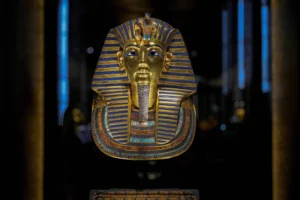
Unlike many royal Egyptian tombs that had been looted over the centuries, Tutankhamun’s burial chamber contained thousands of artifacts, including the iconic golden funerary mask that became a symbol of Ancient Egypt itself.
Yet from the beginning, something seemed unusual.
Compared with the grand tombs of other pharaohs from Egypt’s 18th Dynasty, Tutankhamun’s tomb appeared surprisingly small. It consisted of only a handful of chambers and lacked the scale expected for a king. Carter himself reportedly noted architectural features that did not quite fit the standard design of a royal burial.
For decades, those observations remained little more than curiosities.
Then technology entered the picture.
The Theory That Refused to Die
The modern search for hidden chambers began in 2015 when British Egyptologist Nicholas Reeves proposed a controversial idea.
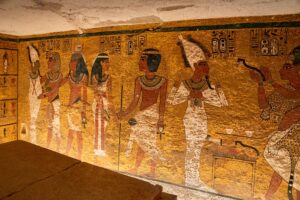
After studying high-resolution scans of the tomb’s painted walls, Reeves suggested that faint lines beneath the plaster might indicate the presence of sealed doorways. According to his theory, the tomb visible today could actually represent only the outer section of a much larger royal burial complex.
Reeves argued that Tutankhamun may have been buried within an existing tomb that had originally been constructed for another royal figure.
His leading candidate was Queen Nefertiti.
One of the most recognizable women of the ancient world, Nefertiti was the wife of Pharaoh Akhenaten and is famous for the stunning painted bust discovered in 1912. Despite her fame, her final resting place has never been found.
If Reeves was correct, the hidden chambers behind Tutankhamun’s tomb might finally solve one of Egyptology’s greatest mysteries.
The First Investigations
The theory immediately captured global attention.
Egyptian authorities authorized multiple investigations using ground-penetrating radar (GPR), a technology capable of detecting hidden structures beneath surfaces without excavation.
Early radar results appeared promising. Some researchers claimed they had identified anomalies that could indicate chambers or corridors behind the walls. Headlines around the world speculated that Nefertiti’s tomb might soon be discovered.
However, the excitement did not last.
Additional radar surveys produced contradictory results. In 2018, a comprehensive study concluded there was no convincing evidence of hidden rooms adjacent to the burial chamber. The findings led many archaeologists to believe the theory had effectively been disproven.
For several years, the search largely faded from public attention.
But the mystery was not finished.
Why the Debate Has Returned
In September 2026, researchers published new findings based on several years of geophysical investigations around the tomb.
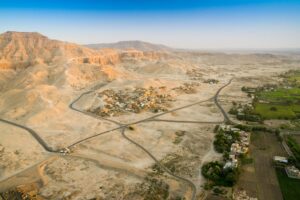
The team combined multiple scientific techniques, including ground-penetrating radar, microgravity measurements, thermal analysis, and studies of the surrounding rock structure. Rather than focusing solely on the walls of the burial chamber, the researchers examined the broader area around the tomb.
Their conclusion was cautious but intriguing.
According to the study, the data suggest the possible existence of corridors and chambers extending beyond the currently known structure of KV62. Researchers argue that these features may predate Tutankhamun’s burial and could belong to a larger royal monument.
The findings do not prove the existence of hidden rooms.
But they do provide enough evidence to justify further investigation, according to the study’s authors.
Could Nefertiti Really Be There?
That remains the biggest question.
Nefertiti lived during one of the most dramatic periods in Egyptian history. Alongside Akhenaten, she was associated with major religious reforms that temporarily transformed ancient Egyptian society.
Historians still debate what happened after Akhenaten’s reign ended. Some evidence suggests Nefertiti may even have ruled as a pharaoh in her own right before disappearing from historical records. Her burial place has never been conclusively identified.
Supporters of the hidden chamber theory argue that several clues point toward a connection.
Tutankhamun’s tomb is unusually small for a king. Certain wall decorations appear to have been altered. The layout resembles a structure that may originally have been intended for another royal occupant.
If additional chambers exist, they could potentially belong to a member of the Amarna royal family, the dynasty associated with Akhenaten and Nefertiti.
Still, many Egyptologists urge caution.
Even if hidden spaces are eventually discovered, there is no guarantee they contain Nefertiti. They could simply be storage rooms, unfinished sections of the tomb, or architectural features unrelated to any royal burial.
The Skeptics Have a Point
One reason this story continues to divide archaeologists is that previous investigations reached very different conclusions.
Some radar studies suggested anomalies behind the walls.
Others found nothing.
Several experts have argued that earlier signals may have been caused by natural variations in the rock rather than hidden chambers. The 2018 survey remains one of the strongest pieces of evidence against the existence of secret rooms directly adjacent to the burial chamber.
That does not necessarily invalidate the new research.
The latest studies examine a wider area around the tomb and use multiple scientific methods rather than relying solely on radar scans. However, independent verification will likely be needed before archaeologists can reach a consensus.
Science often advances through exactly this kind of disagreement.
What Happens Next?
The next phase may involve something far more direct.
Researchers have reportedly requested permission from Egypt’s Supreme Council of Antiquities to conduct carefully controlled drilling and deploy miniature camera-equipped devices into the suspected areas. The goal would be to determine whether the anomalies detected by surveys correspond to actual chambers.
If approved, the investigation could begin in the coming months.
The process would be designed to minimize any risk to the tomb while allowing researchers to see what lies beyond the known structure.
Only then will archaeologists have the evidence needed to answer the question that has captivated historians and the public alike.
Why This Discovery Would Matter
The discovery of hidden chambers beyond Tutankhamun’s tomb would be significant even if Nefertiti is not found.
New rooms could contain artifacts, inscriptions, burial equipment, or historical records from one of the most mysterious periods in ancient Egyptian history. Such evidence could help scholars better understand the political and religious upheaval that followed Akhenaten’s reign.
If the chambers did contain Nefertiti’s burial, the implications would be extraordinary.
It would rank among the most important archaeological discoveries since Howard Carter first entered Tutankhamun’s tomb in 1922. It could also provide new insights into one of history’s most famous queens, whose life continues to fascinate people more than 3,000 years after her death.
A Century-Old Mystery Lives On
Tutankhamun’s tomb has already given the world some of archaeology’s greatest treasures.
Yet more than 100 years after its discovery, it may still be holding secrets.
For now, the existence of hidden chambers remains unproven. The evidence is intriguing, but not definitive. Archaeologists on both sides of the debate agree on one thing: only further investigation will reveal the truth.
Whether the mystery leads to Nefertiti, another royal burial, or nothing at all, the renewed search highlights why ancient Egypt continues to capture the world’s imagination.
Sometimes the most exciting discoveries are not the answers we find, but the questions that refuse to disappear.