What Happens When Two Neutron Stars Collide? The Kilonova Mystery
What happens when two neutron stars collide without forming a black hole? Discover kilonova explosions, stellar remnants and how gold and platinum are created.
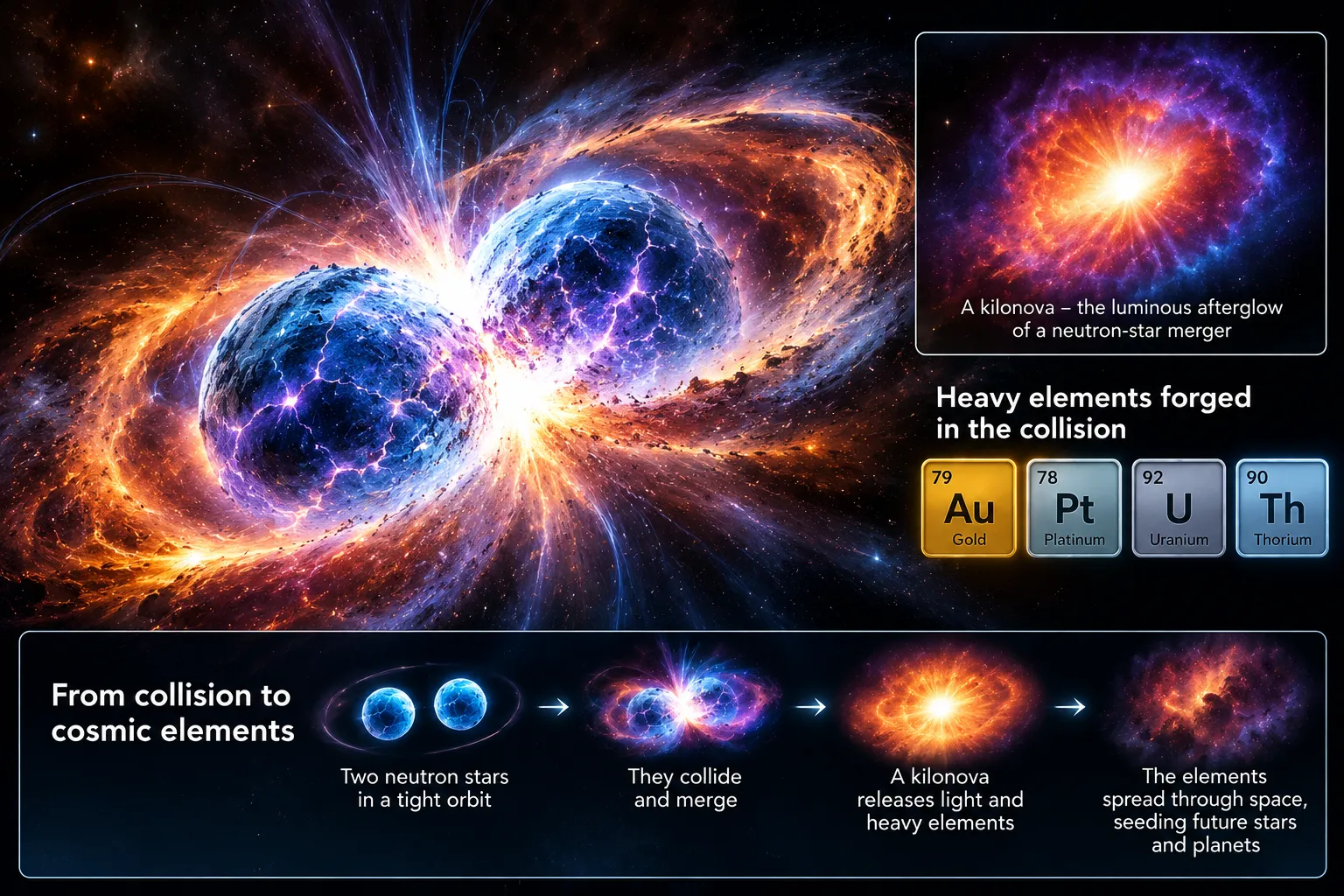
When neutron stars merge, they do not simply combine into a larger object. A considerable amount of matter can be thrown into surrounding space.
Some material escapes during the initial collision through tidal forces and shock waves. Additional matter can be expelled later through winds from the hot remnant and its surrounding accretion disk.
This ejected material is incredibly rich in neutrons.
As it expands and cools, nuclear reactions begin producing new elements through a process known as rapid neutron capture, or the r-process.
The freshly created radioactive elements subsequently decay, releasing energy that heats the expanding cloud of material.
The result is a brilliant astronomical transient called a kilonova.
A kilonova is different from an ordinary supernova. Although both involve powerful stellar events, a kilonova is specifically associated with the radioactive aftermath of neutron-rich material ejected during a compact-object merger.
Its brightness, colour and evolution provide astronomers with valuable information about what happened during the collision.
Some kilonovae initially appear relatively blue, while others become redder as the expanding material develops different chemical compositions.
Elements containing lanthanides have complicated electron structures that make the ejected material more opaque to light. This affects how quickly radiation escapes and changes the appearance of the explosion.
The process is remarkable because the light astronomers observe is partly powered by the radioactive decay of elements that did not exist before the collision.
Where do gold, platinum and other heavy elements come from?
One of the most fascinating consequences of neutron-star mergers is their ability to manufacture elements heavier than iron.
Ordinary stellar nuclear fusion can produce many elements, but it becomes increasingly difficult for stars to create heavier nuclei through the same energy-producing reactions.
Neutron-star mergers provide a different environment.
The expelled material contains enormous numbers of free neutrons. Atomic nuclei can capture these neutrons rapidly, sometimes faster than unstable nuclei have time to undergo radioactive decay.
This creates extremely neutron-rich nuclei that subsequently transform through radioactive decay into more stable elements.
The process can produce a wide range of heavy elements, including gold, platinum and other precious metals, as well as some of the heaviest naturally occurring elements.
It is worth remembering that neutron-star mergers are not necessarily the only places where these elements form. Certain rare stellar explosions and other astrophysical environments may also contribute to the cosmic supply of heavy elements.
However, the evidence connecting neutron-star mergers with heavy-element production has become considerably stronger since astronomers began observing these events directly.
A landmark study published in Nature in October 2017 examined the electromagnetic counterpart of GW170817. Researchers identified evidence for two distinct components of expelled material, associated with lighter and heavier r-process elements.
The study provided some of the strongest early observational evidence that neutron-star mergers contribute substantially to the production of heavy elements throughout the universe.
There is something extraordinary about this connection.
Some of the gold and platinum found on Earth may ultimately have originated in ancient collisions between dead stars, long before our Solar System existed.
GW170817: The collision that changed astronomy
On August 17, 2017, scientists detected an extraordinary event that transformed the study of neutron-star mergers.
The Laser Interferometer Gravitational-Wave Observatory (LIGO) and Virgo detected gravitational waves from two merging neutron stars in a galaxy approximately 130 million light-years away.
The event was designated GW170817.
For the first time, astronomers could study a neutron-star merger using both gravitational waves and electromagnetic radiation.
Within seconds of the gravitational-wave detection, the Fermi Gamma-ray Space Telescope detected a short gamma-ray burst associated with the event.
Astronomers around the world then searched for the visible afterglow and identified a new source of light in the galaxy NGC 4993.
The transient was named AT2017gfo.
Over the following days and weeks, researchers observed how its brightness and colour changed. The observations revealed evidence of freshly synthesised heavy elements in the expanding ejecta.
GW170817 was particularly important because it connected several previously separate areas of astronomy:
-
Gravitational-wave physics.
-
Neutron-star structure.
-
Gamma-ray bursts.
-
Heavy-element nucleosynthesis.
-
Kilonova radiation.
-
The evolution of compact stellar remnants.
However, one question remained unresolved: what happened to the object left behind after the two neutron stars merged?
The available evidence strongly favours the formation of a short-lived, extremely massive neutron-star remnant that subsequently collapsed into a black hole. A prompt collapse appears unlikely, although the precise remnant history is not directly established.
The LIGO Scientific Collaboration's GW170817 research summary provides an account of this historic observation.
What if the merged neutron star never collapses?
This is perhaps the most interesting possibility.
If the combined mass is sufficiently low, the merger could produce a neutron star that remains stable rather than collapsing into a black hole.
Such an object could be extraordinarily energetic.
It would rotate rapidly, possess an intense magnetic field and potentially release enormous amounts of energy through electromagnetic radiation and particle outflows.
Scientists sometimes describe a highly magnetised, rapidly rotating neutron star as a magnetar.
A newly formed magnetar could influence the surrounding material for much longer than a remnant that collapses almost immediately. Its energy output could alter the brightness, duration and evolution of the kilonova.
Researchers are investigating whether some unusually luminous kilonovae might indicate the presence of long-lived neutron-star remnants.
However, interpreting these observations is difficult. Different combinations of ejecta mass, magnetic fields, viewing angles and energy injection can produce overlapping observational signatures.
A 2022 study published in the Monthly Notices of the Royal Astronomical Society examined the diversity of magnetar-powered kilonovae and explored how the lifetime of a merger remnant could influence its electromagnetic appearance.
Read the research: On the Diversity of Magnetar-Driven Kilonovae.
If future gravitational-wave observations reveal a merger followed by evidence of a long-lived neutron star, scientists could gain an entirely new way to study the behaviour of matter under extreme conditions.
Could these collisions explain the origin of heavy elements across the universe?
Neutron-star mergers are now considered important contributors to the cosmic inventory of heavy elements.
However, there is still considerable work to do before scientists can establish exactly how much gold, platinum, uranium and other heavy elements originate from these events.
One challenge is that neutron-star mergers are relatively rare compared with ordinary stellar explosions.
Their contribution depends on how frequently binary neutron stars form, how long they take to merge and how much neutron-rich material they eject.
Astronomers also need to understand how these elements are distributed throughout galaxies.
The discovery of GW170817 demonstrated that neutron-star mergers can produce heavy elements. It did not establish that every heavy element in the universe was created this way.
Future gravitational-wave detectors, including more sensitive observatories, could help scientists identify many additional mergers and compare their electromagnetic signatures.
These observations may eventually reveal whether neutron-star collisions account for most of the universe's heaviest elements or whether other cosmic events play a larger role than currently understood.
The collision that does not necessarily create a black hole
Two neutron stars colliding is one of the most violent events in the universe, but the final outcome is not always a black hole.
Depending on the mass and physical properties of the merging stars, their remains may form a temporary hypermassive neutron star, a longer-lived supramassive object or even a stable neutron star.
Meanwhile, matter expelled into space can undergo rapid neutron capture, producing elements that eventually become part of new stars, planets and possibly life itself.
The most remarkable part is that astronomers can now study these events through gravitational waves and light, rather than relying entirely on theoretical calculations.
GW170817 provided the first extraordinary demonstration of this approach. Future discoveries may reveal even more about the mysterious objects left behind after neutron stars collide.
For now, one conclusion is clear: the death of two stars can become the beginning of something entirely new. Their collision can create a different stellar object, illuminate distant galaxies and manufacture some of the chemical elements that make our universe what it is.
Why SpaceX's Starship May Need 22 Refuelling Missions Before It Can Carry Humans to the Moon
Read story →
NASA's 4 Volunteers Complete 378-Day Simulated Mars Mission
Read story →
Scientists Detect Ghost Particles With 10 Billion Times the Energy of Solar Neutrinos
Read story →