Yellowstone Supervolcano Warning Signs Scientists Expect First
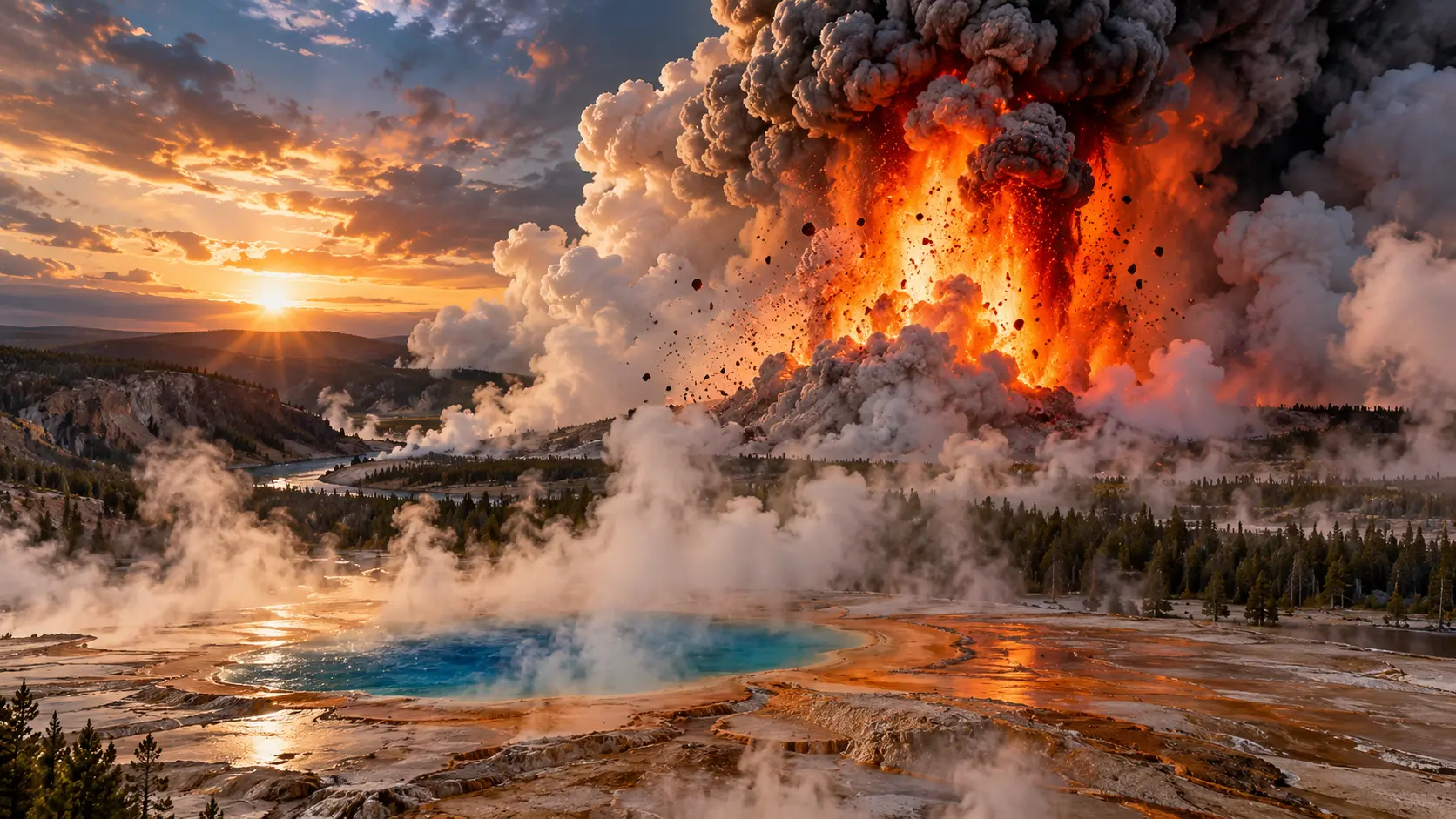
Every few months, a headline about Yellowstone goes viral. An earthquake swarm, a strange steam vent, a road that cracked. Within hours, social media is predicting the end of civilization.
Reality is much quieter, and in many ways more interesting. Yellowstone is one of the most closely watched volcanic systems on Earth. If it ever did start moving toward a major eruption, it wouldn't happen without notice. The question volcanologists ask isn't "will we see it coming?" but "what exactly will we see, and in what order?"
Here is what the science says.
First, a Reality Check on the Odds
Yellowstone has produced three enormous caldera-forming eruptions: about 2.1 million, 1.3 million, and 631,000 years ago. The "overdue" idea comes from lining those up and averaging the gaps. Volcanoes don't run on schedules, and the U.S. Geological Survey says plainly that the intervals are too irregular to treat as a clock.
The USGS Yellowstone Volcano Observatory (YVO) puts the annual chance of a caldera-forming eruption at roughly 1 in 730,000. For comparison, your yearly odds of being hit by a significant asteroid are in a similar ballpark of "not something to plan your life around."
There's also a point that rarely makes the headlines: since that last giant eruption, Yellowstone's more common activity has been far smaller. The most recent lava flow, on the Pitchstone Plateau, is about 70,000 years old. Hydrothermal explosions, where superheated water flashes to steam and blasts out rock, are the far more probable hazard in any given year.
So when we talk about Yellowstone "waking up," it helps to separate scenarios:
- A hydrothermal explosion: local, sudden, and relatively likely over human timescales.
- A lava flow or smaller eruption: unlikely, but geologically precedented.
- A caldera-forming supereruption: extremely unlikely, and preceded by unmistakable escalation.
The warning signs scientists describe apply, with different intensities, to all three.
What's Actually Under Yellowstone
You can't read warning signs without knowing what they're warnings about.
For years, the popular picture was a giant balloon of liquid magma waiting to pop. The real picture, built from seismic imaging, is a vertically extensive "mush" system: crystal-rich rock with pockets of melt, stretching from a few kilometers beneath the surface down toward the mantle. The USGS estimates the upper reservoir holds somewhere around 5 to 15 percent melt, far below the roughly 50 percent or more that's generally thought necessary for a large eruption.
That matters because eruption requires a big shift: a lot more melt, a lot more pressure, and a lot more gas. Those changes leave fingerprints, and each of them shows up in a different instrument.
Warning Sign #1: Earthquakes That Change Character
Yellowstone is already one of the most seismically active places in the United States, with roughly 1,500 to 2,500 earthquakes detected every year. Most are tiny, many are part of swarms, and nearly all are caused by faulting and hydrothermal processes rather than rising magma.
In 2017, a swarm near Maple Creek produced thousands of small quakes over a few months. It generated the usual wave of alarm. It also ended without incident, which is typical. A swarm alone isn't a verdict.
What scientists would look for is a change in pattern:
- Depth migration. Earthquakes progressively moving upward over days or weeks would suggest fluid or magma pushing toward the surface.
- Volcanic-type signals. Standard earthquakes come from rock breaking. Long-period events and harmonic tremor, a sustained, rhythmic shaking, come from fluid moving through cracks. Tremor is a classic sign that something liquid or gaseous is in motion.
- A sharp rise in rate and size across the whole system, not just in one familiar corner of the park.
The key idea is context. Seismologists at the observatory know Yellowstone's baseline extremely well, so anomalies stand out against it. A swarm that behaves like past swarms is noise. One that behaves like nothing in the record gets attention.
Warning Sign #2: The Ground Starts to Move
Yellowstone's floor breathes. Over decades, the caldera has risen and fallen by tens of centimeters. Between the 1920s and mid-1980s, parts of the caldera lifted by about a meter. Since then it has gone through cycles of uplift and subsidence. From 2004 to 2009, some areas rose several centimeters a year before reversing.
GPS stations and satellite radar (InSAR) track this motion with millimeter precision. Normal deformation is slow and reversible. The warning version looks different:
- Rapid, accelerating uplift measured in many centimeters over weeks rather than years.
- Localized bulging concentrated over a specific area, suggesting a pocket of fluid or magma moving into a shallow spot.
- Tilt changes on tiltmeters near thermal basins that don't recover.
Mount St. Helens offers a sobering example of what a magma-driven bulge looks like. Before its 1980 eruption, the north flank swelled outward by up to about 1.5 meters a day. Yellowstone's system is different in nearly every way, but the principle holds: a lot of material squeezing in has to push the surface somewhere.
Warning Sign #3: The Gas Chemistry Shifts
Yellowstone releases enormous quantities of carbon dioxide all the time, on the order of tens of thousands of tons every day, through thermal areas. That's business as usual.
What would worry scientists is a change in the recipe:
- Rising ratios of magmatic gases such as sulfur dioxide and higher-temperature signatures in the gas mix. Deep magmatic gases behave differently from those that have been scrubbed by groundwater.
- Sudden increases in total gas output across many areas at once.
- Helium isotope shifts that point to more mantle-derived gas coming through.
Gas is one of the earliest messengers because it can escape long before magma moves. Satellite and ground-based sampling, combined with continuous monitoring in key basins, helps catch these changes.
Warning Sign #4: The Thermal Features Misbehave
Geysers, hot springs, and mud pots are the visible face of the system, and they change constantly for ordinary reasons: earthquakes, weather, drought, and plumbing blockages.
Steamboat Geyser at Norris is a good example of "weird but fine." After decades of rare eruptions, it began erupting frequently in 2018, setting a record with dozens of eruptions that year. Scientists have not tied that to any increase in magma activity. It's a plumbing story, not a magma story.
Still, a few thermal developments would get immediate scrutiny:
- New thermal areas appearing suddenly, especially with ground that's too hot to touch or dying vegetation.
- Large, rapid jumps in water temperature or acidity across multiple basins.
- Widespread changes at once, rather than isolated shifts in a single feature.
On July 23, 2024, a hydrothermal explosion at Biscuit Basin sent rocks and debris flying and damaged a boardwalk. Nobody was hurt, and the YVO concluded it was driven by shallow hydrothermal processes, not magma. It's the clearest recent reminder that "dangerous" and "supervolcano" aren't the same thing. If you plan to visit, the National Park Service's Yellowstone safety guidance is worth reading, and the single most important rule is to stay on the boardwalks.
It Won't Be One Signal. It Will Be a Pattern
This is the part most coverage misses. No single instrument gives a clean "eruption incoming" alert. Volcanologists build confidence by seeing multiple independent measurements move together.
Picture the realistic escalation:
- Earthquake rates climb and keep climbing, with events shifting shallower.
- GPS and satellite data show uplift or tilt that's faster and more focused than anything in the historical record.
- Gas sampling picks up a stronger magmatic signature.
- Thermal features change in coordinated, unusual ways.
- Tremor appears, a sign that fluids are actively moving in the plumbing.
Any one of these can happen without a volcanic crisis. All of them together, building over weeks or months, would be a different story. For a caldera-forming eruption, researchers expect the unrest to be dramatic enough that nobody would debate it.
That expectation isn't just optimism. Studies of other large silicic systems, along with the physics of moving large volumes of magma, point to substantial precursory activity. Caldera systems that have restarted elsewhere, such as Campi Flegrei in Italy and Long Valley in California, have shown years of unrest, sometimes without erupting at all, which is its own lesson: unrest doesn't guarantee an eruption.
How the Alert System Works
The USGS uses a four-level scale for volcanic activity, and Yellowstone currently sits at the lowest level, "Normal." The steps are Normal, Advisory, Watch, and Warning, with a parallel color code (Green, Yellow, Orange, Red) for aviation. You can read how each level is defined on the USGS Volcano Hazards Program pages.
A move to Advisory would mean unrest above background, which can happen without leading to an eruption. Watch means heightened unrest with an increased potential for eruption. Warning means a hazardous eruption is underway or imminent.
The YVO publishes monthly updates on seismicity, ground deformation, and thermal activity, and they are some of the best primary sources you can read. They are written for the public, they're calm, and they're usually less exciting than the headlines they're fixing.
The Monitoring Network That Makes This Possible
Part of the reason scientists are confident is the sheer density of instruments. The Yellowstone Volcano Observatory is a partnership among the USGS, Yellowstone National Park, the University of Utah, the University of Wyoming, UNAVCO (now part of EarthScope), and several other institutions.
The network includes:
- Dozens of seismometers feeding the University of Utah's Seismograph Stations in near real time.
- A grid of continuous GPS receivers measuring ground motion.
- Satellite radar passes that map deformation across the whole caldera.
- Stream gauges, temperature sensors, and gas monitors in thermal basins.
- Webcams and field crews recording changes to geysers and springs.
Redundancy is the point. A sensor can fail or produce a bad reading. A coordinated change across seismic, geodetic, gas, and thermal data is much harder to explain away.
What a Real Wake-Up Would Look Like
Suppose the pattern does start to build. What happens?
Probably something far less cinematic than the movies. The YVO would likely issue more frequent statements and raise the alert level. The National Park Service might close affected areas. Emergency managers in Wyoming, Montana, and Idaho would activate planning that already exists for volcanic hazards. Scientists would scramble to deploy additional instruments and interpret what the data means.
There would be time. In a developing crisis, the realistic window for the initial escalation is weeks to months, not minutes. And most of the possible outcomes, including a pause or a return to quiet, don't end in a supereruption. Many volcanoes around the world have gone through unrest and settled down. The scientific challenge is that nobody can say in advance which path a particular episode will take, which is why monitoring and honest communication matter so much.
How to Read Yellowstone Headlines Without Panic
A few habits make you a smarter reader of Yellowstone news:
Check the source. If a story cites a Yellowstone expert, make sure the person is actually affiliated with an observatory or research institution. Anonymous "insiders" and recycled doomsday claims are a red flag.
Look for the baseline. "Hundreds of earthquakes" sounds scary until you learn that's a normal week. Good reporting tells you how the number compares to normal.
Notice what's not being said. If a headline implies an eruption without mentioning the alert level, it's probably leaving out the main fact: that the YVO has Yellowstone at Normal.
Go to the primary source. The YVO's monthly updates and the USGS FAQ page, where scientists answer the biggest questions, are free, readable, and refreshingly unhyped.
The day Yellowstone wakes up, if it ever does in a way that matters, won't arrive as a surprise. It would announce itself through a convergence of signals: earthquakes migrating and changing character, ground rising faster than ever recorded, gas chemistry turning more magmatic, and thermal systems shifting across the board. Scientists with some of the best monitoring technology on the planet would be watching all of it in real time.
For now, Yellowstone is doing what it has done for a very long time: shaking a little, steaming a lot, and fascinating anyone who visits. The most useful response to the supervolcano story isn't fear. It's curiosity, and a willingness to read what the experts publish rather than what the algorithm serves up.
Sources and further reading
- USGS Yellowstone Volcano Observatory
- USGS Volcano Hazards Program
- National Park Service: Yellowstone safety
- University of Utah Seismograph Stations
More from What If Science
How an 18-Million-Year-Old Ape Fossil in Egypt Could Change What We Know About Human Evolution
Read story →
Could Entire Ecosystems Still Exist on Earth That Scientists Have Never Discovered?
Read story →
Trees Have Their Own Biological Muscles. Scientists Discover How They Straighten Themselves
Read story →