
A Winter Afternoon That Refused to Be Forgotten
Most schoolyard memories fade with time.
A football game, a classroom prank, a forgotten lesson—these moments usually disappear into the background of childhood. Yet for a group of schoolchildren in a small Welsh village, one ordinary Friday in February 1977 became the beginning of a mystery that would still be discussed nearly half a century later.
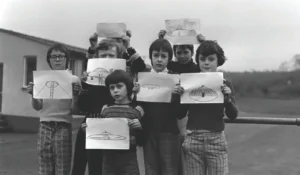
The event took place at Broad Haven Primary School in Pembrokeshire, a quiet coastal community in western Wales. During a lunch break on February 4, several pupils claimed they had seen an unusual metallic object in a nearby field. Some also reported a strange figure standing beside it. What transformed the story from a local curiosity into one of Britain’s most famous UFO cases was what happened next.
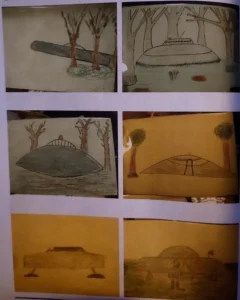
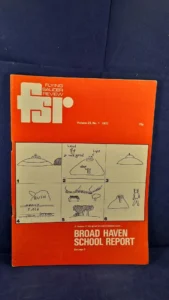
According to widely repeated accounts, the school’s headmaster separated the children and asked them to draw what they had seen. The resulting sketches appeared remarkably similar. To many observers, that similarity suggested the children were describing the same object rather than inventing separate stories. The incident quickly became part of a larger wave of UFO reports across Wales known as the “Welsh Triangle” or “Dyfed Triangle.”
But decades later, researchers examining original records discovered an important detail that complicated the legend. The drawings may not have been created under the conditions many people assumed. That revelation transformed Broad Haven from a straightforward UFO story into something more interesting: a case study in eyewitness testimony, memory, and how mysteries evolve over time.
The Setting: Broad Haven, Wales
In 1977, Broad Haven was a small seaside village far removed from major cities and media attention.
Life moved at a slower pace. The surrounding countryside consisted of fields, hedgerows, farms, and rugged coastline. It was not the sort of place people expected to become the center of an international UFO mystery.
Yet 1977 proved unusual for the region.
Throughout that year, numerous reports of strange lights, unexplained aerial objects, and alleged encounters emerged across Pembrokeshire. Newspapers eventually began referring to the area as the “Welsh Triangle,” drawing comparisons to other famous mystery hotspots around the world.
The Broad Haven school sighting became the event that launched the phenomenon into public consciousness.

What the Children Reported Seeing
Accounts vary slightly depending on the source, but the core story has remained surprisingly consistent.
On February 4, 1977, a group of pupils at Broad Haven Primary School noticed something unusual beyond the playground.
Witnesses described:
- A metallic silver object
- A cigar-shaped or elongated craft
- A dome-like structure on top
- Colored lights
- A figure wearing what appeared to be a silver suit
Some children later described the object as looking like “two saucers joined together.” Others recalled a cigar-shaped craft partially hidden by trees or bushes. Several students claimed the object remained visible for a number of minutes before disappearing.
One pupil, Jeremy Passmore, reportedly described a silvery-green object with a dome and colored light, along with a silver-suited figure nearby. His testimony became one of the most frequently cited accounts associated with the case.
At the time, many adults assumed the children were playing a prank or exaggerating a misunderstanding.
The story might have ended there.
Instead, it gained momentum.
The Headmaster’s Response
The school’s headmaster, Ralph Llewellyn, played a crucial role in preserving the case.
Rather than dismissing the reports outright, he decided to investigate.
Accounts from the period indicate that he interviewed the children individually and asked them to write descriptions and produce drawings of what they had seen. The resulting sketches appeared broadly similar, depicting a silver object with a dome-like structure.
Llewellyn reportedly concluded that the children were sincere in their belief that they had witnessed something unusual. Records later referenced in Ministry of Defence files indicate that he was reluctant to believe the pupils were capable of organizing a sophisticated hoax.
This assessment gave the story credibility that many UFO reports lack.
The witnesses were not anonymous adults.
They were schoolchildren known to their teachers and community.
The Mystery of the Similar Drawings
For decades, one claim dominated discussions of Broad Haven.
The children had allegedly produced nearly identical drawings without communicating with one another.
This detail appeared in countless books, documentaries, magazine articles, and television programs.
Supporters argued that the similarity of the sketches suggested the children had genuinely observed the same object.
Skeptics questioned whether the drawings were truly independent.
The issue became central to the entire case.
If the children had created the drawings immediately after the sighting while completely separated, the similarities would carry greater evidential value.
If they had time to discuss the event first, the significance of the matching sketches would be reduced.
For many years, nobody paid much attention to this distinction.
Then researchers began examining original records.
The Discovery That Changed the Story
One of the most important developments in the Broad Haven case came decades after the sighting itself.
Historian and researcher David Clarke examined school records and Ministry of Defence documents connected to the event.
His findings suggested that a crucial part of the story had been misunderstood.
The sighting occurred on a Friday.
The formal drawing exercise appears to have taken place on the following Monday rather than immediately after the event. That means the children had an entire weekend during which they could have discussed what they saw with classmates, friends, siblings, and parents.
This discovery did not prove the children were mistaken.
Nor did it prove the sighting was a hoax.
What it did demonstrate was that the drawings were not the perfectly isolated psychological test many later accounts implied.
The distinction matters because memory is highly social.
People often influence one another’s recollections without realizing it.
Why Human Memory Is More Complicated Than It Seems
Modern psychology has revealed that eyewitness memory is not like a video recording.
Memories are reconstructed each time they are recalled.
Children are especially vulnerable to:
- Suggestion
- Group influence
- Shared storytelling
- Repeated discussion
- External reinforcement
When a dramatic event occurs, witnesses frequently compare observations and fill gaps in their recollections using information from others.
This process does not require dishonesty.
People can genuinely believe a memory is entirely their own even when it has been shaped by conversations afterward.
That reality makes the Broad Haven case particularly fascinating.
The similar drawings may indicate the children witnessed the same unusual event.
They may also reflect the natural process through which groups develop a shared narrative.
Determining the balance between those possibilities remains difficult.
The Wider Welsh UFO Wave
The Broad Haven sighting did not occur in isolation.
Throughout 1977, numerous UFO reports emerged across western Wales.
Witnesses included:
- Farmers
- Teachers
- Families
- Drivers
- Schoolchildren
Researchers eventually grouped many of these incidents together under the label “Welsh Triangle” or “Dyfed Triangle.”
Some reports described:
- Strange lights
- Metallic objects
- Unusual aircraft
- Humanoid figures
- Bright aerial phenomena
The concentration of reports added to public fascination.
Supporters argued that Broad Haven formed part of a larger unexplained pattern.
Skeptics countered that increased publicity often leads to more reports, regardless of whether unusual phenomena are actually occurring.
Both possibilities remain relevant when evaluating historical UFO waves.
Did Any Adults Witness the Object?
One question frequently raised involves adult corroboration.
If a UFO truly appeared near a school in daylight, why were there not more adult witnesses?
The answer is complicated.
Some reports indicate that adults associated with the school later reported unusual sightings of their own. Accounts connected to teachers and staff have been cited in discussions of the case, though the quality and documentation of those reports vary.
Importantly, no clear photographic evidence emerged.
There were:
- No verified photographs
- No radar records
- No physical traces
- No recovered materials
The primary evidence remains eyewitness testimony and the drawings themselves.
This limitation is one reason the case remains controversial.
The Ministry of Defence Investigation
As public interest grew, reports eventually reached British authorities.
Documents later released through government archives revealed that the Ministry of Defence took enough interest in the Welsh sightings to maintain files and conduct inquiries. At one stage, RAF Police reportedly carried out a discreet investigation into reports from the area.
However, no official conclusion established that extraterrestrial craft were involved.
Nor did authorities produce evidence confirming an ordinary explanation.
Instead, the case remained unresolved.
That ambiguity helped preserve its reputation.
Cases with definitive explanations often fade from public memory.
Unexplained cases tend to endure.
Could It Have Been a Hoax?
Any serious examination of Broad Haven must consider the possibility of misidentification or deliberate fabrication.
Several factors support skepticism.
First, children can influence one another’s memories.
Second, the drawings were apparently created after a weekend delay rather than immediately after the sighting.
Third, no independent physical evidence was recovered.
Yet the hoax explanation also faces challenges.
The children maintained their accounts for years.
No participant ever produced a definitive confession explaining the incident as a coordinated prank.
The headmaster himself reportedly doubted that the students had orchestrated a sophisticated deception.
As a result, the case occupies a middle ground.
There is insufficient evidence to verify extraordinary claims.
There is also insufficient evidence to dismiss the event completely.
Why the Broad Haven Case Still Matters
Nearly fifty years later, Broad Haven remains one of the most discussed schoolyard UFO incidents in history.
Its significance extends beyond UFO research.
The case illustrates how:
- Witness testimony develops over time
- Memory can change through discussion
- Media coverage influences public perception
- Historical records reshape narratives
- Legends evolve from real events
In many ways, Broad Haven is less about extraterrestrials and more about human observation.
The mystery persists because the witnesses were ordinary children describing something they apparently believed they saw.
That sincerity is difficult to dismiss.
At the same time, sincerity does not guarantee accuracy.
The tension between those two truths lies at the heart of the case.
Former pupils describe what they remember seeing during the Broad Haven incident
The Enduring Puzzle of Broad Haven
On a cold February afternoon in 1977, a group of Welsh schoolchildren reported seeing something extraordinary beyond their playground.
Whether it was an unusual aircraft, a misunderstood natural phenomenon, a collective misinterpretation, or something still unidentified remains unknown.
The famous drawings that helped make the case legendary no longer carry the evidential weight many people once assumed. Historical research has shown that the sketches were produced after a weekend gap, allowing time for discussion and memory convergence.
Yet that revelation does not erase the mystery.
It simply changes the questions researchers must ask.
Instead of wondering why isolated children drew identical UFOs without collaborating, investigators now examine a more nuanced puzzle: why a group of young witnesses, living in a quiet corner of Wales, became convinced they had seen something extraordinary in the first place.
Nearly five decades later, no explanation has achieved universal acceptance.
And that uncertainty is precisely why the Broad Haven Primary School sighting continues to occupy a unique place in the history of unexplained phenomena.
