
Here is a puzzle that sounds like a mistake the first time you hear it. Astronomers say the universe is about 13.8 billion years old. They also say the observable universe stretches roughly 46 billion light-years in every direction. Light travels at one light-year per year, so light that has been traveling for 13.8 billion years should have covered 13.8 billion light-years, not 46.
Either something is wrong with the numbers, or something is wrong with how we think about distance. The answer is the second one. The figure is correct, and it doesn’t break physics. It comes from the way space itself behaves on the largest scales.
The universe is 13.8 billion years old, but the observable universe has a radius of about 46 billion light-years because space has been expanding while light travels. The 46 billion figure is the current distance to the sources of ancient light, not how far the light itself traveled.
The naive calculation, and why it fails
Suppose the universe were a static stage, with galaxies sitting at fixed positions and light crossing the gap between them. In that universe, the farthest thing you could see would be 13.8 billion light-years away, because light from anything farther simply wouldn’t have arrived yet. Your view would be a sphere with a radius equal to the age of the universe multiplied by the speed of light.
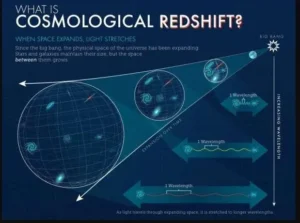
But our universe isn’t static. Since the Big Bang, space has been expanding, and everything in it has been carried along by that stretching.
Think of an ant walking along a rubber band. The ant moves at a steady pace, say one centimeter per second. Now imagine that while it walks, someone stretches the band. The ant ends up farther from its starting point than its walking alone would explain, because the ground under it grew. Light traveling through an expanding universe is the ant. Space is the rubber band.
The key point is that the light never travels faster than light. It always moves at the speed of light through the space it’s in. The extra distance comes from the space itself growing while the light is in transit.
What “46 billion light-years” actually means
The 46 billion light-year figure is not how far the light traveled. It’s how far away the source of that light is right now, measured with the expansion accounted for. Cosmologists call this the comoving distance. It’s a way of saying, “If we could freeze the expansion today and stretch a tape measure out to that object, how long would the tape be?”
That is a different question from “How long has the light been traveling?” or “How far away was the object when it emitted the light?” There are three distances hiding inside one sentence, and most of the confusion comes from mixing them up.
The first is the light-travel distance, which is the age-of-light distance you get by multiplying travel time by the speed of light. It can never exceed 13.8 billion light-years.
The second is the distance at emission, meaning how far away the object was when it sent the light. For very distant objects, this is far smaller than you’d expect, because the universe was smaller then.
The third is the distance today, which is how far away the object has since become. This is the big number, and it’s where the 46 billion figure comes from.
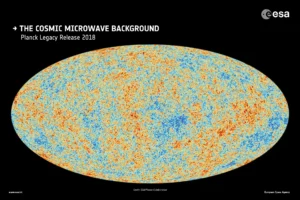
A concrete example helps. Take the oldest light we can detect, the cosmic microwave background. It was released about 380,000 years after the Big Bang, when the universe cooled enough for atoms to form and light could finally travel freely. That light has been traveling for nearly the entire age of the universe. The matter that emitted it was only about 42 million light-years away from our region at the time. Since then, the universe has expanded by a factor of roughly 1,100. That same matter is now about 46 billion light-years away.
So the light was released from a nearby patch of hot, glowing gas, and while it made its journey, the gap between that gas and us grew a thousandfold. Both numbers are true. They describe different moments.
Galaxies that recede faster than light
Now the puzzle gets stranger. The expansion of space isn’t the same everywhere. It follows a rule known as Hubble’s law: the farther away something is, the faster it recedes. At our present understanding, the expansion rate is around 70 kilometers per second for every megaparsec of distance (a megaparsec is about 3.26 million light-years). Double the distance and you double the recession speed.
Follow that rule out far enough, and you reach a distance where the recession speed equals the speed of light. That distance is about 14 billion light-years, and the sphere it encloses is called the Hubble sphere. Beyond it, galaxies are receding from us faster than light.
That sounds like a violation of Einstein’s relativity, which says nothing can travel faster than light. It isn’t, and the reason is important. Relativity’s speed limit applies to motion through space. Galaxies aren’t moving through space at those speeds. Space between us and them is expanding. Two objects can be separating faster than light purely because the space between them is growing, with neither object exceeding the light speed limit locally.
The next question is natural: if those galaxies are receding faster than light, how can their light ever reach us? The answer is one of the more elegant ideas in cosmology. Imagine light emitted from a galaxy beyond the Hubble sphere, heading toward us. At first, the expansion carries it away from us even as it aims our way. But the Hubble sphere itself isn’t fixed. For most of cosmic history it has been growing, so eventually it can overtake light that started out beyond it. The light that seemed to be losing the race ends up inside our Hubble sphere and then arrives.
That is why we can see galaxies whose current recession speed is far above the speed of light. We’re not seeing where they are now. We’re seeing where they were, when the light left them.
The farthest things we’ve actually seen
This isn’t only theory. We can point to real objects that show the effect.
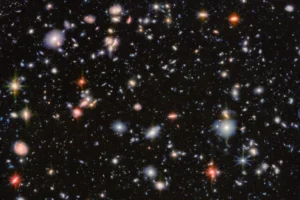
The James Webb Space Telescope has found galaxies from the universe’s first few hundred million years. The record has been pushed repeatedly, and the current holders have redshifts above 14. Redshift is the stretching of light as space expands, and a redshift of 14 means the wavelengths have been stretched by a factor of about 15.
Take a galaxy at that redshift. Its light left it when the universe was only about 290 million years old, and it has been traveling for roughly 13.5 billion years. But at the time the light was emitted, that galaxy was only about two billion light-years from our part of the universe, because everything was packed closer together then. Today, after all the stretching, its distance is roughly 34 billion light-years.
So one galaxy carries three different distances: 13.5 billion light-years by light travel time, about 2 billion light-years at the moment of emission, and about 34 billion light-years today. None of them is wrong. They answer three different questions.
Webb also shows why this matters for astronomy, not just for curiosity. The light from these distant galaxies arrives stretched out of the visible range and into the infrared, which is exactly why Webb was built as an infrared telescope. The expansion of the universe is not just a theoretical footnote. It shapes the design of our most powerful instruments.
Why the edge of what we can see keeps moving out
The 46 billion light-year radius is not a fixed boundary in space. It’s a boundary in time and information: the limit of what light has had time to bring us since the Big Bang. Cosmologists call it the particle horizon.
Think of a ship at sea. You can only see to the horizon, but the horizon isn’t a wall. It’s a limit of your vantage point. If you sail forward, the horizon moves with you and new territory appears. Likewise, as time passes, light from farther and farther regions has time to reach us, and the observable universe grows.
Two details make this more interesting.
First, the boundary grows faster than one light-year per year. That is because the comoving distance to the horizon increases as light from farther regions arrives, and each of those regions is also being carried farther away by expansion. The radius of the observable universe today is much larger than the age of the universe times the speed of light, and it continues to grow.
Second, every observer has their own observable universe. The sphere we see is centered on us. An observer in a galaxy 10 billion light-years away would have a sphere of the same size, centered on their location, overlapping ours but not identical. The observable universe isn’t the universe. It’s what’s visible from where we happen to be.
The universe that we’ll never see
There’s a twist that adds a note of melancholy to this story. The universe’s expansion isn’t just continuing. It’s accelerating.
In 1998, two teams of astronomers studying distant exploding stars found that the expansion was speeding up rather than slowing down, a discovery later honored with the Nobel Prize in Physics. The cause is called dark energy, a name that really just stands for our ignorance of what’s driving it. Whatever it is, it makes the universe expand ever faster.
The consequence is that there’s a second boundary, called the cosmic event horizon, which sits at roughly 16 billion light-years in comoving distance. Light emitted today by any galaxy beyond that boundary will never reach us, no matter how long we wait. The expansion will carry those galaxies away too fast for their light to ever catch up.
In the far future, galaxies currently within our view will slip beyond that horizon, one by one, and vanish from sight. Eventually, a civilization living in our region, if any exists, would see only the galaxies gravitationally bound to their own. Beyond that, the sky would be empty. Astronomers of that era would have no way to discover that the universe had ever expanded or had a Big Bang. The evidence would have been carried out of reach.
That thought is sometimes used to argue that we live in a special, perhaps fleeting, time in which the evidence for cosmic history is still available to us. It’s a reminder that what we can know about the universe is shaped by when we happen to exist.
It’s also worth noting that the nature of dark energy is an open question. A recent analysis of nearly 3,000 supernovae has raised the possibility that the mysterious force accelerating the universe may not be what we assumed. If dark energy changes over time, the future of the cosmic horizon could look different from the standard picture. It’s a live area of research, and the results are not settled. SciTechDaily
What lies beyond the 46 billion light-years?
The 46 billion light-year radius marks the edge of what we can observe, not the edge of the universe. This point trips up many readers, so it deserves emphasis.
Beyond the observable universe, there’s almost certainly more universe. We just can’t receive signals from it. Physicists don’t know how much more. Measurements of the geometry of space, especially from the cosmic microwave background, show that the universe is extremely close to flat on the scales we can measure. A flat universe is consistent with an infinite one, although a finite universe that is simply much larger than what we can see would look flat too.
Some of the most common misconceptions worth clearing up:
- The universe did not expand into empty space. The Big Bang was not an explosion at a point in a pre-existing void. Space itself expanded everywhere at once. There’s no center and no edge from which it spread.
- The observable universe is not the whole universe. It’s the region from which light has had time to reach us. The whole may be far larger, possibly infinite.
- We are not at the center of anything special. The observable universe is centered on us only because it’s defined by our vantage point. Every observer sees their own version.
Why this isn’t a paradox at all
The apparent paradox in the headline dissolves once we stop treating space as a fixed stage. The number 13.8 billion is the age of the universe, the time elapsed since the Big Bang. The number 46 billion is a distance measured today, after 13.8 billion years of expansion have stretched the space between us and the sources of the light we see. Different quantities, different questions, and no contradiction.
What’s remarkable is how well the whole picture holds together. Astronomers can measure redshifts, the brightness of exploding stars, the pattern in the cosmic microwave background, and the clustering of galaxies. All of these independent lines of evidence agree on the same expansion history. The numbers weren’t invented to patch up a paradox. They came out of measurement.
There is, however, one live tension worth mentioning. Different methods of measuring the current expansion rate, known as the Hubble constant, give slightly different answers. Measurements based on the early universe give a lower value, while measurements based on nearby stars and supernovae give a higher one. This disagreement, called the Hubble tension, may point to measurement problems or to new physics. Either way, it doesn’t overturn the basic picture. It changes the exact numbers a little, and the answer to the 46 billion question would shift only modestly.
The takeaway
The next time someone says the universe is 13.8 billion years old and yet we can see 46 billion light-years away, you can explain it in a few sentences. Light travels at a fixed speed, but space grows while the light is in transit. The 46 billion light-years is where the sources of that ancient light are now, not how far the light traveled. The light left when those sources were much closer, and the expansion of space did the rest.
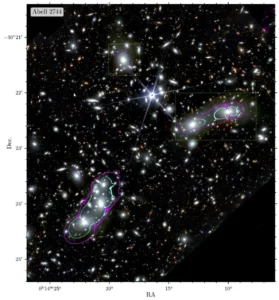
The deeper lesson is that the universe isn’t a box we live in. It’s a dynamic thing whose geometry changes with time, and our sense of distance, built from a lifetime on a small and static planet, doesn’t scale to the cosmos. When you look at a distant galaxy in a Webb image, you’re seeing a snapshot from the distant past, from a place that has long since moved far beyond where it appears, in a stretch of space that has grown enormously since the light set out.
That’s what makes the question so worth asking. The answer isn’t that the numbers are wrong. It’s that the universe is stranger, and more beautiful, than our everyday intuition prepared us for.
FAQs
1. How can we see 46 billion light-years if the universe is only 13.8 billion years old?
Space expands while light travels through it. The light we see left its source long ago, when the source was much closer, and the source has since been carried far away. The 46 billion light-years is where that source is today, not the distance the light traveled.
2. Is the observable universe the whole universe?
No. The observable universe is only the region whose light has had time to reach us since the Big Bang. Measurements suggest the whole universe is much larger than what we can see, and it may be infinite, though scientists can’t yet confirm that.
3. Can galaxies really move faster than light?
Galaxies can recede from us faster than light because the space between us is expanding, without any galaxy moving through space faster than light. Relativity’s speed limit applies to motion through space, not to the stretching of space itself. This is why we can still see some galaxies that are now receding faster than light.
4. What is beyond the edge of the observable universe?
Almost certainly more universe, but we can’t receive signals from it. Its light hasn’t had time to reach us. Whether it continues forever, or eventually curves back on itself, is still an open question.
5. Will we lose sight of distant galaxies in the future?
Yes, in the very distant future. Because the expansion of the universe is accelerating, light emitted today from beyond the cosmic event horizon (roughly 16 billion light-years in comoving distance) will never reach us. Over billions of years, more galaxies will slip out of view, though the nature of dark energy is still being studied.
