

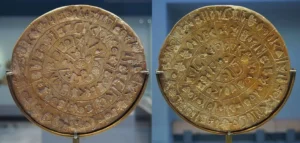
In the summer of 1908, an Italian archaeologist working on the island of Crete lifted a small, baked clay disc out of the dirt. It was about the size of a saucer. Both sides were covered in a spiral of tiny pictures: a running man, a feathered head, a fish, a shield, a beehive.
More than a century later, nobody has read it. Not conclusively, anyway.
The Phaistos Disc is one of archaeology’s most stubborn puzzles, and it keeps its grip on people for a good reason. It’s a complete, intact message from the Bronze Age, and it’s written in a script that appears nowhere else on Earth.
Where the disc was found
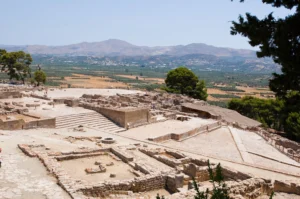
Luigi Pernier was digging at the Minoan palace of Phaistos, on the southern coast of Crete, when the disc turned up on 3 July 1908. It lay in a small basement room of the palace complex, buried alongside a tablet written in Linear A, the still-undeciphered script of the Minoans. The deposit was sealed under debris, which suggests a destruction layer, probably from a fire.
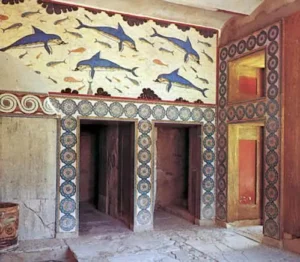
The Minoans were the island’s Bronze Age civilization, famous for their palaces, their frescoes of bull-leaping and dolphins, and their sea trade across the eastern Mediterranean. The disc is generally dated to roughly 1850 to 1600 BCE, though the exact date is debated. You can read a solid overview of the culture in the Encyclopaedia Britannica’s entry on Minoan civilization.
Today the disc sits in the Heraklion Archaeological Museum in Crete, behind glass, where visitors can walk around it but not touch it.
What it actually looks like
The disc is small. It measures roughly 16 centimeters across and about 2 centimeters thick, made of fired clay. A line of symbols spirals inward from the edge on each side, and the groups of signs are separated by short vertical lines, which most scholars read as word dividers.
The numbers are what make it tantalizing:
- 241 signs in total across both sides
- 45 distinct symbols
- About 61 groups of signs, which look like words
Forty-five different symbols is a meaningful clue. Alphabets usually have 20 to 30 characters. Full picture-writing systems like Egyptian hieroglyphs have hundreds. A count around 45 points toward a syllabary, where each sign stands for a syllable, much like Linear B or the Japanese kana. That’s the most common assumption, but it is an assumption.
The first “printed” document?
Here’s the part that surprises people. The signs weren’t carved or drawn. Each one was pressed into the wet clay with a separate stamp, a small punch with the symbol cut into it. The craftsperson laid down the spiral one stamp at a time.
That makes the Phaistos Disc a candidate for the earliest known example of movable-type printing, roughly 3,000 years before Gutenberg. It’s a tempting claim, but it needs care. The stamps were reused, but there’s no sign anyone was producing multiple copies of a text. It’s more accurate to say the disc shows an impressive technical idea that didn’t go anywhere.
It also raises an uncomfortable question. If you have a set of punches, you’ve invested in a system. Why use it for a single object? Either more discs existed and were lost, or this one mattered enough to justify the effort.
Which way do you read it?
Even the reading direction takes some reasoning. Most scholars think the text runs from the outside edge toward the center, and several details support that. The signs that depict figures face right, and in many ancient scripts the characters face toward the start of the line. Also, the stamping appears to get cramped near the center, as if the maker misjudged how much space remained and had to squeeze the last signs in.
That reasoning is plausible, and it’s the standard view. But notice that none of it is proof. It’s inference built on the shape of an object, which is exactly the situation researchers face with the entire disc.
Why it hasn’t been deciphered
Decipherment usually needs one of two things: a bilingual text, or a large body of writing in the same script. The most famous success, Michael Ventris’s decoding of Linear B in 1952, depended on thousands of tablets and a script that turned out to record an early form of Greek. The Wikipedia article on Linear B gives a good account of how that worked.
The Phaistos Disc has neither advantage. It’s a single document of just 241 signs, and we don’t know what language it records. Without a comparison text, there’s nothing to check a proposed reading against. Any scholar can assign sounds to the symbols and produce a plausible-sounding result, and there’s no way to prove them wrong or right.
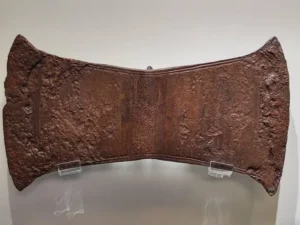
There’s a near-neighbor that raises hopes. The Arkalochori Axe, a ceremonial bronze double axe found in a Cretan cave, carries a short inscription of about 15 signs, a few of which resemble Phaistos symbols. It’s a hint that the script wasn’t a one-off, but it’s far too little to build a translation on.
The leading theories
Over the years, people have proposed that the disc is a hymn, a prayer, a calendar, a game board, a legal text, a list of names, even a kind of board game. A few of the more serious ideas:
A religious text. Because the disc was found in or near a cult area of the palace, many researchers lean toward a ritual or devotional purpose. The repeated groups of signs look a bit like refrains, which fits a hymn or chant.
A Minoan-language document. The language of the Minoans is unknown, so this is hard to test, but it’s the default assumption given where the disc was found.
An import. Some have suggested the disc came from elsewhere, perhaps Anatolia. This idea has appealed to people because the script is unique on Crete, though it’s a minority position.
A claimed decipherment. In 2008, the researcher Gareth Owens published a reading that interpreted the disc as a prayer to a mother goddess. It drew attention, but most specialists remain unconvinced, largely because of the core problem above: with so little text, it can’t be verified.
Scholars generally treat any claimed solution with caution, and with good reason. Many decipherments of this disc have come and gone.
Is it a fake?
Whenever something is this strange, someone asks if it’s a hoax. In 2008, the antiquities dealer Jerome Eisenberg argued the disc might be a forgery from the early 20th century. His argument was largely about its uniqueness: a text this unusual appearing exactly when archaeologists were hungry for discoveries.
The response from most archaeologists has been firm. The disc was excavated by a professional team in a documented context, found beside a Linear A tablet in an undisturbed layer. A forger in 1908 would have had to invent a stamped script, with no known examples, in a convincing Minoan style, and bury it where excavators would later dig. The simplest explanation remains the genuine one. The disc is widely accepted as authentic, though its isolation makes the debate understandable.
Why it still matters
The disc isn’t just a curiosity. It sits at the edge of a bigger story. Crete produced at least three writing systems in the Bronze Age: Cretan hieroglyphs, Linear A, and Linear B. Only Linear B has been read. The rest, along with the Phaistos Disc, remain closed books. Whatever the Minoans had to say about their gods, their trade, their rulers and their daily lives, we’re still mostly reading their pottery and their ruins instead of their words. The Wikipedia article on the Phaistos Disc collects the main proposals and sources if you want to dig deeper.
The disc has also found a second life in modern culture. Its symbols were added to the Unicode standard, so you can now type them. The Unicode chart for the Phaistos Disc block lists all 46 characters, a quiet tribute to a script we can display but not understand.
What would change the picture
Honest answer: a second inscription. If another disc, or a longer text in the same script, turned up in a dig, researchers would suddenly have something to compare. Patterns could be tested. Reading proposals could finally be checked against something other than themselves.
That’s not impossible. Crete is still being excavated, and Bronze Age sites keep producing surprises. Until then, the disc remains a message sent across 3,600 years with no key.
There’s something humbling in that. Someone sat down, chose their stamps carefully, and pressed a message into clay in a spiral, probably confident that anyone who needed to would understand it. They were right for a while. Then the world that could read it ended, and the message outlived its audience.
We can still hold the disc in our minds, count its signs, argue about its meaning. What we can’t do is hear what it says.
Sources and further reading
- Phaistos Disc, Wikipedia
- Minoan civilization, Encyclopaedia Britannica
- Linear B, Wikipedia
- Unicode Phaistos Disc chart