
More than 5,000 years ago, long before the rise of the Roman aqueducts or the great hydraulic engineering projects of the ancient world, a sophisticated society emerged in the wetlands of eastern China. Its people built monumental structures, organized large-scale labour and developed an extraordinary system for managing water in a challenging landscape.
This was Liangzhu, an ancient urban centre in what is now Zhejiang Province, near the lower Yangtze River.
Its most remarkable achievement was not simply the construction of a city. It was the creation of a vast hydraulic landscape designed to manage water, support agriculture and protect settlements from the risks of seasonal flooding.
Archaeologists have uncovered dams, reservoirs, channels and other structures associated with a water-management system extending across the surrounding terrain. These discoveries have changed how researchers understand the technological abilities of early urban societies.
Liangzhu’s story also raises a deeper question: how could a society that lacked modern machinery, steel tools and contemporary engineering knowledge organize the resources and labour needed to reshape an entire landscape?
The answer lies in a combination of environmental knowledge, collective effort, careful planning and generations of accumulated experience. The ancient inhabitants of Liangzhu did not need modern technology to solve complex problems. They needed to understand the land on which they lived.
And that may be the most important lesson their remarkable water system has left behind.
1. A city built around the problem of water
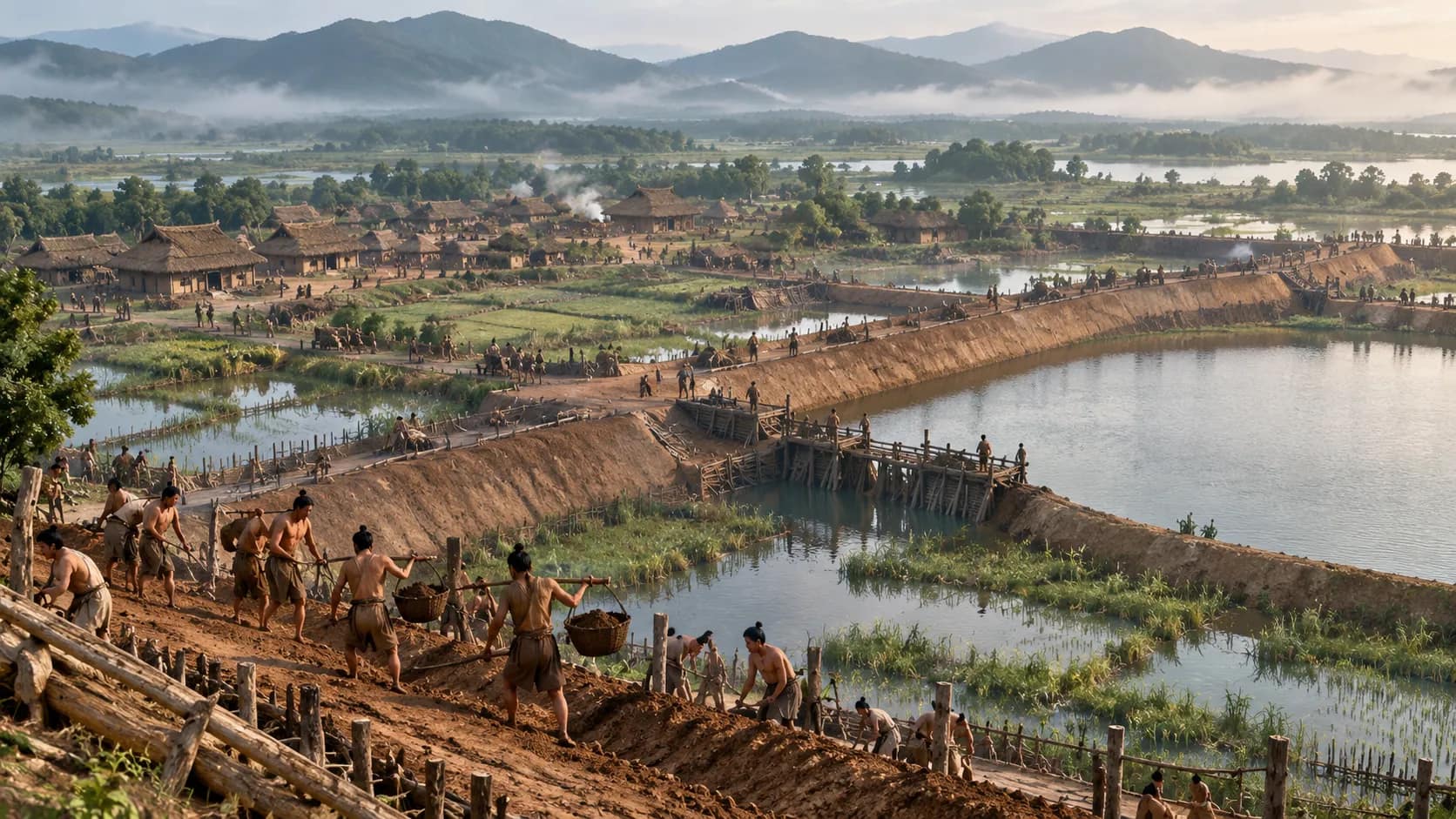
Liangzhu flourished approximately 5,300 to 4,300 years ago in the lower Yangtze region of China. The city itself developed during roughly 3300–2300 BCE, with its peak belonging to a period when communities across the world were experimenting with permanent settlements, agriculture and new forms of social organization.
The surrounding landscape presented both opportunities and dangers. Rivers, wetlands and seasonal rainfall supported rice cultivation, but they also created challenges for people trying to build stable settlements and maintain reliable agricultural production.
Water could nourish crops and transport goods. It could also flood fields, damage homes and disrupt food supplies.
For the people of Liangzhu, managing water was therefore not an isolated engineering problem. It was fundamental to the survival and expansion of their society.
The archaeological evidence suggests that they responded by developing a network of water-control structures around the settlement. Rather than depending on a single enormous dam, they constructed multiple features across different parts of the landscape.
These included high dams near valley entrances, lower dams across flatter terrain and long earthen levees along the foothills. Together, these structures formed an extensive hydraulic system connected to the surrounding waterways and reservoirs.
What makes this achievement so remarkable is its age. These were not structures built by an industrial civilization equipped with excavators, concrete mixers or precision surveying instruments. They were the work of a society that relied on human labour, practical knowledge of soils and water, and methods of construction developed through experience.
The landscape itself became part of the city’s infrastructure.
2. The engineering hidden inside the earth
The ancient builders of Liangzhu did not leave behind detailed engineering plans or written instructions explaining how they designed their water system. Instead, archaeologists have reconstructed the system by examining the remains of the structures, their locations, the surrounding geology and radiocarbon dates.
One of the most important investigations, published in 2017, identified an extensive network of dams, levees and ditches associated with the Liangzhu culture. Radiocarbon evidence placed major construction activity around 5,200–4,800 years ago.
The researchers identified three broad types of structures.
High dams: Holding back water in the valleys
Some dams were constructed where low ground lay between hills. These barriers helped retain water in reservoirs near the foothills of the Tianmu Mountains.
Building a dam in such a location required more than simply piling up soil. Builders needed to identify suitable ground, estimate where water would collect and create a barrier capable of withstanding pressure from the retained water.
The surviving evidence does not reveal every calculation or decision made by the original builders. Nevertheless, the placement of the structures indicates a practical understanding of topography and water movement.
Low dams: Managing water across the plains
Other dams were built across lower-lying terrain, where swampy conditions made construction difficult.
Excavations revealed layers of clay and bundles of plant material incorporated into some structures. These bundles, wrapped in grass leaves, resembled primitive sandbags and helped form part of the layered construction.
This is an especially revealing detail. It suggests that the builders were not merely dumping earth into a channel. They used selected materials in a deliberate sequence, creating structures adapted to the conditions of the ground.
Modern civil engineers also have to consider foundation stability, seepage, soil composition and the forces acting on an embankment. Liangzhu’s builders approached their own version of these problems with the materials and knowledge available to them.
Levees: Reshaping the landscape
One set of earthen levees extended for at least five kilometres along the lower slopes of the surrounding hills. Archaeological measurements indicate that some sections were approximately 20–50 metres wide and 2–7 metres high.
Structures on this scale would have required enormous quantities of earth to be excavated, moved, positioned and compacted.
They also had to fit into a wider system. A barrier that redirected water in one location could affect conditions elsewhere, making the placement and coordination of different structures important.
The achievement was not simply the construction of large embankments. It was the creation of a connected network whose individual components worked together across a broad area.
3. The astonishing human effort behind the project
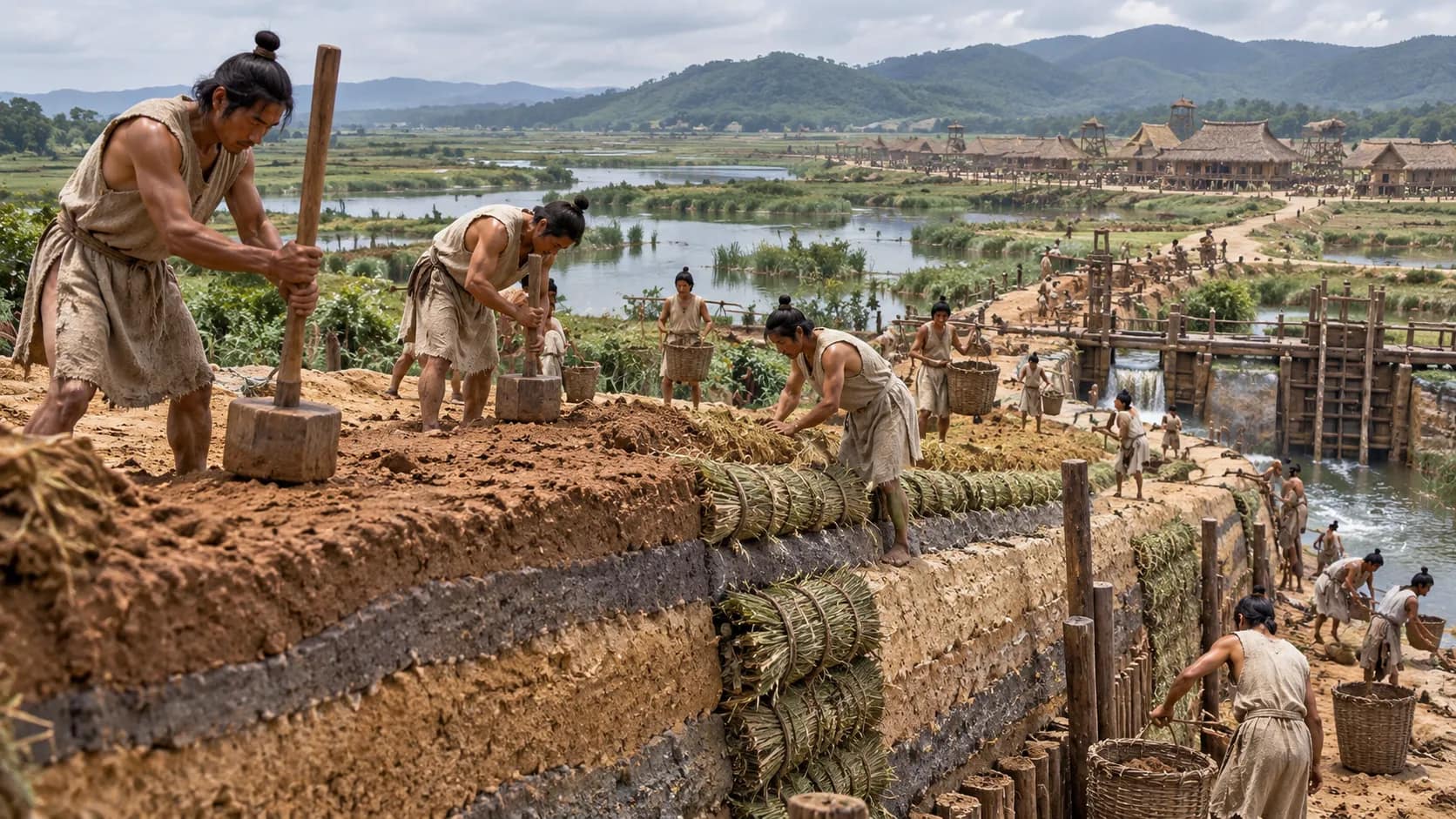
The physical scale of Liangzhu’s hydraulic system raises another question: who built it?
The work could not have been completed by a handful of specialists. It required large numbers of people to gather materials, excavate soil, transport loads, prepare foundations and maintain the growing network of structures.
The 2017 research estimated that constructing the ancient dams involved moving approximately 2.88 million cubic metres of earth. Its labour calculations suggested that around 3,000 people working for nearly eight years could have carried out this undertaking. These figures are estimates based on the researchers’ reconstruction, rather than a surviving record of the actual workforce or schedule.
Even with that qualification, the scale is extraordinary.
Imagine the practical requirements. Workers would need tools, food, shelter and access to construction sites. Earth had to be sourced and transported, while different sections of the system needed to be built in a sequence that made sense for the terrain.
Some people may have had greater experience with construction, soils or water. Others would have performed the repeated physical work of excavation and transport. Organizers would have needed to coordinate tasks and ensure that materials and workers reached the appropriate locations.
The exact administrative system remains uncertain. Archaeologists cannot simply assume that Liangzhu used the same labour arrangements as later kingdoms. The evidence nevertheless points to a society capable of organizing major collective projects over extended periods.
This is an important distinction. Engineering is not only about the person who designs a structure. It also depends on the social systems that make construction possible.
Liangzhu’s dams reveal both technical knowledge and the capacity to mobilize resources on a remarkable scale.
4. Water management helped support a thriving city
Liangzhu’s hydraulic infrastructure existed alongside an urban settlement covering approximately 300 hectares. The city included earthen walls, large artificial platforms, waterways and areas associated with elite and ceremonial activity.
Rice cultivation formed the economic foundation of Liangzhu society. Reliable agricultural production would have helped support people who were not engaged exclusively in farming, including craftspeople, construction workers and those involved in administration and ritual activities.
Water management may have contributed to this development in several ways.
First, reservoirs and barriers could help moderate the effects of seasonal water fluctuations. The precise function of every structure is not equally well established, but flood management and water storage were important potential benefits.
Second, the wider network of channels and waterways could support movement around the region. Archaeological research has suggested that waterways helped transport materials, including stone used in city construction.
Third, water infrastructure could connect communities and agricultural areas to the urban centre. Such connections would have helped sustain an economy in which food, raw materials and labour were increasingly coordinated.
The system therefore needs to be understood as part of a wider landscape rather than as an isolated collection of dams.
Water linked farming, transport, construction and urban life. Controlling it could help a community become more productive, but it could also concentrate influence in the hands of those who organized access to land and resources.
Liangzhu’s elaborate jade objects and differences between burials suggest that its society had developed social distinctions and a system of authority. Researchers have considered how the hydraulic enterprise related to that wider political and ritual order. The precise relationship between water control and political power remains a subject for interpretation, rather than a simple cause-and-effect story.
5. How did they build so much without modern machinery?
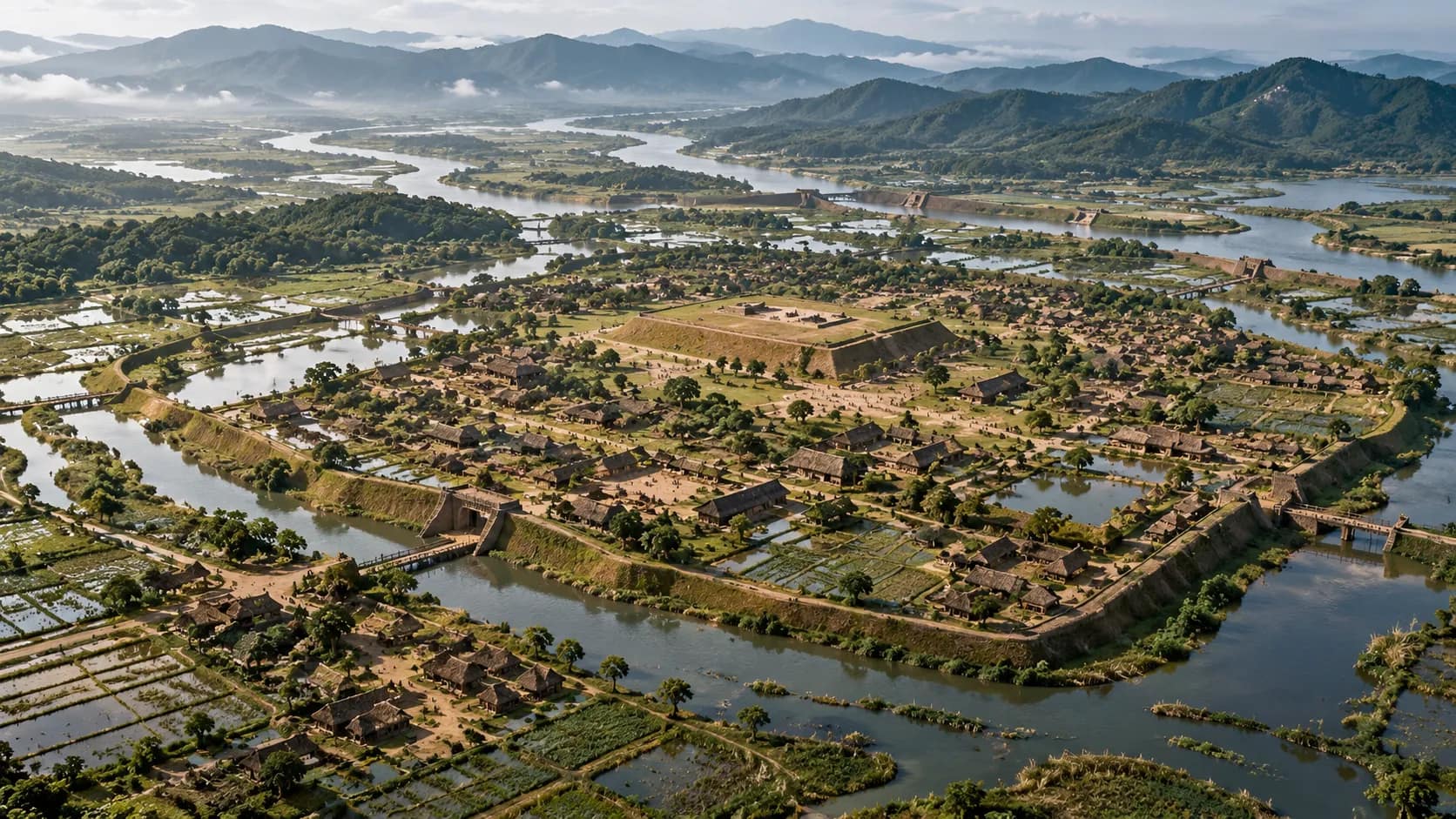
It is tempting to describe Liangzhu’s water system as a mystery because it appears so ambitious for its time. But its construction does not require lost technology or unexplained engineering knowledge.
The available evidence points toward methods based on natural materials, careful placement and organized manual labour.
Wooden implements, baskets, woven plant materials and earth could accomplish a great deal when thousands of workers performed coordinated tasks. The use of layered clay and plant-wrapped bundles demonstrates that the builders selected materials and arranged them deliberately.
Their knowledge may have developed through generations of experience with floods, wetland soils, rice cultivation and settlement construction. People who repeatedly observed where water accumulated, where embankments failed and how different soils behaved could develop reliable practical techniques without formal engineering mathematics.
This is a form of technological expertise that archaeological evidence can easily underestimate. It may leave behind fewer recognizable objects than metalworking or monumental stone architecture, but its results can transform an entire landscape.
There is also an important lesson about innovation. Complex infrastructure does not always emerge from a single invention. It can develop through the gradual refinement of many smaller techniques, combined with the organizational ability to apply them at scale.
Liangzhu’s water system represents precisely this kind of achievement.
6. The mystery of Liangzhu’s decline
A civilization’s greatest engineering achievement does not guarantee its survival.
Liangzhu eventually declined, and its urban centre was abandoned. Archaeological and environmental research has investigated the role of changing rainfall, flooding and broader hydrological conditions in the region.
A study published in Science Advances in 2021 examined the collapse of Liangzhu and other Neolithic cultures in the lower Yangtze region. Its findings linked cultural changes in the area to climate and environmental shifts, including changing precipitation patterns.
The relationship between climate and Liangzhu’s decline is complex. Researchers continue to investigate how changes in water conditions interacted with agricultural production, settlement patterns and the society’s ability to adapt.
It would be misleading to claim that one flood destroyed the city or that the water system suddenly failed. The available evidence supports a more cautious explanation involving environmental pressures and changes in the conditions that had helped the settlement prosper.
This possibility makes Liangzhu’s history particularly relevant today.
Water infrastructure can reduce environmental risks, but it cannot eliminate them. Reservoirs and embankments depend on maintenance, changing rainfall patterns and the surrounding landscape. A system designed for one set of conditions may become less effective when those conditions change.
The fate of Liangzhu reminds us that engineering and environmental resilience must develop together.
7. What modern cities can learn from a 5,000-year-old system
The people of Liangzhu worked in a world very different from ours, yet some of their challenges remain familiar.
Cities today struggle with seasonal flooding, water shortages, drainage failures and the environmental consequences of building across wetlands. Modern engineering has vastly expanded the available tools, but it has not removed the need to understand local geography and water movement.
Liangzhu offers several useful lessons.
Infrastructure works best as a connected system. Its dams, levees and waterways were distributed across the landscape. Modern water management also benefits from considering entire river basins rather than treating each drainage channel or reservoir as an isolated project.
Local materials and conditions matter. The ancient builders used earth and plant materials suited to their environment. Modern engineers likewise need to account for soil properties, local ecology and the long-term behaviour of construction materials.
Large projects depend on social organization. Even a technically sound design cannot succeed without planning, labour, resources and maintenance. The human systems behind infrastructure remain as important as the physical structures themselves.
Environmental knowledge must evolve. Liangzhu developed in a landscape shaped by seasonal water variation. Its later decline highlights the importance of understanding how climate and hydrology change over time.
These lessons do not mean that ancient techniques can simply replace modern flood defences. They show why the principles of integrated planning, local knowledge and long-term adaptation remain relevant across thousands of years.
8. A forgotten achievement, not a lost technology
Liangzhu’s water system forces us to reconsider how technological sophistication is recognized in the archaeological record.
When people think about early civilizations, they often imagine monumental temples, elaborate pottery, metal tools or spectacular burial objects. Liangzhu certainly had impressive material culture, including finely worked jade. But its most consequential achievement may have been less visually dramatic: a network of earthen structures designed to manage water across a broad region.
The system required an understanding of terrain, materials, construction and the relationship between human settlement and the natural environment. It also required an extraordinary degree of collective coordination.
Archaeologists are still refining their understanding of how its components were constructed, how they functioned together and how the hydraulic system influenced the development of the city. New survey techniques and environmental studies may reveal additional details that are difficult to identify from surface remains alone. Recent research has also explored the use of machine learning to help identify ancient water-management features that blend into the surrounding terrain.
What makes Liangzhu remarkable is not that its builders possessed mysterious abilities unavailable to other human societies. It is that they developed effective solutions to demanding environmental problems long before the technologies we associate with modern engineering existed.
Their achievements were grounded in observation, experimentation, accumulated knowledge and organized work.
Five millennia later, the earthworks they left behind continue to reveal how much a society can accomplish when it learns to work with the landscape rather than simply build over it.




