
Deep beneath the frozen surface of Antarctica, thousands of highly sensitive instruments are watching for something that is almost impossible to catch. These instruments are searching for particles that can travel through entire planets, pass through human bodies and cross enormous distances in space without leaving an obvious trace.
They are called neutrinos, and scientists often describe them as ghost particles.
What makes them particularly fascinating is that some of the highest-energy neutrinos detected by the IceCube Neutrino Observatory carry approximately 10 billion times the energy of a typical neutrino produced by the Sun.
The discovery highlights just how extreme the universe can be. Somewhere beyond our planet, powerful astrophysical processes are producing particles with extraordinary energies. Yet scientists still have important questions about exactly where some of these particles originate and how nature accelerates them to such remarkable levels.
A November 2, 2026, report from the University of California, San Diego, has brought renewed attention to this extraordinary research, including the work of physicist Francis Halzen, whose contributions to IceCube were recognized with the 2026 Nobel Prize in Physics.
The mystery is not simply how scientists detect something so elusive. It is what these particles might tell us about black holes, collapsing stars, cosmic accelerators and the earliest history of the universe.
What Exactly Are These Ghost Particles?
Neutrinos are elementary subatomic particles. Unlike protons and electrons, they carry no electrical charge, and their masses are incredibly small.
Scientists recognize three varieties, known as:
-
Electron neutrinos
-
Muon neutrinos
-
Tau neutrinos
They are produced in several natural processes, including nuclear reactions inside the Sun, radioactive decay, supernova explosions and interactions involving cosmic rays.
Their most unusual characteristic is how rarely they interact with ordinary matter.
Every second, enormous numbers of neutrinos pass through Earth and through our bodies. Most continue travelling without interacting with a single atom.
According to physicist George Fuller of UC San Diego, approximately 100 billion neutrinos pass through every square centimetre of the human body each second.
We do not feel them. They do not make us glow, and they do not cause noticeable physical effects under ordinary circumstances.
Their ability to travel through matter almost unhindered makes them incredibly valuable to astronomers. Unlike ordinary light, which can be absorbed, scattered or blocked by clouds of gas and dust, neutrinos can escape from some extremely dense cosmic environments.
This means they can carry information from places that conventional telescopes struggle to investigate.
Why Are Some Neutrinos 10 Billion Times More Energetic Than Solar Neutrinos?
Not all neutrinos are created with the same amount of energy.
The Sun produces enormous quantities of relatively low-energy neutrinos through nuclear fusion. These particles provide scientists with valuable information about the reactions taking place inside our nearest star.
Cosmic neutrinos can be dramatically more energetic.
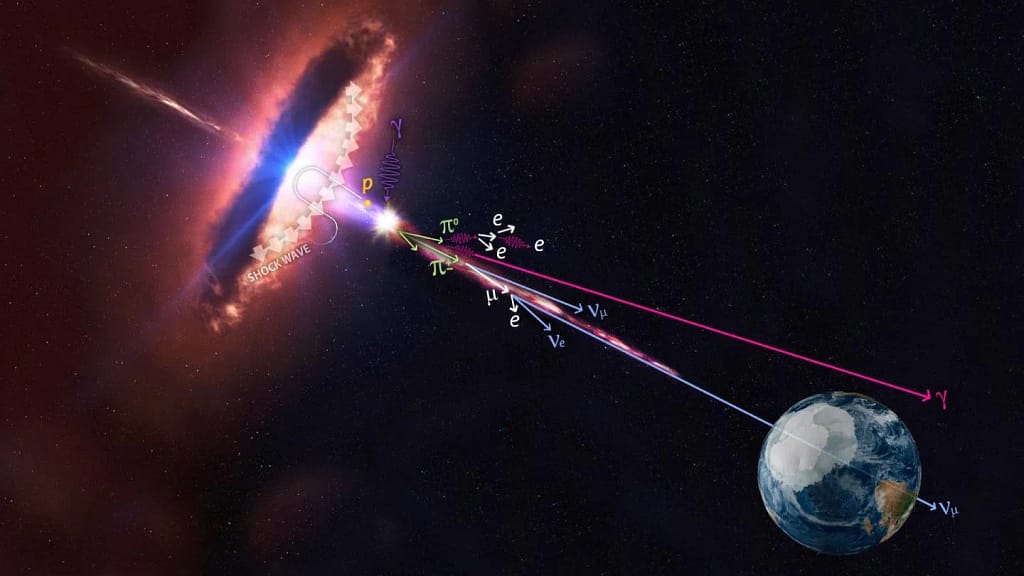
Some originate in environments where particles are accelerated to extraordinary speeds and collide with other particles, producing secondary particles that eventually generate neutrinos.
Potential environments include:
-
Supermassive black holes surrounded by active accretion disks.
-
Active galactic nuclei, where enormous amounts of energy are released.
-
Exploding stars and supernova remnants.
-
Regions surrounding highly magnetized neutron stars.
-
Powerful cosmic-ray acceleration sites.
These environments contain some of the most energetic physical processes known to science.
When high-energy particles collide with matter or radiation, they can produce unstable particles called mesons. These particles decay, generating neutrinos among their products.
The resulting neutrinos can travel across intergalactic distances before reaching Earth.
The energy comparison is especially striking: the highest-energy neutrinos discussed in the UC San Diego report can carry approximately 10 billion times the energy of a typical solar neutrino.
But there is an important distinction. Scientists have identified populations of astrophysical neutrinos and associated some with distant cosmic sources. They have not identified the origin of every exceptionally energetic event.
That uncertainty is one reason researchers remain so interested in them.
How Does IceCube Detect Something That Almost Never Interacts?
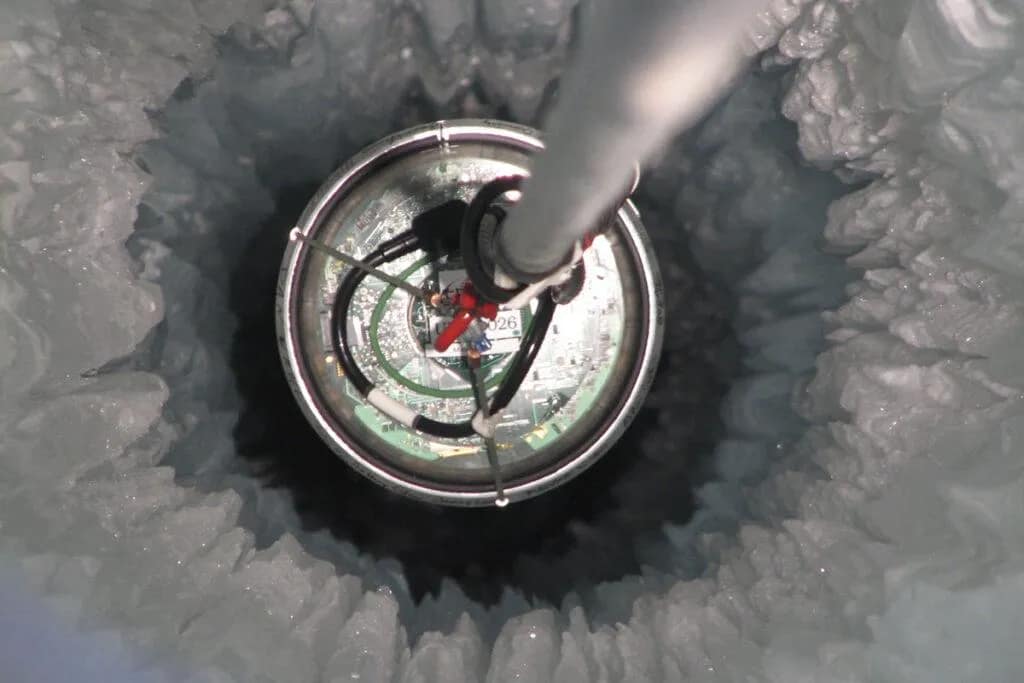
The IceCube Neutrino Observatory is one of the most unusual scientific instruments ever constructed.
Instead of using a conventional telescope with mirrors and lenses, researchers built a gigantic detector inside the Antarctic ice.
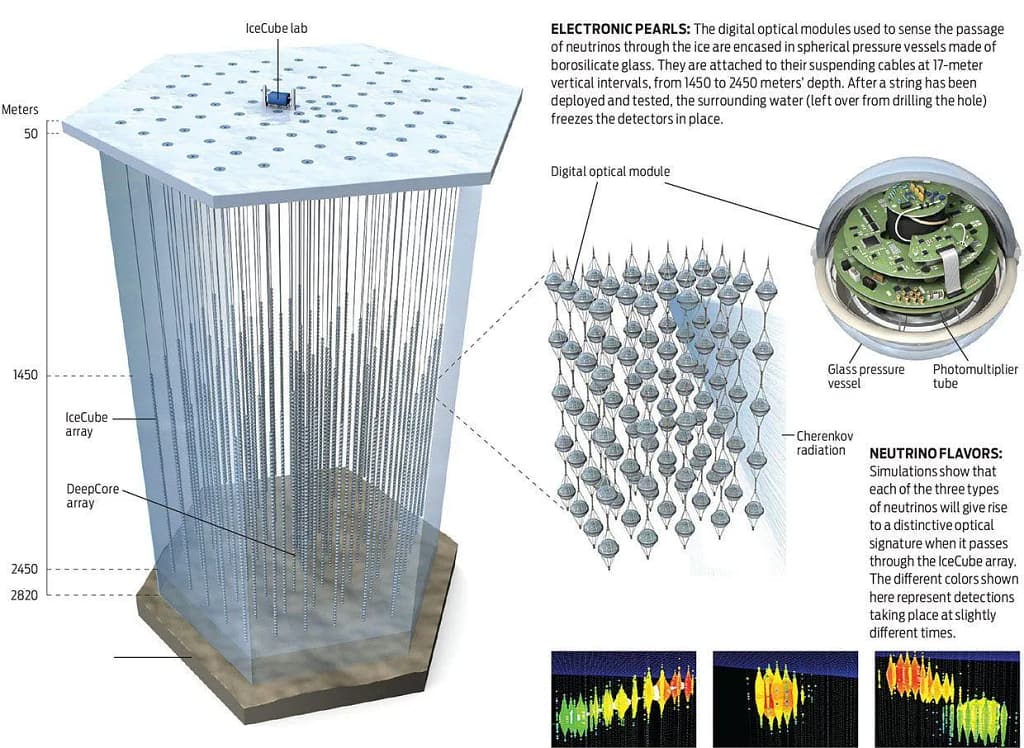
The facility occupies approximately one cubic kilometre of ice beneath the South Pole.
Its construction involved drilling deep holes into the Antarctic ice and lowering long strings containing thousands of highly sensitive optical detectors. These instruments are designed to detect extremely faint flashes of light.
The observatory began operating in 2011, after years of construction and development.
But why put a particle detector beneath kilometres of ice?
The answer lies in the unusual interaction between neutrinos and matter.
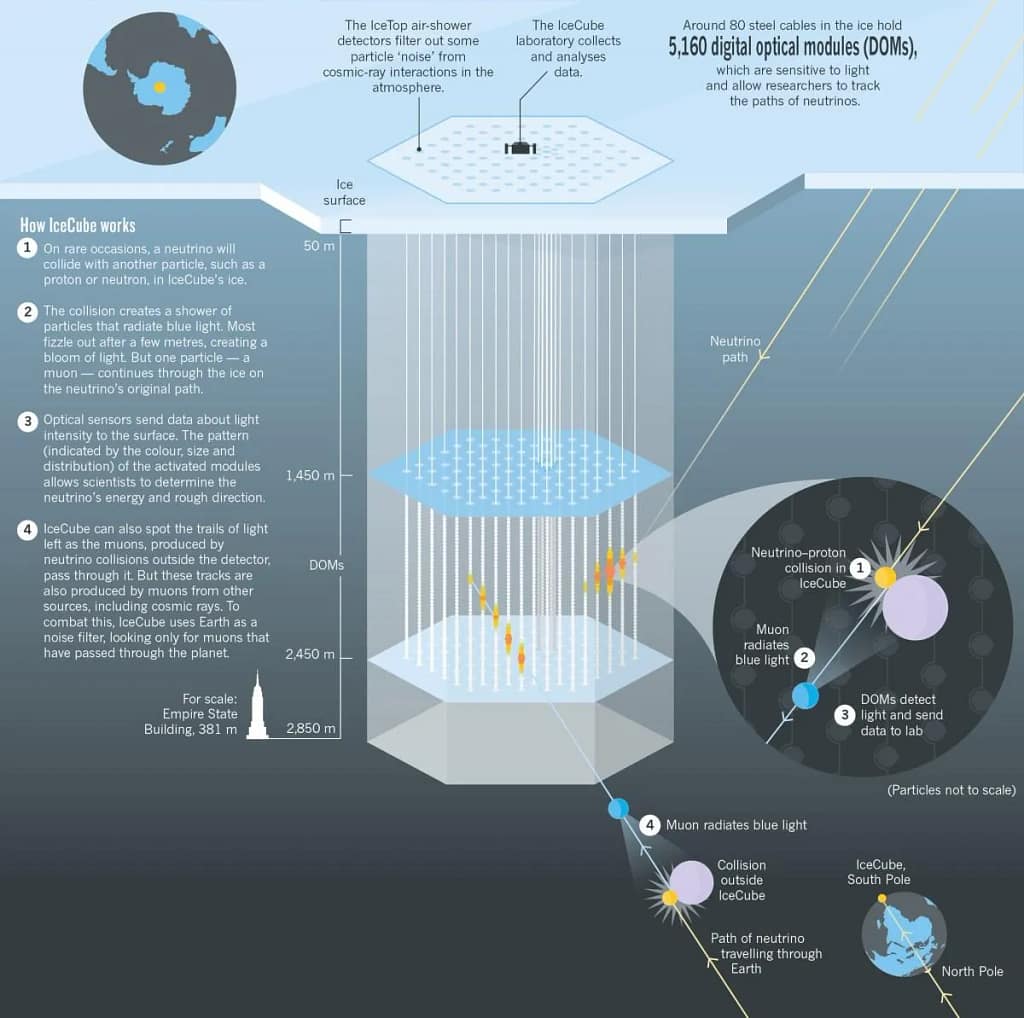
Occasionally, a neutrino travelling through the Antarctic ice collides with an atomic nucleus. This interaction can produce a charged secondary particle, such as a muon.
If that particle moves faster than light travels through the surrounding ice, it generates a faint blue glow called Cherenkov radiation.
This is not a violation of Einstein’s theory of relativity. Nothing is travelling faster than light in a vacuum. The particle is simply moving faster than light can propagate through that particular material.
IceCube’s optical sensors detect these tiny flashes.
By examining when the light arrives, how bright it is and how it spreads through the detector, scientists can reconstruct the event and estimate the incoming neutrino’s energy and direction.
In other words, the observatory does not photograph neutrinos directly. It detects the light produced by the secondary particles created when neutrinos occasionally interact with the ice.
This indirect detection method has opened an entirely new way of studying the universe.
Where Do These Extraordinary Neutrinos Come From?

One of the biggest questions in neutrino astronomy is identifying the cosmic engines responsible for producing the most energetic particles.
Scientists have several leading possibilities.
1. Supermassive black holes
At the centres of many galaxies are supermassive black holes containing millions or billions of times the mass of the Sun.
Some of these black holes actively consume surrounding gas and dust. As material spirals towards them, it heats up and releases enormous amounts of energy.
In certain systems, powerful jets of particles are launched into space at speeds approaching the speed of light.
These environments, known as active galactic nuclei, are among the strongest candidates for producing high-energy cosmic neutrinos.
IceCube has already provided important evidence connecting astrophysical neutrinos with an active galactic nucleus.
On September 22, 2017, the observatory detected a high-energy neutrino arriving from the direction of the blazar TXS 0506+056. Gamma-ray telescopes independently observed the galaxy undergoing a period of increased activity.
This was a landmark moment because it offered the first compelling evidence linking a high-energy neutrino to a specific cosmic accelerator.
2. Exploding stars and collapsing stellar cores
When massive stars reach the end of their lives, their cores can collapse, sometimes forming neutron stars or black holes.
These catastrophic events produce extraordinary conditions involving intense gravity, extreme temperatures and enormous quantities of energetic particles.
Neutrinos are particularly important during stellar collapse because they can escape from regions where ordinary light struggles to travel.
Scientists believe studying these particles could reveal details about what happens inside a collapsing star, including how the explosion develops and what kind of compact object remains behind.
3. Neutron stars and cosmic particle accelerators
Neutron stars are incredibly dense remnants of massive stars.
Some rotate rapidly and possess extraordinarily powerful magnetic fields. These objects, particularly pulsars and magnetars, can create extreme environments in which particles are accelerated.
Their surrounding environments may produce neutrinos through interactions involving energetic particles and radiation.
However, identifying which objects produce the highest-energy neutrinos remains an active scientific challenge.
The Mystery of an Even More Powerful Cosmic Particle
Perhaps the most intriguing part of the UC San Diego discussion concerns a neutrino detected by an experiment similar to IceCube.
According to George Fuller, this particle carried approximately 200 times the energy of the already extraordinarily energetic neutrinos being discussed.
Its origin remains unknown.
That is an important distinction: this exceptionally energetic event should not be confused with a newly announced IceCube detection on November 2. The November report discusses the broader achievements of neutrino astronomy and the unresolved question of where the most energetic particles originate.
Why does this matter?
Because a particle carrying such an extraordinary amount of energy must have been produced through an extremely powerful physical process.
Scientists need to understand whether it originated from an unusual cosmic accelerator, an exceptionally energetic astrophysical event or a process that existing models do not adequately explain.
The answer could help refine our understanding of how particles gain energy across the universe.
Could Neutrinos Reveal What Happened During the Big Bang?
The implications of neutrino research extend far beyond black holes and exploding stars.
Scientists believe neutrinos played an important role in the early universe.
During the first moments after the Big Bang, the universe was extraordinarily hot and dense. Elementary particles interacted constantly, and neutrinos formed part of this energetic cosmic environment.
As the universe expanded and cooled, these particles continued travelling through space.
Scientists predict that a vast population of ancient neutrinos still exists today. They are collectively known as the cosmic neutrino background.
Detecting this ancient population directly remains extraordinarily difficult because these relic neutrinos have extremely low energies.
Nevertheless, researchers are developing indirect methods to investigate their influence on the universe.
One promising avenue involves studying the cosmic microwave background, the faint radiation left over from the early universe.
The Simons Observatory, located in Chile’s Atacama Desert, is studying this ancient radiation. Its measurements could help researchers investigate fundamental cosmological questions, including the influence of neutrinos on the evolution of the universe.
UC San Diego researchers are involved in this broader effort.
If scientists can better constrain the properties of ancient neutrinos, they may gain new information about the conditions that existed shortly after the universe began expanding.
This would help connect particle physics with cosmology.
Why the 2026 Nobel Prize Matters
Neutrino astronomy has reached an important milestone in 2026.
Physicist Francis Halzen received the 2026 Nobel Prize in Physics for his decisive contributions to the IceCube Neutrino Observatory and the discovery of high-energy neutrinos of astrophysical origin.
His work helped turn an ambitious scientific proposal into one of the most important observatories in modern astrophysics.
The National Science Foundation supported the construction and operation of IceCube, which uses thousands of optical sensors buried deep inside Antarctic ice.
Among its major achievements are:
-
The detection of high-energy neutrinos arriving from beyond our Solar System.
-
Evidence connecting neutrinos with a distant active galactic nucleus.
-
The first neutrino-based image of the Milky Way, published in 2023.
-
New opportunities to investigate the origins of cosmic rays and extreme astrophysical phenomena.
These achievements have helped establish neutrinos as an important new tool for exploring the universe.
What Could Scientists Discover Next?
The next generation of neutrino research could make some of today’s biggest astronomical mysteries easier to investigate.
Scientists are working to improve existing detectors and develop complementary observatories capable of identifying increasingly rare cosmic events.
One important goal is to improve the accuracy with which researchers determine where a neutrino originated.
If an observatory detects a high-energy neutrino, astronomers can alert telescopes around the world to investigate the same region of space.
They can then compare neutrino observations with gamma rays, X-rays, visible light and gravitational waves.
This approach is known as multi-messenger astronomy.
Instead of relying on a single type of observation, scientists combine different cosmic signals to build a more complete picture of an astronomical event.
Future improvements could help answer several fundamental questions:
-
Which black holes are responsible for producing the most energetic neutrinos?
-
How do cosmic accelerators generate particles with such extraordinary energies?
-
Can neutrinos reveal what happens inside collapsing stars?
-
What role did neutrinos play in shaping the early universe?
-
Are there unknown astrophysical processes that current theories cannot explain?
Each answer could open another set of questions.
The Universe Is Sending Messages We Are Only Beginning to Understand
For centuries, astronomers have studied the universe primarily through light. Telescopes have revealed distant galaxies, exploding stars, black holes and planets orbiting other suns.
Neutrinos offer something different.
They are messengers that can escape from environments where ordinary electromagnetic radiation may be absorbed or scattered. Their journeys can preserve clues about the extreme physical processes that created them.
The IceCube Neutrino Observatory has demonstrated that an enormous detector buried beneath Antarctic ice can reveal information about distant cosmic environments.
Yet the most energetic neutrinos continue to present a mystery.
Some carry approximately 10 billion times the energy of typical solar neutrinos, while an even more extraordinary event detected by a similar experiment raises questions about how nature can produce particles with such enormous energies.
Scientists have not yet identified every source.
And that is precisely what makes the search so fascinating.
The next extraordinary neutrino detection could help reveal the hidden workings of a distant black hole, expose the physics of a collapsing star or provide another clue about the universe’s earliest moments.
For now, thousands of sensors remain frozen beneath Antarctica, waiting for another almost invisible visitor from the depths of space.




