
Imagine waking up every morning knowing that the nearest people outside your home are millions of kilometres away. You cannot step outside for a walk, order fresh food, visit a hospital or call someone and expect an immediate response. Even a simple message to Earth could take almost an hour to travel there and back.
For four volunteers, this was not a science-fiction scenario. It was their daily reality for 378 days.
On October 31, 2026, four crew members emerged from NASA’s simulated Mars habitat at the Johnson Space Center in Houston, Texas, after spending more than a year living under conditions designed to resemble a human mission to the Red Planet.
The experiment was part of NASA’s Crew Health and Performance Exploration Analog (CHAPEA), an ambitious programme designed to answer a question that becomes increasingly important as humanity prepares for deep-space exploration:
Can human beings remain healthy, mentally resilient and productive while living on another planet for an entire year?
The experiment never left Earth. But the lessons it provides could influence how the first human settlements on Mars are designed.

Inside Mars Dune Alpha: A year without ordinary Earth life
The four volunteers were Ross Elder, mission commander; Ellen Ellis, medical officer; Matthew Montgomery, science officer; and James Spicer, flight engineer.
They lived inside Mars Dune Alpha, a 1,700-square-foot, three-dimensional-printed habitat designed to recreate some of the conditions of a future Martian settlement.
The facility is located at NASA’s Johnson Space Center, but its interior was designed to make everyday life feel considerably less like being on Earth.
The habitat included private sleeping quarters, a kitchen, exercise facilities, medical and research areas, a technical workspace and a dedicated crop-growing area.
Outside was a simulated Martian landscape where the crew conducted activities resembling spacewalks, collected geological samples and practised operating equipment in bulky spacesuits.
The second CHAPEA mission began on October 19, 2025. The crew finally emerged on October 31, 2026, after completing their 378-day assignment.
This was NASA’s second completed year-long CHAPEA simulation, following the first crew’s successful return in July 2024.
The psychological challenge: Living with the same three people for 378 days

One of the biggest challenges of a real Mars mission may not be the journey itself. It could be the people travelling together.
On Earth, even someone living in a relatively isolated location can eventually go outside, visit another person or change their surroundings.
On Mars, those options would be extremely limited.
The CHAPEA volunteers experienced prolonged confinement, restricted personal space, repetitive routines and separation from their families.
Communication with Earth was deliberately delayed to reproduce the distance between the planets. Depending on their relative positions, signals between Mars and Earth can take several minutes to travel in one direction. NASA’s simulation incorporated delays of up to approximately 22 minutes.
This means a question sent to mission control could not receive an immediate response. Even a simple exchange could require considerable patience.
The crew had to develop independent decision-making skills rather than depending on constant instructions from Earth.
Teamwork was equally important. Small disagreements, fatigue or poor communication could become serious problems when four people share a confined environment for more than a year.
NASA’s behavioural health researchers monitored factors related to crew health, performance and adaptation. The full scientific analysis of the second mission’s data will take additional time, so it would be premature to claim that the experiment has already established a definitive psychological formula for Mars exploration.
Could astronauts grow their own food on Mars?
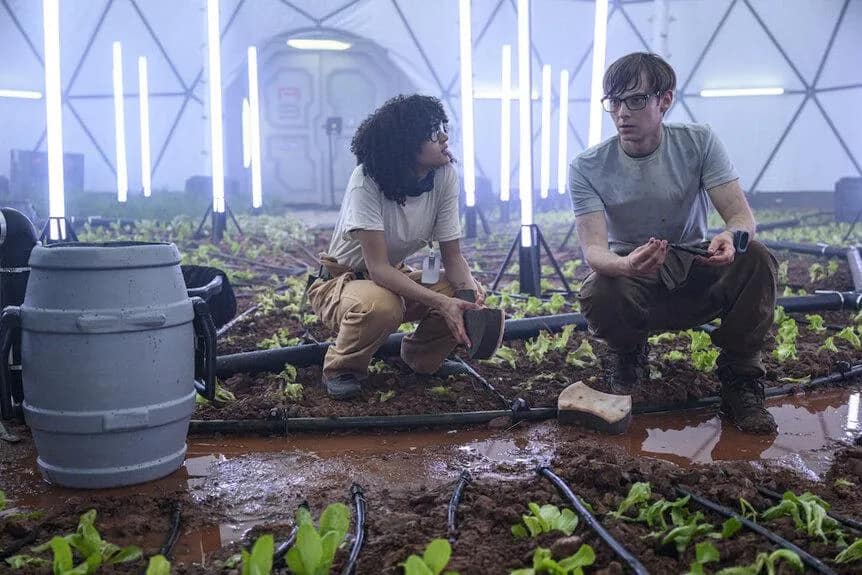
Food is another major challenge.
Sending enough food from Earth for a journey lasting years would be expensive and logistically complicated. A permanent settlement would eventually need to produce at least some of its own food.
During CHAPEA, the crew worked with crop cultivation as part of the mission’s research activities.
They grew plants and explored the practical challenges of maintaining a small agricultural system inside an isolated habitat.
But there is an important distinction: the volunteers did not become completely self-sufficient farmers. Their main food supply consisted of shelf-stable, prepackaged meals, with crops providing an opportunity to investigate how fresh produce could supplement future space diets.
Growing food on Mars would involve several obstacles:
-
Water management: Every drop would need to be carefully conserved and recycled.
-
Lighting: Plants would require controlled illumination, particularly inside protected habitats.
-
Nutrient supply: Artificial growing systems would need reliable sources of essential minerals.
-
Contamination: Microorganisms and plant diseases would need to be monitored.
-
Space limitations: Greenhouses would compete with laboratories, sleeping quarters and other essential facilities for valuable space.
There is also a psychological benefit to consider. Caring for plants, harvesting vegetables and having access to fresh food could make an isolated environment feel more familiar and less monotonous.
NASA’s research into space nutrition and crop cultivation could therefore help solve two problems simultaneously: food security and crew wellbeing.
What happens when equipment breaks millions of kilometres from Earth?
A broken machine on Earth can often be repaired by a technician within hours. On Mars, the same problem could become a mission-threatening emergency.
The CHAPEA crew performed habitat maintenance, technical operations and simulated equipment repairs.
They also conducted simulated extravehicular activities, commonly known as EVAs or spacewalks.
These exercises helped researchers investigate how astronauts might maintain equipment, operate tools and perform demanding physical tasks while wearing protective spacesuits.
Consider a failure in a future Martian settlement:
A water filtration system stops working. A power controller begins overheating. A greenhouse loses its temperature regulation.
The crew cannot simply wait for an engineer to arrive.
They would need to identify the problem, assess available resources, follow repair procedures and make decisions with limited assistance from Earth.
This is why NASA deliberately incorporates equipment failures, resource constraints and demanding workloads into its analogue missions.
The goal is not simply to test whether people can survive in a confined habitat. It is to understand whether they can continue performing complicated scientific and engineering tasks when things go wrong.
The 22-minute communication problem
One of the most important lessons for future Mars missions concerns communication.
Earth and Mars are separated by hundreds of millions of kilometres at certain points in their orbits.
Radio signals travel at the speed of light, but even light needs time to cross that distance.
Depending on planetary positions, a one-way message can take up to approximately 22 minutes.
That creates a significant operational problem.
Imagine an astronaut discovering an unexpected geological formation during a Marswalk. They send photographs and a description to scientists on Earth.
Mission control examines the information and prepares instructions. By the time the response reaches Mars, nearly an hour may have passed.
In an emergency, that delay could be critical.
The CHAPEA programme therefore investigates how crews can operate autonomously, make decisions independently and manage communication interruptions.
NASA has also explored simulated periods of communication blackout during the programme.
Future Mars explorers will need sophisticated onboard systems, reliable procedures and enough training to handle unexpected situations without waiting for Earth to tell them what to do.
What did NASA actually learn from the 378 days?

The most important result is not a single discovery. It is the collection of operational and human-performance data gathered during an unusually long period of isolation.
NASA will use the information to investigate several questions:
-
How do people adapt psychologically to extended confinement?
-
How do limited food supplies and exercise opportunities affect physical health?
-
How much independence should astronauts have when communication with Earth is delayed?
-
What habitat systems need to be maintained or redesigned for long-term survival?
-
How can small crews maintain productivity, cooperation and morale over several years?
The four volunteers have completed their assignment, but their scientific contribution is not finished. NASA has scheduled post-mission evaluations and debriefings to examine their physical health, psychological wellbeing and performance.
The results will help researchers compare the second mission with the first CHAPEA experiment and improve plans for future lunar and Martian exploration.
Does this mean humans are ready to live on Mars?
Not yet.
There is a fundamental difference between living inside a simulated Martian habitat on Earth and surviving on the actual planet.
The CHAPEA facility cannot fully reproduce:
-
Mars’ surface radiation environment.
-
Its approximately 38% Earth gravity.
-
The extreme temperature variations.
-
Martian dust and its potential effects on equipment.
-
The absence of a breathable atmosphere.
-
The consequences of a genuine medical emergency millions of kilometres from Earth.
The volunteers also had access to support infrastructure at Johnson Space Center that a real Mars crew would not have nearby.
Nevertheless, these simulations are valuable because they allow NASA to study human behaviour and operational problems before astronauts face them in space.
A real Mars mission will require several technologies to work together, including reliable life-support systems, radiation protection, energy generation, food production, medical facilities and advanced autonomous equipment.
A failure in just one essential system could have serious consequences.
The next big question: Can humans build a permanent settlement on Mars?
The completion of the second CHAPEA mission brings humanity another step towards understanding what long-duration living beyond Earth might involve.
But a permanent Mars settlement would require much more than sending four astronauts to a distant planet.
It would require an environment where people could produce food, recycle water, generate energy, manufacture essential components and provide medical care without depending entirely on supplies from Earth.
Perhaps the most important lesson from these 378 days is that Mars exploration is not simply an engineering challenge.
It is a human challenge.
The first settlers will need to cope with isolation, uncertainty, limited resources and the psychological demands of living in an unfamiliar world.
NASA’s experiments are beginning to show how difficult that could be — and what scientists must solve before the first humans establish a lasting presence on the Red Planet.
The journey to Mars may take months. Learning how to live there could take years. And these four volunteers have helped humanity understand what comes next.




