
In the early 2000s, the United States government needed to make a material it had already made successfully in the 1980s. It couldn’t, at least not right away. The material was a classified component in the W76 warhead, and the effort to recreate it ran a year late and about $69 million over budget, according to a 2009 Government Accountability Office report.
Nobody stole the secret and no civilization collapsed. The people who knew how to do it simply retired, the factory was torn down, and the paperwork turned out to be thinner than anyone assumed.
That’s how most technologies get lost. Popular versions of the story involve ancient super-races and suppressed inventions, and the real versions are usually stranger and more useful. Here are seven cases where humans really did lose something, plus one famous “loss” that turns out to be mostly myth. For each I’ve said what’s established, what’s still argued about, and where you can check it yourself.
Why knowledge disappears in the first place
A technique can be forgotten even while it’s being used every day. There are a few recurring reasons.
The knowledge lives in people, not paper. Researchers call this tacit knowledge: the feel of a forge at the right temperature, the sound a mixture makes when it’s ready. Writing down a recipe captures the ingredients but rarely the judgment. When the practitioners retire or die, the recipe is left without its interpreter.
The supply chain breaks. Some crafts depend on a specific ore, a specific clay or a specific trade route. If the source dries up, the method can survive on paper and still stop working.
Secrecy works too well. Governments and guilds protect valuable methods by restricting who knows them. That protection is also a single point of failure.
Demand vanishes. If nobody needs the thing anymore, nobody trains the next generation. Sometimes the technology is replaced by something better, and sometimes the need simply disappears.
Small or isolated groups struggle to keep complex skills alive. This is contested, and I’ll come back to it near the end.
Keep those five in mind. Every case below is a variation on them.
1. Roman concrete: the recipe survived, the understanding didn’t
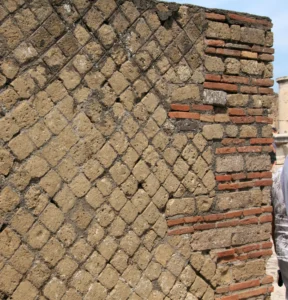
Roman harbors, aqueducts and the Pantheon dome are still standing after roughly two thousand years, while much modern concrete needs serious repair within decades. For a long time, the standard explanation was volcanic ash from around Pozzuoli, near Naples, which Roman writers praised as a key ingredient.
In 2023, a team led by MIT’s Admir Masic published a study in Science Advances examining 2,000-year-old mortar from the city wall at Privernum, Italy. They focused on small white chunks called lime clasts, which had long been dismissed as evidence of sloppy mixing. The MIT report on the study says the team’s analysis points to “hot mixing”: adding quicklime directly to the mix rather than using pre-slaked lime. That process generates heat, speeds up setting and leaves behind lime clasts that can react with water and re-fill new cracks.
The researchers backed this up with lab tests. As ScienceAlert reported, cracked samples made with the quicklime approach healed within about two weeks, while the control samples stayed cracked.
The honest caveat is that this is a proposed mechanism, and other researchers are still testing it. It’s also a subtler kind of loss than “the recipe vanished.” Roman writers described ingredients, and the material itself survived everywhere. What was lost was the working understanding of why it worked, and that had to be rebuilt with electron microscopes.
2. The Antikythera mechanism: a gearbox from 2,000 years too early
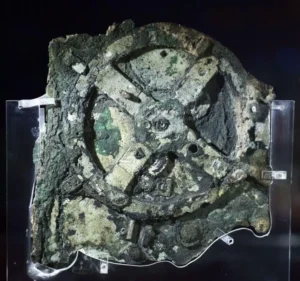
In 1901, divers recovered a corroded lump of bronze from a shipwreck off the Greek island of Antikythera. It turned out to be a geared astronomical device from roughly the second century BC, with at least 30 interlocking gears. Researchers believe it predicted eclipses and tracked calendars, including the cycle of the ancient Panhellenic Games.
In 1901, divers recovered a corroded lump of bronze from a shipwreck off the Greek island of Antikythera. It turned out to be a geared astronomical device from roughly the second century BC, with at least 30 interlocking gears. Researchers believe it predicted eclipses and tracked calendars, including the cycle of the ancient Panhellenic Games. We’ve covered the hidden inscriptions, eclipse dial and planetary display of the Antikythera Mechanism in a separate deep dive, so here I’ll stick to the part that matters for this list: the gap around it.
The American Society of Mechanical Engineers, which designated it a historic landmark, notes that similarly complex geared devices didn’t reappear in Europe until the mechanical clocks of the 13th century. A Manchester University research summary goes further, describing it as an order of magnitude more complicated than any surviving mechanism from the following thousand years, with no known precursor.
Be careful with the word “forgotten” here, though. We only have one. Ancient writers, including Cicero, mention similar devices, so it may not have been unique in its day, but a single surviving object can’t prove how widespread the craft was. What we can say is that the surviving evidence of that level of miniaturized gearing stops for well over a thousand years.
3. Greek fire: a secret guarded so well it died with the state
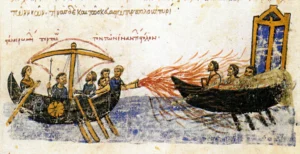
Byzantine forces used a liquid incendiary weapon from around the seventh century, famously in the defense of Constantinople against Arab fleets in the 670s. It was sprayed through bronze siphons, stuck to targets and reportedly kept burning on water.
The recipe was a state secret. World History Encyclopedia records that Emperor Romanos II named three things that must never reach foreign hands: the imperial regalia, a royal princess and Greek fire. The secrecy worked. On one occasion, a Bulgar force captured a fire-projecting apparatus along with the liquid and couldn’t operate it.
The Byzantine Empire fell in 1453, and the exact formula has never been recovered. Historians agree that a petroleum-based liquid like naphtha was probably central. Beyond that, proposals include resin, sulfur, quicklime and saltpeter, and they remain educated guesses. Some scholars also doubt the tidy story that a single inventor, Kallinikos, created it from scratch, and suggest he improved an existing technology.
This is the “secrecy works too well” case. Protecting the method from your enemies also means very few people have it to pass on.
4. Damascus steel: the secret ingredient was a trace of dirt
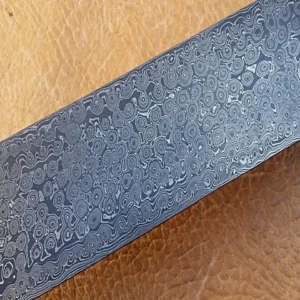
Blades made from Indian wootz steel and finished in the Middle East were famous for their edge and their rippled, watery patterns. The production of genuine examples faded out around the middle of the 18th century, and smiths who tried to revive it for the next two hundred years mostly failed.
The breakthrough came in the 1990s. Metallurgists John Verhoeven and Alfred Pendray, along with William Dauksch, published an analysis in the journal JOM titled The Key Role of Impurities in Ancient Damascus Steel Blades. Their conclusion was that the distinctive patterns came from a carbide-banding effect, driven by tiny amounts of carbide-forming elements such as vanadium in the original ingots. They also concluded that the finest blades may have come only from ingots made with ore from certain regions of India.
That points to the likeliest explanation for the loss: not a forgotten technique, but a supply chain that changed. If the right ore ran out or stopped being traded, smiths could follow the same steps and get a plainer result, with no way of knowing why.
A separate claim got much more press than it deserved. A 2006 Nature paper reported carbon nanotubes in a Damascus sabre. Other researchers, Verhoeven among them, have questioned whether the structures were truly nanotubes, and nobody has shown they explain the blade’s performance. The banding is well established. The nanotube story is not.
5. Polynesian wayfinding: nearly lost, then relearned
For centuries, Pacific navigators crossed thousands of miles of open ocean without instruments, reading stars, swells, winds, clouds and bird behavior. By the twentieth century, long-distance non-instrument navigation had almost vanished from Hawaii and much of Polynesia.
The revival is well documented. The Polynesian Voyaging Society built the double-hulled canoe Hōkūleʻa, and in 1976 it sailed from Hawaii to Tahiti with no instruments. Their own account says it was the first time in about 600 years that a voyaging canoe had sailed that route, and that the voyage was meant to challenge the theory that Polynesians had settled the Pacific by accident.
The navigator was Mau Piailug, from the tiny Micronesian island of Satawal, where the tradition was still alive. As JSTOR Daily’s profile describes, he was the only person on that crew who held the full body of traditional wayfinding knowledge. He later trained Nainoa Thompson, who repeated the crossing in 1980.
This case matters because it shows the opposite outcome. The knowledge survived because one person held it and, crucially, agreed to teach it. A few decades later, and it might have been gone for good.
6. Fogbank: forgetting in the age of documentation
This is the modern case that should unsettle everyone who assumes records solve the problem.
Fogbank is the codename for a classified material used in the W76 warhead. It was made at the Y-12 complex in Tennessee from the mid-1970s until 1989, and the production building then sat idle and was slated for decommissioning. When the government launched a life-extension program for the warhead in the 2000s, the National Nuclear Security Administration found it had to make the material again.
The GAO’s 2009 finding, as quoted in press coverage at the time, was that NNSA had kept few records of the process and almost all the staff with expertise had retired or left. It reported $69 million in cost overruns and a delay of at least a year.
The agency pushed back on the wording. In its published FAQ, NNSA said it hadn’t lost the knowledge of how to make the material, but that losing experienced staff complicated building a new production capability. Both statements can be true, and the practical result was the same: a hard, expensive scramble.
The root cause, as reported in secondary sources, was an unexpected one. The original product apparently depended on a certain impurity, and modern cleaning processes applied to the input materials were removing the substance that produced it. Nobody had realized the impurity mattered. The material itself remains classified, so details are limited to what’s been made public.
The program’s final refurbished warheads were delivered in 2018.
7. The Tasmanian toolkit: a contested case
This one comes with a warning label.
In a 2004 paper in American Antiquity, anthropologist Joseph Henrich argued that over roughly 8,000 years of isolation after rising seas cut Tasmania off from mainland Australia, its societies lost a series of skills, likely including bone tools, cold-weather clothing, fishing spears and boomerangs. His explanation was demographic: a small, cut-off population has fewer people to learn from, so complex skills erode.
It’s an influential idea and it has real critics. Vaesen and colleagues published a challenge in PNAS in 2016 to whether population size explains this kind of loss, and archaeologists have long argued over how much was truly lost versus never adopted, or dropped for practical reasons.
I include it because it’s the most-cited example of the “small groups lose skills” theory, and because a careful reader should know it isn’t settled. Anyone repeating it as established fact is ahead of the evidence.
The myth: “NASA lost the Saturn V blueprints”
Space fans repeat this one constantly, usually with a sigh about lost greatness. It’s partly wrong.
Writing in The Space Review, Dwayne Day calls the idea that NASA lost or destroyed the blueprints untrue, noting NASA ran an active knowledge-retention program for Saturn’s key components, especially its engines. Museums hold F-1 engines, and NASA engineers at Marshall Space Flight Center have taken one apart to study it.
An earlier piece in the same publication gives a more careful version. It argues that the archives are incomplete, with real gaps, but that a complete set of Saturn V blueprints never existed in the first place, because the engines were being modified as they were built.
So the real lesson is subtler than “NASA threw it out.” A design document is not the same as the know-how to build the thing, and rebuilding a 1960s rocket would also run into parts and suppliers that no longer exist. Notice how similar that sounds to Fogbank.
What these cases have in common
Read together, the stories point in the same direction.
Recipes are not knowledge. Roman concrete, Damascus steel and Fogbank all had written or physical traces. What disappeared was the understanding of why each step mattered, including steps nobody knew were important.
Invisible dependencies do the damage. A trace of vanadium in an ore. An impurity in a cleaning process. A supply route that closed. The lost ingredient is often one the practitioners never listed.
Apprenticeship is fragile. Polynesian wayfinding survived because a teacher was willing and a student was ready. Fogbank nearly didn’t for the mirror-image reason.
“Lost” is often a spectrum. Damascus steel is largely reverse-engineered. Roman concrete is being decoded. Greek fire remains unknown. Treat any claim of a totally vanished technology with the same skepticism you’d apply to a claim of a totally solved mystery.
There’s also an uncomfortable modern angle. If a well-funded, heavily documented program can lose critical process knowledge in two decades, any organization that depends on a handful of experts is exposed. The practical countermeasures are unglamorous: capture the reasoning, not just the steps, overlap generations of staff, and keep at least one working example running rather than a shelf of manuals.
Frequently asked questions
What is the best-known example of a lost technology?
Greek fire and Damascus steel are the two most cited. Greek fire’s recipe is still unknown, while Damascus steel has largely been reverse-engineered since the 1990s.
Did the Romans really have self-healing concrete?
A 2023 MIT-led study proposed that lime clasts, produced by hot mixing with quicklime, gave Roman concrete a self-healing ability, and it demonstrated the effect in the lab. It’s a strong hypothesis rather than a closed case.
Did NASA lose the plans to the Saturn V?
Not in the simple sense. Records exist but are incomplete, and a full set of “blueprints” never existed. Rebuilding the rocket would depend on knowledge and parts beyond the paperwork.
Can lost technologies be recovered?
Sometimes. Polynesian wayfinding was revived through teaching, Damascus steel through metallurgical analysis, and Fogbank through repeated engineering work. Greek fire hasn’t been.
Is the Antikythera mechanism proof of lost advanced technology?
It’s proof of a sophisticated Greek gear-making tradition. It doesn’t show anything supernatural or extraterrestrial, and we don’t know how many similar devices existed.
The bottom line
Humans don’t lose technologies because they get careless. They lose them because knowledge is stored in people, supply chains and habits, and all three are fragile. The most striking case here isn’t ancient at all: a modern government with detailed records and huge resources still stumbled over a material it had already made.
The next time you hear that some ancient people had secrets we can’t match, ask two questions. Was the loss real, or just an unanswered question? And what fragile thing was the knowledge actually stored in?
