
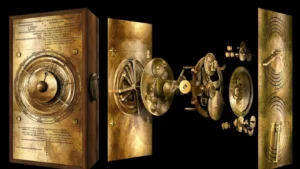
More than two thousand years ago, somewhere in the ancient Mediterranean world, a craftsman assembled a machine so sophisticated that modern scientists are still trying to understand everything it could do.
It wasn’t powered by electricity. It had no silicon chips, screens, or software. Yet it could track the movements of celestial bodies, predict eclipses, follow complex astronomical cycles, and perform calculations that would not reappear in mechanical devices for well over a thousand years.
Today, that extraordinary artifact is known as the Antikythera Mechanism, and despite more than a century of study, researchers continue to uncover new clues hidden within its corroded bronze fragments.
The device has been called the world’s first analog computer. Some historians describe it as one of the most astonishing technological achievements of the ancient world. Others see it as evidence that ancient Greek science and engineering reached levels far beyond what most people imagine.
What makes the story even more remarkable is that the Antikythera Mechanism was never found in a royal palace, a great library, or a famous temple.
It was discovered by accident at the bottom of the sea.
And ever since, it has challenged everything we thought we knew about the history of technology.
A Discovery Hidden Beneath the Mediterranean

The story begins in 1900 near the Greek island of Antikythera.
A group of sponge divers seeking shelter from a storm descended into the waters off the island and made an astonishing discovery. Resting on the seabed was the wreck of an ancient Roman-era ship filled with statues, pottery, jewelry, and other treasures.
Archaeologists soon launched a recovery effort.
Among the artifacts brought to the surface was a heavily corroded lump of bronze that initially attracted little attention. It looked like nothing more than a damaged piece of metal.
Then something unexpected happened.
As the artifact dried, researchers noticed the remains of interlocking gears embedded within the corrosion.
Ancient gears.
Complex gears.
Gears that had no business existing in an object more than 2,000 years old.
What scientists had recovered was not merely another shipwreck artifact.
It was a machine unlike anything previously known from the ancient world.
Why the Antikythera Mechanism Shocked Historians
When historians first examined the device, many struggled to believe what they were seeing.
Ancient civilizations certainly built impressive structures and developed advanced mathematics. But conventional wisdom suggested that precision mechanical engineering on this scale was a much later development.
The Antikythera Mechanism forced scholars to reconsider that assumption.
The surviving fragments revealed a network of bronze gears carefully cut with remarkable precision. These gears were arranged in a way that allowed the machine to perform complex astronomical calculations.
It was not a simple calendar.
It was not a decorative object.
It was a computational device.
In essence, it was a machine designed to model the heavens.
For decades, researchers debated how sophisticated it really was.
As imaging technology improved, the answer became increasingly clear:
It was far more advanced than anyone initially realized.
The World’s First Analog Computer

The term “computer” often brings modern technology to mind, but computers existed long before electronics.
A computer, at its core, is a device that processes information and performs calculations.
The Antikythera Mechanism did exactly that.
Users would turn a hand crank connected to a system of gears. As the gears rotated, pointers on the front and back dials moved to display astronomical information.
Researchers believe the machine could predict:
- The phases of the Moon
- Solar cycles
- Lunar cycles
- Eclipse dates
- Planetary movements
- Calendar events
Some scholars even suggest it may have tracked the known planets visible to the ancient Greeks.
This was not guesswork.
It was mathematics transformed into machinery.
The device essentially converted astronomical knowledge into a portable mechanical model of the cosmos.
The Mystery of the Missing Technology
One of the most puzzling aspects of the Antikythera Mechanism is not how it was built.
It’s why similar machines seemingly disappeared.
The mechanism is generally dated to around the second century BCE.
Yet nothing of comparable complexity appears again in surviving historical records for many centuries.
Mechanical clocks would eventually emerge in medieval Europe.
Astronomical calculators would reappear.
Precision gearing would become common.
But there is a vast technological gap between the Antikythera Mechanism and many later developments.
Historians still debate why.
Did knowledge of the device die with a small group of specialists?
Were similar machines once widespread but lost to history?
Did libraries and workshops containing technical knowledge disappear during political and social upheavals?
No one knows for certain.
The Antikythera Mechanism remains a reminder that technological progress is not always a straight line.
Sometimes knowledge is lost.
Sometimes entire traditions vanish.
Looking Inside a 2,000-Year-Old Machine
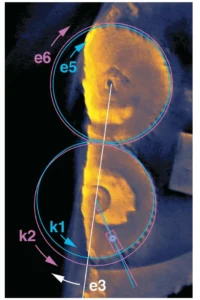
For much of the twentieth century, researchers could only study the outer surfaces of the surviving fragments.
The interior remained hidden beneath layers of corrosion.
That changed with modern imaging technology.
Advanced X-ray scanning and three-dimensional reconstruction allowed scientists to peer inside the mechanism without damaging it.
The results transformed understanding of the device.
Researchers discovered dozens of gears arranged in intricate patterns.
Tiny inscriptions became visible.
Previously unknown mechanical relationships emerged.
What had once appeared to be a mysterious lump of bronze became a readable technological document.
Each scan revealed new information.
And remarkably, scientists are still finding surprises.
The Hidden Writing Inside the Mechanism
One of the most important discoveries involved text.
The mechanism contains thousands of Greek characters engraved onto its surfaces.
These inscriptions functioned much like an instruction manual.
They explained the operation of certain dials and described astronomical phenomena represented by the machine.
For years, much of this writing was unreadable.
Corrosion had obscured critical sections.
Modern imaging techniques changed that.
Researchers have gradually recovered more of the text, allowing them to reconstruct parts of the mechanism’s original purpose.
The inscriptions revealed that the device was not merely a scientific instrument.
It was also an educational tool.
Its creators wanted users to understand the cosmic cycles being displayed.
In other words, it was designed to teach people about the universe.
The Eclipse Prediction Machine
One of the mechanism’s most impressive features involves eclipses.
Ancient astronomers understood that eclipses followed predictable cycles.
The Antikythera Mechanism appears to have incorporated this knowledge mechanically.
A dial on the back of the device tracked the Saros cycle, a period of approximately 18 years after which similar eclipses tend to repeat.
By turning the gears, users could determine when future eclipses were likely to occur.
This capability was extraordinary.
Predicting eclipses required detailed astronomical knowledge and precise mathematical relationships.
The mechanism embedded that knowledge into a system of bronze gears.
For an ancient observer, it must have seemed almost magical.
The Moon’s Irregular Motion
The Moon does not move through the sky at a constant speed.
Its orbit is slightly elliptical, causing its apparent motion to vary.
Ancient Greek astronomers recognized this behavior and developed mathematical models to explain it.
The Antikythera Mechanism appears to incorporate one of these models mechanically.
Researchers discovered a gear arrangement capable of reproducing the Moon’s changing speed.
This is one of the reasons historians regard the device as so remarkable.
It did not merely display simple cycles.
It simulated real astronomical behavior.
In effect, it contained a mechanical model of celestial dynamics.
That level of sophistication would impress engineers even today.
Were the Planets Included?
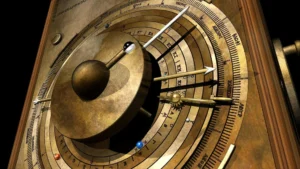
One of the most intriguing questions concerns the planets.
The surviving fragments are incomplete.
Large portions of the original device are missing.
As a result, researchers must reconstruct some features based on evidence and inference.
Several studies suggest that the mechanism may originally have displayed the motions of Mercury, Venus, Mars, Jupiter, and Saturn.
These were the five planets known to ancient Greek astronomers.
Recent computer modeling and analysis of gear arrangements have strengthened the case that planetary displays may have existed.
If true, the Antikythera Mechanism would have represented a complete mechanical model of the ancient cosmos.
It would not simply track the Sun and Moon.
It would reproduce the movements of the known universe.
Why Scientists Keep Returning to the Mechanism
More than a century after its discovery, researchers continue investigating the device.
Why?
Because many questions remain unanswered.
Among them:
- Who built it?
- Where was it made?
- How many similar devices existed?
- What was its exact purpose?
- Who used it?
- Why did the technology disappear?
Every new study provides additional clues.
Yet each answer often raises new questions.
The mechanism sits at the intersection of archaeology, astronomy, engineering, mathematics, and history.
Few artifacts connect so many fields simultaneously.
The Ancient Genius Behind the Machine
The identity of the creator remains uncertain.
Several possibilities have been proposed.
Some scholars have suggested connections to the scientific traditions of Rhodes, an important center of learning in the ancient Mediterranean.
Others have pointed toward intellectual lineages associated with figures such as Hipparchus, one of antiquity’s greatest astronomers.
No direct evidence identifies the inventor.
Yet whoever designed the mechanism possessed extraordinary knowledge.
They understood astronomy.
They understood mathematics.
They understood mechanical engineering.
Most importantly, they understood how to combine these disciplines into a functioning machine.
That achievement places the creator among the most brilliant engineers of the ancient world.
Could There Have Been More?
This question fascinates historians.
The Antikythera Mechanism may be unique.
Or it may simply be the only surviving example.
The ancient world produced countless bronze objects.
Many were melted down and recycled.
Others were lost in wars, fires, earthquakes, and shipwrecks.
It is entirely possible that similar devices once existed but did not survive.
If that is true, the mechanism may represent a broader technological tradition that has largely vanished from the historical record.
Future discoveries could change everything.
Another shipwreck.
Another buried workshop.
Another forgotten machine.
The possibility keeps researchers searching.
What Modern Engineers Think
When engineers examine reconstructions of the mechanism, they are often astonished by its complexity.
The device contains gear trains capable of performing sophisticated calculations.
The precision required to manufacture these gears is significant.
Each component had to work together accurately.
This was not crude craftsmanship.
It was high technology by ancient standards.
Modern replicas demonstrate that the mechanism was not merely theoretical.
It worked.
The gears moved.
The calculations functioned.
The machine achieved exactly what its creators intended.
That realization continues to challenge outdated assumptions about ancient capabilities.
Lessons for the Modern World
The Antikythera Mechanism offers an important lesson.
History is full of surprises.
Technological sophistication does not always progress smoothly from simple to complex.
Civilizations can achieve remarkable breakthroughs.
Knowledge can spread.
Knowledge can disappear.
And sometimes centuries later, that knowledge is rediscovered.
The mechanism reminds us that people living two thousand years ago were every bit as intelligent, curious, and inventive as people today.
Given the right circumstances, they produced technology that still inspires awe.
The Ancient Computer That Refuses to Give Up Its Secrets
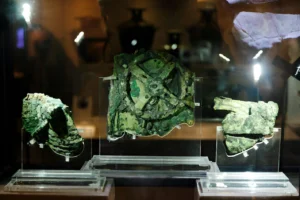
Even after decades of research, the Antikythera Mechanism remains partly mysterious.
Scientists continue analyzing inscriptions.
Engineers continue testing reconstructions.
Archaeologists continue studying the shipwreck where it was found.
Every few years, another discovery emerges.
A newly deciphered inscription.
A revised gear arrangement.
A better understanding of its astronomical functions.
The machine continues to reveal hidden layers of complexity.
That is why it remains one of the most fascinating artifacts ever discovered.
Not because it proves the existence of lost civilizations.
Not because it rewrites everything we know about history.
But because it demonstrates something equally remarkable:
More than two thousand years ago, human beings built a mechanical model of the universe sophisticated enough that modern researchers are still uncovering its secrets.
And perhaps the greatest mystery is not how the Antikythera Mechanism worked.
It’s how a machine so far ahead of its time could disappear from history for centuries—and then return from the bottom of the sea to astonish the world all over again.


