
For more than six centuries, a strange book has challenged some of the world’s brightest minds.
Cryptographers have studied it. Linguists have analyzed it. Historians have traced its journey across Europe. Computer scientists have fed its symbols into advanced algorithms. Even artificial intelligence has been enlisted to help solve the puzzle.
Yet nobody can say with certainty what the book actually says.
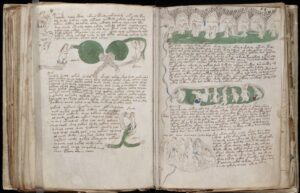
Known as the Voynich Manuscript, this mysterious volume is often described as the world’s most enigmatic book. Filled with pages of unknown writing, bizarre illustrations, unusual plants, astronomical diagrams, and scenes unlike anything found in other medieval manuscripts, it has resisted every serious attempt at decipherment. More than a century after its rediscovery, the manuscript remains unreadable.
What makes the Voynich Manuscript so fascinating is not simply that it is old. Countless medieval books survive from the same era.
What makes it extraordinary is that researchers know the manuscript is real, yet they still cannot understand it.
In an age when artificial intelligence can translate languages in seconds and computers can analyze billions of data points, the Voynich Manuscript remains one of humanity’s most stubborn mysteries.
A Book Unlike Any Other
The Voynich Manuscript is housed today at Yale University’s Beinecke Rare Book and Manuscript Library, where it is cataloged as MS 408. Scholars believe it was created in Central Europe during the early fifteenth century, making it roughly 600 years old. Scientific testing has dated the parchment used in the manuscript to between 1404 and 1438.
At first glance, the manuscript looks like an ordinary medieval book.
Then you begin turning the pages.
Instead of recognizable Latin, German, Italian, or any known medieval language, the pages are filled with an unfamiliar script. The characters appear consistent and organized, suggesting a real writing system rather than random scribbles. The text flows naturally across hundreds of pages as though it records meaningful information.
Accompanying the text are illustrations that make the mystery even deeper.
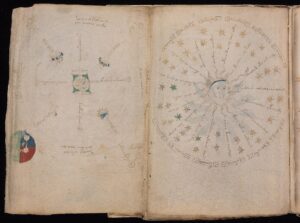
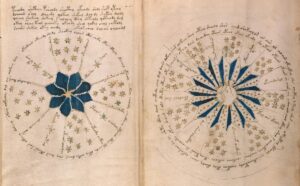
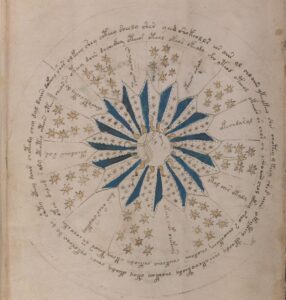
Many pages feature plants that do not clearly match known species. Others contain star charts, zodiac symbols, circular diagrams, and strange cosmological imagery. Some sections show women bathing in green pools connected by elaborate tube-like structures. Another part resembles a pharmaceutical handbook filled with herbs and containers.
The result is a manuscript that feels both familiar and alien.
It looks as though it should be understandable.
Yet it isn’t.
The Discovery That Shocked Scholars
Although the manuscript is centuries old, the modern world only became aware of it in 1912.
That year, a Polish-American rare book dealer named Wilfrid Voynich acquired the manuscript from a Jesuit institution near Rome. Fascinated by its contents, Voynich introduced it to scholars and researchers, hoping its secrets could be unlocked. The manuscript eventually became known by his name.
From the beginning, theories emerged.
Some believed the manuscript was written by the medieval English scholar Roger Bacon.
Others suspected it contained alchemical knowledge, secret scientific discoveries, or encoded messages from a forgotten civilization.
The mystery only deepened because nobody could produce a convincing translation.
Decades passed.
Then decades more.
Still no breakthrough arrived.
Is It Really a Code?
One of the first ideas researchers explored was the possibility that the manuscript was encrypted.
After all, secret codes and ciphers were not unknown during the medieval period.
If the manuscript concealed valuable knowledge, encryption would have protected its contents.
The theory attracted serious attention from professional cryptographers.
Some of the same minds who worked on military codebreaking during the twentieth century examined the manuscript.
They failed.
Again and again.
Every proposed solution eventually collapsed under scrutiny. A translation might appear convincing for a few lines, only to become meaningless elsewhere in the text.
This failure created a difficult question.
If the manuscript is a cipher, why has nobody decoded it?
And if it isn’t a cipher, what exactly is it?
The Language Nobody Recognizes
Another possibility is that the manuscript is written in a real language.
Perhaps it records a language that has disappeared from history.
Perhaps it uses an unknown writing system.
Perhaps it represents a dialect that left few surviving records.
Modern linguistic analysis has produced intriguing clues.
Researchers have found that the text exhibits patterns commonly associated with natural languages. Certain words appear frequently. Others occur only in specific sections. The distribution of symbols does not look random. Statistical studies suggest the manuscript contains meaningful structure.
That observation has led some scholars to argue that the manuscript is unlikely to be nonsense.
The problem is that no known language fits the evidence.
The text remains trapped in a strange middle ground.
It appears language-like.
Yet it matches nothing researchers have ever seen.
The Plants That Shouldn’t Exist
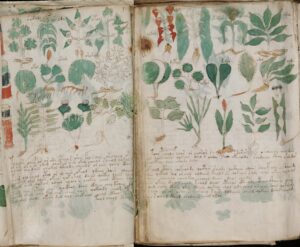
Among the manuscript’s most famous illustrations are its plants.
Entire sections are devoted to botanical drawings.
In medieval Europe, books about medicinal plants were common. Herbal manuals helped physicians identify remedies and treatments.
At first, researchers assumed the illustrations would provide answers.
If the plants could be identified, perhaps the manuscript’s purpose could be determined.
Instead, the plants created new problems.
Some illustrations resemble real species.
Others appear to combine features from multiple plants.
Still others seem entirely unknown.
Over the years, botanists have attempted to match the drawings with plants from Europe, Asia, and the Americas.
No consensus has emerged.
The strange vegetation has fueled speculation for decades.
Was the artist drawing from imagination?
Was the manuscript describing an unfamiliar region?
Or are the illustrations symbolic rather than literal?
Nobody knows.
A Journey Through Time
Despite uncertainty surrounding its contents, researchers have uncovered much about the manuscript’s history.
Evidence suggests it circulated among educated and influential individuals.
One documented owner was Holy Roman Emperor Rudolf II, who reportedly purchased the manuscript for a substantial sum and believed it might contain valuable knowledge. Later, it passed through the hands of scholars, physicians, and collectors before eventually finding its way to Yale University.
The manuscript’s survival is remarkable in itself.
Wars destroyed countless medieval documents.
Fire, moisture, neglect, and time erased many others.
Yet this strange book endured.
The irony is striking.
History preserved the manuscript.
Understanding it remains the challenge.
The Scientific Investigation
One reason the Voynich Manuscript continues to captivate researchers is that modern science has confirmed many aspects of its authenticity.
Carbon dating performed on the parchment places its creation in the early fifteenth century. Analysis of inks and pigments has shown consistency with materials used during the medieval period. Additional studies have examined everything from the manuscript’s binding to the animal skins used to create its pages.
These findings eliminated some popular theories.
For example, claims that the manuscript was a modern forgery became increasingly difficult to defend.
The physical evidence points strongly toward a genuine medieval origin.
This conclusion makes the mystery more compelling.
If the manuscript is authentic, then someone invested an enormous amount of effort creating it.
The work required expensive materials, skilled craftsmanship, and significant time.
People generally do not devote such resources to producing meaningless gibberish.
Could It Be an Elaborate Hoax?
Not everyone agrees.
Some researchers continue to wonder whether the manuscript could be a historical hoax.
Perhaps it was created to impress wealthy collectors.
Perhaps it was designed to appear mysterious.
Perhaps it was intended as a puzzle.
Yet this explanation faces challenges.
The manuscript contains hundreds of pages of carefully structured text. Maintaining consistent patterns across such a large work would have required extraordinary dedication.
Moreover, statistical analyses suggest the text behaves more like genuine language than random nonsense.
That doesn’t prove the manuscript contains meaningful information.
But it does make the hoax theory harder to sustain.
When Artificial Intelligence Entered the Mystery
In recent years, researchers have turned to machine learning and artificial intelligence.
The hope was straightforward.
If computers can recognize hidden patterns in massive datasets, perhaps they could identify the language underlying the manuscript.
AI systems have examined word frequencies, character combinations, and structural patterns.
Some projects have proposed potential linguistic relationships.
Others have suggested possible decoding methods.
None has achieved broad acceptance.
The challenge is simple but severe.
Artificial intelligence works best when it has reference material.
The Voynich Manuscript provides very little.
There is no confirmed translation.
No bilingual version.
No known author.
No clear language family.
No external key.
As a result, AI faces many of the same obstacles as human researchers.
Technology has advanced dramatically.
The mystery remains.
The Five-Scribe Discovery
One of the more intriguing developments emerged from paleographic research, the study of historical handwriting.
Researchers examining the manuscript found evidence suggesting multiple individuals contributed to its creation.
Rather than being the work of a single writer, the manuscript may have involved several scribes. Some studies have proposed that as many as five people participated in producing the text.
This discovery raises fascinating questions.
Were they members of a scholarly community?
Monks?
Physicians?
Researchers working on a shared project?
If multiple scribes were involved, they all understood the writing system well enough to use it consistently.
That suggests the script had meaning for its creators.
Unfortunately, it still does not reveal what that meaning was.
Why the Mystery Endures
The Voynich Manuscript possesses a rare quality.
It combines genuine evidence with profound uncertainty.
Researchers know roughly when it was created.
They know where it has been.
They know what materials were used.
They can study every page in extraordinary detail.
Yet the central question remains unanswered.
What does it say?
Many historical mysteries eventually yield to persistence.
New documents are discovered.
Fresh evidence emerges.
Hidden records come to light.
The Voynich Manuscript has resisted all of these paths.
Every answer seems to generate new questions.
That is why the manuscript continues attracting experts from multiple disciplines.
Cryptography.
Linguistics.
History.
Computer science.
Art history.
Medieval studies.
Each field contributes another piece to the puzzle.
None has solved it.
The World’s Most Famous Unread Book
As of 2026, no decipherment of the Voynich Manuscript has been accepted by the scholarly community. Numerous claims have appeared over the years, often generating headlines before being challenged by experts. The consensus remains unchanged: the manuscript has not been conclusively decoded.
That reality makes the Voynich Manuscript unique.
Most books exist to communicate information.
This one has become famous because it cannot.
Its unreadability is precisely what transformed it into a legend.
Every generation brings new tools and new ideas.
Perhaps future advances in artificial intelligence will uncover patterns humans have overlooked.
Perhaps an overlooked archive will reveal a critical clue.
Or perhaps the manuscript will continue to guard its secrets for centuries to come.
A Mystery That Refuses to Disappear
The Voynich Manuscript reminds us that not every mystery has been solved.
Modern science has mapped the human genome, landed spacecraft on distant worlds, and built machines capable of astonishing feats of computation.
Yet a small illustrated book from the fifteenth century still sits beyond our understanding.
That contradiction is part of its appeal.
The manuscript is both known and unknown.
We know it exists.
We know it is real.
We know it has a history.
But we do not know what story it tells.
And until someone finally reads its pages, the Voynich Manuscript will remain one of the most fascinating unsolved puzzles in human history—a silent voice from six centuries ago, waiting for someone to understand its language.


