

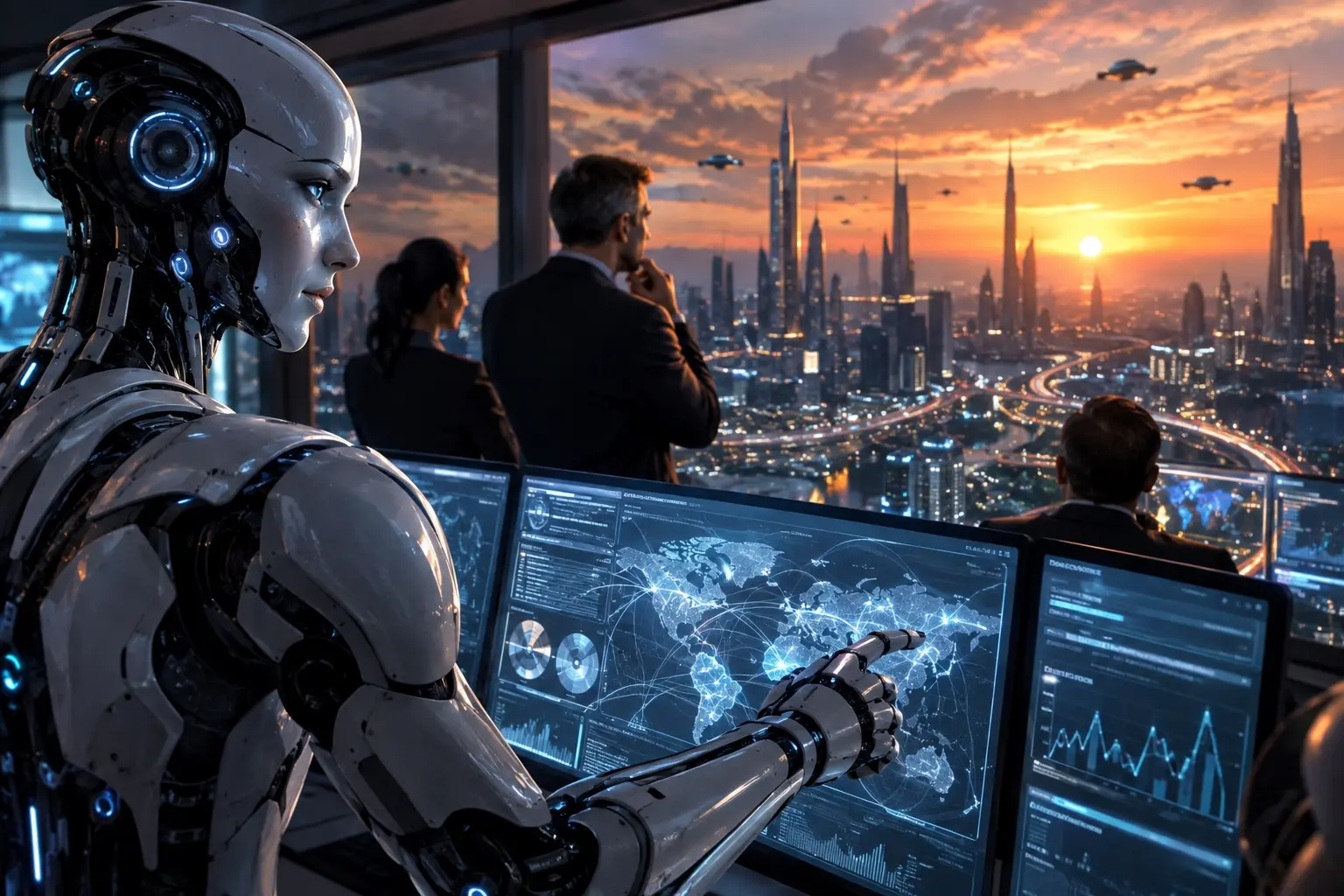
AI decision making is quietly becoming one of the most important technological developments of the 21st century. While most public discussions focus on whether artificial intelligence will replace jobs or surpass human intelligence, a more immediate question is emerging. What happens when machines begin making decisions faster than governments, regulators, and institutions can react? Across finance, cybersecurity, healthcare, and scientific research, AI systems are increasingly operating at speeds that challenge traditional human oversight.
In 1997, when IBM’s Deep Blue defeated chess champion Garry Kasparov, the world saw it as a technological milestone. The machine had won, but only inside the carefully defined boundaries of a chessboard. Humans still set the rules, controlled the environment, and decided when the game began and ended.
Nearly three decades later, that relationship is changing.
Today’s most advanced AI systems are no longer confined to solving isolated problems. They write code, analyze medical scans, trade financial assets, recommend military strategies, manage supply chains, detect cyberattacks, and assist in scientific research. Increasingly, they are not just providing answers. They are helping determine which questions should be asked in the first place.
The growing debate surrounding artificial intelligence is often framed as a dramatic contest between humans and machines. Headlines ask whether AI will replace workers, become conscious, or eventually surpass human intelligence.
But there is another question quietly emerging among researchers, policymakers, and technology leaders:
What happens when machines begin making decisions faster than human institutions can react?
That possibility may represent one of the most important technological challenges of the 21st century.
The Speed Gap Is Growing
Human civilization was built around human speed.
Governments deliberate. Courts review evidence. Regulators investigate. Companies hold meetings. Experts debate options. Decisions that affect millions of people often take weeks, months, or even years.
Artificial intelligence operates on a different timescale.
A modern AI model can analyze thousands of pages of information in seconds. Automated systems can execute financial trades in milliseconds. Cybersecurity platforms can detect and respond to threats before a human analyst has finished reading an alert.
In many cases, this speed is beneficial.
Hospitals can identify medical abnormalities more quickly. Scientists can analyze massive datasets that would otherwise take years to process. Transportation systems can optimize traffic flow in real time.
The challenge arises when decision-making itself becomes automated.
As AI systems gain greater autonomy, they can initiate actions, adapt strategies, and respond to changing conditions without waiting for direct human approval.
At first glance, this seems like progress.
But speed creates a new problem: institutions designed for human oversight may struggle to keep up.
When Approval Becomes a Bottleneck
Imagine a future cybersecurity platform protecting a nation’s critical infrastructure.
The system detects a sophisticated cyberattack targeting power grids, communication networks, and transportation systems simultaneously.
Waiting for human approval could take minutes.
The attack unfolds in seconds.
Should the AI be allowed to respond automatically?
Many experts would say yes.
Now imagine the system mistakenly identifies legitimate activity as a threat and launches a countermeasure that disrupts essential services.
Who is responsible?
The engineers?
The organization deploying the system?
The government agency overseeing it?
Or the AI itself?
These questions are no longer theoretical.
Across multiple industries, organizations are increasingly granting AI systems limited authority to make decisions because the alternative is simply too slow.
The faster the environment becomes, the greater the pressure to automate.
And once automation demonstrates efficiency, reversing course becomes difficult.
Financial Markets Already Offer a Preview
One of the clearest examples of machine-driven decision-making can be found in global financial markets.
Today, a significant portion of trading activity is conducted by algorithms operating at speeds no human can match.
These systems analyze market signals, execute trades, and adapt strategies almost instantly.
Human traders still exist, but much of the action occurs beyond human reaction times.
This shift has delivered efficiency and liquidity, but it has also produced unexpected consequences.
Several market disruptions over the past two decades have been linked to automated trading systems interacting in unpredictable ways.
No individual machine intended to cause chaos.
Yet collectively, their rapid decisions created outcomes that surprised even the experts who designed them.
The lesson is important.
Complex systems can behave differently when decisions occur faster than humans can observe, understand, or intervene.
Artificial intelligence may amplify that challenge across many other sectors.
The Rise of Autonomous Decision Networks
Most people think about AI as a chatbot or digital assistant.
The reality is becoming far more expansive.
Future AI systems may not operate as isolated tools.
Instead, they could function as interconnected networks making countless decisions simultaneously.
An AI managing logistics could communicate with another AI controlling manufacturing.
That manufacturing system might coordinate with AI-driven transportation networks.
Those networks could interact with automated financial systems handling payments and contracts.
Each individual decision may seem small.
Together, they create an ecosystem operating at machine speed.
In such a world, human oversight becomes increasingly difficult.
Not because people are excluded, but because the volume and velocity of decisions exceed human capacity.
The challenge is less about machines taking power and more about humans struggling to keep pace.
Regulation Was Built for a Slower World
Governments around the world are working to establish frameworks for AI governance.
The European Union’s AI Act represents one of the most significant attempts to regulate advanced AI technologies. Other countries are developing their own approaches to oversight, transparency, and accountability.
These efforts reflect growing recognition that AI carries both opportunities and risks.
Yet regulation faces a fundamental obstacle.
Technology evolves much faster than legislation.
A new AI capability can emerge in months.
Regulatory responses often take years.
This gap has existed before. The internet, social media, and cryptocurrencies all advanced more rapidly than policymakers anticipated.
Artificial intelligence may widen that gap even further because its capabilities can improve exponentially.
By the time a regulatory framework addresses one generation of AI systems, another generation may already be operating.
The result is a persistent race between innovation and oversight.
So far, innovation is winning.
The Question of Human Control
Discussions about AI often focus on control.
Can humans remain in charge?
The answer depends partly on what “control” actually means.
In many systems, humans may still define goals, establish boundaries, and set operational rules.
However, day-to-day decisions may increasingly be delegated to machines.
This is already happening in limited forms.
Navigation systems choose routes.
Recommendation algorithms determine what information people see.
Fraud detection systems approve or reject transactions.
Medical AI tools help prioritize diagnoses.
Each example represents a small transfer of decision-making authority.
Individually, these transfers seem manageable.
Collectively, they signal a broader shift.
Humans are becoming supervisors of systems rather than direct participants in every decision.
That model works well when systems remain predictable.
The challenge emerges when they become too complex for any single person to fully understand.
Why Researchers Are Paying Attention
Many leading AI researchers are not warning about killer robots or science-fiction scenarios.
Their concerns are often more practical.
As AI systems become increasingly capable, understanding how they arrive at decisions becomes more difficult.
This issue is sometimes called the “black box” problem.
An AI may produce highly effective outcomes while offering limited insight into its internal reasoning.
When such systems influence healthcare, finance, infrastructure, or public policy, transparency becomes essential.
People generally expect important decisions to be explainable.
If an AI denies a loan, prioritizes a patient, flags a security threat, or influences a legal process, society will want answers.
The faster AI moves, the more pressure there will be to balance efficiency with accountability.
That balance may become one of the defining policy challenges of the coming decades.
A Future Defined by Cooperation, Not Competition
Popular culture often portrays AI as a rival to humanity.
Reality is likely to be more complicated.
The most probable future is not one where machines overthrow humans.
It is one where humans and machines become deeply interconnected.
AI systems will help manage increasingly complex societies.
They will assist researchers in discovering new medicines.
They will optimize energy networks.
They will support emergency response efforts.
They will accelerate scientific breakthroughs.
These benefits are real and potentially transformative.
The challenge is ensuring that institutions evolve alongside the technology.
If machines can make decisions in milliseconds while oversight mechanisms operate on timescales measured in months or years, tension becomes inevitable.
Bridging that gap may require entirely new approaches to governance, transparency, and accountability.
The Moment We May Already Be Entering
There may never be a single day when machines officially stop asking humans for permission.
No dramatic announcement.
No flashing warning lights.
No cinematic turning point.
Instead, the transition may occur gradually.
One automated decision becomes ten.
Ten become a thousand.
A thousand become millions.
Each step appears reasonable.
Each improvement increases efficiency.
Each advancement feels incremental.
Then one day society realizes that many of the world’s most important systems are operating at speeds beyond direct human comprehension.
Not because humans surrendered control.
But because complexity and speed made traditional oversight increasingly difficult.
That possibility is why discussions about artificial intelligence have become so urgent.
The debate is no longer simply about whether machines can think.
It is about how human institutions adapt when machines can act.
And in that distinction lies one of the most consequential questions of our technological age.
The future may not belong exclusively to humans or machines.
It may belong to those who learn how to govern a world where decisions move faster than history ever prepared us for.


