

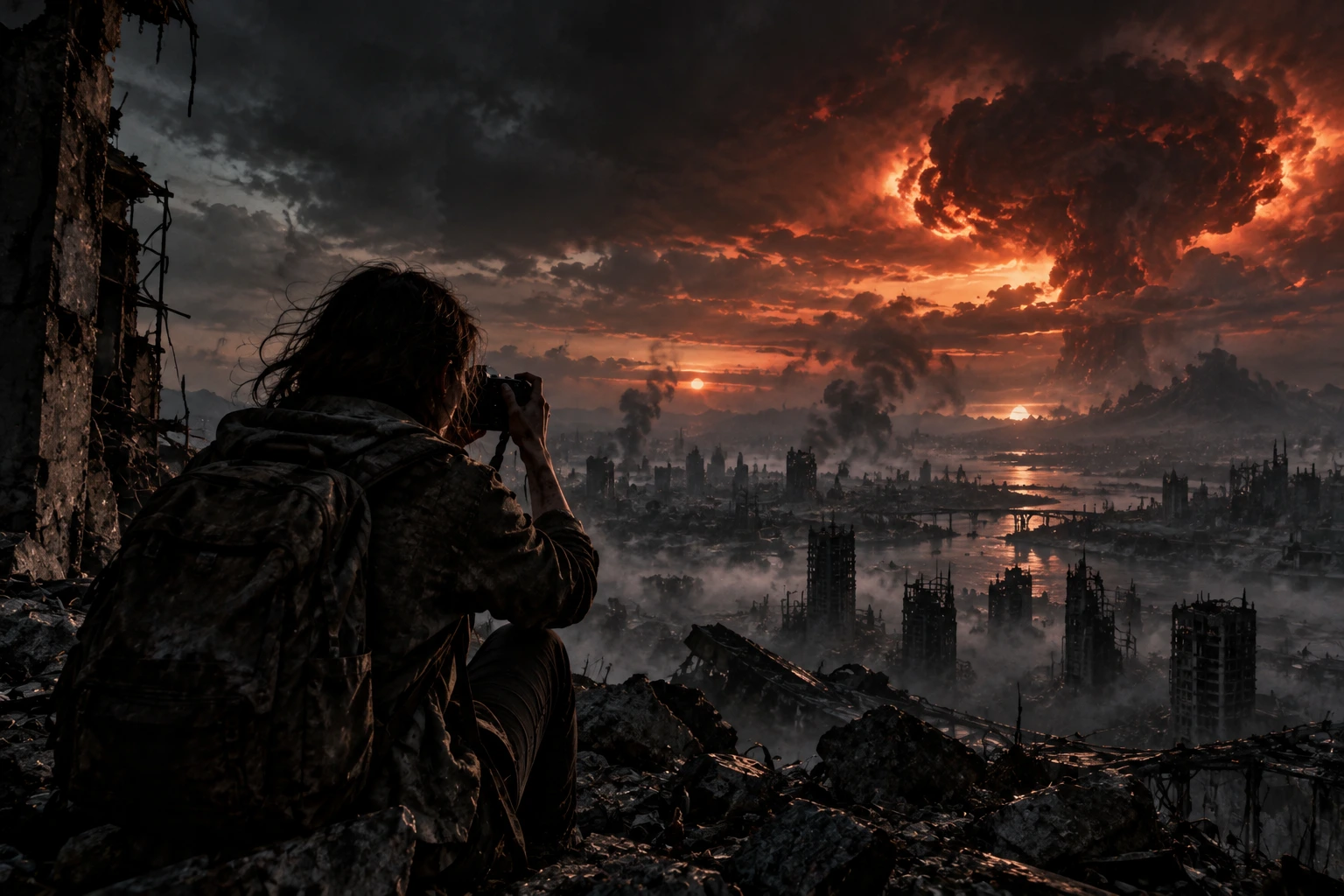
Imagine a gallery where every image ever created by humanity exists.
From the blurry photograph of the early 1800s to the famous Earthrise picture taken from the moon, portraits of loved ones, selfies, wedding photos, pictures of pets, sunsets, wars, birthdays, and galaxies.
Now imagine going to the very end of this gallery.
There is one image, which is the last photograph ever taken by a human.
It may not be the best picture, or the most iconic, simply the last.
A weird question, yes, but one that touches on technology, sociology, astronomy, and philosophy.
Every civilization leaves behind artifacts for posterity to find and wonder at: the Egyptian pyramids or Roman roads.
The most prolific artifact humans seem likely to leave behind, though, is photos.
As of right now, billions of photos are being sent to phones every day.
Phones have turned photography into a constant background activity for many people.
Humans have largely entered the era where we document ourselves on a moment-by-moment basis.
There will, of course, be a final photograph, one way or another.
What would the last photograph taken by a human be?
The answer may say something surprising about us.
A Species Obsessed With Recording Itself
Photography is, in a cosmic sense, quite new.
For most of human history, things simply happened, and then they were gone.
You could paint a memory or write it down, but the only way to preserve a moment was to capture a picture of it.
Photography changed our relationship with time and memory forever.
Now, humans record almost everything.
Meals are photographed before being eaten.
Vacations are documented with photos, as are graduations, fights, storms, and chance encounters.
Satellites are constantly taking photos of Earth from space, and photographs of other planets are being taken.
Security cameras record every day.
If there are future historians and archaeologists on the other side of history, they may conclude that the defining characteristic of modern humans is an obsession with documenting everything.
The reason this sort of question about the last photograph matters is because it’s possible the last photograph won’t be something specially chosen to be documented.
A few thousand years ago, the Roman Empire began its slow decline.
Few historians or archaeologists would claim the Romans really knew that it was happening while they watched it unfold.
Few people likely suspected they were the first and only western civilization to ever exist.
Likewise, if something were to happen that would lead to the death of the human race, no one would really suspect it at the moment it happened.
It would likely only seem obvious to future historians and archaeologists in retrospect.
Same with the last photograph ever taken by humans.
It may be something completely unassuming.
It may be an image no one thought twice about.
Why We Would Probably Not Know It Was the Last
Humans are notoriously bad at picking out the end of something while we’re actually observing it.
Few people really suspected they were living in the twilight of the Roman Empire.
The last passenger pigeon, too, was never photographed.
Few people knew that the passenger pigeon was going to be the last of its kind, until, of course, it was.
If the decline of the human race, for whatever reason, was to come suddenly, the last photograph taken by humans would likely simply be something unassuming.
Maybe you’d see a child playing in the park.
Maybe you’d see a busy street.
Perhaps you’d see a scientist working on something or a tourist taking a photograph of a mountain.
It would only seem to be important, perhaps, if anyone actually lived long enough to actually realize it was important.
In an odd way, the most historically significant photograph humans will likely ever take may end up being something that seems completely insignificant.
The Technology Problem
There’s another problem, of course: technology.
Humanity may well stop photographing things altogether.
Photography exists because our brains simply aren’t able to remember or recall every single memory.
Photographs are an external memory device.
However, new technology makes it possible humans may soon be able to remember everything we want to remember.
Some researchers are already working on ways for humans to store memories as data.
In other words, virtual reality.
If humans were to gain the ability to remember everything, to experience everything we want to experience, photography may cease to have any relevance.
If humans enter this strange technologically enhanced new age, the last photograph may well be taken long before the last human being dies.
A Photograph of Earth?
It’s easy to assume that the last photograph humans take would be some sort of dramatic image showing civilization descending into chaos or some sort of threat like a giant asteroid hurtling towards Earth.
However, human history shows us that this isn’t likely to be the case.
When photographs of Earth were first taken from the stars, they quickly became iconic.
Humans realized Earth was unique, special, and, for a brief moment in time, we looked at home.
Perhaps if humanity starts expanding outwards and living in other planets and systems, the last picture may not necessarily be a shot pointing outwards, but instead a look back at our home.
Imagine a lone human explorer many millennia in the future, traveling the stars.
They’re about to upgrade their ship to a more advanced model with better photographic abilities.
Before they leave, they decide to take a final shot with their current camera.
On the sensor is the tiny speck of Earth.
The pale, blue dot, hanging in the darkness of space, the birthplace of humanity.
The Loneliness Hypothesis
Another hypothesis worth considering, however, is the loneliness hypothesis.
Perhaps the last photograph taken by humans was taken by a single human being.
Maybe the human race does not die out, but instead dwindles away until there’s only one human left.
There are many ways for extinction to happen.
It can be sudden, or it can be over the longer term.
Many species have died out due to population loss.
What would the last human photograph look like if there was only one human left?
Would it be a self-portrait?
Would it be a shot of the stars?
Would it be a reminder to themselves that they are not alone?
Every photograph taken by humans has always assumed there will be someone to see it someday.
Perhaps the last photograph ever taken by the last human being to ever live will be the first photograph in history that has no assumed audience.
The AI Witness
It’s entirely possible that humanity may cease to exist and not be aware of it.
Humans can also expect to be overtaken by artificial intelligence at some point in the future.
Researchers who study the long-term future of technology have considered the possibility that AI systems may survive long after the death of the human race itself.
If this were to happen, the last photograph by a human may potentially stay preserved in some database.
Perhaps it would never be viewed by anyone because there would be no one left to view it.
This would make the photograph an archaeological anomaly.
A relic not of humans, because no humans remained, but instead of the AI that had taken over after humans had disappeared.
The most likely answer is surprisingly mundane.
Science fiction loves dramatic finales, but the reality of life is much more mundane.
Looking at the history of the human race, the most likely candidate for the last human photograph is something that would be completely unassuming.
It would be something normal to the person taking it.
The last photograph would be significant not because of what was in the field of view, but rather because of what would come next.
The last image humans took would be, in many ways, the same as just about every other photograph taken in the history of humanity.
What the Question Says About Us
Perhaps the most interesting part of the question is asking it to begin with.
Humans are unique among the species on Earth in that we’re aware of the possibility of endings.
We know civilizations die out someday, species eventually go extinct, and stars burn out and die.
We’re aware that our own lives will end someday.
Photography is, in many ways, a rebellion against time.
Every image that humans take simply says “this moment existed”.
We photograph birthdays because children grow up and become adults.
We photograph our loved ones because life is short.
We photograph discoveries because human memory is not perfect.
The existence of the last photograph is guaranteed if humanity lasts long enough to take it, but that fact is not necessarily a sad one.
It’s a testament to how long human civilization may stretch across history.
It is also true that there were countless photographs before the very last one.
In some strange way, that means the photograph would not be an end, but rather a kind of fulfillment.
The Frame That Closes Human History
At some point in the future, long after humans have existed, maybe centuries or millennia from now, a person will take the final photograph ever taken by a human.
They may not even know at the time that it’s the final one.
It may be something remarkable or something mundane.
It may be a picture of another planet, or of a loved one, or a road, or a sunrise.
Whatever is in that image, however, will mark the end of one of the most fascinating acts of human life: freezing a moment in time on film.
If this photograph is ever discovered, it will not only be a fascinating piece of history, but also an end to a long tradition.
The last photograph ever taken by a human will likely be a final statement that, for a long while, there were sentient beings on this planet who looked at the universe and felt a strange compulsion to record what they saw.


