

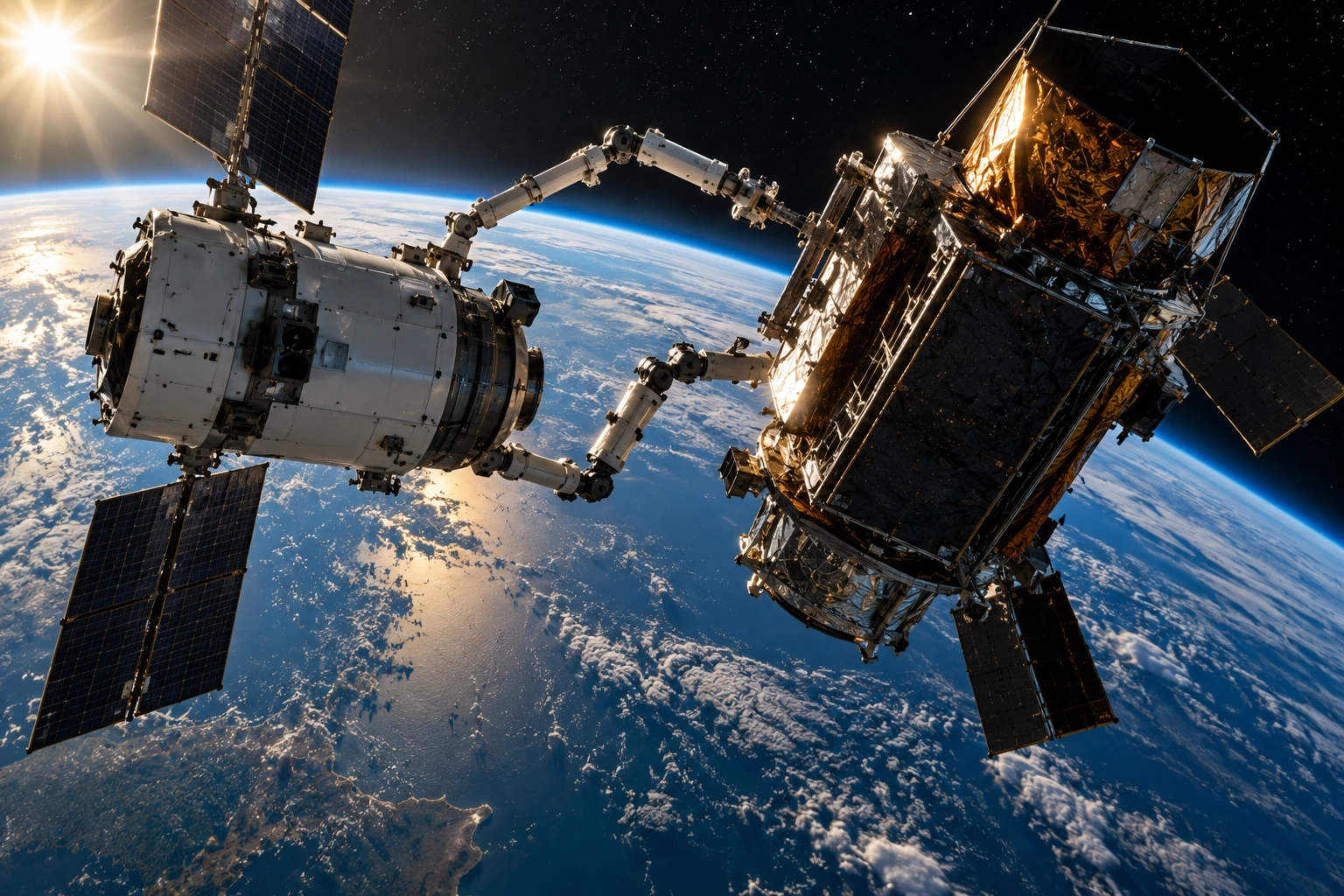
NASA’s attempt to save a dying space telescope didn’t succeed. Yet the mission may mark the beginning of an entirely new era in orbit.
Space history is filled with spectacular successes.
The Moon landing.
The Hubble Space Telescope.
The Mars rovers.
But some of the most important moments in exploration aren’t victories. They’re failures that reveal what comes next.
In 2026, NASA and private aerospace company Katalyst Space Technologies attempted something that had never been done before: rescue an aging satellite already in orbit and give it a second life.
The target was the Neil Gehrels Swift Observatory, a space telescope that has spent more than two decades studying some of the most violent events in the universe. The plan was ambitious. A robotic spacecraft called LINK would rendezvous with Swift, capture it, and push it into a higher orbit, extending its scientific mission for years.
It didn’t work.
Technical failures aboard the rescue spacecraft forced NASA to abandon the effort before the orbital boost could be completed. Swift is now expected to re-enter Earth’s atmosphere later this year.
On paper, that sounds like a failed mission.
In reality, it may be remembered as the moment satellite servicing became a serious part of humanity’s future in space.
Why NASA Tried to Save Swift
The Swift Observatory was never supposed to last this long.
Launched in 2004, the spacecraft was designed to study gamma-ray bursts—brief but extraordinarily powerful explosions occurring across the universe. Over the years, Swift exceeded expectations, helping astronomers investigate black holes, neutron stars, supernovae, and other extreme cosmic events.
Like many satellites in low Earth orbit, however, Swift faced an unavoidable problem.
Earth’s atmosphere doesn’t end abruptly. Even hundreds of kilometers above the surface, traces of atmospheric particles create drag. Over time, that drag slowly pulls satellites downward.
Most modern spacecraft carry enough fuel to perform orbital corrections.
Swift does not.
After more than two decades in orbit, the telescope was gradually losing altitude. Solar activity accelerated the process, bringing the spacecraft closer to the end of its operational life.
NASA faced a choice.
Allow a valuable scientific asset to die.
Or attempt something unprecedented.
The agency chose the second option.
Enter LINK: The Space Tow Truck
The rescue mission centered on a robotic servicing spacecraft called LINK.
Built by Katalyst Space Technologies under a $30 million NASA contract, LINK was designed to perform one of the most difficult maneuvers in spaceflight: approaching another spacecraft, matching its orbit, capturing it, and then altering its trajectory.
This may sound straightforward.
It isn’t.
Imagine trying to dock with a moving object traveling more than 27,000 kilometers per hour while both vehicles orbit Earth.
Now imagine doing it autonomously, without astronauts physically guiding the process.
That’s the challenge orbital servicing missions face.
The margin for error is tiny.
A small mistake can destroy both spacecraft.
Yet if successful, the mission would have demonstrated that satellites no longer need to be abandoned simply because they run out of fuel.
That possibility attracted attention across the entire space industry.
The Mission Begins to Unravel
LINK launched in July 2026 with considerable expectations.
Soon after reaching orbit, however, problems emerged.
The spacecraft suffered attitude-control issues. Two of its reaction wheels failed, making it difficult to maintain stable orientation. Communication became intermittent, and engineers struggled to regain full control.
Every day spent troubleshooting consumed precious resources.
Most importantly, it consumed fuel.
Space missions operate under strict fuel budgets. A rescue spacecraft cannot simply stop at a cosmic gas station when things go wrong.
As engineers fought to stabilize LINK, the fuel available for the actual rescue steadily decreased.
Eventually, NASA reached a difficult conclusion.
The mission could no longer safely perform the orbital boost required to save Swift.
The rescue operation was officially canceled.
For many observers, the story appeared finished.
But something surprising happened next.
A Failure That Almost Succeeded
Even after the rescue was abandoned, LINK continued its approach.
Against considerable odds, the spacecraft managed to reach within approximately 15 kilometers of Swift and gathered valuable navigation and imaging data.
That distance may sound large.
In orbital mechanics, it’s remarkably close.
The spacecraft demonstrated key capabilities required for future servicing missions:
- Precision orbital navigation
- Autonomous rendezvous operations
- Close-proximity spacecraft tracking
- On-orbit inspection techniques
Those technologies are exactly what future satellite repair and refueling systems will need.
In other words, LINK failed at its primary objective but succeeded in proving that many of the underlying technologies are viable.
That’s why many engineers view the mission differently from the public.
The telescope wasn’t saved.
The concept was.
The Bigger Problem Above Earth
The significance of this mission becomes clearer when viewed against a larger backdrop.
Earth orbit is becoming crowded.
Thousands of active satellites currently circle the planet.
Thousands more are planned.
Many will eventually fail, run out of fuel, or become obsolete.
Traditionally, that has been accepted as normal.
Build a satellite.
Launch it.
Use it.
Replace it.
But that approach is expensive.
Modern satellites can cost hundreds of millions—or even billions—of dollars to design, launch, and operate.
Throwing them away because of a depleted fuel tank increasingly seems wasteful.
The industry is beginning to ask a different question:
What if satellites could be repaired instead?
Researchers have spent years studying robotic servicing, orbital repair, refueling systems, and space-debris management as ways to extend spacecraft lifetimes and reduce orbital waste.
The Swift rescue mission became one of the first real-world attempts to move those ideas beyond theory.
Space Has Seen Repairs Before
The concept of rescuing spacecraft isn’t entirely new.
NASA famously repaired the Hubble Space Telescope multiple times using astronauts aboard the Space Shuttle.
Those servicing missions transformed Hubble from a troubled telescope into one of the most productive scientific instruments in history.
But there was a catch.
Human servicing missions are extremely expensive.
They also require astronauts.
And today, there is no operational Space Shuttle.
That reality has pushed engineers toward robotic alternatives.
Interestingly, NASA’s history includes another notable satellite rescue effort. In 1984, astronauts aboard Space Shuttle Challenger repaired the Solar Maximum Mission satellite after a difficult and initially unsuccessful capture attempt. The mission ultimately succeeded and extended the spacecraft’s life by years.
The difference today is that robots are attempting to perform tasks once reserved for astronauts.
If they succeed consistently, the economics of spaceflight could change dramatically.
The Birth of an Orbital Service Industry
Many experts believe the future space economy will depend heavily on in-orbit servicing.
Instead of launching entirely new spacecraft, operators could:
- Refuel aging satellites
- Replace failed components
- Upgrade onboard systems
- Relocate satellites to new orbits
- Remove dangerous debris
The comparison often used is aviation.
Modern airlines do not discard aircraft after every flight.
Planes undergo maintenance, repairs, inspections, and upgrades throughout their operational lives.
Satellites may eventually follow a similar model.
The Swift mission offered a glimpse of that future.
Even though the rescue itself failed, it demonstrated that governments and private companies are willing to invest in orbital maintenance infrastructure.
That shift may prove more important than saving a single telescope.
Why Failure Matters in Space Exploration
Space exploration has never been a straight path.
Many technologies considered routine today emerged from early failures.
Reusable rockets were once viewed as unrealistic.
Autonomous spacecraft docking was once experimental.
Planetary landings routinely failed before becoming more reliable.
The same pattern may apply to satellite servicing.
The LINK mission was assembled rapidly—within about nine months—an extraordinarily short timeline for a spacecraft designed to perform a highly complex orbital operation.
Rapid development inevitably carries risk.
Engineers now possess real-world data about what worked, what failed, and what must improve.
Future servicing spacecraft will likely benefit directly from those lessons.
That’s often how progress happens in aerospace.
One mission teaches the next.
The Day Space Became Repairable
Years from now, most people probably won’t remember the technical details of LINK’s reaction-wheel failure.
They may not remember the exact date the rescue was canceled.
They may not even remember Swift itself.
What they might remember is that this was one of the first serious attempts to treat satellites not as disposable machines, but as infrastructure worth maintaining.
That’s a profound change in thinking.
For the first six decades of the Space Age, humanity largely operated under a launch-and-replace model.
The coming decades may look very different.
Future spacecraft could be serviced, upgraded, refueled, repaired, and even rescued by robotic vehicles operating far above Earth.
The Swift telescope likely cannot be saved now. Its journey is approaching its final chapter.
But the idea behind the mission survived.
And sometimes, in the history of exploration, the survival of an idea matters far more than the success of a single mission.


