

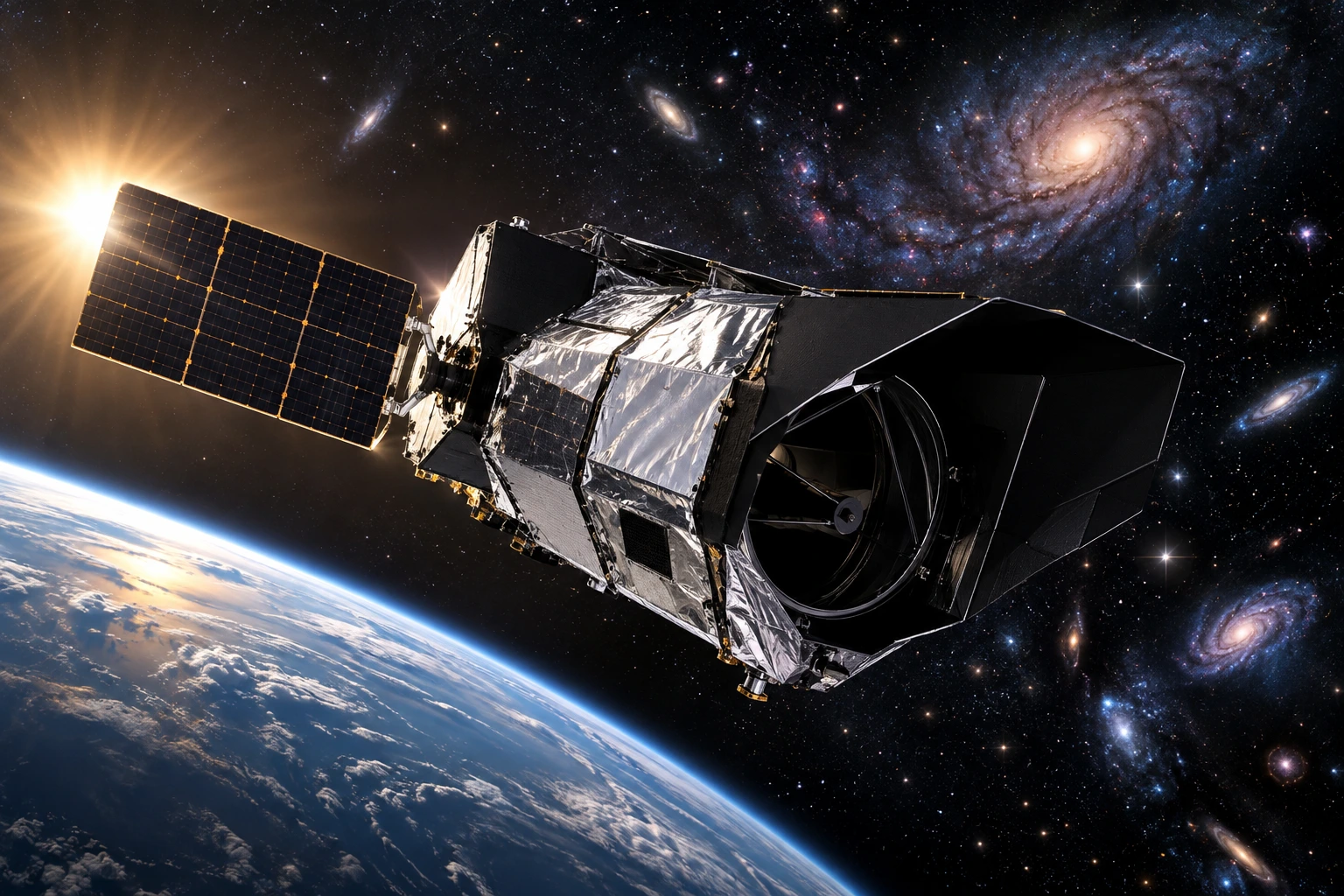
A million miles from Earth, a new cosmic detective is waking up.
NASA’s Nancy Grace Roman Space Telescope has begun activating its instruments as it travels toward its permanent observation post in deep space. One of its most important technologies—the Roman Coronagraph Instrument—has already powered on successfully, marking a major milestone in the observatory’s commissioning process. What was recently a spacecraft on a rocket is now beginning its transformation into one of the most ambitious astronomical observatories ever built.
Imagine standing on a mountain overlooking a vast city.
Hubble is like examining one building through a powerful zoom lens.
Roman is like photographing the entire city while still being able to see the windows.
That ability changes everything.
Instead of studying a handful of objects, Roman will study millions.
Instead of examining individual galaxies, it will map huge portions of the universe.
And when scientists suddenly gain access to that much data, unexpected discoveries often follow.
A Mission Aimed at the Universe’s Greatest Mystery

Most people assume astronomers understand what the universe is made of.
In reality, they understand only a small fraction of it.
Ordinary matter—the stars, planets, gas clouds, and galaxies we can see—accounts for only a tiny percentage of the cosmos.
The rest appears to consist of two invisible components: dark matter and dark energy.
Dark matter acts like an invisible scaffold holding galaxies together. Dark energy appears to be pushing the universe apart at an accelerating rate. Together, these mysterious ingredients dominate the cosmos, yet nobody knows exactly what they are.
Roman was specifically designed to help solve this puzzle.
The telescope will survey billions of galaxies and create one of the most detailed maps of the universe ever assembled. By tracking how galaxies cluster together across vast distances and cosmic time, scientists hope to better understand how dark matter shapes the universe and whether dark energy behaves the way current theories predict.
The implications could be enormous.
If Roman detects inconsistencies in existing models, physicists may be forced to revise some of the fundamental assumptions underlying cosmology.
Building a 3D Map of the Cosmos
One of Roman’s most ambitious goals is creating a gigantic three-dimensional map of the universe.
This isn’t just a catalog of galaxies.
It’s an attempt to reconstruct the large-scale architecture of cosmic history itself.
By measuring the positions and distances of billions of galaxies, Roman will help scientists visualize how the universe evolved over billions of years. Researchers will be able to examine how matter accumulated, how galaxy clusters formed, and how cosmic expansion changed over time.
Astronomers often compare the universe to a giant web.
Galaxies aren’t scattered randomly through space. They form filaments, clusters, and enormous structures connected across unimaginable distances.
Roman will provide one of the clearest views yet of this cosmic web.
And hidden within that map could be clues to forces we don’t yet understand.
Hunting for More Than 100,000 New Worlds

Dark matter and dark energy may dominate headlines, but Roman’s search for planets could prove equally revolutionary.
Scientists expect the observatory to discover more than 100,000 exoplanets—worlds orbiting stars beyond our solar system. Some of these planets may resemble worlds already known to astronomers. Others could represent entirely new categories of planetary systems.
Particularly exciting is Roman’s ability to detect planets that many other observatories struggle to find.
These include distant worlds orbiting far from their stars and rogue planets wandering through space without any parent star at all.
Imagine a planet drifting alone through the darkness between star systems.
No sunrise.
No sunset.
No nearby sun.
Astronomers suspect billions of such worlds may exist in the Milky Way.
Roman could help reveal just how common they really are.
The Technology That Could Transform the Search for Alien Worlds
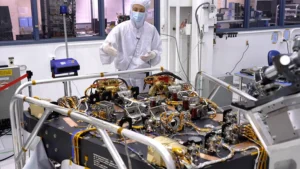

Perhaps Roman’s most fascinating instrument is the coronagraph.
This sophisticated device is designed to block a star’s overwhelming glare so astronomers can directly observe faint objects nearby. The coronagraph that recently powered on during commissioning is considered one of the most advanced space-based planet-imaging technologies ever developed.
The challenge is difficult to overstate.
Trying to photograph an exoplanet next to its star is often compared to spotting a tiny firefly beside an enormous floodlight.
Normally the star completely overwhelms the planet’s reflected light.
Roman’s coronagraph uses sophisticated masks, mirrors, and wavefront-control technology to suppress starlight and expose objects that would otherwise remain invisible.
While the instrument is officially considered a technology demonstration, many scientists see it as something much bigger.
It’s a preview of the technologies future observatories may use to directly image Earth-like planets orbiting distant stars.
In other words, Roman may help lay the groundwork for the telescopes that eventually search for signs of life beyond our solar system.
Roman, Hubble, and Webb: A Powerful Cosmic Team
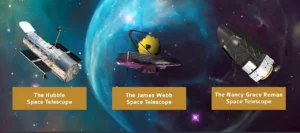

Roman is often described as a successor to Hubble.
In reality, it’s better understood as part of a team.
Hubble excels at detailed observations.
James Webb specializes in studying faint and distant objects from the early universe.
Roman will provide the wide-angle perspective neither telescope can achieve efficiently. Its field of view is more than 100 times larger than Hubble’s, allowing it to rapidly identify targets worthy of deeper investigation.
Think of Roman as the scout.
It surveys vast cosmic territory, identifies unusual objects, and reveals patterns invisible at smaller scales.
Then Hubble and Webb can zoom in for closer examination.
Together, the three observatories will offer astronomers an unprecedented view of the universe.
The Possibility Nobody Can Predict
History shows that the most important discoveries are often the ones scientists weren’t looking for.
When Hubble launched, nobody expected it would reveal thousands of previously unknown galaxies in tiny patches of seemingly empty sky.
When astronomers first began studying exoplanets, they assumed most planetary systems would resemble our own.
Instead, they found bizarre worlds that challenged every expectation.
Roman may follow the same pattern.
Its enormous surveys will generate staggering amounts of data. Somewhere within those observations could be objects, structures, or phenomena that nobody has predicted.
Perhaps new types of planets.
Perhaps unexpected behavior in dark energy.
Perhaps evidence that our understanding of gravity remains incomplete.
The larger the survey, the greater the chance of finding surprises.
And Roman’s survey will be among the largest ever conducted from space.
The Beginning of a New Cosmic Census
The telescope is still months away from full science operations.
Engineers will continue calibrating instruments, testing systems, and fine-tuning performance as Roman approaches its destination near the Sun-Earth L2 point, roughly one million miles from Earth. Initial science images are expected after commissioning is completed.
Yet even now, astronomers can sense the significance of the moment.
The activation of Roman’s instruments represents the first step in a mission that could catalog billions of galaxies, discover more than 100,000 worlds, and shed new light on mysteries that have puzzled scientists for generations.
Some telescopes help us see farther.
Others help us see more clearly.
Roman may do something even more important.
It may show us parts of the universe we didn’t know existed.


