

Few lost artifacts have captured the world’s imagination quite like the Ark of the Covenant.
For thousands of years, the legendary object has occupied a unique place at the intersection of history, archaeology, religion, and mystery. It has inspired explorers, historians, theologians, treasure hunters, and filmmakers. Entire expeditions have been launched in search of it. Books have been written about it. Documentaries continue to debate its fate.
Yet despite centuries of searching, nobody has conclusively found it.
Or at least, nobody has presented evidence that has convinced the wider scholarly community.
That uncertainty has transformed the Ark of the Covenant into one of history’s greatest unsolved mysteries.
Was it destroyed long ago?
Was it hidden to protect it from invading armies?
Could it still be concealed in an undiscovered chamber beneath an ancient city?
Or does it survive in a location known only to a small group of guardians?
The truth remains elusive.
What is certain is that the Ark of the Covenant remains one of the most famous missing artifacts ever described, and the search for it continues to this day.
What Was the Ark of the Covenant?
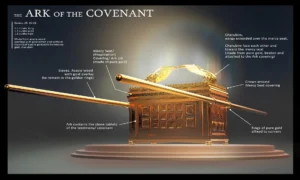
According to the Hebrew Bible, the Ark of the Covenant was a sacred chest constructed during the Israelites’ journey through the wilderness after the Exodus from Egypt.
Descriptions in the Book of Exodus portray it as a wooden chest made from acacia wood and overlaid with gold. It featured two gold cherubim on its lid, known as the Mercy Seat, where God’s presence was believed to manifest. The Ark was designed to hold the stone tablets associated with the Ten Commandments. (britannica.com)
The Ark occupied a central place in Israelite religious life.
It was not merely a ceremonial object.
It represented a covenant between God and the people of Israel and was regarded as one of the holiest objects in the ancient world.
Biblical accounts describe the Ark being carried by priests during important events and playing a significant role in religious ceremonies. (britannica.com)
Whether one approaches the subject from a religious or historical perspective, there is no doubt that the Ark held immense cultural significance.
The Ark’s Journey Through Ancient History
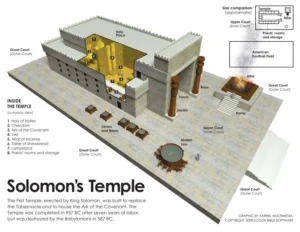
Biblical narratives trace the Ark through several important periods of ancient Israelite history.
The Ark was reportedly housed in a portable sanctuary known as the Tabernacle before eventually being brought to Jerusalem by King David. Later, it was placed within the First Temple built by King Solomon. (britannica.com)
The Temple became the spiritual center of the Kingdom of Judah.
According to tradition, the Ark was kept within the Holy of Holies, the innermost sanctuary of the Temple and its most sacred location.
Then something happened.
The historical trail begins to fade.
References to the Ark become increasingly scarce.
Eventually, it disappears from the historical record altogether.
And that disappearance is what transformed it from a religious object into one of history’s greatest mysteries.
The Moment the Ark Vanished
One of the most important events in ancient Near Eastern history occurred in 586 BCE.
That year, the Babylonian king Nebuchadnezzar II conquered Jerusalem and destroyed Solomon’s Temple. Historical records confirm the destruction of the city and the exile of many inhabitants. (britannica.com)
The problem is that surviving records do not clearly state what happened to the Ark.
Ancient inventories list numerous treasures taken from the Temple.
The Ark is not explicitly mentioned among them. (jewishvirtuallibrary.org)
This omission has fueled centuries of speculation.
If the Babylonians captured it, why wasn’t it listed?
If they destroyed it, why was that fact not recorded?
If priests hid it before the city’s fall, where did they take it?
These questions remain unanswered.
And because there is no definitive historical account of the Ark’s fate, competing theories have flourished.
Theory One: The Ark Was Destroyed
Many historians consider the simplest explanation the most likely.
The Ark may have been destroyed during the Babylonian conquest.
Ancient warfare was devastating.
Cities burned.
Temples were looted.
Sacred objects disappeared.
The destruction of Solomon’s Temple was catastrophic, and countless artifacts were lost. (britannica.com)
From this perspective, the Ark may simply have shared the fate of countless other objects from antiquity.
The challenge is that no direct evidence confirms this scenario.
No surviving Babylonian record states that the Ark was destroyed.
No archaeological discovery has resolved the question.
As a result, alternative theories continue to attract attention.
Theory Two: Hidden Beneath Jerusalem
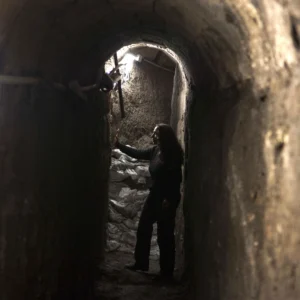
Perhaps the most popular theory suggests that the Ark was hidden before Jerusalem fell.
According to various traditions, priests may have concealed it within tunnels, chambers, or secret storage locations beneath the Temple Mount.
This theory appeals to many people because it offers a dramatic possibility:
The Ark could still exist.
Jerusalem is known to contain extensive underground structures from multiple historical periods. Archaeologists have documented tunnels, cisterns, chambers, and hidden spaces beneath parts of the ancient city. (israelmuseum.org.il)
However, investigating beneath the Temple Mount presents enormous challenges.
The area is one of the most religiously and politically sensitive sites on Earth. Archaeological excavations are highly restricted, making it difficult to test many claims associated with hidden chambers. (nationalgeographic.com)
As a result, theories about secret underground locations remain largely speculative.
Theory Three: The Ethiopian Connection
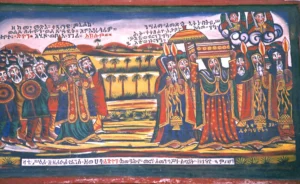
One of the most famous and enduring claims comes from Ethiopia.
According to Ethiopian Orthodox tradition, the Ark of the Covenant was transported to Ethiopia centuries before the Babylonian destruction of Jerusalem.
The tradition is recorded in the Kebra Nagast, an important Ethiopian text that tells the story of Menelik I, who is described as the son of King Solomon and the Queen of Sheba. According to the narrative, the Ark eventually came to Ethiopia and remains there today. (britannica.com)
The claimed location is the Church of Our Lady Mary of Zion in Aksum.
According to the tradition, a single guardian monk protects the Ark and is the only person permitted to view it. (britannica.com)
The claim has attracted enormous international attention.
However, independent verification has never been allowed.
Researchers have not been permitted to examine the object directly.
As a result, historians and archaeologists remain unable to confirm or refute the claim conclusively.
Theory Four: Hidden on Mount Nebo
Another tradition appears in ancient Jewish texts.
According to one account, the prophet Jeremiah hid the Ark before the Babylonian invasion.
The story suggests that the Ark was concealed in a cave on Mount Nebo, located in modern-day Jordan. (britannica.com)
The account has inspired searches for centuries.
Yet despite repeated investigations, no evidence confirming the Ark’s presence on Mount Nebo has been discovered.
The theory remains part of the larger mystery.
Interesting.
Possible.
Unproven.
Archaeology and the Search for Evidence
The search for the Ark occupies a unique position in archaeology.
Unlike many ancient artifacts, the Ark’s existence is primarily documented through religious texts rather than surviving physical evidence.
This creates a challenge.
Historians generally distinguish between what can be demonstrated through archaeology and what is known through textual traditions.
Archaeologists have uncovered extensive evidence relating to ancient Israel, Judah, Jerusalem, and neighboring civilizations. They have discovered inscriptions, buildings, seals, pottery, and numerous artifacts connected to the biblical world. (israelmuseum.org.il)
But no verified archaeological discovery of the Ark has ever been announced.
That absence does not necessarily prove it never existed.
Ancient artifacts disappear all the time.
It simply means that, so far, the physical evidence remains elusive.
Why the Ark Fascinates People
The mystery of the Ark endures because it combines several powerful elements.
History.
Religion.
Archaeology.
Adventure.
The possibility of discovery.
Unlike many lost objects, the Ark carries enormous symbolic significance.
For believers, it represents a sacred connection to biblical history.
For historians, it offers a fascinating puzzle.
For archaeologists, it is one of the most sought-after missing artifacts of antiquity.
For the public, it represents the possibility that one of history’s greatest treasures might still be waiting to be found.
Very few objects occupy all of those categories simultaneously.
Modern Expeditions and Claims
Over the last century, numerous individuals and organizations have claimed to have located the Ark.
Some have pointed to caves.
Others have identified ancient tunnels.
A few have announced sensational discoveries.
None of these claims has produced evidence accepted by the broader scholarly community.
This pattern is common in archaeology.
Extraordinary discoveries require extraordinary evidence.
The more significant the claim, the stronger the evidence must be.
So far, no claim has met that standard.
The mystery therefore remains unresolved.
Could the Ark Still Exist?
This is the question that continues to drive interest.
The answer depends largely on which historical scenario is correct.
If the Ark was destroyed during the Babylonian conquest, it no longer exists.
If it was captured and melted down, it is gone.
If it was hidden and forgotten, it may still await discovery.
If Ethiopian tradition is correct, it may already reside in a known location.
At present, historians do not possess enough evidence to choose conclusively among these possibilities.
Uncertainty remains.
And uncertainty fuels curiosity.
The Broader Historical Importance
Even if the Ark were never found, its significance would remain enormous.
The Ark influenced religious traditions for thousands of years.
It appears in sacred texts.
It shaped cultural memory.
It inspired art, literature, and scholarship across multiple civilizations.
Its impact extends far beyond the question of whether the object survives physically.
In many ways, the Ark’s legacy has already endured longer than most ancient artifacts ever could.
A Mystery That Refuses to Disappear
History is full of lost treasures.
Most eventually fade into obscurity.
The Ark of the Covenant is different.
More than 2,500 years after it vanished from the historical record, people continue searching for answers.
The mystery survives because the evidence is incomplete.
Theories remain plausible.
Questions remain open.
And the possibility of discovery remains alive.
Every archaeological breakthrough, every newly translated text, and every fresh investigation has the potential to reveal something previously unknown.
Perhaps one day a hidden chamber will be uncovered.
Perhaps an ancient document will emerge from an archive.
Perhaps evidence will finally resolve one of history’s oldest debates.
Until then, the Ark of the Covenant remains exactly what it has been for centuries:
A missing artifact surrounded by mystery, faith, history, and speculation.
And one of the greatest unsolved puzzles of the ancient world.
The Search Continues
The story of the Ark of the Covenant is ultimately a story about humanity’s relationship with the past.
We are drawn to mysteries because they remind us how much remains unknown.
Despite satellites, advanced archaeology, artificial intelligence, and modern technology, some questions continue to resist easy answers.
The Ark is one of those questions.
It stands at the crossroads of history and legend.
Some believe it is hidden.
Others believe it was lost forever.
Many simply want to know the truth.
For now, that truth remains out of reach.
But as long as the mystery survives, so will the search.


