

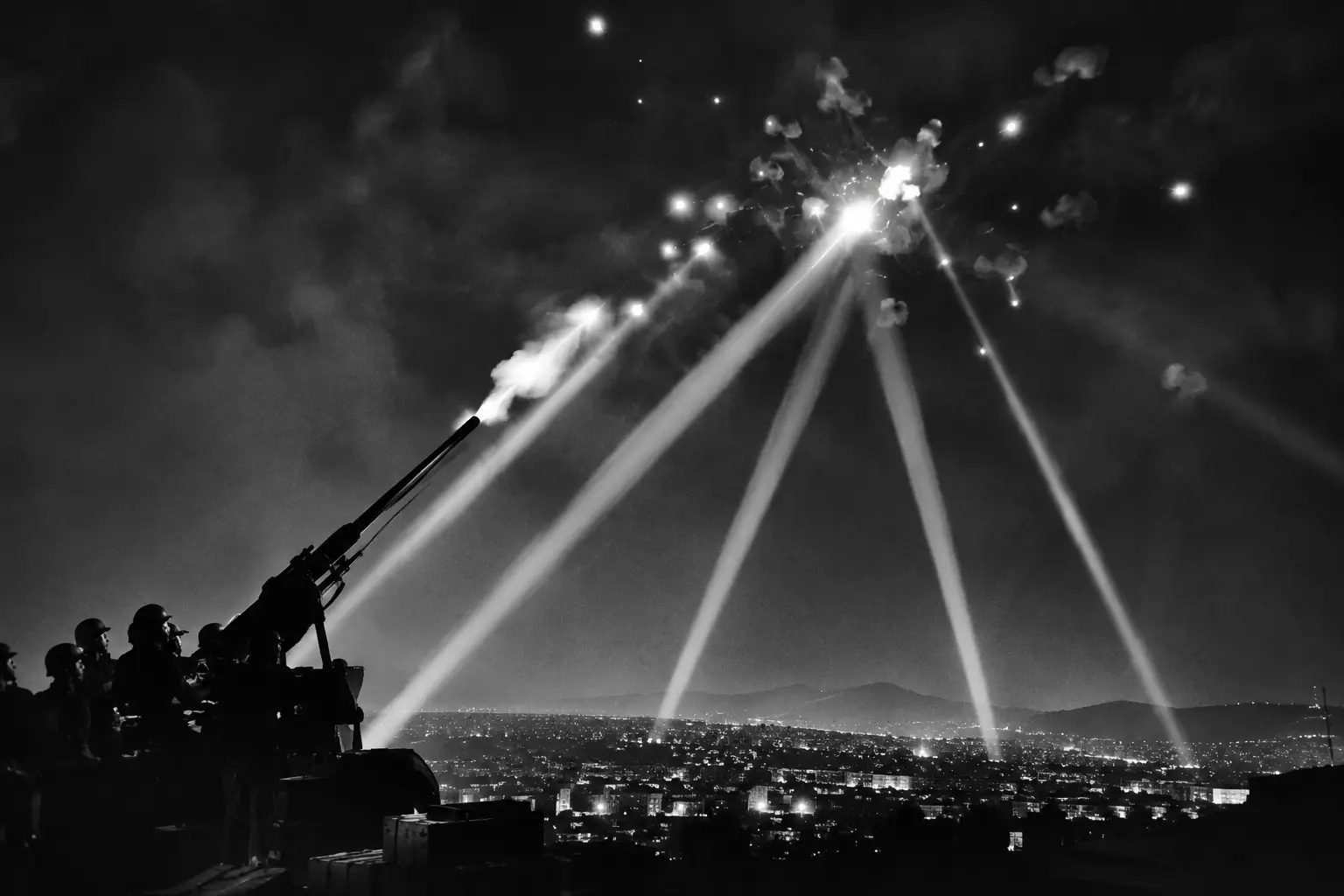
Just before dawn on February 25, 1942, Los Angeles became a battlefield.
Air raid sirens screamed across the city. Searchlights sliced through the darkness. Anti-aircraft guns thundered from military positions along the California coast. For more than an hour, American forces fired approximately 1,400 rounds of ammunition into the night sky. Residents watched explosions bloom above their homes while rumors spread that Japanese aircraft were attacking the West Coast.
Then daylight arrived.
No wreckage was found. No enemy aircraft were confirmed. No bombs had been dropped. Yet one of the largest anti-aircraft barrages ever fired over the continental United States had already taken place.
More than eight decades later, the “Battle of Los Angeles” remains one of World War II’s most enduring mysteries. Historians generally view it as a wartime false alarm amplified by fear, confusion, and misidentification. However, a central question continues to fascinate researchers and the public alike:
What exactly were military personnel firing at?
America Was Already on Edge
To understand the incident, it is necessary to return to the tense winter of 1942.
The United States had entered World War II less than three months earlier following the Japanese attack on Pearl Harbor. Across the West Coast, fears of a Japanese invasion or bombing raid were widespread. Military commanders expected further attacks against American territory and infrastructure.
Those fears intensified on February 23, 1942, when the Japanese submarine I-17 surfaced near Santa Barbara and shelled the Ellwood Oil Field. Although the attack caused limited damage, it marked one of the first enemy bombardments of the U.S. mainland during the war. Military personnel throughout California were immediately placed on heightened alert.
Against that backdrop, almost any unusual sight or radar contact had the potential to trigger alarm.
The Night the Alarms Began
During the evening of February 24, military officials received intelligence suggesting that an enemy attack on Southern California was possible. Reports of strange lights and unidentified objects near defense installations added to growing anxiety.
Shortly after 2:00 a.m. on February 25, radar operators detected what appeared to be an unidentified target approaching Los Angeles from over the Pacific Ocean. Military units were placed on alert. A blackout order followed. Air raid sirens sounded throughout Los Angeles County.
Millions of residents suddenly found themselves standing in darkness.
Nobody knew whether enemy aircraft were actually approaching.
The Sky Erupts
At approximately 3:16 a.m., anti-aircraft batteries opened fire.
Searchlights converged on points in the sky while artillery crews launched shell after shell into the darkness. Witnesses later described an extraordinary scene: exploding ammunition, crisscrossing beams of light, and clouds of smoke illuminated by flashes from hundreds of detonations.
The barrage continued until roughly 4:14 a.m.
By the time the firing stopped, military units had expended around 1,400 anti-aircraft shells. Different historical sources cite totals ranging from approximately 1,400 to 1,447 rounds.
What makes the event extraordinary is not merely the amount of ammunition fired.
It is the fact that nobody could later agree on what the targets actually were.
Witnesses Saw Completely Different Things
One reason the Battle of Los Angeles remains controversial is the astonishing variety of eyewitness accounts.
Some military personnel and civilians reported seeing aircraft moving through searchlight beams. Others claimed to observe multiple objects traveling across the sky. A few witnesses believed enemy bombers were clearly visible.
Yet many observers—including experienced journalists and military officers—reported seeing nothing at all.
War correspondent Ernie Pyle and Los Angeles Times reporter Bill Henry both observed the barrage but later stated they could not identify any aircraft in the sky. Coast Artillery officer Colonel John G. Murphy similarly concluded that no enemy planes had been visible.
These contradictory accounts created a puzzle that has never been fully resolved.
Were some witnesses observing actual aircraft?
Or were people interpreting searchlights, smoke, shell bursts, and wartime anxiety as evidence of enemy attackers?
The Government Couldn’t Agree Either
Confusion was not limited to civilians.
Senior U.S. officials offered conflicting explanations almost immediately.
Secretary of the Navy Frank Knox publicly described the entire episode as a false alarm. According to his assessment, there had been no enemy attack and no hostile aircraft over Los Angeles.
The Army reached a different conclusion.
Secretary of War Henry Stimson suggested that unidentified aircraft may indeed have been present and stated that as many as several aircraft could have entered the area, possibly conducting reconnaissance.
Official military histories later noted that Army investigators believed between one and five unidentified aircraft may have triggered the firing, while the Navy maintained there had been no justification for the barrage.
The result was unusual:
Two branches of the U.S. government publicly disagreed about one of the most dramatic military incidents on the American mainland during World War II.
The Famous Photograph That Fueled UFO Theories
No discussion of the Battle of Los Angeles is complete without mentioning the famous newspaper photograph.
Published by the Los Angeles Times, the image appears to show multiple searchlights converging on a bright object in the night sky. Over the decades, the photograph became one of the most widely circulated images in UFO literature.
To UFO enthusiasts, the image seemed to capture an unidentified craft being targeted by military defenses.
However, photographic experts and historians have generally argued that the apparent object is likely the result of image enhancement, lighting effects, smoke, and the photographic limitations of the era rather than evidence of an extraterrestrial spacecraft. The original image looked substantially different from later reproduced versions.
Even so, the photograph helped transform the Battle of Los Angeles from a wartime mystery into a cornerstone of UFO folklore.
What Do Historians Think Happened?
Most professional historians do not believe Los Angeles was visited by alien spacecraft in 1942.
Instead, the dominant explanation combines several factors.
Wartime Anxiety
The attack on Pearl Harbor and the recent submarine shelling near Santa Barbara had created an atmosphere of extreme nervousness. Military personnel were expecting an attack and were primed to react quickly.
Radar Limitations
Radar technology in 1942 was still relatively new. False contacts and misidentifications were common, particularly along the West Coast during the early months of the war.
Weather Balloons
Several investigations suggested that meteorological balloons may have contributed to the initial alarm. Historical military reviews later pointed to weather balloons as a plausible trigger for the event.
Smoke and Optical Illusions
Once hundreds of shells began exploding overhead, visibility deteriorated dramatically. Searchlights reflected off smoke clouds, creating shapes and movements that observers could easily interpret as aircraft.
Together, these factors may have created a chain reaction in which military units genuinely believed they were engaging enemy targets that did not actually exist.
Yet One Mystery Refuses to Go Away
Despite the mainstream explanation, historians acknowledge that some aspects of the incident remain unclear.
Military records confirm that radar operators reported unidentified contacts before the shooting began. Witness testimony remains inconsistent. Army and Navy conclusions differed significantly. And no single explanation accounts perfectly for every report made that night.
Importantly, “unidentified” does not automatically mean extraterrestrial.
It simply means that investigators never reached a definitive conclusion regarding every observation associated with the event.
Many historical mysteries remain unresolved not because they involve extraordinary phenomena, but because evidence is incomplete and eyewitness testimony is unreliable.
The Battle of Los Angeles appears to fall into that category.
The Real Legacy of the Battle of Los Angeles
The most remarkable aspect of the Battle of Los Angeles may not be what was in the sky.
It may be what the event revealed about life during wartime.
A city of millions watched as fear, uncertainty, technology, and human perception collided in real time. Military personnel acted on radar reports, intelligence warnings, and visual observations. Civilians interpreted flashes and explosions through the lens of a nation recently attacked at Pearl Harbor. The result was a dramatic confrontation with an enemy that may never have existed.
By sunrise, anti-aircraft fragments had damaged buildings and vehicles, and several civilian deaths were linked to accidents and stress associated with the blackout and barrage. Yet no confirmed enemy aircraft were ever recovered.
More than 80 years later, the Battle of Los Angeles continues to occupy a unique place in American history—part military incident, part psychological case study, and part enduring mystery.
The guns fired. The shells exploded. The searchlights locked onto something—or seemed to.
But the identity of the target remains one of World War II’s most intriguing unanswered questions.


