

Evaluating the Pentagon’s AARO Framework: Reporting Protocols, Flaring Artifacts, and Open Cases
For years, the public conversation about UFOs has been dominated by a simple question:
Are we being visited by something non-human?
But inside the Pentagon, investigators are asking a very different question.
What exactly did the sensors detect?
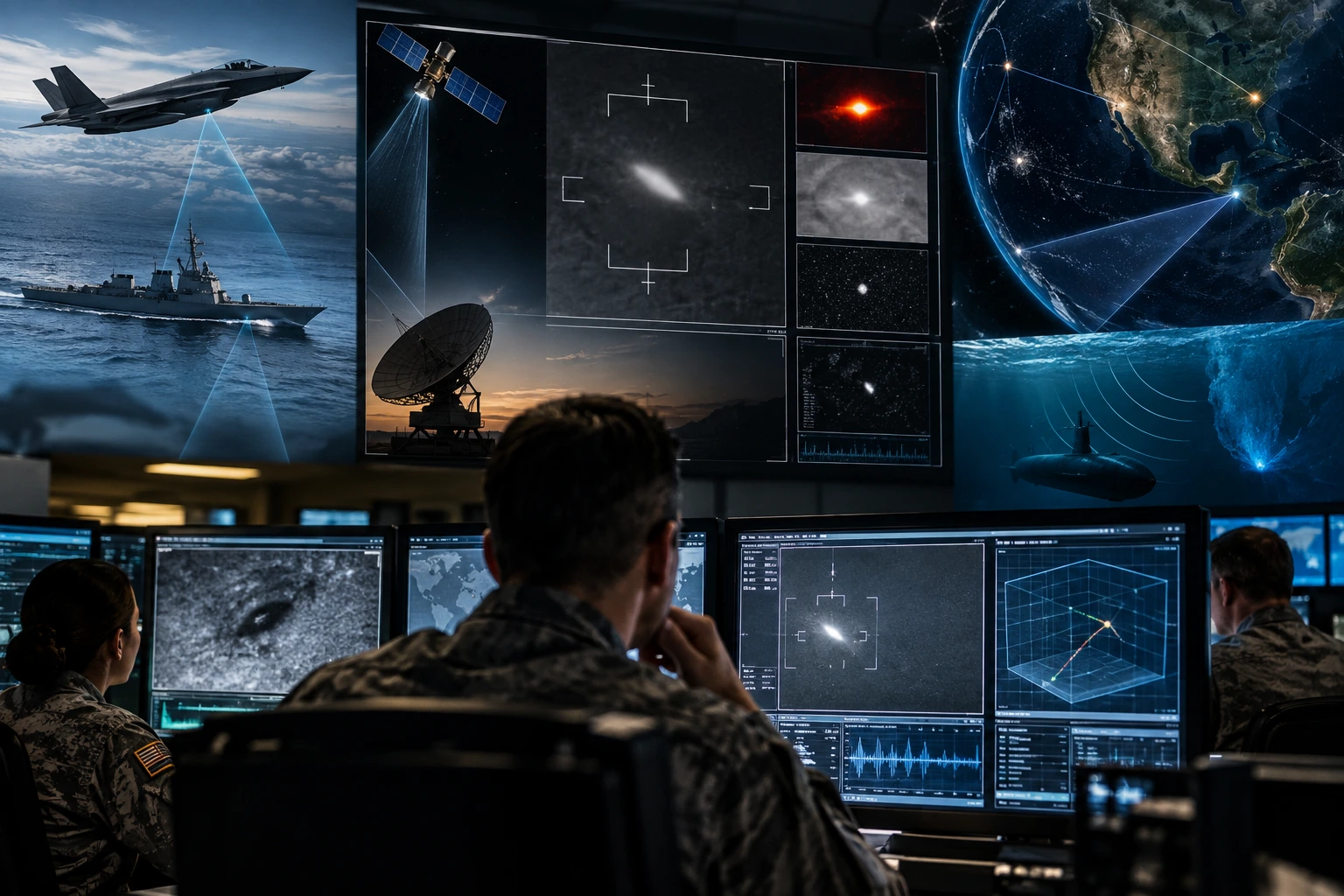
That distinction lies at the heart of the modern U.S. government’s approach to Unidentified Anomalous Phenomena (UAPs). While public debates often focus on extraterrestrial possibilities, the Pentagon’s All-domain Anomaly Resolution Office (AARO) operates more like a fusion center for aerospace intelligence, gathering enormous volumes of radar data, infrared imagery, electro-optical recordings, satellite observations, pilot testimony, and classified sensor feeds.
The office’s mission is not to prove or disprove alien visitation.
Its mission is to determine whether an observed anomaly represents a sensor artifact, an atmospheric phenomenon, a foreign surveillance platform, a classified domestic system, or something genuinely unexplained.
As UAP reports continue to emerge from military personnel around the world, understanding how AARO processes those reports reveals a far more sophisticated story than most disclosure narratives suggest.
The Birth of AARO
The creation of AARO represents the latest evolution of a decades-long effort to systematically investigate unexplained aerial incidents.
Earlier programs such as the Advanced Aerospace Threat Identification Program (AATIP) and the Unidentified Aerial Phenomena Task Force (UAPTF) generated significant public interest but faced criticism regarding data standardization, reporting consistency, and analytical methodology.
In 2022, the U.S. Department of Defense established the All-domain Anomaly Resolution Office to centralize anomaly investigations across multiple operational environments.
The term “all-domain” is important.
AARO’s responsibility extends beyond the skies.
The office investigates unusual observations reported in:
- Air domains
- Maritime environments
- Space operations
- Underwater regions
- Transitional zones where objects appear to move between domains
This broader mandate reflects modern security concerns, where advanced surveillance systems and emerging technologies often operate across traditional boundaries.
The Challenge of Modern Sensor Data
One of the biggest misconceptions surrounding military UAP reports is that investigators primarily analyze eyewitness testimony.
In reality, modern military investigations increasingly begin with sensor data.
Today’s aircraft, naval vessels, satellites, missile defense systems, and surveillance platforms generate staggering quantities of information every second.
A single event may involve:
- Active radar returns
- Passive radio-frequency detections
- Infrared tracking systems
- Optical cameras
- Satellite observations
- Electronic intelligence data
- Flight telemetry
- Pilot communications
The challenge is not a lack of information.
The challenge is determining which information accurately represents reality.
Modern sensors can produce false targets, tracking errors, atmospheric distortions, electronic interference, software anomalies, and optical illusions.
Before investigators can determine what an object was, they must determine whether an object existed at all.
The Multi-Sensor Verification Process
One of the most important aspects of the AARO UAP report framework is the emphasis on multi-sensor corroboration.
A single sensor detection rarely provides enough confidence to classify an event.
For example, a radar system might register a fast-moving target.
However, if no corresponding infrared signature, optical observation, or secondary sensor confirmation exists, analysts must consider alternative explanations.
These may include:
- Radar reflections
- Signal propagation anomalies
- Atmospheric ducting
- Electronic interference
- Software processing errors
The evidentiary value of a report increases significantly when multiple independent systems detect the same event simultaneously.
A target observed by radar, infrared sensors, and trained personnel becomes much more difficult to dismiss as a technical artifact.
This layered verification process forms the backbone of modern military UAP data analysis.
Why Camera Footage Often Misleads
Many of the most famous UFO videos released over the past decade initially appeared extraordinary.
Objects seemed to accelerate instantly.
Some appeared to rotate.
Others looked as if they were defying known aerodynamics.
Subsequent investigations frequently revealed a more complicated reality.
Advanced imaging systems operate within specific optical and computational constraints.
Camera zoom levels, stabilization algorithms, tracking software, sensor saturation, and perspective effects can dramatically alter the apparent behavior of a target.
AARO investigators routinely examine whether unusual motion results from:
- Parallax effects
- Sensor lock behavior
- Aircraft movement
- Optical distortion
- Environmental conditions
- Tracking system limitations
In several high-profile cases, seemingly impossible maneuvers were later attributed to combinations of camera geometry and platform motion.
This does not mean all reports are explained.
It means extraordinary visual appearances require rigorous technical validation.
The Role of 3D Reconstruction
One of the most significant advancements in Pentagon UFO investigation methodology involves three-dimensional event reconstruction.
Instead of relying on a single video frame, analysts attempt to recreate the entire geometry of an incident.
This process combines:
- Aircraft position data
- Sensor orientation
- Altitude measurements
- Speed calculations
- Environmental conditions
- Target trajectory estimates
The resulting model allows investigators to determine how an object would appear from multiple perspectives.
In many cases, behavior that initially looks extraordinary becomes understandable when reconstructed in three dimensions.
An object appearing to dart across the sky at extreme speeds may actually be moving much more slowly at a different distance than originally assumed.
Conversely, some events remain difficult to explain even after reconstruction.
These cases typically receive additional analytical attention.
Flaring Artifacts and Sensor Illusions
Among the most common sources of confusion in military UAP data are flaring artifacts.
Infrared systems, particularly those operating in complex atmospheric environments, can produce unusual visual signatures.
Heat sources may appear distorted due to:
- Temperature gradients
- Atmospheric turbulence
- Sensor blooming
- Lens effects
- Image-processing algorithms
Similarly, bright celestial objects can sometimes generate unexpected signatures.
Stars, planets, satellites, and distant aircraft may behave differently than expected when viewed through highly specialized military systems.
AARO analysts therefore spend considerable effort distinguishing genuine objects from sensor-generated phenomena.
This aspect of the process rarely attracts headlines, yet it represents one of the most important components of anomaly resolution.
National Security Comes First
Public fascination often centers on extraterrestrial explanations.
From a defense perspective, however, another possibility commands greater attention.
What if an unexplained object is not alien?
What if it belongs to a strategic competitor?
An unidentified aerial observation could potentially represent:
- Advanced surveillance technology
- Novel drone systems
- Electronic warfare platforms
- Hypersonic vehicles
- Intelligence collection assets
This is why many reports are treated as potential security concerns before they are treated as scientific mysteries.
The primary purpose of military UAP investigations is threat assessment.
Determining whether an anomaly reflects foreign technological advancement remains a central priority.
Open Cases and the Unknown Category
Despite extensive analytical efforts, not every report reaches a definitive conclusion.
This has fueled ongoing public interest in AARO’s findings.
Contrary to popular belief, “unresolved” does not necessarily mean “alien.”
It simply means the available evidence is insufficient to establish a high-confidence explanation.
Several factors can contribute to unresolved cases:
- Limited sensor coverage
- Incomplete recordings
- Poor environmental conditions
- Missing contextual data
- Conflicting observations
In intelligence analysis, uncertainty is not failure.
It is often the most honest conclusion available.
AARO’s framework reflects this principle by allowing some cases to remain open until additional evidence emerges.
The Geopolitical Dimension
The emergence of AARO reflects broader geopolitical realities.
Modern airspace has become increasingly crowded and technologically complex.
Military forces around the world are deploying:
- Autonomous drones
- AI-assisted reconnaissance systems
- Hypersonic vehicles
- Electronic warfare platforms
- Space-based surveillance assets
As a result, distinguishing between routine activity, foreign intelligence operations, sensor anomalies, and genuinely unusual events has become increasingly difficult.
The office therefore occupies a unique position at the intersection of:
- National security
- Aerospace engineering
- Intelligence analysis
- Data science
- Military operations
Its work is less about sensational revelations and more about maintaining situational awareness in an increasingly contested environment.
What AARO’s Data Pipeline Actually Reveals
Perhaps the most surprising lesson from AARO’s methodology is how much modern anomaly investigation resembles advanced data science.
The public often imagines investigators staring at mysterious videos.
In reality, analysts are more likely to be comparing telemetry streams, correlating radar returns, reconstructing trajectories, and evaluating sensor confidence scores.
The focus is not the mystery itself.
The focus is the reliability of the data.
Every report enters a structured pipeline:
- Collection
- Validation
- Corroboration
- Reconstruction
- Classification
- Threat assessment
- Archival review
Only after these stages can analysts determine whether an event reflects known phenomena, sensor limitations, national-security concerns, or a genuinely unresolved anomaly.
The process is methodical, technical, and often far less dramatic than public speculation suggests.
Beyond the Disclosure Narrative
The modern conversation surrounding UAPs often revolves around disclosure—what governments know and whether hidden information exists.
Yet AARO’s framework points toward a more nuanced reality.
The greatest challenge may not be secrecy.
It may be complexity.
The skies above military operations are monitored by some of the most sophisticated sensor networks ever created. Those systems generate vast quantities of data, but data alone does not guarantee understanding.
Every anomaly must pass through layers of verification, reconstruction, and analysis before conclusions can be reached.
In that sense, AARO’s most important contribution may not be proving extraordinary claims.
It may be establishing a rigorous scientific and intelligence-based framework for evaluating them.
As technology advances and sensor networks become even more capable, the future of UAP investigation will likely depend less on dramatic sightings and more on the quality of the information feeding the pipeline.
And in the world of modern aerospace intelligence, the difference between mystery and explanation often comes down to a single question:
Did the sensors truly see what observers believed they saw?


