

What Is MoM-BH*-1? How Supermassive Cocooned Cores Reframe Galactic Evolution
For decades, astronomers believed they understood the basic sequence of cosmic growth. First came stars. Then galaxies. Somewhere later, black holes emerged and slowly grew into the supermassive monsters found at the centers of galaxies today.
Then the James Webb Space Telescope (JWST) arrived and shattered that comfortable timeline.
When Webb peered into the distant universe, it revealed hundreds of mysterious objects that shouldn’t have existed. They appeared as tiny crimson points scattered throughout the young cosmos. They were compact, extraordinarily bright, and strangely abundant.
Astronomers called them Little Red Dots.
No one knew exactly what they were.
Some researchers suggested they were compact galaxies. Others argued they were hidden quasars. A few proposed more exotic explanations. Yet none of the models completely matched what JWST was seeing.
Now, a remarkable discovery may have changed the conversation entirely.
Researchers analyzing JWST observations have identified an extraordinary object named MoM-BH-1*, a candidate black hole star—a previously unseen cosmic phenomenon that could explain not only Little Red Dots but also one of astronomy’s biggest mysteries: how enormous black holes appeared so quickly after the Big Bang.
The Universe’s Impossible Giants
The puzzle began long before JWST.
Astronomers have discovered supermassive black holes containing billions of solar masses less than a billion years after the Big Bang. According to conventional growth models, there simply wasn’t enough time for these objects to become so large.
Black holes grow by consuming surrounding matter through a process called accretion. However, growth rates are usually limited by a physical threshold known as the Eddington limit, where outward radiation pressure balances inward gravitational pull.
Yet the early universe seemed packed with black holes that ignored this apparent speed limit.
Something was missing from the story.
The discovery of Little Red Dots deepened the mystery. These objects appeared in astonishing numbers during cosmic dawn—the period when the first galaxies emerged. They were too bright, too compact, and too unusual to fit neatly into existing categories.
Enter the Little Red Dots
At first glance, Little Red Dots looked unremarkable.
In JWST images, they appeared as faint reddish specks.
But their spectral signatures told a different story.
Many showed evidence of intense energy production concentrated within incredibly small regions. Some displayed unusual emission features that hinted at dense gas environments surrounding powerful central engines.
The deeper astronomers looked, the stranger these objects became.
One possibility gradually gained traction: perhaps these weren’t galaxies dominated by stars at all.
Perhaps they were dominated by growing black holes.
Not ordinary black holes.
Something far stranger.
A new class of object known as a BH*, or black hole star.
What Exactly Is a Black Hole Star?
The term sounds contradictory.
Stars generate energy through nuclear fusion. Black holes generate energy by devouring matter.
A black hole star combines aspects of both.
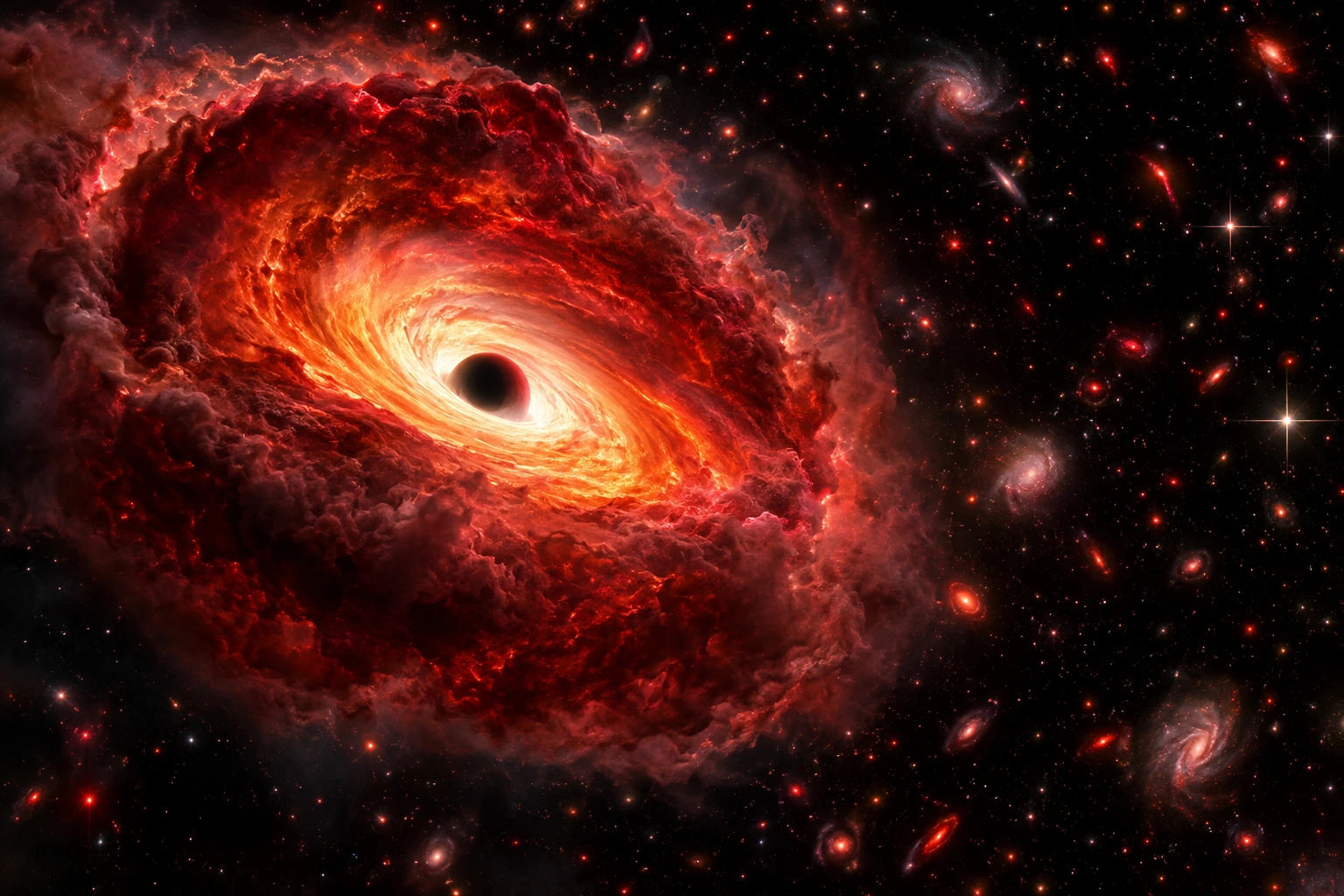
Imagine a young black hole buried inside an enormous cocoon of dense hydrogen and helium gas. Instead of being visible as a traditional accretion disk, the black hole becomes completely wrapped in a thick, turbulent envelope.
Matter falls inward at extraordinary rates.
The resulting energy becomes trapped and repeatedly scattered through the surrounding gas.
From a distance, the entire structure begins behaving almost like a gigantic star.
The black hole acts as the power source.
The surrounding gas envelope functions like a stellar atmosphere.
The result is an object capable of radiating enormous amounts of energy while appearing fundamentally different from both ordinary stars and classical quasars.
MoM-BH*-1: The Object That Changed Everything
The breakthrough came through a JWST program called Mirage or Miracle (MoM).
Researchers searching for extremely distant galaxies encountered an object unlike anything else in their dataset.
It was extraordinarily red.
Extraordinarily bright.
And astonishingly difficult to explain.
Named MoM-BH-1*, the source existed only about 660 million years after the Big Bang. Observations revealed an enormous Balmer break, unusual hydrogen signatures, and evidence for an incredibly dense gaseous environment surrounding a central compact source.
When astronomers attempted to model the object as a galaxy, the numbers failed.
When they modeled it as stars, the energy output became physically impossible.
But when they simulated a rapidly growing black hole embedded inside a dense hydrogen cocoon, something remarkable happened.
The model matched the observations.
Researchers concluded that MoM-BH*-1 is likely the strongest evidence yet for a genuine black hole star.
Why the Discovery Matters
The importance of MoM-BH*-1 extends far beyond a single object.
It may provide a direct glimpse into a previously unknown stage of black hole evolution.
Traditional models assume black holes spend most of their growth history exposed as active galactic nuclei or quasars.
But black hole stars suggest a hidden phase.
During this phase, a young black hole remains buried inside an extremely dense cocoon, allowing it to grow rapidly while masking its true nature.
Because the surrounding gas traps radiation, the system may sustain periods of super-Eddington accretion—growth rates that exceed traditional theoretical limits.
This is exactly the kind of mechanism astronomers have been searching for to explain the rapid appearance of supermassive black holes in the early universe.
Solving the Little Red Dot Mystery
Perhaps the most exciting implication is what MoM-BH*-1 means for Little Red Dots.
For years, astronomers debated whether all Little Red Dots represented the same type of object.
Increasingly, evidence points toward a common explanation.
Many Little Red Dots appear consistent with galaxies whose visible light is dominated by a central black hole star.
Instead of observing billions of stars, JWST may often be seeing the glow of dense gaseous cocoons surrounding rapidly growing black holes.
The redness comes from gas processing and re-emitting radiation.
The compact appearance comes from the small physical size of the central engine.
The extraordinary brightness comes from the immense energy released during rapid accretion.
In other words, the mysterious dots scattered throughout Webb’s images may not be ordinary galaxies at all.
They may be snapshots of black holes caught during their most explosive growth phase.
The Super-Eddington Connection
One phrase appears repeatedly in discussions of black hole stars:
Super-Eddington accretion.
Under ordinary circumstances, intense radiation from infalling matter pushes outward against additional material trying to fall inward.
This creates a natural growth limit.
Yet if a black hole is wrapped inside a sufficiently dense envelope, much of that radiation becomes trapped.
The outward pressure is reduced.
The black hole can continue consuming matter at rates previously thought unsustainable.
This mechanism effectively creates a growth accelerator.
Instead of requiring billions of years, a black hole could accumulate enormous mass in a comparatively short period.
For astronomers struggling to explain the universe’s earliest supermassive black holes, this possibility is transformative.
A New Evolutionary Path for Galaxies
The implications extend beyond black holes themselves.
If black hole stars are common, they may represent a previously unrecognized phase in galaxy formation.
The standard narrative places stars at the center of early galactic evolution.
Black hole stars suggest a more intertwined story.
Some galaxies may have developed around rapidly growing black holes from the very beginning.
Rather than black holes being secondary products of galactic evolution, they may have acted as foundational engines influencing the structure, chemistry, and growth of their host galaxies.
This would force astronomers to rethink how the earliest cosmic structures emerged after the Big Bang.
Are There More Black Hole Stars Waiting to Be Found?
Almost certainly.
MoM-BH*-1 may simply be the first object recognized clearly enough to reveal the phenomenon.
Researchers have already identified hundreds of candidates whose properties resemble black hole star models across a wide range of cosmic history. Studies suggest these BH*-dominated sources are not confined to the earliest universe but may persist across billions of years of cosmic evolution.
Future JWST observations will search for additional examples.
Astronomers will examine their spectra, measure their environments, and determine whether black hole stars truly represent a widespread stage of black hole growth.
If confirmed, textbooks may require revision.
Entire chapters describing the birth of galaxies and supermassive black holes could need rewriting.
Looking Beyond the Event Horizon
When the first Little Red Dots appeared in JWST images, they seemed like a minor curiosity—tiny red smudges hiding in the deepest corners of the observable universe.
Today they are emerging as clues to one of the greatest cosmic puzzles ever confronted.
MoM-BH*-1 suggests that nature may have invented an entirely different way to build giant black holes: not through slow growth, but through hidden, cocooned engines operating behind walls of dense gas.
The discovery does more than reveal a new object.
It exposes a missing chapter in the history of the universe.
For decades, astronomers searched for the origin of the earliest cosmic giants by looking directly at black holes.
Ironically, the answer may have been concealed inside something that looked almost like a star.
And if JWST has taught us anything, it is that the universe rarely hides its deepest secrets in places we expect to find them.


