

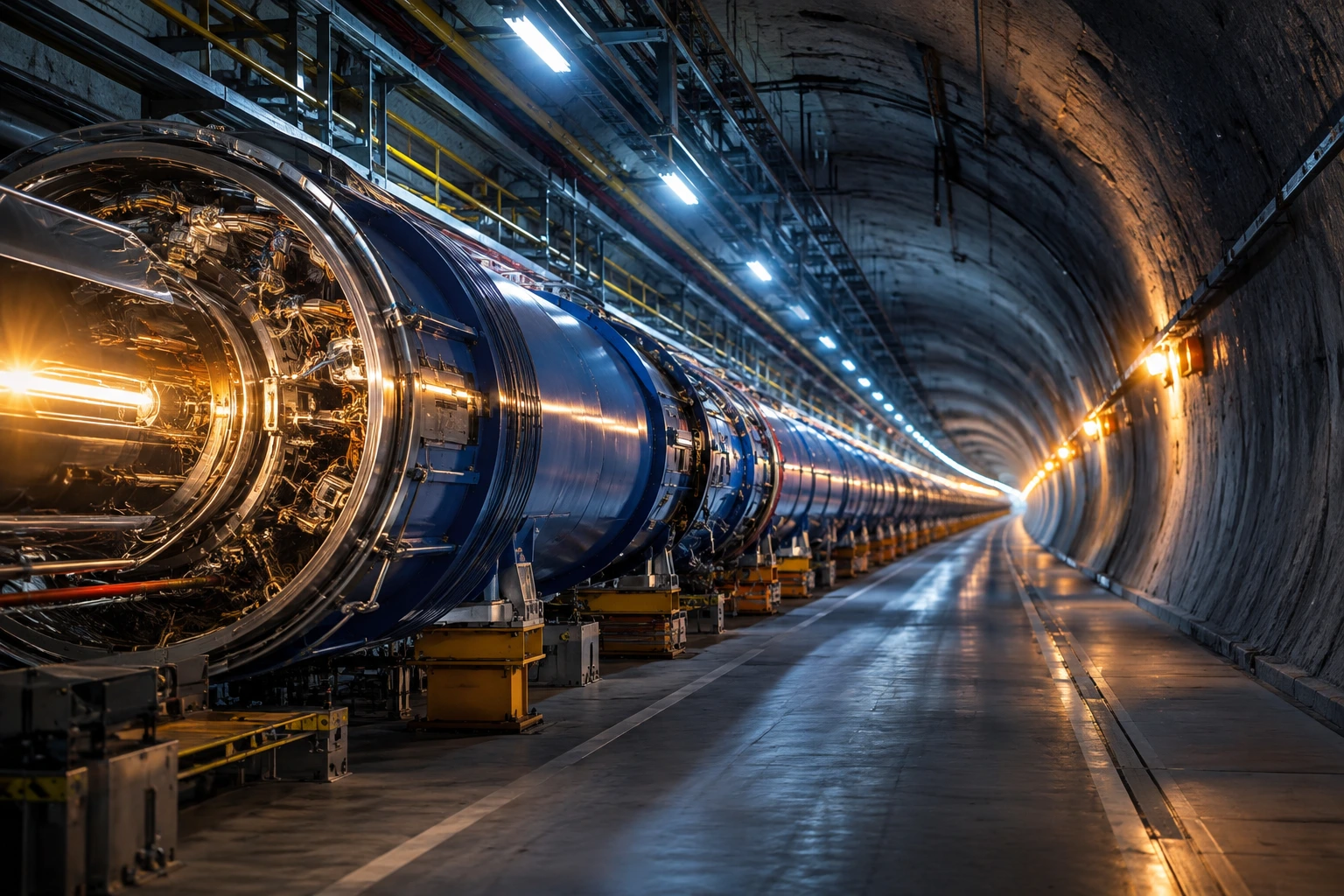

For most people, the Large Hadron Collider already sounds impossibly huge.
This sprawling underground ring of 27 kilometers (17 miles) in circumference, buried along the French-Swiss border, is the machine that made the discovery of the Higgs boson in 2012 possible.
However, many physicists believe the LHC might not be big enough to answer some of science’s most pressing questions.
What is dark matter?
Why is gravity so much weaker compared to the other fundamental forces?
Why does the universe contain far more matter than antimatter?
And perhaps most importantly, is there physics beyond the Standard Model?
To find answers, CERN is considering an even bigger machine. The Future Circular Collider would be more than three times as large as the LHC and vastly more powerful. If approved, it would become the biggest scientific instrument humans have ever built.
It wouldn’t just be bigger. It would push human exploration much deeper into the fundamental structure of reality.
Why CERN Is Already Thinking Beyond the LHC
It might seem odd for physicists to be looking ahead to the machine that succeeds the LHC while the current collider is still operating.
The reason is simple: facilities of this scale take decades to plan, fund, and build.
The LHC is expected to continue producing valuable scientific data well into the 2040s, while physicists and governments are already discussing what should come next.
CERN’s Future Circular Collider is currently the leading candidate for Europe’s post-LHC particle physics program. A decision on whether to proceed is expected around 2028.
So, while not immediately necessary, the FCC could become the flagship particle physics project of the second half of the 21st century.
Just How Big Would It Be?

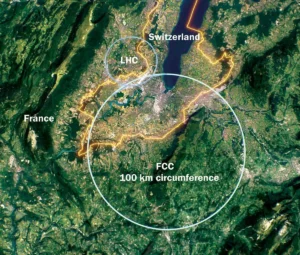
The size of the proposed collider is difficult to imagine.
The LHC’s 27-kilometer circumference already seems enormous.
The Future Circular Collider would occupy a ring-shaped tunnel around 91 kilometers in circumference.
The tunnel would run beneath parts of France and Switzerland and even pass under Lake Geneva.
Its average depth would be around 200 meters below the surface, with multiple experimental sites distributed along the ring.
This would make the FCC more than three times longer than the LHC.
If built, it would rank among the largest scientific infrastructure projects ever undertaken by humanity.
Beyond the sheer size, however, the real difference lies in its capabilities.
The FCC is expected to allow collisions at much higher energies than the LHC can achieve today.
The Quest for 100 TeV
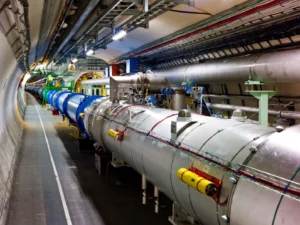

Particle colliders accelerate particles to extraordinary speeds before smashing them together.
The more energetic the collision, the deeper physicists can probe into the structure of matter.
The LHC operates at collision energies measured in the tens of teraelectronvolts (TeV), while the proposed proton-proton FCC could reach around 100 TeV—roughly seven to eight times higher than the LHC’s design energy.
The difference may sound like a technical detail, but in particle physics, higher energy means more opportunities for discovery.
According to Albert Einstein’s famous equation, E = mc², energy and mass are equivalent.
This means that higher-energy collisions can create heavier particles that cannot be produced in lower-energy experiments.
If entirely new particles exist beyond those currently known to science, the FCC could be one of humanity’s best chances of finding them.
The Mystery That Keeps Physicists Up at Night
There is a common misconception that modern physics has essentially finished its work.
The reality is very different.
Many of the universe’s most fundamental mysteries remain unsolved.
Astronomers currently estimate that ordinary matter makes up only a small fraction of the universe.
Dark matter and dark energy appear to dominate the cosmos, yet their true nature remains unknown.
The Standard Model is an elegant theory that successfully describes known particles and forces, but it struggles to explain gravity, neutrino masses, and dark matter.
This is why many physicists see value in higher-energy colliders.
The goal is not simply to confirm existing theories but to discover entirely new particles, forces, or phenomena.
History shows that whenever humanity develops dramatically better tools for observing nature, unexpected discoveries often follow.
The Higgs Boson Is Still Full of Secrets
Many people see the discovery of the Higgs boson as the climax of particle physics.
For physicists, it was more like the start of a new chapter.
While scientists know that the Higgs field plays a central role in giving elementary particles their mass, many aspects of the Higgs boson itself are still being studied.
Researchers are particularly interested in understanding its properties with greater precision and determining whether it interacts with particles that have not yet been discovered.
One of the FCC’s primary goals would be to study the Higgs boson in unprecedented detail.
Scientists have even nicknamed the first planned stage of the project the “Higgs factory” because it would produce enormous numbers of Higgs particles for precision measurements.
Small deviations from current predictions could reveal clues pointing toward entirely new physics.
Sometimes a scientific revolution begins not with a dramatic discovery, but with a tiny anomaly that refuses to disappear.
A Two-Step Plan
The Future Circular Collider would not be built all at once.
Instead, the project is designed in stages.
The first stage would be an electron-positron collider focused on precision studies of particles such as the Higgs boson and other key components of the Standard Model.
Later, the same tunnel could host a far more powerful proton-proton collider capable of reaching much higher energies.
Supporters see this approach as a way to maximize scientific return over many decades.
Rather than building a single machine, the FCC would serve as a long-term research platform capable of supporting multiple generations of experiments.
Not Everyone Agrees
Although many physicists are excited about the proposal, the FCC has generated considerable debate.
Large-scale scientific projects inevitably raise questions about cost, environmental impact, and priorities.
The estimated cost of the first stage is around 15 billion Swiss francs, making it one of the most expensive scientific projects ever proposed in Europe.
Critics argue that there is no guarantee the FCC will discover new particles or reveal entirely new physics.
Some researchers suggest that alternative approaches—such as dark matter detectors, astrophysical observations, or smaller specialized experiments—might deliver greater scientific value for the money invested.
Supporters counter that groundbreaking discoveries are often impossible to predict.
When earlier colliders were built, scientists did not know exactly what they would find.
The eventual discoveries of particles such as the W and Z bosons, the top quark, and the Higgs boson demonstrate how transformative these facilities can become.
It’s Also an Engineering Challenge
Even if governments approve the project, constructing the FCC would be a remarkable engineering challenge.
Scientists and engineers would need to develop new generations of superconducting magnets capable of steering particle beams around a 91-kilometer ring.
Power consumption, cooling systems, detector technology, radiation management, and long-term sustainability would all play crucial roles.
In many ways, the FCC is not just a physics project.
It is also an engineering project that pushes the limits of what humanity can build.
Could It Discover New Physics?
This is the billion-dollar question.
Nobody knows.
And that uncertainty is exactly what makes the project so compelling to many scientists.
The LHC successfully discovered the Higgs boson, but it has yet to provide clear evidence of physics beyond the Standard Model.
The FCC could open a new realm of physics, potentially uncovering previously unknown particles, hidden forces of nature, or clues about dark matter.
It might reveal subtle flaws in existing theories or expose entirely new layers of reality.
It is also possible that it will find none of these things.
Yet even that outcome would force physicists to rethink some of their assumptions about how the universe works.
Either way, the results could reshape our understanding of nature.
A Machine for the Next Generation
Most of the scientists who may someday analyze data from the FCC are still students today.
Some may not even have been born yet.
That is the reality of scientific projects that operate on timescales measured in decades.
The Future Circular Collider is more than an engineering proposal.
It reflects humanity’s enduring desire to understand the unknown.
Civilizations build libraries, observatories, telescopes, and particle accelerators because some questions are simply too important to ignore.
Whether the FCC ultimately moves forward remains uncertain.
But even after all the discoveries made by the Large Hadron Collider, physicists are still staring into the darkness beyond current knowledge—and wondering what they might find if they could see a little farther.


