For a brief moment, it looked as though Mars had developed a sense of humor.
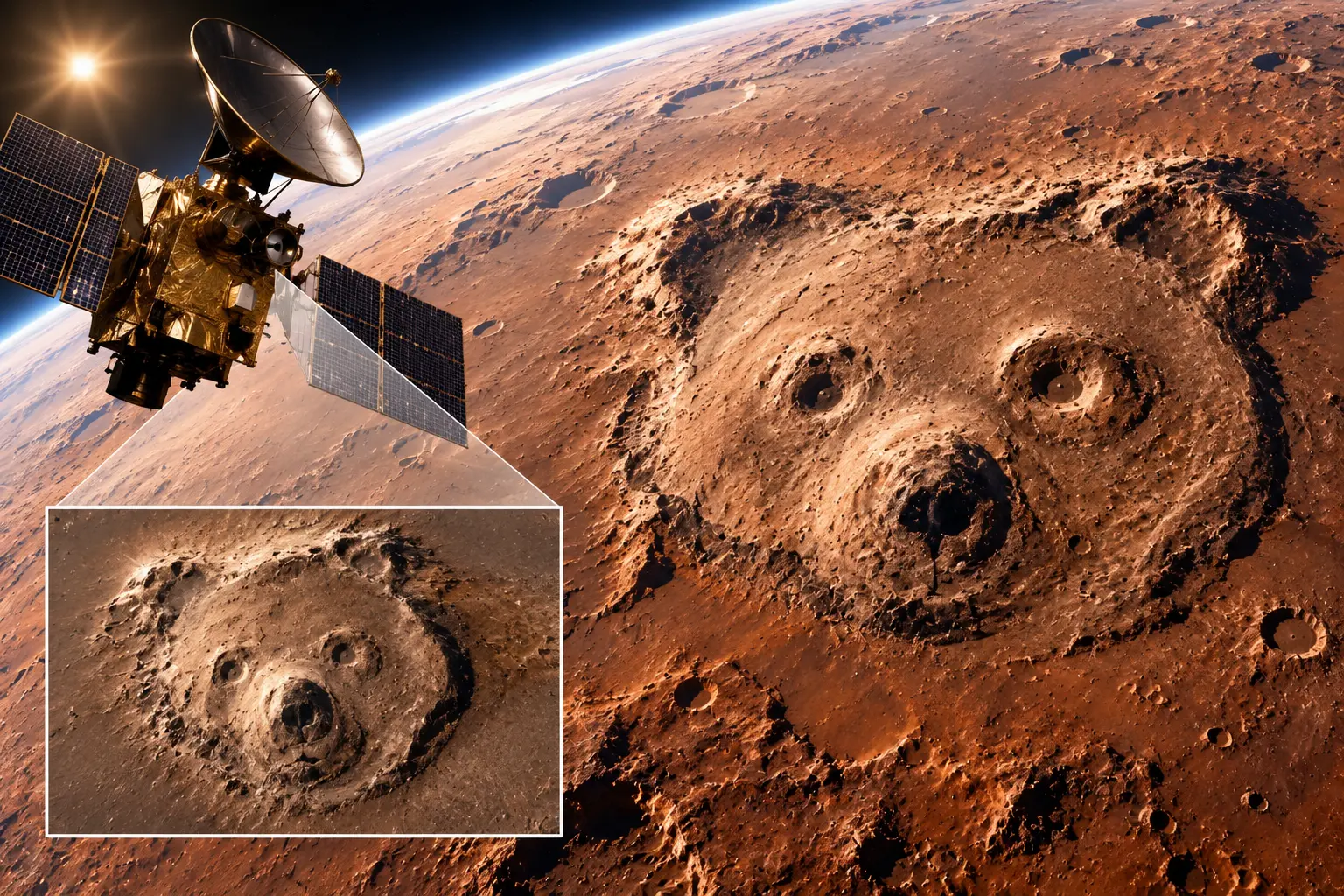
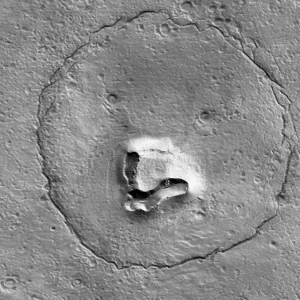
High above the Red Planet’s dusty surface, NASA’s Mars Reconnaissance Orbiter captured an image that immediately caught the attention of scientists and the public alike. Seen from approximately 251 kilometers (156 miles) above Mars, a peculiar geological formation appeared to stare back from the barren landscape with two eyes, a nose, and the unmistakable outline of a bear’s head.

The image quickly spread across the internet, joining a long list of Martian formations that seem strangely familiar to human observers. Unlike some controversial examples from the past, however, scientists were quick to explain that there is no mystery creature lurking on Mars.
Instead, the “bear face” is a fascinating example of how geology and human perception can combine to create something extraordinary.
Yet beneath the amusing appearance lies a genuine scientific story—one that reveals how impacts, volcanic activity, erosion, and billions of years of planetary evolution continue to shape the Martian surface.
A Surprising Discovery From Orbit
The image was captured on December 12, 2022, by the High Resolution Imaging Science Experiment (HiRISE) camera aboard NASA’s Mars Reconnaissance Orbiter (MRO). At the time, the spacecraft was passing roughly 251 kilometers above the southern highlands of Mars, an ancient region heavily marked by craters and geological scars.
HiRISE is one of the most powerful cameras ever sent to another planet. Since arriving at Mars in 2006, it has photographed thousands of locations with remarkable detail, allowing scientists to study everything from sand dunes and landslides to potential landing sites for future missions.
Among the countless images returned by the camera, this one immediately stood out.
The formation appeared astonishingly similar to a cartoon bear.
Two circular depressions resembled eyes.
A central feature looked like a nose.
A larger circular outline created the appearance of a head.
The resemblance was so striking that NASA itself highlighted the image, referring to it as a “bear lookalike” on Mars.
Why Humans See Faces Everywhere

The bear face is a classic example of a psychological phenomenon known as pareidolia.
Pareidolia occurs when the human brain recognizes familiar patterns—particularly faces—in random objects or landscapes.
It is the reason people sometimes see animals in clouds, faces in tree bark, or expressions on the front of cars.
Evolutionary psychologists believe humans developed an extraordinary ability to identify faces because recognizing other humans quickly offered survival advantages.
As a result, our brains are exceptionally sensitive to facial patterns.
Sometimes they become a little too sensitive.
Even when no face actually exists, the brain can connect random shapes into something recognizable.
Mars has produced numerous examples of pareidolia over the years, but few have been as visually convincing as the bear-shaped formation.
What Scientists Believe Created the “Bear”
Although the formation looks playful, the geological explanation is surprisingly complex.
According to NASA and researchers associated with the HiRISE project, the bear face consists of several unrelated geological features that happen to align perfectly from an orbital perspective.
The “eyes” are believed to be impact craters.
Mars has been bombarded by asteroids and meteoroids for billions of years, leaving the surface covered with craters of every imaginable size.
In this case, two craters happened to form in positions that create the appearance of eyes.
The “nose” appears to be a hill containing a V-shaped collapse structure.
Scientists suggest it may represent a volcanic vent, a mud vent, or a feature created by underground material collapsing inward over time.
The larger circular outline forming the bear’s head may be the remnant of a buried impact crater.
Over millions of years, sediment, volcanic material, or mud deposits could have filled the crater. As the underlying material settled, fractures developed, creating the circular pattern visible today.
When viewed together, these unrelated geological structures create one of the most convincing examples of planetary pareidolia ever photographed.
Mars: A Planet Shaped by Impacts
To appreciate how unusual the bear face appears, it helps to understand Mars itself.
Unlike Earth, Mars lacks a thick atmosphere capable of burning up many incoming meteoroids.
The planet also lacks active plate tectonics and widespread erosion from oceans.
As a result, ancient impact scars remain visible for immense periods of time.
Some Martian craters are billions of years old.
Scientists estimate that countless impacts have struck Mars throughout its history, creating the heavily cratered terrain visible today.
Many of the circular features contributing to the bear face likely originated during this long bombardment period.
The Role of Ancient Volcanism
Mars is also home to some of the largest volcanoes in the Solar System.
Olympus Mons, for example, stands nearly three times taller than Mount Everest.
Although the bear formation is not connected to a giant volcano, scientists believe volcanic processes may have contributed to the central “nose” feature.
Volcanic vents can create unusual depressions and collapse structures.
Over time, lava flows, ash deposits, and underground magma movement can leave behind complex geological patterns.
Combined with impact activity, these processes help create the diverse landscapes seen across Mars today.
Why Mars Produces So Many Strange Shapes
Mars is often described as a geologist’s paradise.
Its surface preserves evidence of processes that occurred billions of years ago.
Because erosion is relatively slow compared with Earth, ancient formations can remain recognizable for extraordinary lengths of time.
The result is a world filled with bizarre terrain.
Scientists have identified landscapes resembling:
- Spiders
- Trees
- Swiss cheese
- Dragons
- Human faces
- Hearts
- Fingerprints
- Animal shapes
Most are simply the result of natural geological processes combined with our tendency to recognize familiar patterns.
The bear face joins this long list of fascinating visual coincidences.
The Legacy of the “Face on Mars”
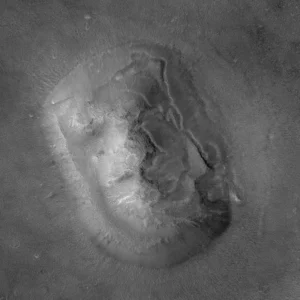
Any discussion of face-like formations on Mars inevitably recalls one of the most famous examples in space exploration history.
In 1976, NASA’s Viking 1 spacecraft photographed a mesa in the Cydonia region of Mars that appeared to resemble a giant human face.
The image sparked decades of speculation.
Some claimed it represented evidence of an ancient Martian civilization.
Books, documentaries, and conspiracy theories flourished around the idea.
Later missions changed the story completely.
Higher-resolution images from Mars Global Surveyor, Mars Express, and Mars Reconnaissance Orbiter revealed that the feature was simply a natural hill viewed under unusual lighting conditions.
The face disappeared when seen with modern cameras.
The bear face differs in an important way.
Scientists never suggested it might be artificial.
From the beginning, researchers identified it as a geological coincidence and an entertaining example of pareidolia.
Why HiRISE Matters

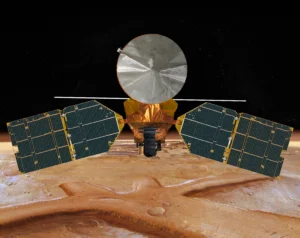
The bear image also highlights the importance of the HiRISE camera.
Built by the University of Arizona and operating aboard the Mars Reconnaissance Orbiter, HiRISE has transformed our understanding of the Red Planet.
Its extraordinary resolution allows scientists to observe features smaller than a meter across.
This capability has revealed:
- Active sand dune movement
- Seasonal frost changes
- Dust devil tracks
- Landslides
- Fresh impact craters
- Ancient river channels
- Potential signs of past water activity
The camera has even photographed Mars rovers from orbit.
Without HiRISE, many of the geological details that create formations like the bear face would remain invisible.
What the Formation Reveals About Mars
While the bear face itself is not evidence of life, it does offer scientific value.
Researchers can use such formations to study:
- Crater formation processes
- Surface erosion
- Collapse structures
- Ancient volcanic activity
- Sediment deposition patterns
Each unusual feature contributes to a broader understanding of how Mars evolved over billions of years.
Even seemingly humorous images can provide meaningful scientific information.
That is one reason NASA often shares visually striking photographs with the public.
They capture attention while simultaneously revealing the complexity of another world.
Could Mars Have Once Looked Very Different?
One of the most fascinating aspects of Martian geology is that the planet was once dramatically different from the cold desert we see today.
Evidence gathered by orbiters and rovers suggests Mars once possessed rivers, lakes, and perhaps even a northern ocean.
Ancient valleys, delta formations, and mineral deposits point to a wetter past.
Some of the geological processes that shaped the bear formation may have occurred during periods when Mars had a thicker atmosphere and more active surface conditions.
Studying these features helps scientists reconstruct the planet’s history and investigate whether it may once have been habitable.
A Reminder That Mars Still Surprises Us

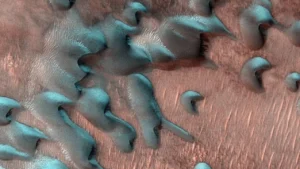
After decades of exploration, Mars remains a world capable of producing surprises.
Every year, orbiters return thousands of images showing landscapes that appear both alien and strangely familiar.
Some reveal clues about the planet’s ancient climate.
Others uncover evidence of active geological change.
And occasionally, one reveals a giant bear staring back from the Martian surface.
The formation photographed from 251 kilometers above Mars is not an alien creature, a hidden monument, or evidence of a lost civilization. It is a remarkable coincidence created by impact craters, collapse structures, and geological processes acting over immense spans of time.
Yet that explanation may be even more fascinating.
Because it reminds us that nature—on Earth and on Mars—often creates shapes and patterns so unexpected that they seem almost impossible.
And somewhere among the countless unexplored landscapes of the Red Planet, there may be many more waiting to be discovered.