
For decades, astronomers believed they had a reasonably good understanding of the brightest objects in nearby galaxies. Black holes devouring matter, neutron stars spinning at incredible speeds, exploding stars, and powerful X-ray binaries have all been cataloged and studied in remarkable detail.
Then scientists looked again—and found something they had somehow been missing all along.
Using archival observations from NASA’s Chandra X-ray Observatory, researchers recently identified an entirely new population of cosmic objects scattered across six nearby galaxies. These strange sources emit unusually low-energy X-rays while appearing to produce enormous amounts of extreme ultraviolet (EUV) radiation, a form of light that is notoriously difficult to observe directly. The team uncovered 84 of these objects and named them hypersoft X-ray sources. Their discovery may help explain long-standing puzzles involving galactic ionization and the origins of certain stellar explosions.
What makes this finding especially exciting is that these objects were hiding in data astronomers already had. The discovery suggests that the universe may contain vast populations of energetic objects that have remained invisible simply because scientists were looking in the wrong way.
A Discovery Hidden in Plain Sight
Astronomical discoveries often involve new telescopes, advanced instruments, or observations of distant corners of the universe. This discovery took a different route.
Researchers led by Mustafa Muhibullah at the University of Alabama examined publicly available observations stored in the Chandra archive. Instead of searching for bright, high-energy X-ray sources, they focused on extremely soft emissions at the lowest energies detectable by the observatory.
What emerged was surprising.
The team identified 84 objects distributed across six nearby galaxies. The sample included two spiral galaxies—Andromeda (M31) and the Pinwheel Galaxy (M101)—along with four elliptical galaxies. The objects appeared both in regions filled with young stars and in areas dominated by older stellar populations.
This broad distribution immediately suggested that astronomers were not looking at a rare phenomenon confined to a specific environment.
Instead, they may have uncovered an entirely new population of cosmic emitters.
What Exactly Is a Hypersoft X-Ray Source?
To understand why astronomers are excited, it helps to understand what makes these objects different.
Most known X-ray sources emit a wide range of X-ray energies. Black holes, neutron stars, and accreting white dwarfs typically generate substantial amounts of medium- and high-energy X-rays.
Hypersoft X-ray sources behave differently.
They appear primarily—or sometimes exclusively—at energies below 0.3 kiloelectronvolts (keV), making them extraordinarily soft compared with conventional X-ray emitters. When astronomers examined higher-energy images, many of these sources essentially disappeared.
This unusual behavior suggested that most of their energy is not actually being emitted in the X-ray band at all.
Instead, scientists believe much of their radiation is concentrated in the extreme ultraviolet region of the electromagnetic spectrum—a poorly observed zone that lies between ultraviolet light and X-rays.
That realization may be the key to understanding why these objects remained hidden for so long.
The Universe’s Invisible Window
Astronomers have explored almost every region of the electromagnetic spectrum, from radio waves to gamma rays.
But the extreme ultraviolet region remains one of the least understood.
The problem is not technological incompetence. It is physics.
Hydrogen and helium gas absorb EUV radiation extremely efficiently. Within our own Milky Way, clouds of interstellar gas block most EUV photons before they can reach Earth-based or orbiting telescopes. As a result, the universe becomes effectively opaque in this wavelength range.
Imagine trying to study an entire ecosystem while wearing glasses that completely block one color of light.
That is essentially the challenge astronomers face when observing the EUV universe.
Hypersoft X-ray sources may represent a population of objects whose energy output peaks precisely in this hidden region of the spectrum. Scientists are therefore detecting only the faint X-ray “tail” of a much more powerful emission process.
Among the Brightest Objects in Their Galaxies
One of the most surprising aspects of the discovery is that these sources are not weak.
In fact, they appear to be extraordinarily luminous.
Some hypersoft sources radiate energy at levels approaching those of the brightest non-explosive objects found in galaxies. The most luminous examples produce around 10³⁸ ergs of energy per second in the observed X-ray band alone, while models indicate their total energy output may be substantially higher once their hidden EUV emission is considered.
That means these objects may outshine the Sun by hundreds of thousands or even millions of times.
Despite this enormous energy output, they remained largely undetected because most of their radiation emerges in a part of the spectrum astronomers struggle to observe directly.
It is a reminder that brightness alone does not guarantee visibility.
What Are These Objects?
At the moment, scientists do not have a definitive answer.
The leading explanation involves binary star systems.
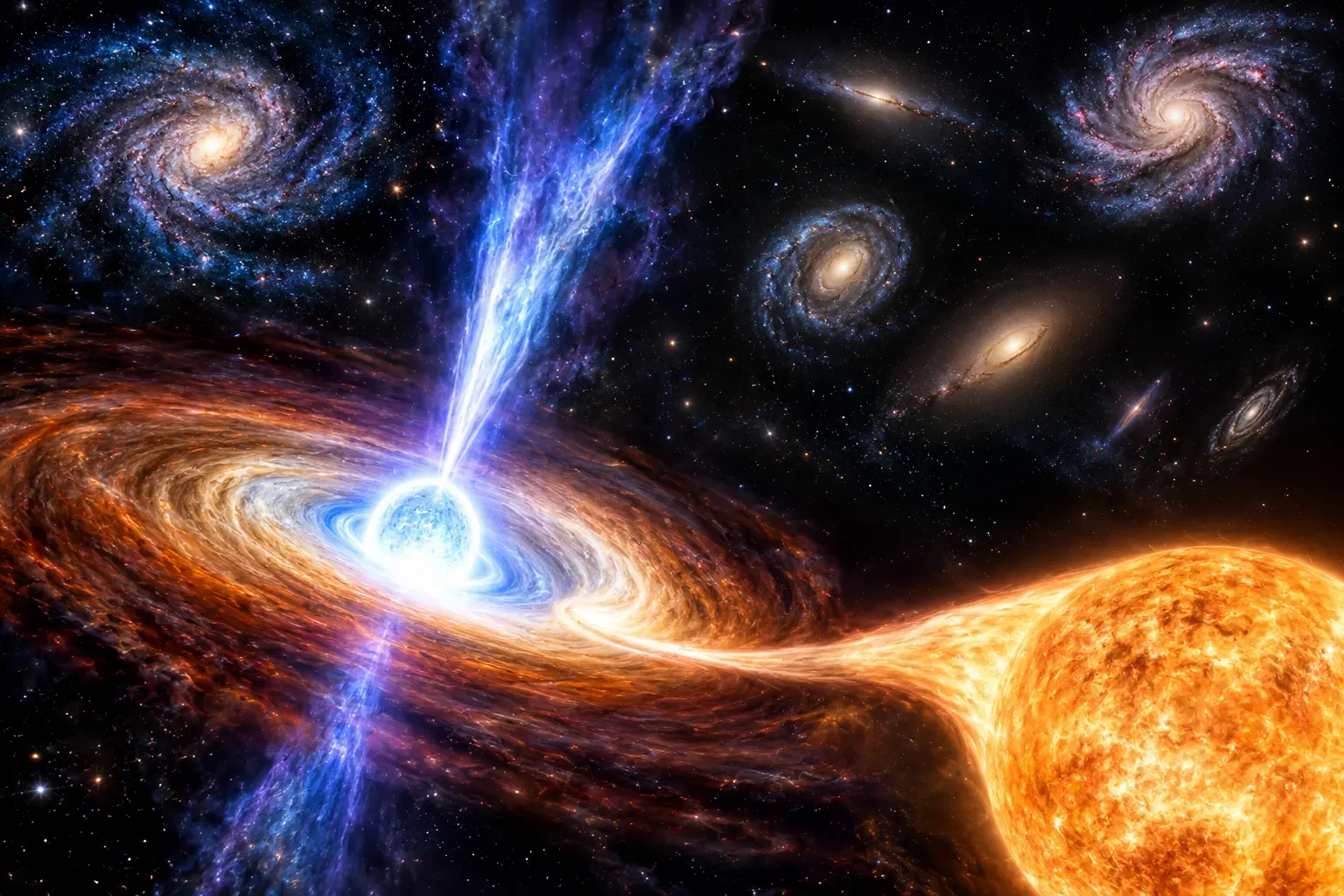
In such systems, one star pulls material away from a companion. As gas spirals inward, it heats up dramatically and emits radiation. Similar processes power many known X-ray sources throughout the universe.
Researchers suspect hypersoft sources may involve:
- White dwarfs accreting material from companion stars
- Neutron stars drawing in gas from nearby companions
- Stellar-mass black holes feeding on neighboring stars
- Post-nova systems undergoing unusual evolutionary stages
The mystery is that none of these known categories normally produce radiation with the exact characteristics observed in the new population.
Scientists therefore believe hypersoft X-ray sources may represent several different physical systems united by a common emission mechanism rather than a single type of object.
Filling a Major Cosmic Ionization Gap
One reason the discovery has attracted so much attention is its potential impact on galactic evolution.
Astronomers have long known that gas between stars in many galaxies appears more ionized than expected.
Ionization occurs when electrons are stripped from atoms by energetic radiation. Massive stars contribute significantly to this process, but observations have often revealed ionization levels that seem difficult to explain using stars alone.
This discrepancy has become known as an ionization gap.
Scientists have suspected that an additional source of energetic radiation must be helping ionize interstellar gas.
Hypersoft X-ray sources could be exactly what researchers have been searching for.
Because they likely emit enormous quantities of EUV radiation, they could provide a substantial fraction of the missing ionizing photons needed to explain observations across many galaxies.
If confirmed, this would significantly alter models of how galaxies evolve over time.
Why Ionization Matters
Ionization is not merely an obscure detail of astrophysics.
It influences how galaxies function.
The ionization state of gas affects its temperature, density, chemistry, and ability to collapse into new stars. These properties influence star formation rates, stellar evolution, and the long-term development of galactic ecosystems.
Even modest changes in ionization can ripple through an entire galaxy over millions of years.
That means understanding the source of ionizing radiation is essential for building accurate models of galaxy evolution.
Hypersoft X-ray sources may represent a missing piece of that puzzle.
A Possible Connection to Type Ia Supernovae
The discovery may also shed light on another major mystery.
Type Ia supernovae are among the most important objects in astronomy.
These stellar explosions serve as “standard candles” that allow astronomers to measure vast cosmic distances. Observations of Type Ia supernovae played a central role in the discovery that the expansion of the universe is accelerating—a finding that ultimately led to the concept of dark energy.
Despite their importance, astronomers still do not fully understand the systems that trigger these explosions.
One leading theory involves white dwarfs gradually accumulating material from companion stars until they reach a critical mass and explode.
Many hypersoft X-ray sources may fit the profile of systems undergoing exactly this kind of accretion. Some researchers therefore suspect they could represent previously overlooked progenitors of Type Ia supernovae.
If future observations confirm this connection, it would represent a major advance in understanding one of astronomy’s most important classes of explosions.
Why Were They Missed for So Long?
This may be the most fascinating aspect of the story.
Astronomers were not ignoring these objects.
The problem was observational bias.
Modern X-ray telescopes are generally optimized for higher-energy emissions. At extremely low energies, detector sensitivity declines significantly. Meanwhile, interstellar gas absorbs both EUV radiation and the softest X-rays.
Together, these effects created a blind spot.
The sources existed in archival observations for years, but their unusual spectral characteristics made them difficult to recognize as a coherent population.
Only after researchers specifically searched for objects visible at the lowest X-ray energies and absent at higher energies did the hidden population emerge.
Sometimes scientific breakthroughs come not from looking farther—but from looking differently.
What Happens Next?
The discovery of 84 hypersoft X-ray sources is unlikely to be the end of the story.
It is probably the beginning.
Researchers suspect the true population could be much larger than current observations suggest. The six galaxies studied were chosen because they had extensive archival observations and favorable viewing conditions. Many more galaxies remain unexplored using similar techniques.
Future observations with next-generation observatories may reveal thousands of similar objects.
Astronomers will also attempt to determine exactly what physical systems create hypersoft emissions, how they evolve, and how common they are throughout the universe.
Each answer could open entirely new questions.
A Hidden Universe Revealed
Astronomy often advances through spectacular discoveries—new planets, exploding stars, or distant galaxies.
Yet some of the most important breakthroughs occur when scientists uncover something that was hiding in plain sight.
NASA’s identification of 84 hypersoft X-ray sources suggests that nearby galaxies contain a previously overlooked population of extraordinarily energetic objects. These mysterious emitters may help explain why interstellar gas becomes ionized, reveal new clues about the origins of Type Ia supernovae, and expose a hidden universe of extreme ultraviolet radiation that astronomers have struggled to observe for decades.
For now, the objects remain enigmatic.
But if history is any guide, discoveries like this often mark the start of a much larger scientific journey. What began as a search through old data may ultimately reshape our understanding of how galaxies evolve, how stars die, and how some of the universe’s brightest yet most elusive objects have remained hidden from view for so long.