

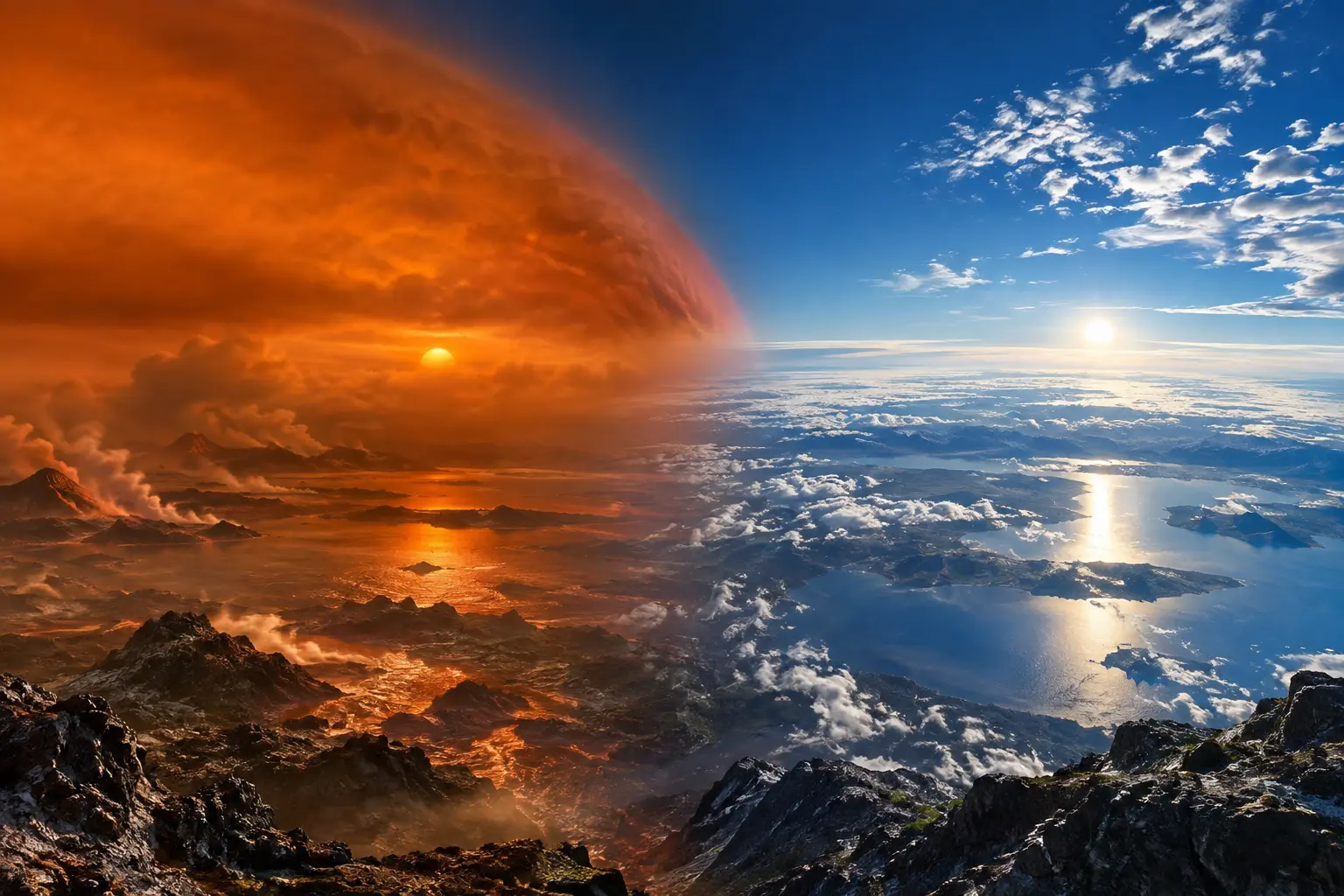
For most of human history, people have looked up and seen the same familiar scene: a blue sky, white clouds, and a bright yellow Sun. It feels permanent, almost timeless. Yet according to scientists, the sky above your head is actually one of the newest versions Earth has ever worn.
Travel back billions of years, and the world would be almost unrecognizable.
The oceans may have existed, volcanoes dominated the landscape, and primitive microbes were beginning to transform the planet. But the sky? It likely wasn’t blue at all. Depending on when you visited ancient Earth, you might have seen a hazy orange atmosphere, a thick methane shroud, or even skies tinted by gases that no longer dominate our world. The transformation from that alien-looking planet to the Earth we know today is one of the greatest stories in planetary science.
Researchers studying ancient rocks, atmospheric chemistry, and Earth’s earliest minerals are piecing together a picture of a planet whose appearance changed dramatically over billions of years. The evidence suggests that Earth’s sky has undergone multiple revolutions—and each one helped shape the evolution of life itself.
The First Atmosphere Was Born in Fire
Earth formed about 4.5 billion years ago during a violent period of collisions and planetary construction. In its infancy, the young world was anything but peaceful.
Massive impacts from asteroids and protoplanets repeatedly melted portions of Earth’s surface. Scientists believe that after some of these impacts, the planet was covered by oceans of molten rock known as magma oceans. As these fiery surfaces cooled, gases escaped from the interior and began forming Earth’s earliest atmosphere.
This first atmosphere was nothing like today’s.
There was essentially no breathable oxygen. Instead, it likely contained large amounts of carbon dioxide, nitrogen, water vapor, hydrogen, and other volcanic gases. Depending on the stage of Earth’s development, the atmosphere may have been dense, hot, and chemically unstable.
If a modern human somehow stood on that ancient world, survival would be impossible. The air would be toxic, temperatures extreme, and the sky entirely unfamiliar.
A Sun That Was Fainter Than Today
One of the strangest facts about ancient Earth is that the Sun itself was different.
About four billion years ago, the Sun produced roughly 70% of the energy it generates today. By all logic, Earth should have been frozen solid. Yet geological evidence shows that liquid water existed on the planet. Rivers flowed, oceans formed, and conditions suitable for life eventually emerged.
This mystery is known as the “Faint Young Sun Paradox.”
Scientists believe the solution lies in Earth’s ancient atmosphere. Powerful greenhouse gases likely trapped enough heat to keep the planet warm despite the dimmer Sun. Methane may have played a particularly important role. Produced by early microbial life and geological processes, methane could have acted as a planetary blanket, preventing Earth from becoming an icy wasteland.
But methane may have done something even more remarkable: it may have changed the color of the sky itself.
The Orange World Hypothesis
One of the most fascinating discoveries in recent decades suggests that Earth may once have resembled Saturn’s moon Titan more than the blue planet we know today.
Geochemical evidence and atmospheric models indicate that around 2.7 to 2.4 billion years ago, Earth may have experienced periods when methane concentrations became extremely high. Under the influence of sunlight, methane could have produced a thick hydrocarbon haze in the atmosphere.
This haze would have scattered sunlight differently than today’s oxygen-rich atmosphere.
Instead of seeing a clear blue sky, an observer might have looked upward and seen an orange, amber, or copper-colored world. Some researchers have even suggested that ancient Earth may have appeared as a “pale orange dot” when viewed from space.
The haze could have been thick enough to soften sunlight, creating an eerie glow across the planet. Sunsets may have looked dramatically different. The horizon might have appeared perpetually smudged by atmospheric particles.
To modern eyes, Earth would have looked less like home and more like an alien planet.
Life Was Quietly Changing Everything
While volcanoes and geological processes shaped the atmosphere, the most important transformation came from something microscopic.
Tiny organisms called cyanobacteria evolved the ability to perform oxygenic photosynthesis. Using sunlight, they split water molecules and released oxygen as a byproduct. What began as a biological innovation eventually became one of the most consequential events in planetary history.
At first, the oxygen produced by these microbes didn’t accumulate in the atmosphere. Instead, it reacted with iron and other substances in the oceans and crust.
For hundreds of millions of years, oxygen was effectively trapped.
Eventually, however, Earth’s oxygen sinks became saturated. The balance began to shift.
The atmosphere was about to change forever.
The Great Oxidation Event
Around 2.5 to 2.3 billion years ago, Earth experienced what scientists call the Great Oxidation Event.
During this period, atmospheric oxygen rose dramatically compared with earlier levels. Although oxygen concentrations were still far below modern values, the change was revolutionary. Earth’s atmosphere was beginning its transition toward the oxygen-rich environment we know today.
The consequences were enormous.
Methane levels declined. Atmospheric chemistry shifted. New minerals began forming. Entire ecosystems were forced to adapt to a world that was becoming increasingly hostile to organisms dependent on oxygen-free environments.
The sky changed too.
As methane haze diminished and oxygen increased, sunlight interacted with the atmosphere in new ways. The orange veil that may have once shrouded Earth gradually disappeared.
The familiar blue sky was beginning to emerge.
Why Is the Sky Blue Today?
The blue sky we take for granted exists because molecules in Earth’s atmosphere scatter short wavelengths of sunlight more efficiently than longer wavelengths.
This phenomenon, known as Rayleigh scattering, causes blue light to spread across the sky in all directions.
But this effect depends heavily on atmospheric composition.
Change the gases. Change the particles suspended in the air. Change the density of the atmosphere.
The sky changes too.
Planetary scientists studying exoplanets often emphasize this point. A planet’s atmosphere acts like a filter through which sunlight passes. Different atmospheric chemistries can create dramatically different visual appearances.
Earth’s modern blue sky is not inevitable. It is a consequence of billions of years of atmospheric evolution.
Earth Didn’t Change Just Once
One common misconception is that Earth’s atmosphere transformed in a single event.
In reality, the process appears to have been far more complex.
Research suggests that oxygen levels fluctuated over long periods. Some studies indicate that atmospheric conditions may have swung between different states before stabilizing. Methane-rich hazes may have appeared and disappeared multiple times. Oxygen “oases” may have existed locally long before oxygen became widespread globally.
Earth’s atmospheric history was likely a series of transitions rather than a single dramatic switch.
That complexity is one reason scientists continue studying ancient rocks with such enthusiasm. Every new discovery helps refine our understanding of how planetary atmospheres evolve.
What Ancient Earth Teaches Us About Alien Worlds
The story of Earth’s changing sky has implications far beyond our own planet.
Astronomers are now discovering thousands of planets orbiting distant stars. Many of these worlds have atmospheres, and scientists hope to identify those capable of supporting life.
Understanding Earth’s past provides a valuable roadmap.
If a distant exoplanet displays signs of methane haze, it might resemble Earth during its Archean era. If oxygen is detected, it could indicate biological activity—or perhaps a stage of planetary evolution similar to Earth’s later history.
In other words, Earth’s ancient sky may offer clues about what inhabited planets elsewhere in the universe look like today.
The search for extraterrestrial life increasingly depends on understanding our own planet’s atmospheric past.
A Planet in Constant Transformation
It’s easy to think of Earth as a finished world.
Yet the geological record tells a different story.
The blue sky overhead is not the original version of Earth’s atmosphere. It is the latest chapter in a story that has unfolded over more than four billion years. Before the blue skies, before abundant oxygen, before forests and animals, Earth may have glowed beneath an orange haze rich in methane and mystery.
The next time you look upward on a clear day, consider this: if you had stood on the same planet billions of years ago, you might not have recognized it at all.
The oceans could still have been there. The continents might have existed in some form. Life may already have been hard at work.
But the sky above would have belonged to another Earth entirely.


