
A decades-old scientific paper calculated that humanity’s population could approach infinity on November 13, 2026. With the date approaching, the extraordinary prediction is attracting renewed attention. But what did the researchers actually discover, and should we be worried?
A scientific paper published more than 65 years ago appears to have identified a precise date for doomsday: Friday, November 13, 2026. Its title, Doomsday: Friday, 13 November, A.D. 2026, sounds like a warning about an approaching apocalypse. However, the researchers were investigating something considerably different from the destruction of Earth.
Their concern was the extraordinary acceleration of human population growth and what might happen if the trend continued indefinitely.
The paper appeared in the prestigious journal Science on November 4, 1960. Its authors were physicist Heinz von Foerster and his colleagues Patricia M. Mora and Lawrence W. Amiot. Their mathematical model suggested that humanity’s population would approach infinity on the specified date if historical growth continued along the same trajectory. Source: Original paper indexed by PubMed.
As November 2026 approaches, the prediction raises an obvious question: Did these scientists discover a genuine deadline for humanity, or did their mathematics reveal the limitations of predicting the future?
The Scientists Behind the 2026 Doomsday Prediction

Heinz von Foerster was an Austrian-American physicist and an influential figure in cybernetics, the study of control, communication and feedback in complex systems.
Working with Mora and Amiot at the University of Illinois, he examined historical estimates of the world’s population. The researchers noticed an unusual pattern: humanity’s population appeared to be increasing at a rate that could not be adequately described by a simple, constant percentage growth model.
Instead, their analysis suggested that population growth had accelerated over an extended historical period.
They developed a mathematical relationship that fitted historical population estimates and extrapolated the resulting curve into the future. Under that model, the population would rise increasingly rapidly, eventually approaching a mathematical singularity.
The date associated with that singularity was 2026.
The researchers were not claiming that an asteroid would strike Earth, that the Sun would explode or that the planet would suddenly become uninhabitable. Their prediction concerned the consequences of an apparently accelerating population trend.
What Does the Mathematical Equation Actually Mean?
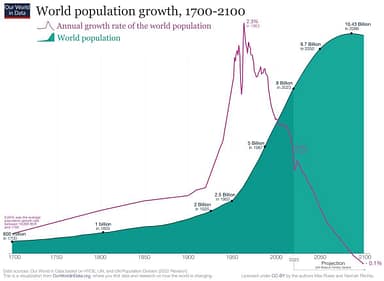
To understand the prediction, it helps to distinguish between exponential and hyperbolic growth.
Exponential growth occurs when a quantity increases by a relatively constant percentage over time. A population that grows exponentially can double repeatedly, although the time required for each doubling depends on the growth rate.
Hyperbolic growth behaves differently. Under certain mathematical relationships, growth accelerates as the quantity increases, producing a curve that becomes progressively steeper.
Von Foerster and his colleagues found that a hyperbolic-type equation described historical human population estimates remarkably well. When extended mathematically, the curve approached an infinite population at a finite point in time.
That point became the paper’s famous doomsday date.
But there is a critical limitation: a mathematical singularity is not a physical event that must occur in the real world.
An equation can predict infinity because its mathematical structure permits that outcome. Nature, however, operates under physical, biological and environmental constraints.
Humans require food, water, energy, shelter and functioning ecosystems. No mathematical extrapolation can make the planet capable of supporting an actually infinite population.
The date therefore represented the endpoint of a mathematical model, not a scientifically established deadline for Earth’s destruction.
Why the Prediction Did Not Match Reality
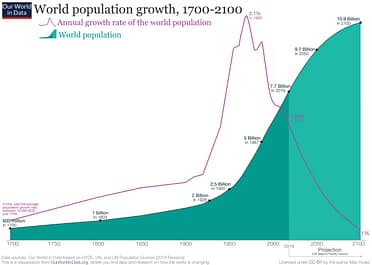
The central weakness of the prediction was its dependence on historical trends continuing into the future.
Population growth is influenced by birth rates, death rates, healthcare, education, economic conditions, access to contraception, urbanisation and changing family preferences.
These factors do not remain constant indefinitely.
During the decades following the paper’s publication, fertility rates declined across much of the world. Many countries experienced a demographic transition in which families had fewer children as living conditions, education and healthcare changed.
Consequently, global population growth slowed rather than continuing along the accelerating trajectory suggested by the original model.
This illustrates a fundamental problem in mathematical forecasting: a model can fit past observations extremely well without reliably predicting what happens next.
Historical data describe what has happened under particular circumstances. Future outcomes depend on whether those circumstances persist, change or disappear entirely.
The 1960 prediction remains a striking example of how an equation can produce a precise date while relying on assumptions that eventually fail.
What Scientists Actually Expect for World Population
Modern demographic projections provide a very different picture of humanity’s future.
According to the United Nations’ World Population Prospects 2024, the global population was approximately 8.2 billion in 2024. The organisation projected that it could reach around 10.3 billion in the mid-2080s before declining slightly to approximately 10.2 billion by 2100.
These are projections rather than certainties, but they differ dramatically from the unlimited growth implied by the earlier model.
The United Nations also reported that population growth is slowing in many regions, while some countries are already experiencing population decline. Source: United Nations population projections.
This does not mean population-related challenges have disappeared.
Rapid growth can place pressure on infrastructure, housing, food production, freshwater supplies and public services. Meanwhile, ageing populations and falling birth rates create different economic and social challenges in other countries.
The important point is that population trends vary across regions and change over time. A single equation cannot capture every factor shaping humanity’s future indefinitely.
Could November 13, 2026, Still Be a Dangerous Date?
There is no credible scientific evidence that November 13, 2026, will mark the end of the world because of the 1960 prediction.
The date is not associated with a scientifically established planetary catastrophe. It follows from extending a particular mathematical relationship beyond the historical data used to construct it.
That distinction matters because sensational headlines can turn a theoretical result into an apparently imminent threat.
Humanity faces genuine risks, including climate change, nuclear conflict, pandemics and environmental degradation. Those threats deserve serious attention because they are supported by identifiable mechanisms and evidence, not because an old equation produces a memorable date.
Nor does rejecting this particular prediction mean that unlimited population growth or resource consumption would be harmless. Sustainable development remains important, but those questions must be addressed using current evidence and realistic models.
The 2026 date is best understood as a reminder that mathematical precision does not automatically translate into predictive certainty.
The Real Lesson Behind the Doomsday Equation
When November 13, 2026, arrives, the significance of the date will be historical and scientific rather than apocalyptic.
Von Foerster and his colleagues created a memorable mathematical warning about a trend they believed humanity needed to examine. Their equation demonstrated how a seemingly convincing pattern could lead to an extraordinary conclusion when extended far beyond its original observations.
The episode also raises a broader question relevant to modern science: how confidently should we trust predictions about complex systems, from population growth and climate to artificial intelligence and the future of civilisation?
Mathematics is an indispensable tool for exploring such questions. But its conclusions depend on the assumptions, data and limits of the models being used.
The world is not expected to end on November 13, 2026, because of this paper. What the date offers instead is an opportunity to examine how scientific predictions are made, why they sometimes fail and why understanding the difference between a mathematical possibility and a real-world forecast matters.
The real warning was never that the planet had a scheduled expiration date. It was that humanity should not confuse the continuation of a historical trend with a guaranteed future.


