
Earth’s Invisible Radiation Shield Has Been Breached: Scientists Discover a Hidden Danger
The exact scientific discovery: Researchers have found that an extreme solar storm can generate dangerous, ultra-energetic electrons inside a region of Earth’s radiation belts previously believed to be protected by an almost impenetrable boundary.
Editorial clarification: The headline uses “breached” to describe the unexpected radiation event. Scientists did not find that Earth’s magnetic field had collapsed or that particles simply crossed the boundary from outside. The important discovery is that electrons were accelerated locally inside the supposedly protected region.
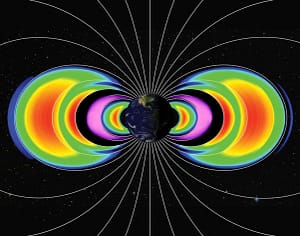
The Invisible Shield Around Earth Has a Weakness
Earth has a natural defence system that most people never see.
It is not a physical wall, a layer of metal or a protective atmosphere. It is an enormous magnetic environment that surrounds our planet, trapping charged particles from the Sun and other sources in two vast regions known as the Van Allen radiation belts.
For decades, scientists have studied these belts to understand how Earth protects itself from the dangerous radiation travelling through space.
But a remarkable discovery published in October 2026 has challenged an important assumption about this invisible shield.
Researchers led by scientists at Nagoya University in Japan have discovered that an extreme solar storm can produce extremely energetic electrons inside a region previously considered an almost impenetrable barrier.
The discovery was made using observations from Japan’s Arase spacecraft, which detected electrons with energies exceeding three million electronvolts deep inside this supposedly protected region.
The findings were published in the scientific journal Geophysical Research Letters on October 26, 2026.
This is not evidence that Earth’s magnetic field has failed. Nor does it mean that our planet has suddenly become defenceless against the Sun.
But it reveals something important: under extreme space-weather conditions, regions scientists previously considered relatively protected can become sources of dangerous radiation.
And that raises a question with implications for satellites, astronauts, space stations and future missions to the Moon and Mars.
If a region once considered a natural radiation barrier can suddenly produce dangerous particles, how safe is the space environment around Earth really?
What Are the Van Allen Radiation Belts?
To understand the discovery, we first need to understand the invisible structures surrounding Earth.
In 1958, American space scientist James Van Allen and his research team identified regions of intense radiation surrounding our planet using instruments aboard the Explorer 1 satellite.
The discovery changed our understanding of Earth’s magnetic environment.
These regions became known as the Van Allen radiation belts.
They consist primarily of charged particles, including energetic electrons and protons, trapped by Earth’s magnetic field.
Rather than forming solid protective layers, the belts resemble enormous doughnut-shaped regions surrounding the planet.
Scientists generally distinguish between two major belts:
The inner radiation belt
The inner belt is relatively close to Earth and contains large populations of energetic protons, along with electrons.
It is generally more stable than the outer belt, although its particle environment can change under certain conditions.
The outer radiation belt
The outer belt contains highly energetic electrons and is considerably more dynamic.
Solar storms can dramatically change its particle populations, sometimes increasing radiation levels and sometimes causing particles to disappear.
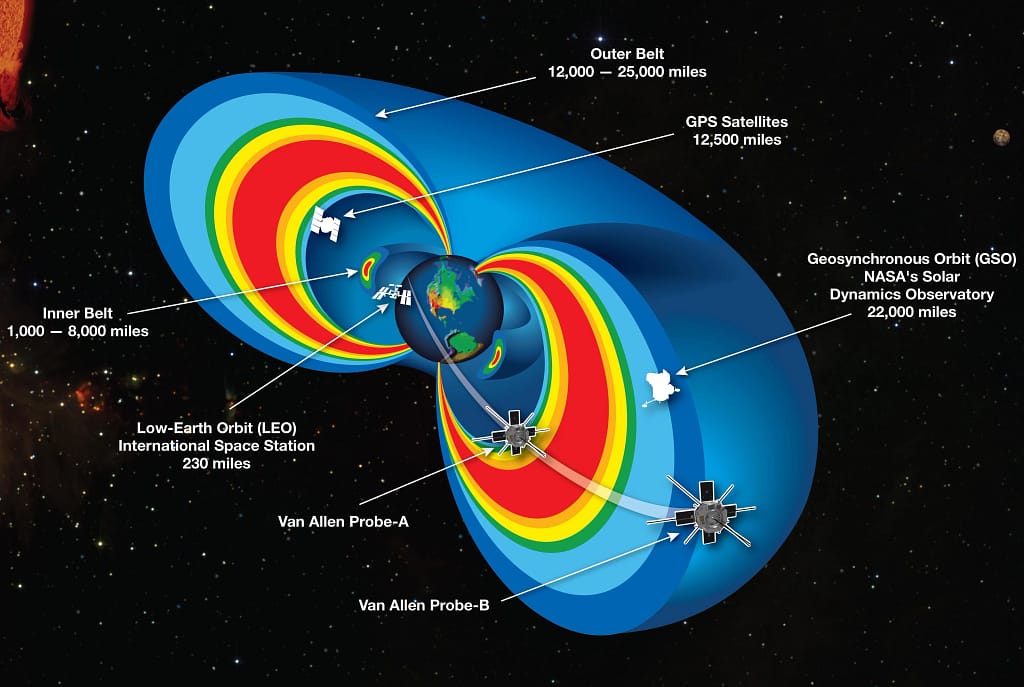
The belts are important because energetic particles can damage spacecraft electronics, degrade solar panels and create radiation exposure risks for astronauts.
Spacecraft travelling through these regions must therefore be designed with radiation protection in mind.
But the latest research focuses on something more specific: an unusual boundary inside the inner magnetosphere that scientists believed prevented extremely energetic electrons from penetrating further towards Earth.
The Impenetrable Barrier Scientists Thought Would Hold
For more than a decade, researchers studying Earth’s radiation environment have observed a striking boundary near three Earth radii from the planet’s centre.
This region is commonly described as the electron impenetrable barrier.
It is not a physical wall.
Instead, it is a boundary in the distribution of highly energetic electrons, beyond which these particles were rarely observed under typical conditions.
The barrier became particularly important after research published in 2014 showed that ultra-relativistic electrons were strongly restricted from moving inward beyond this boundary.
Scientists have investigated several possible explanations, including interactions between charged particles and electromagnetic waves in Earth’s magnetosphere.
One proposed mechanism involves a phenomenon known as plasmaspheric hiss, which can scatter energetic electrons and influence their movement.
Human-generated very-low-frequency radio transmissions may also contribute to shaping the radiation environment.
However, the exact processes responsible for maintaining the boundary are complex and remain an active area of research.
For years, observations suggested that the region inside this boundary was relatively protected from extremely energetic electrons.
Then came May 2024.
The May 2024 Solar Superstorm Changed Everything
In May 2024, Earth experienced one of the most powerful geomagnetic storms in recent decades.
The disturbance was triggered by intense solar activity involving coronal mass ejections and other solar eruptions.
These events sent enormous quantities of charged particles and magnetic energy towards Earth.
When the solar material interacted with our planet’s magnetic environment, it produced a major geomagnetic disturbance.
The effects were visible across the world.
Auroras appeared at unusually low latitudes, with spectacular displays reported in places that rarely experience them.
But while people were photographing colourful skies, something important was happening much higher above Earth.
The Japanese Arase spacecraft was observing the behaviour of energetic particles trapped inside the magnetosphere.
Its measurements revealed an unexpected increase in highly energetic electrons inside the supposedly protected region.
Some of these particles possessed energies exceeding three megaelectronvolts (MeV).
To put that into perspective, one electronvolt is the energy gained by an electron accelerated through an electric potential difference of one volt. A megaelectronvolt represents one million electronvolts.
At these energies, electrons can penetrate certain spacecraft materials and potentially damage sensitive electronic components.
The discovery was not simply that radiation levels increased.
It was how the particles appeared there.
Researchers found evidence that the electrons were accelerated locally inside the boundary rather than simply travelling inward from the outer radiation belt.
That distinction is the heart of the new research.
The Mysterious Space Waves That Accelerated the Electrons
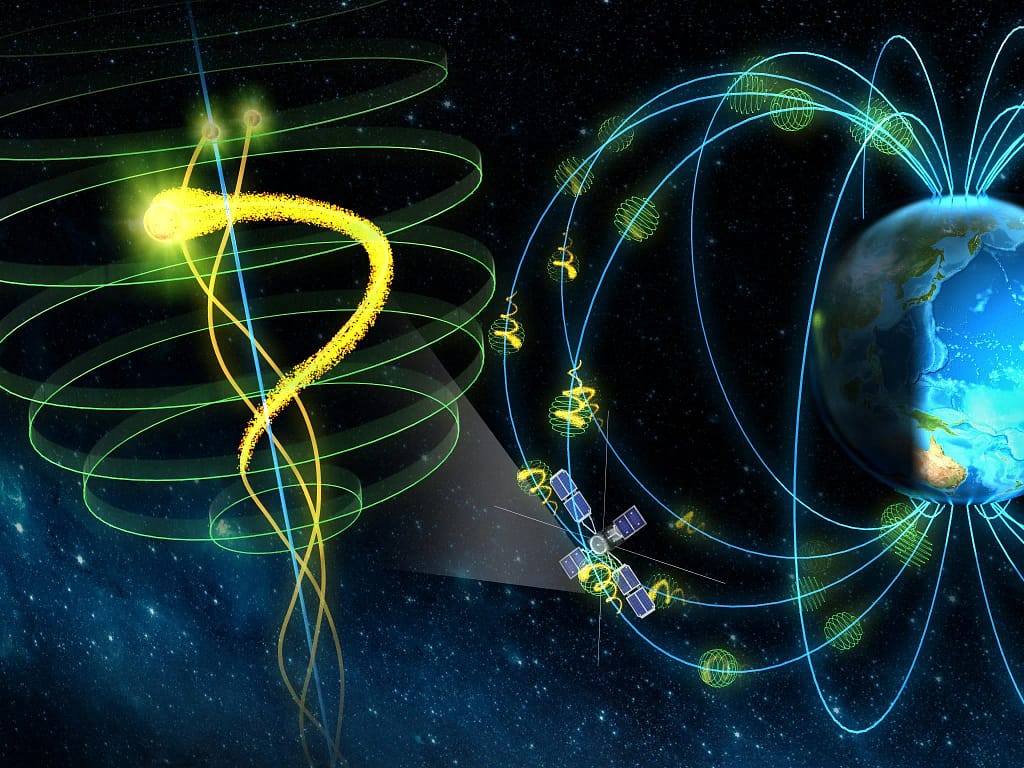
Perhaps the most fascinating part of the discovery involves electromagnetic waves known as chorus waves.
These are naturally occurring waves in Earth’s magnetosphere.
They are called chorus waves because, when converted into audio signals, their rising and falling frequencies can resemble the sound of birds singing.
They are not ordinary sound waves travelling through air. They are electromagnetic signals propagating through plasma.
And they can have a powerful effect on charged particles.
Under suitable conditions, chorus waves interact with energetic electrons through a process called wave-particle resonance.
This interaction can transfer energy to electrons, accelerating them to extremely high speeds.
The Nagoya University research team found that intense chorus-wave activity coincided with the development of the energetic electron population inside the previously protected region.
But why did these waves become so effective during the May 2024 storm?
The answer involves another important structure surrounding Earth: the plasmasphere.
How the Plasmasphere Helped Create a Dangerous Radiation Environment
The plasmasphere is a region of relatively cool, dense plasma surrounding Earth.
It contains electrically charged particles that influence how electromagnetic waves travel through near-Earth space.
During the May 2024 superstorm, the plasmasphere was strongly disturbed.
Its outer boundary contracted closer to Earth, leaving parts of the region around the radiation barrier with much lower plasma density than usual.
This created conditions that favoured intense chorus-wave activity.
The researchers found that the depleted plasma environment persisted much longer than normal.
Under typical circumstances, the plasmasphere begins recovering on a timescale of approximately two days.
During the May 2024 event, it took around 4.3 to 4.7 days for plasma density to recover to more than half of its pre-storm level in the observed region.
That prolonged disturbance provided an extended opportunity for the wave-particle interactions associated with local electron acceleration.
In other words, the solar storm did more than inject energy into Earth’s magnetic environment.
It changed the conditions inside the magnetosphere in ways that allowed a new population of dangerous electrons to develop.
This is why the discovery matters.
A region previously considered relatively protected may not remain so during extreme space-weather events.
And the implications extend beyond scientific curiosity.
Could This Radiation Damage Satellites?
The immediate concern is not that Earth’s population is suddenly exposed to dangerous radiation.
The bigger concern is the technology orbiting our planet.
Modern civilisation depends heavily on satellites.
They support:
-
GPS navigation and positioning.
-
International telecommunications.
-
Weather forecasting.
-
Television and internet connectivity.
-
Military surveillance and communications.
-
Earth observation and disaster monitoring.
Many of these spacecraft operate in environments where energetic particles can affect their electronic systems.
High-energy electrons can penetrate spacecraft shielding and deposit electrical charge inside materials.
This can lead to a phenomenon known as deep dielectric charging.
When electrical charge accumulates inside spacecraft materials, it can eventually produce a discharge that damages electronic components.
Possible consequences include:
-
Temporary satellite malfunctions.
-
Damage to sensitive electronic circuits.
-
Degradation of solar panels.
-
Disruption of communications systems.
-
Reduced spacecraft operational lifetimes.
The latest discovery suggests that satellite designers and space-weather forecasters may need to pay closer attention to radiation conditions in regions previously considered relatively protected.
It does not mean that satellites are automatically at risk whenever a solar storm occurs.
The actual danger depends on particle energy, exposure duration, spacecraft design, shielding and orbital location.
Could Astronauts Be in Danger?
This is where the discovery becomes particularly relevant to the future of human space exploration.
Astronauts travelling beyond Earth’s protective magnetic environment already face significant radiation risks.
NASA has spent decades studying how cosmic rays, solar energetic particles and trapped radiation affect the human body.
The latest findings introduce another consideration.
If extreme geomagnetic storms can generate energetic electrons inside regions of Earth’s magnetosphere that were previously considered relatively protected, spacecraft operating there may face radiation conditions that are more complicated than expected.
For astronauts aboard the International Space Station, the situation is different from that of astronauts travelling towards the Moon.
The ISS operates in low Earth orbit, where Earth’s magnetic field provides substantial protection from some forms of space radiation.
However, it is not completely shielded from radiation.
Astronauts still receive higher radiation exposure than people living on the ground, and their exposure varies with solar activity, orbital position and other factors.
The new study does not establish that Crew Dragon spacecraft or the ISS are facing an immediate new danger.
But it provides additional information that could improve radiation forecasting for future missions.
What about astronauts travelling to the Moon?
NASA’s Artemis programme aims to return humans to the lunar environment and eventually establish a sustained presence there.
Unlike astronauts aboard the ISS, lunar crews will spend more time outside Earth’s strongest protective magnetic environment.
They will face exposure to galactic cosmic rays and potentially intense solar particle events.
Spacecraft, habitats and spacesuits will need appropriate radiation protection.
Better understanding of Earth’s radiation belts could also improve planning for spacecraft departing Earth and travelling through near-Earth space.
What about Mars missions?
Mars presents an even greater challenge.
A crewed journey could take several months each way, and astronauts would spend extended periods beyond Earth’s magnetic protection.
There would be no practical way to return them quickly if a serious radiation-related medical emergency occurred.
Understanding how solar storms influence radiation environments is therefore essential for planning future deep-space missions.
The May 2024 event is a reminder that space-weather forecasting must account for complicated interactions between solar activity, Earth’s magnetic field and energetic particles.
Could Another Solar Superstorm Make the Situation Worse?
The May 2024 geomagnetic storm was an exceptional event, but it was not the first major solar disturbance to affect Earth.
Our planet has experienced powerful geomagnetic storms throughout recorded history.
One of the most famous examples is the Carrington Event of 1859.
During that event, intense geomagnetic disturbances affected telegraph systems, with reports of electrical sparks and equipment malfunctions.
If a comparable event occurred today, the consequences could be more serious because modern civilisation depends heavily on interconnected electrical and satellite infrastructure.
However, it would be inaccurate to suggest that every powerful solar storm will reproduce the same radiation-belt conditions observed in May 2024.
The latest research identifies a particular combination of atmospheric, plasma and electromagnetic conditions associated with the event.
Scientists need more observations to determine how frequently similar conditions develop and how they vary between storms.
That is one reason continued monitoring of Earth’s magnetosphere is so important.
How Scientists Plan to Monitor This Invisible Radiation Threat
The discovery was made possible by the Japanese Arase spacecraft, also known as the Exploration of energization and Radiation in Geospace (ERG) mission.
Launched in December 2016, Arase was designed to investigate how particles are accelerated and transported through Earth’s radiation belts.
Its instruments measure energetic particles, plasma conditions and electromagnetic waves.
By combining these measurements, scientists can investigate how radiation environments change during geomagnetic storms.
The latest research demonstrates the importance of observing several different processes simultaneously.
Monitoring solar activity alone is not enough.
Researchers also need to understand:
-
How the plasmasphere responds to geomagnetic disturbances.
-
Where chorus waves develop.
-
How energetic electrons gain energy.
-
How radiation populations move through the magnetosphere.
-
How long dangerous conditions persist after a solar storm.
These measurements could eventually help improve space-weather forecasting systems.
More accurate forecasts would give satellite operators additional time to prepare spacecraft for potentially hazardous radiation conditions.
They could also help mission planners identify periods when certain operations might need to be delayed or modified.
What This Discovery Does Not Mean
The phrase “Earth’s radiation shield has been breached” sounds dramatic, but the actual scientific findings are more precise.
There are several important misconceptions worth avoiding.
| Misconception | What the research actually shows |
|---|---|
| Earth’s magnetic field has collapsed | No. The magnetic field remains active. |
| Solar radiation is now reaching Earth’s surface unchecked | No such finding was reported. |
| The radiation belts have disappeared | No. The study concerns energetic electrons inside a particular boundary. |
| All satellites are suddenly in danger | Risk depends on orbital location, exposure and spacecraft protection. |
| The planet has lost its natural radiation protection | The discovery reveals a limitation in our understanding of radiation-belt behaviour, not the collapse of Earth’s protection. |
The most important finding is that the supposedly protected region can become a local source of highly energetic electrons under extreme space-weather conditions.
That is a significant discovery without needing to exaggerate what happened.
The Bigger Question: How Much Do We Really Know About Earth’s Magnetic Shield?
Earth’s magnetic environment is far more complicated than a simple protective bubble.
It constantly responds to the Sun, solar wind, charged particles and changing plasma conditions.
The Van Allen radiation belts are dynamic structures, not permanent, unchanging barriers.
The October 2026 discovery demonstrates that even regions previously regarded as relatively stable can behave unexpectedly during extreme events.
It also highlights how much scientists still need to understand about the relationship between solar storms and near-Earth space.
For a civilisation increasingly dependent on satellites and preparing to send humans farther into the Solar System, that knowledge is becoming essential.
Perhaps the biggest lesson is that Earth’s natural protection systems should never be treated as completely predictable.
The invisible shield around our planet is remarkably effective, but it is not an impenetrable wall.
And as humanity moves deeper into space, understanding its limitations could become one of the most important challenges in space science.
Final Thoughts: The Invisible Danger Above Our Heads
We rarely think about the radiation belts surrounding Earth.
They are invisible, thousands of kilometres above the surface and far removed from everyday human experience.
Yet they influence the safety of satellites, spacecraft and astronauts.
The new discovery by Nagoya University researchers offers a fascinating reminder of how much remains to be understood about our planet’s magnetic environment.
A solar superstorm in May 2024 created conditions that allowed highly energetic electrons to develop inside a region scientists had considered almost impenetrable.
The discovery does not mean Earth has lost its magnetic protection.
But it does mean that our understanding of dangerous radiation in near-Earth space needs to become more sophisticated.
As humans prepare for lunar exploration and eventual journeys to Mars, the question is no longer simply how to travel through space.
It is how to survive the invisible dangers waiting along the way.
Earth has a remarkable natural shield. But science is now discovering that even this shield has behaviours we are only beginning to understand.




