

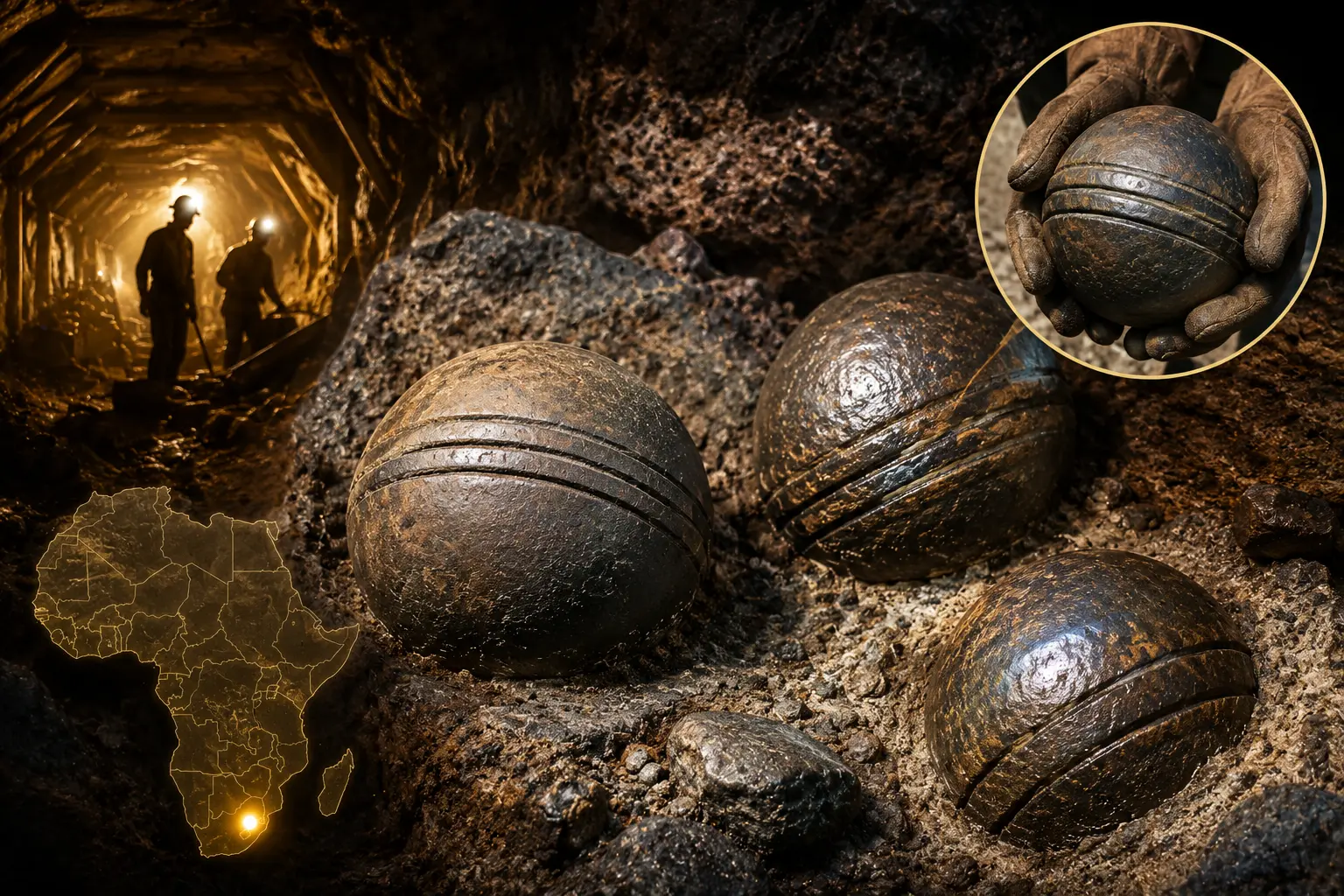
Imagine digging nearly two miles beneath the surface of the Earth and discovering what appear to be perfectly crafted metallic balls embedded inside ancient rock.
Some are almost perfectly round.
Others have mysterious grooves running around their middle, as though they were manufactured on a machine.
Even more astonishing, the rock surrounding them is estimated to be nearly 3 billion years old—long before dinosaurs, plants, or even complex life existed.
Could these strange objects really be remnants of an ancient civilization?
Did extraterrestrials visit Earth billions of years ago?
Or is nature capable of producing objects so unusual that they seem impossible?
For decades, the mysterious Klerksdorp Spheres have fueled one of the world’s most enduring ancient alien debates. While television documentaries and internet forums often describe them as impossible artifacts, geologists insist the explanation is far less mysterious.
So what is the truth?
Let’s journey deep beneath South Africa’s ancient mines to separate scientific evidence from one of archaeology’s most fascinating myths.
A Discovery Hidden Deep Underground
The story begins in the gold-rich region near Klerksdorp, South Africa.
For decades, miners extracting valuable minerals from Precambrian rock formations occasionally stumbled across unusual spherical objects unlike anything they had seen before.
These strange spheres varied in size from a few centimeters to roughly the size of a baseball.
Some appeared smooth.
Others displayed three nearly parallel grooves encircling their equators.
To anyone seeing them for the first time, they looked surprisingly manufactured.
The discovery quickly attracted curiosity.
If these objects really were embedded inside rock nearly 2.8 to 3 billion years old, they would predate every known civilization by an unimaginable margin.
Humans, after all, have existed for only around 300,000 years.
The age difference is staggering.
Why Did People Think They Were Artificial?
The Klerksdorp Spheres became famous largely because of how unusual they appear.
Supporters of ancient alien theories point to several features.
1. Their Nearly Perfect Shape
Many specimens appear remarkably spherical.
Nature certainly creates rounded stones, but these looked unusually symmetrical.
2. The Parallel Grooves
Several spheres possess distinct grooves wrapping around their centers.
To some observers, these resemble machine-made decorative rings.
3. Their Incredible Age
Perhaps the biggest mystery lies in the rocks surrounding them.
The spheres were reportedly found inside Precambrian pyrophyllite deposits nearly three billion years old.
If the objects were manufactured, who—or what—made them?
No humans existed.
No animals with advanced intelligence existed.
Earth itself looked completely different.
The Ancient Alien Theory
Once photographs of the spheres spread across books, documentaries, and later the internet, speculation exploded.
Some researchers outside mainstream geology suggested the spheres might be:
- Alien probes
- Ancient technological components
- Lost artifacts from a forgotten civilization
- Evidence that intelligent visitors reached Earth billions of years ago
Television programs featuring ancient astronaut theories often showcased the spheres as objects that supposedly “cannot be explained.”
Some writers even claimed they possessed impossible hardness or perfect balance.
Others argued they resembled precision bearings produced in modern factories.
It certainly makes for a compelling mystery.
But how much of it is supported by evidence?
What Geologists Actually Found
The scientific explanation is considerably less dramatic—but no less fascinating.
Geologists who studied the Klerksdorp Spheres discovered that they are natural geological formations called concretions.
Most consist primarily of:
- Hematite
- Goethite
- Wollastonite
- Pyrite or related minerals
These minerals formed naturally over immense periods of geological time.
As mineral-rich fluids moved through volcanic ash deposits, they gradually accumulated around small centers.
Layer upon layer built up until rounded masses developed.
The result?
Natural spheres.
Nature, it turns out, is surprisingly good at creating symmetry.
But What About the Grooves?
This is perhaps the feature that intrigues people the most.
Those three parallel grooves look intentional.
Yet geologists explain they likely formed because the spheres grew along tiny cracks, fractures, or sedimentary layering within the surrounding rock.
As pressure increased over millions of years, these growth patterns became preserved.
In other words, the grooves weren’t carved.
They developed naturally during mineral formation.
Nature often produces remarkably geometric structures.
Examples include:
- Giant crystal columns
- Perfect snowflakes
- Hexagonal basalt formations
- Symmetrical geodes
The grooves simply represent another example of geology creating shapes our brains instinctively associate with intelligent design.
Are They Really Metallic?
Many articles describe the spheres as metallic.
This is only partly true.
Some specimens contain iron-rich minerals such as hematite, giving them a metallic appearance.
Others contain pyrite, often called “fool’s gold.”
However, looking metallic does not mean they were manufactured from refined metal.
Iron minerals naturally occur throughout Earth’s crust.
Over billions of years, chemical processes can create surfaces that appear polished or metallic without any human involvement.
The “Impossible Hardness” Myth
One of the internet’s most persistent claims is that the spheres are harder than steel.
This story has circulated for decades.
However, there is no scientific evidence supporting it.
Laboratory analysis shows the minerals composing the spheres possess hardness values entirely consistent with naturally occurring rocks.
They are certainly durable.
But they are not miraculous.
Nor are they made from unknown alloys.
Did One Sphere Really Rotate by Itself?
Another fascinating story claims museum workers observed one of the spheres slowly rotating inside a display case without anyone touching it.
This anecdote has appeared repeatedly online.
Yet there has never been reliable scientific documentation confirming the claim.
Possible explanations include:
- Slight vibrations
- Uneven surfaces
- Display case movement
- Misinterpretation
- Embellishment over time
Stories often grow more mysterious each time they are retold.
Without controlled observation, such accounts remain anecdotes rather than evidence.
Why Ancient Rocks Make the Mystery Even Better
Ironically, the real geology may be even more incredible than the alien explanation.
Three billion years ago:
- Earth had almost no oxygen.
- No forests existed.
- No dinosaurs walked the planet.
- Continents looked completely different.
- Life consisted almost entirely of microscopic organisms.
During this unimaginably distant era, volcanic ash accumulated beneath ancient seas.
Mineral-rich groundwater slowly transformed portions of these deposits.
Given enough time—millions upon millions of years—nature sculpted the spherical concretions we see today.
The objects themselves are authentic relics of Earth’s deep past.
Their existence truly is extraordinary.
Just not for the reasons many assume.
Why Do They Fool So Many People?
Humans are exceptionally good at recognizing patterns.
Psychologists call this pareidolia—our tendency to see meaningful designs even where none were intentionally created.
It’s why we recognize:
- Faces in clouds
- Animals in rock formations
- Buildings on Mars
- Artificial-looking objects in nature
The Klerksdorp Spheres trigger this instinct perfectly.
Their symmetry feels engineered.
Their grooves resemble machining.
Their ancient age adds another layer of mystery.
Our brains naturally leap toward intelligent creators.
Similar Natural Objects Around the World
The Klerksdorp Spheres aren’t unique.
Nature has produced comparable formations elsewhere.
The Moeraki Boulders (New Zealand)
Massive spherical stones scattered across beaches, formed naturally through sedimentary processes.
The Cannonball Concretions (North Dakota)
Large rounded rocks created through mineral cementation.
Stone Balls of Kazakhstan
Perfectly spherical geological formations stretching across desert landscapes.
Each has inspired legends.
Each once puzzled observers.
Each eventually received geological explanations.
Could Ancient Aliens Still Be Possible?
The existence of natural explanations for the Klerksdorp Spheres does not completely rule out the broader search for extraterrestrial intelligence.
Scientists actively investigate:
- Technosignatures
- Radio signals from distant civilizations
- Potential microbial life on Mars
- Habitable exoplanets
- Ocean worlds like Europa and Enceladus
The universe is unimaginably vast.
Many astronomers believe intelligent life could exist elsewhere.
However, extraordinary claims require extraordinary evidence.
At present, no credible scientific study concludes the Klerksdorp Spheres are alien artifacts.
What Makes the Mystery Worth Studying?
Even if the spheres are natural, they remain scientifically valuable.
They provide clues about:
- Earth’s ancient environment
- Mineral formation
- Early geological processes
- Precambrian chemistry
Studying these formations helps researchers reconstruct our planet’s earliest history—an era almost impossible to imagine.
In that sense, the spheres are genuine time capsules.
The Internet’s Role in the Legend
The Klerksdorp Spheres gained worldwide fame long before social media.
Books about ancient civilizations featured them.
Television documentaries amplified the mystery.
Then the internet transformed them into viral sensations.
Over time, unsupported claims became repeated so often they appeared factual.
This illustrates an important lesson.
Curiosity is valuable.
But curiosity should always be paired with evidence.
Final Verdict: Alien Artifact or Geological Wonder?
The Klerksdorp Spheres occupy a fascinating place where science meets imagination.
On one side lies a captivating story of ancient alien visitors leaving behind metallic objects billions of years before humanity appeared.
On the other stands decades of geological research showing that remarkable natural processes can produce shapes that look astonishingly artificial.
Today’s evidence strongly supports the geological explanation.
Yet the mystery continues to captivate because it challenges our assumptions about what nature can create.
Whether viewed as ancient concretions or as inspiration for imaginative speculation, the Klerksdorp Spheres remind us that Earth still holds countless surprises beneath its surface.
Sometimes, the real story is just as astonishing as the myths.
Frequently Asked Questions
What are the Klerksdorp Spheres?
They are naturally occurring spherical mineral concretions found in ancient South African rock formations near Klerksdorp.
How old are they?
The surrounding rock is estimated to be approximately 2.8–3 billion years old, making the formations among the oldest geological features associated with such objects.
Are the spheres metallic?
Some contain iron-rich minerals that give them a metallic appearance, but they are natural mineral formations rather than manufactured metal objects.
Did aliens create the Klerksdorp Spheres?
There is no credible scientific evidence supporting an extraterrestrial origin. Geological studies explain them as naturally formed concretions.
Why do they have grooves?
Researchers believe the grooves formed naturally during mineral growth and geological pressure over immense periods of time.


