

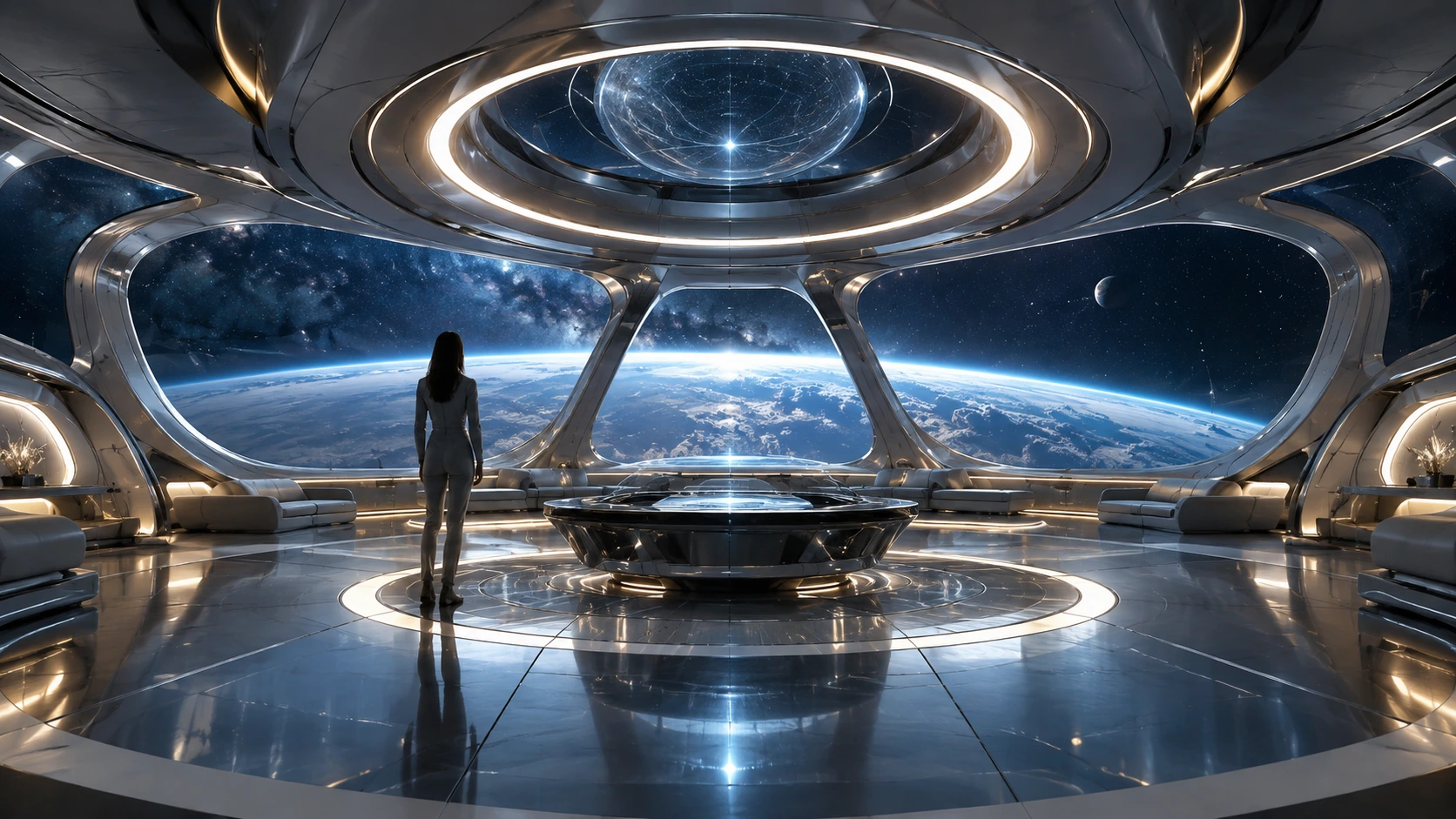

One of the strangest things about UFO stories is that they rarely focus on the spacecraft themselves.
Most discussions revolve around lights in the sky, radar detections, mysterious photographs, or reports of unusual flight behavior. Yet if an advanced civilization were capable of crossing the immense distances between stars, the truly fascinating question might not be how its spacecraft looks from the outside.
It might be what waits inside.
For decades, people who claim close encounters with UFOs have described stepping into environments that seemed to defy common expectations. Their accounts often include smooth walls without visible seams, rooms illuminated without obvious light sources, and technology that appeared to function without buttons, switches, or screens.
These reports remain unverified, and no scientific evidence has confirmed that any human has entered an extraterrestrial vehicle. Nevertheless, they raise an intriguing question that extends beyond UFO folklore and into the realm of science itself.
If a civilization possessed technology thousands—or perhaps millions—of years more advanced than our own, what would the interior of one of its spacecraft actually look like?
The answer may have less to do with science fiction and more to do with the direction human technology is already heading. As artificial intelligence becomes increasingly autonomous, interfaces disappear into software, and machines learn to adapt to their users, some scientists and futurists suspect that truly advanced technology may not resemble machinery at all.
And that possibility leads to a surprising conclusion.
The inside of an alien spacecraft might look far simpler—and far stranger—than anything Hollywood has ever imagined.
The Curious Similarities in UFO Witness Reports

For decades, individuals claiming close encounters with UFOs have described entering unusual craft.
These accounts remain unverified, and there is no scientific evidence proving that any of these reported experiences involved extraterrestrial vehicles. Still, researchers have long noted an interesting pattern.
Many descriptions sound surprisingly similar.
Witnesses frequently describe interiors that appear remarkably simple. Instead of crowded machinery and visible technology, they often report smooth curved walls, seamless surfaces, soft lighting, and an absence of obvious controls.
Some describe rooms that seem larger on the inside than the exterior dimensions would suggest.
Others report walls that appear almost alive, changing texture or brightness in response to activity.
Whether these similarities reflect genuine encounters, cultural influences, psychological expectations, or something else entirely remains a matter of debate.
But they raise an intriguing possibility.
Perhaps truly advanced technology wouldn’t look advanced at all.
Why So Many UFO Interiors Sound Surprisingly Alike
One of the most fascinating aspects of UFO lore is not the differences between stories but the similarities.
People from different countries, different decades, and vastly different backgrounds often describe environments that share common features. Circular rooms. Diffuse lighting. Curved architecture. A strange absence of visible machinery.
Skeptics argue that cultural influence may explain much of this consistency. Movies, television shows, books, and popular UFO narratives can shape expectations and memories.
That argument carries weight.
Human memory is not a perfect recording device. It is influenced by suggestion, interpretation, and prior experience.
Yet the pattern remains intriguing.
Many reports describe technologies that appear integrated into the environment itself. There are few references to engines, wiring, mechanical controls, or the industrial complexity one might expect from a sophisticated machine.
Instead, witnesses often describe spaces that feel almost minimalist.
This observation aligns with an interesting trend visible in human technology.
The more advanced our tools become, the less visible their complexity tends to be.
Human Technology Is Already Moving in That Direction
Consider the evolution of everyday devices.
A modern smartphone contains more computing power than the systems that guided Apollo astronauts to the Moon.
Yet it has fewer visible controls than many electronics from decades ago.
Buttons disappeared.
Switches vanished.
Complexity moved beneath the surface.
Technology became more powerful while becoming less obvious.
The same pattern appears in automobiles. Advanced software quietly manages countless processes behind the scenes while drivers interact with increasingly simplified interfaces.
Artificial intelligence is accelerating this trend.
People no longer need to understand the inner workings of a recommendation algorithm to use it. They simply interact with the result.
Now extend that trajectory another thousand years.
Or ten thousand.
The most advanced technology may become nearly invisible.
Not because it is absent.
Because it is so thoroughly integrated into its environment that it no longer announces itself as technology.
An alien spacecraft built by a civilization far older than ours might follow the same path.
Would There Even Be a Cockpit?
Science fiction often portrays alien spacecraft with command centers, navigation consoles, and pilot stations.
But those designs are largely based on human needs.
Human pilots require controls because humans must actively operate machines.
An advanced civilization may not.
Artificial intelligence is already becoming capable of handling increasingly complex tasks. Autonomous systems manage aircraft, monitor industrial facilities, analyze data, and make decisions at speeds beyond human capability.
A civilization capable of interstellar travel may rely on machine intelligence far more advanced than anything humans currently possess.
If so, traditional cockpits could become unnecessary.
The spacecraft itself might handle navigation, threat assessment, communication, maintenance, and route optimization automatically.
Occupants might simply specify a destination—or perhaps not even that.
The vehicle could anticipate needs before they are expressed.
In such a scenario, a cockpit would be as outdated as a horse-drawn carriage.
The most advanced spacecraft imaginable might contain no visible flight controls at all.
The Spacecraft May Already Know What You Need

Artificial intelligence is changing humanity’s relationship with machines.
For most of history, humans adapted to technology.
Increasingly, technology adapts to humans.
Your phone predicts words before you finish typing.
Streaming services anticipate what you might want to watch.
Navigation systems adjust routes automatically.
These systems remain primitive compared to what may exist centuries from now, but they reveal a direction.
Technology is becoming predictive.
Now imagine extending that trend across thousands of years.
An advanced spacecraft might monitor the biological and cognitive state of its occupants continuously.
Environmental conditions could adjust automatically.
Information could appear exactly when needed.
Communication systems could anticipate questions before they are asked.
To a human visitor, the experience might feel less like operating a machine and more like interacting with a highly intelligent environment.
The craft itself becomes a partner rather than a tool.
Why UFOs Might Not Have Windows
One of the most surprising possibilities involves something many people take for granted.
Windows.
Science-fiction spacecraft are often filled with observation decks and panoramic viewing areas.
Real engineers are generally less enthusiastic.
Windows create vulnerabilities. They add structural complexity and limit design flexibility.
Modern aerospace systems increasingly rely on sensors rather than direct visual observation.
Future spacecraft may take this principle much further.
An advanced vehicle could gather information across a vast range of wavelengths and physical phenomena beyond normal human perception.
Visible light.
Infrared.
Radio frequencies.
Magnetic fields.
Perhaps even forms of information humans have not yet discovered.
Occupants would receive a richer understanding of their surroundings than any physical window could provide.
Ironically, the most advanced spacecraft may feel completely enclosed while simultaneously offering perfect awareness of the outside universe.
What If Thought Replaces Controls?
Researchers today are already exploring brain-computer interfaces capable of translating neural activity into digital commands.
The technology remains in its infancy, but the concept is no longer science fiction.
Now imagine the same idea after thousands of years of refinement.
An advanced civilization may communicate directly with machines through thought.
No keyboards.
No screens.
No buttons.
No physical controls.
The spacecraft responds to intention itself.
A human entering such an environment might see an empty room and assume nothing is happening.
Meanwhile, the occupants could be controlling every aspect of the craft through interfaces invisible to us.
The technology would not appear advanced.
It would appear absent.
Could Alien Spacecraft Be Partly Biological?
Human beings tend to separate biology and technology into different categories.
Nature is one thing.
Machines are another.
Future technology may blur that distinction.
Scientists already develop materials inspired by living systems. Artificial intelligence borrows concepts from neural networks. Researchers investigate self-healing materials capable of repairing damage.
Now extend those ideas thousands or millions of years into the future.
A spacecraft might not be built in the conventional sense.
It might be grown.
Damage could heal rather than require repairs.
Systems could adapt dynamically to changing conditions.
Walls might alter their structure.
Surfaces could respond to touch.
Lighting could emerge from biological processes embedded within the material itself.
The result would not feel like entering a machine.
It might feel like entering a living organism.
While there is no evidence such spacecraft exist, the possibility highlights a recurring mistake humans often make.
We assume alien technology would resemble ours.
History suggests that assumption may be unreliable.
What If the Walls Are the Computer?
Perhaps the most transformative possibility is that every surface serves multiple functions simultaneously.
Human architecture separates roles.
Walls support structures.
Computers process information.
Displays show data.
Future technologies may merge those functions together.
The walls themselves could become computers.
Sensors.
Displays.
Communication systems.
Environmental controls.
Energy storage devices.
All at the same time.
A visitor would struggle to distinguish where the machine ends and the room begins.
Every surface would be active.
Every surface would be intelligent.
Technology would not occupy the environment.
It would be the environment.
The Physics Problem Nobody Talks About
Many UFO reports describe extraordinary flight characteristics.
Sudden acceleration.
Instant changes in direction.
Silent movement.
Apparent defiance of conventional aerodynamics.
If such capabilities were real, they would introduce a fascinating challenge.
The forces involved would normally be devastating for biological occupants.
Human pilots can lose consciousness under extreme acceleration.
Yet reported occupants are often described as unaffected.
One possible explanation involves technologies that manipulate spacetime itself rather than moving conventionally through it.
Concepts such as warp drives remain speculative and unproven, but they demonstrate how radically different transportation technologies could alter the interior experience.
Passengers might feel no acceleration at all.
No turbulence.
No vibration.
No sensation of movement.
The cabin could remain perfectly calm while performing maneuvers impossible for modern aircraft.
To human visitors, that environment might feel profoundly unnatural.
The One Surprising Possibility

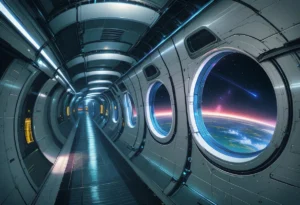
Of all the theories surrounding alien spacecraft interiors, one stands above the rest.
What if there is no single interior?
What if every visitor experiences something different?
Humans perceive reality through biological filters.
Our eyes detect only a narrow range of light.
Our ears capture only certain frequencies.
Our brains simplify enormous amounts of information.
An advanced civilization may understand perception at levels humans can barely imagine.
If so, the spacecraft might actively adapt to whoever enters it.
A human visitor sees walls, corridors, and rooms.
Another intelligent species might perceive entirely different structures.
The environment becomes a translation system.
A communication interface.
A bridge between radically different forms of intelligence.
Modern virtual reality offers a primitive glimpse of this concept. Different users can occupy the same digital environment while experiencing different information layers.
An advanced extraterrestrial equivalent could operate on a far grander scale.
The spacecraft adjusts itself to the observer.
Not physically.
Perceptually.
Which leads to a remarkable question.
Perhaps asking what a UFO looks like from the inside is the wrong question altogether.
The better question might be:
What does the spacecraft want you to see?
The Real Mystery May Not Be the Craft
For generations, humanity has looked toward the stars and wondered whether intelligent life exists elsewhere.
That question remains unanswered.
Yet hidden inside it is another mystery.
If advanced civilizations exist, how would we recognize their technology?
Human beings often assume progress means larger machines, more visible power, and greater complexity.
But history suggests another possibility.
Technology often becomes simpler as it becomes more advanced.
It disappears into the background.
Electricity transformed civilization, yet most people rarely think about the networks powering their homes.
Artificial intelligence increasingly operates behind interfaces that reveal little about the complexity underneath.
The same trend may continue indefinitely.
If humanity ever encounters a genuine extraterrestrial spacecraft, the greatest surprise may not be its speed or power.
It may be its simplicity.
No flashing control panels.
No dramatic command bridge.
No walls covered with mysterious instruments.
Just an environment so advanced that the technology itself becomes nearly invisible.
And perhaps that’s why this question continues to fascinate people.
Because somewhere between physics, engineering, psychology, and imagination lies a possibility that challenges nearly every assumption we have about intelligence.
The inside of a UFO may not resemble the future we expect.
It may resemble something we don’t yet possess the concepts to understand.


