

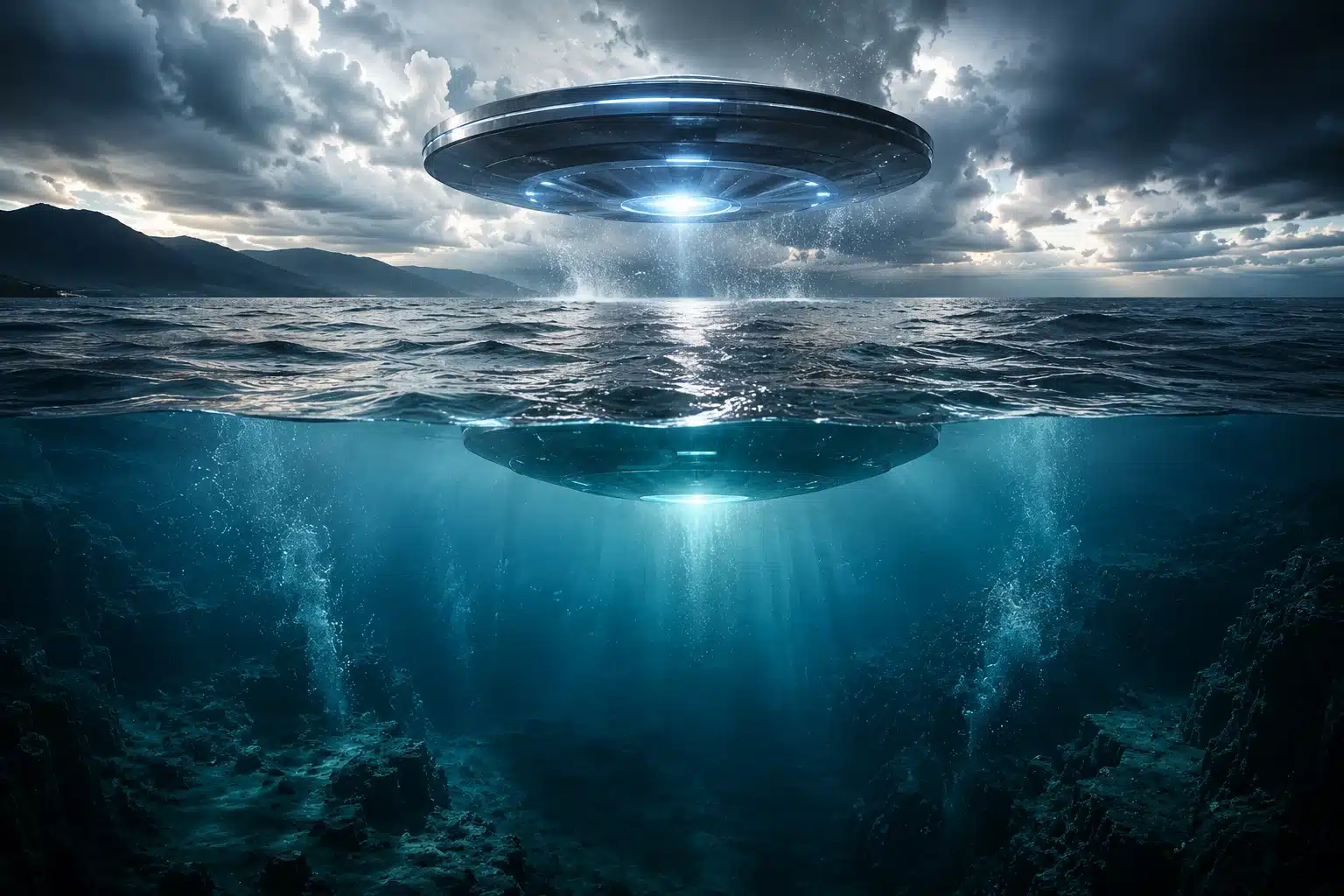
The Most Puzzling Reports Aren’t in the Sky
On a clear night over the ocean, military sensors track an unidentified object moving above the water. Moments later, the target appears to descend toward the sea. Operators attempt to follow it, but the object seemingly vanishes.
Did it enter the ocean?
Was it a sensor illusion?
Or was it something operating in a way modern technology struggles to explain?
These questions sit at the center of one of the most debated subjects in contemporary UAP research: transmedium phenomena.
Unlike conventional unidentified aerial sightings, transmedium cases involve reports of objects allegedly moving between multiple environments—such as space, the atmosphere, and water—without displaying the limitations expected of known aircraft, spacecraft, submarines, or drones. The concept has become so significant that U.S. law specifically includes “transmedium objects or devices” within the official definition of Unidentified Anomalous Phenomena (UAP).
For researchers investigating the possibility of Non-Human Intelligence (NHI), these reports represent some of the most intriguing cases on record. For skeptics and government investigators, they represent some of the most challenging analytical problems in modern aerospace intelligence.
What Does “Transmedium” Actually Mean?
The term “transmedium” refers to an object that can transition between two or more physical domains.
Those domains include:
- Space
- Earth’s atmosphere
- Surface environments
- Underwater environments
According to the official definition used by the U.S. government, transmedium UAP are objects that appear capable of operating across multiple domains while remaining unidentified.
The concept is important because each environment presents unique engineering challenges.
Aircraft are designed for atmospheric flight.
Spacecraft are optimized for operation in vacuum.
Submarines function under immense water pressure.
Building a single platform capable of seamlessly operating in all three environments would represent a technological achievement far beyond publicly acknowledged capabilities.
That possibility is one reason transmedium reports continue to attract attention from intelligence agencies, military analysts, and scientists.
Why Transmedium Cases Matter
Most UAP reports can eventually be attributed to ordinary explanations such as aircraft, balloons, drones, satellites, atmospheric effects, or sensor artifacts.
Transmedium cases are different.
If verified, they would suggest performance characteristics that challenge conventional engineering assumptions.
An object moving from air to water without a visible reduction in speed would face enormous physical stresses.
Water is approximately 800 times denser than air.
Any vehicle transitioning between the two environments would typically experience dramatic resistance and turbulence.
Yet some witness reports claim no such effects were observed.
This does not prove extraordinary technology exists.
It does explain why these cases receive disproportionate attention.
The Navy Encounters That Sparked Global Interest
Public fascination with transmedium UAP accelerated after several military incidents became widely known.
Among the most discussed are reports from U.S. Navy personnel who described unusual objects operating near naval training areas.
Witnesses reported objects appearing on advanced radar systems, performing unexpected maneuvers, and in some accounts descending toward the ocean.
While many details remain disputed, these encounters helped shift UAP discussions from fringe speculation to a topic receiving serious governmental review.
The emergence of AARO and subsequent congressional investigations reflected growing recognition that some incidents warranted formal analysis.
However, despite years of investigation, definitive explanations for every reported encounter have not emerged.
What AARO Has Actually Found
The All-domain Anomaly Resolution Office (AARO) was created to investigate unidentified phenomena using a scientific, data-driven framework. Its mission includes examining reports across air, maritime, space, and transmedium environments.
AARO has released numerous videos, case analyses, and annual reports.
One of the most important findings is often overlooked:
Most investigated cases do not ultimately support extraordinary interpretations.
In a notable case involving Puerto Rico that had been widely cited online as evidence of transmedium behavior, AARO’s reconstruction determined that the objects remained over land throughout the encounter and did not exhibit genuine transmedium characteristics. Investigators concluded that the apparent transition into water resulted from observational and sensor-related factors rather than actual movement between domains.
This case demonstrates a recurring challenge in UAP investigations.
What appears extraordinary at first glance may look very different after detailed analysis.
The Evidence Gap
Despite increasing transparency, a major problem remains.
Most reported transmedium incidents lack complete datasets.
AARO has repeatedly emphasized that many unresolved cases suffer from insufficient information needed for definitive attribution. Some reports contain only partial sensor recordings, eyewitness observations, or secondary recordings of military displays.
Without complete radar tracks, precise distance measurements, environmental data, and multi-sensor confirmation, determining whether an object truly moved between domains becomes extremely difficult.
This evidence gap explains why many cases remain unresolved.
Unresolved does not mean confirmed.
It simply means investigators lack enough information to reach a high-confidence conclusion.
The Ocean Connection
One of the most persistent themes in transmedium reports involves water.
Military personnel, commercial pilots, and civilian witnesses have repeatedly reported unidentified objects near oceans, coastlines, and maritime operating areas.
Some recently released AARO materials describe unidentified objects moving close to ocean surfaces. Mission reports mention observations involving targets flying near water, tracking across maritime environments, or exhibiting unusual visual characteristics. However, these reports generally stop short of confirming anomalous behavior.
The ocean’s role in UAP reports has fueled speculation for decades.
Earth’s oceans cover more than 70 percent of the planet’s surface, while large portions remain poorly mapped and sparsely monitored.
For proponents of NHI theories, this makes deep oceans a conceivable location for hidden activity.
For scientists, it simply highlights how little humanity still knows about its own planet.
The NHI Hypothesis
The possibility of Non-Human Intelligence has become increasingly visible in public discussions surrounding UAP.
NHI refers broadly to intelligence that does not originate from human beings.
Importantly, NHI is not synonymous with extraterrestrials.
The term encompasses multiple possibilities, including unknown biological entities, advanced artificial intelligence systems, hypothetical non-human civilizations, or concepts that remain entirely speculative.
At present, no publicly available evidence released by AARO or other government agencies confirms the existence of NHI. Official investigations continue to state that no verified evidence has established extraterrestrial technology, alien spacecraft, or non-human intelligence behind reported UAP incidents.
Nevertheless, unresolved cases continue to drive public curiosity because they leave open questions that investigators have not yet answered.
Space-to-Sea Claims Remain Unverified
Perhaps the most dramatic transmedium claims involve objects allegedly moving from space into Earth’s atmosphere and then into the ocean.
Such capabilities would imply technologies far beyond publicly known aerospace systems.
Yet official reports do not currently provide verified evidence of such transitions.
AARO’s latest annual reporting data actually suggests how rare confirmed transmedium observations remain. Among hundreds of reported incidents reviewed during a recent reporting period, investigators documented reports occurring in air and space domains, but none were officially categorized as maritime or transmedium events.
This finding is significant.
It suggests that while transmedium reports generate substantial attention, confirmed evidence remains extremely limited.
Why Sensors Can Be Misleading
Modern military sensors are extraordinarily capable.
They are not infallible.
Infrared systems, radar platforms, electro-optical cameras, atmospheric conditions, software processing, viewing angles, and environmental factors can all influence what operators observe.
Several AARO case reviews have shown how objects initially perceived as anomalous were later attributed to ordinary explanations once additional data became available. Balloons, aircraft, environmental conditions, and optical effects have all contributed to misidentifications.
This does not mean every report is explained.
It does mean extraordinary claims require exceptionally strong evidence.
The Scientific Challenge Ahead
The transmedium mystery represents a collision between human observation, advanced technology, and incomplete data.
Scientists face a difficult task.
They must remain open to unexpected discoveries while applying rigorous standards of evidence.
That balance is essential.
History shows that many seemingly impossible observations eventually receive conventional explanations.
History also shows that scientific breakthroughs sometimes emerge from anomalies that refuse to disappear.
Determining which category applies to transmedium UAP remains one of the field’s central challenges.
A Mystery That Refuses to Sink
The most compelling aspect of the transmedium debate is not that it proves the existence of Non-Human Intelligence.
It is that the question remains unresolved.
Government investigations have expanded dramatically.
Military reporting systems have improved.
Sensor capabilities continue advancing.
Thousands of reports have been collected and analyzed.
Yet a small number of cases continue to resist easy explanation.
For now, the evidence points toward caution rather than certainty.
There is no publicly verified proof that objects are routinely traveling between space, air, and deep ocean environments using technologies beyond human understanding.
At the same time, the persistence of unexplained reports ensures the subject remains a focus of scientific inquiry and national security attention.
Whether future investigations reveal misunderstood natural phenomena, classified human technologies, sensor limitations, or something entirely unexpected, the transmedium mystery remains one of the most fascinating frontiers in the ongoing effort to understand unidentified anomalous phenomena.


