The Fermi Paradox is one of the most fascinating and unsettling mysteries in modern science. More than seventy years after physicist Enrico Fermi famously asked, “Where is everybody?”, scientists are still struggling to explain why the universe appears silent despite containing billions of potentially habitable worlds.
On a summer day in 1950, physicist Enrico Fermi asked a simple question that would become one of the most profound mysteries in science:
“Where is everybody?”
At first glance, it sounds almost casual. But hidden within those three words is a puzzle that has troubled astronomers, physicists, philosophers, and dreamers for decades.
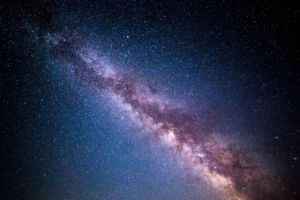
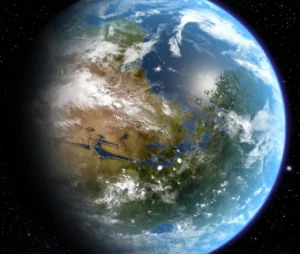
The universe is unimaginably vast. Modern estimates suggest there may be hundreds of billions of stars in our Milky Way galaxy alone, and potentially trillions of galaxies across the observable universe. Around many of those stars orbit planets. Some of those planets exist in regions where liquid water could survive. Some may have atmospheres. Some may even resemble Earth.
If the conditions for life are so common, then one question becomes impossible to ignore:
Why haven’t we found any evidence of intelligent extraterrestrial civilizations?
No confirmed alien signals.
No alien spacecraft.
No giant engineering projects around distant stars.
No unmistakable signs that another technological civilization exists.
This contradiction between what mathematics suggests and what observations reveal is known as the Fermi Paradox.
More than seventy years after Fermi posed his famous question, the paradox remains unsolved. In fact, recent discoveries of Earth-like worlds, potentially habitable planets, and mysterious cosmic phenomena have made the mystery even deeper.
And the answer, if we ever find it, could change humanity’s understanding of its place in the universe forever.
What Exactly Is the Fermi Paradox?
The Fermi Paradox is not a scientific law or a formal theory.
Instead, it is a contradiction between two ideas:
- The universe appears large enough and old enough that intelligent civilizations should be common.
- We have found no convincing evidence that such civilizations exist.
In other words:
The numbers suggest aliens should be everywhere. Reality suggests they are nowhere.
This contradiction is the paradox.
The question becomes even more puzzling when you consider the age of the universe. The Milky Way is over 13 billion years old. Earth formed about 4.5 billion years ago. Humanity developed advanced technology only within the last few centuries.
If another civilization emerged just one million years before us—a tiny fraction of cosmic history—it could theoretically become vastly more advanced than humanity is today.
Yet the sky remains silent.
Who Was Enrico Fermi?

Enrico Fermi was one of the twentieth century’s most influential physicists.
He helped develop nuclear physics, contributed to quantum theory, and played a major role in creating the world’s first nuclear reactor.
The famous question reportedly emerged during a casual lunch conversation at Los Alamos National Laboratory.
Scientists were discussing UFO reports and the possibility of interstellar travel when Fermi suddenly asked:
“Where is everybody?”
His point was simple.
If advanced civilizations are common, some of them should have had plenty of time to spread across the galaxy.
Even traveling at relatively slow speeds, a civilization could theoretically colonize the Milky Way within a few million years—a blink of an eye on cosmic timescales.
If that’s true, evidence of such civilizations should be visible.
But it isn’t.
The Numbers Suggest We Shouldn’t Be Alone
Modern astronomy has transformed our understanding of planets.
When Fermi asked his famous question, scientists had not yet discovered a single planet beyond our solar system.
Today, astronomers have confirmed thousands of exoplanets.
Many orbit within their stars’ habitable zones.
Some are rocky.
Some appear Earth-sized.
Some may contain water.
Each new discovery makes the paradox harder to ignore.
Astronomers continue finding worlds that appear capable of supporting life, a trend explored in our article on Fermi Paradox: Astronomers Keep Finding Earth-Like Worlds.
The more planets we discover, the more reasonable it seems that life could arise elsewhere.
Yet despite this growing catalog of potentially habitable worlds, evidence of intelligent civilizations remains elusive.
Enter the Drake Equation
In 1961, astronomer Frank Drake developed a famous formula designed to estimate the number of communicative civilizations in our galaxy.
Known as the Drake Equation, it considers factors such as:
- The rate of star formation
- The number of planets around stars
- The fraction of planets that could support life
- The likelihood of intelligent life evolving
- The lifespan of technological civilizations
The equation does not provide a single answer.
Instead, it demonstrates how uncertainty in these variables dramatically affects the outcome.
Optimistic estimates suggest thousands of civilizations could exist in the Milky Way.
Pessimistic estimates suggest we might be alone.
The paradox exists because even conservative assumptions often imply that some evidence of extraterrestrial intelligence should be detectable.
The Great Silence
One of the strangest aspects of the Fermi Paradox is often called The Great Silence.
The universe appears quiet.
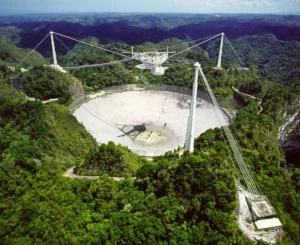
For decades, projects such as SETI (Search for Extraterrestrial Intelligence) have listened for artificial radio signals.
Nothing definitive has been found.
No confirmed alien message has ever been received.
No transmission has been verified as extraterrestrial in origin.
The silence itself has become one of the strongest pieces of evidence in the paradox.
If intelligent civilizations are abundant, why don’t we hear them?
Solution #1: Intelligent Life Is Extremely Rare
Perhaps the simplest explanation is that intelligent life is extraordinarily uncommon.
Life itself may be relatively common.
Microbial organisms might exist on countless planets.
But evolving from simple organisms into intelligent, technological beings could be exceptionally difficult.
Earth’s history supports this possibility.
Life appeared relatively early.
Intelligent life appeared much later.
For billions of years, Earth hosted only simple organisms.
Perhaps intelligence is not an inevitable outcome of evolution.
If that is true, humanity may be among the first intelligent species ever to emerge.
Solution #2: The Great Filter
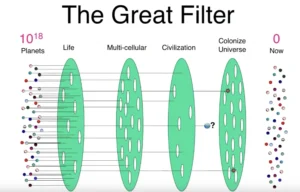
One of the most famous explanations is known as The Great Filter.
The theory proposes that somewhere between lifeless matter and galaxy-spanning civilizations lies an obstacle so difficult that almost nobody survives it.
Possible filters include:
- The origin of life itself
- The evolution of complex cells
- The development of intelligence
- Technological self-destruction
- Environmental collapse
- Artificial intelligence risks
The frightening question is whether the filter lies behind us or ahead of us.
If it is behind us, humanity may be extraordinarily lucky.
If it is ahead of us, then countless civilizations may have already failed the same test.
For a deeper exploration of this idea, see our article on The Great Filter Is Ahead: Why the Silence of the Dead Is the Universe’s Scariest Mystery.
Solution #3: The Dark Forest Theory
Another explanation comes from science fiction but has attracted serious discussion.
Known as the Dark Forest Theory, it imagines the universe as a dark forest filled with hunters.
Every civilization hides.
Every civilization fears being discovered.
Making your presence known could attract hostile attention.
In this scenario, advanced civilizations remain silent for survival.
The universe appears quiet because everyone is deliberately hiding.
It is a disturbing possibility.
Perhaps the silence is not evidence of emptiness.
Perhaps it is evidence of caution.
Solution #4: Advanced Civilizations Are Beyond Recognition
Humans often assume alien civilizations would behave like us.
But why should they?
A civilization millions of years older than humanity might not use radio.
It might not build cities.
It might not communicate through methods we understand.
Advanced civilizations could exist in forms that appear completely natural to us.
They may have transitioned into digital consciousness, artificial intelligence, or technologies beyond current human imagination.
If so, we may be looking directly at evidence of advanced civilizations without recognizing it.
Solution #5: We Are Searching the Wrong Way
Humanity has only been searching seriously for extraterrestrial intelligence for a few decades.
That is an incredibly short period.
Consider trying to detect a specific conversation occurring somewhere on Earth while listening for only a few seconds.
Failure would not prove the conversation doesn’t exist.
Similarly, the universe is vast.
We have examined only a tiny fraction of it.
Future technologies may reveal evidence that current instruments simply cannot detect.
What Recent Discoveries Mean
Recent discoveries have made the Fermi Paradox more intriguing than ever.
The James Webb Space Telescope is examining exoplanet atmospheres in unprecedented detail.
Astronomers continue finding potentially habitable worlds.
Researchers are investigating possible biosignatures—chemical indicators of life—in distant planetary atmospheres.
Each discovery adds new pieces to the puzzle.
Instead of reducing uncertainty, many findings increase it.
The more suitable planets we discover, the harder it becomes to explain the apparent absence of intelligent civilizations.
Could Humanity Be Early?
One fascinating possibility suggests humanity may simply be early.
The universe is still relatively young compared to its future lifespan.
Many stars capable of supporting habitable planets will exist for trillions of years.
Perhaps intelligent civilizations have not yet had enough time to emerge in large numbers.
In this view, humanity could be among the earliest technological species in cosmic history.
Future civilizations may become common long after Earth is gone.
The Possibility Nobody Likes
There is another possibility that many scientists prefer not to think about.
What if advanced civilizations destroy themselves?
Technological progress brings extraordinary power.
It also creates extraordinary risks.
Nuclear weapons.
Biological engineering.
Artificial intelligence.
Planetary-scale environmental change.
If civilizations consistently develop technologies capable of ending their existence, the galaxy could be filled with extinct societies.
This idea connects directly to the Great Filter hypothesis and remains one of the most unsettling explanations for the silence.
Why the Fermi Paradox Matters
At first glance, the Fermi Paradox may seem like an abstract question about aliens.
In reality, it is also a question about humanity.
The paradox forces us to ask:
- How common is intelligent life?
- What is humanity’s future?
- Are technological civilizations stable?
- What dangers lie ahead?
- What responsibilities come with advanced technology?
Understanding the fate of hypothetical alien civilizations could help us understand our own.
What If We Finally Find Evidence?
Imagine receiving a confirmed alien signal tomorrow.
The consequences would be enormous.
Humanity would instantly know it is not alone.
Philosophy, religion, science, politics, and culture would all be affected.
Yet even a discovery of microbial life elsewhere would be revolutionary.
Finding life on Mars, Europa, or an exoplanet would demonstrate that biology is not unique to Earth.
The implications would echo through generations.
The Mystery Endures
Despite decades of research, the Fermi Paradox remains unresolved.
No explanation has emerged as the clear winner.
Perhaps intelligent life is rare.
Perhaps civilizations hide.
Perhaps they destroy themselves.
Perhaps they are all around us in forms we cannot recognize.
Or perhaps humanity is the first civilization to ask the question.
For now, nobody knows.
The Question That Refuses to Die
Every night, billions of stars shine above us.
Around many of those stars orbit planets.
Around some of those planets, life may exist.
Around a few, intelligent beings may look toward the sky and wonder if they are alone.
The universe should be crowded.
It should be noisy.
It should be full of evidence that intelligence has emerged elsewhere.
Yet we continue to encounter the same haunting silence.
More than seventy years after Enrico Fermi casually asked his famous question, science still lacks an answer.
And perhaps that is what makes the Fermi Paradox so captivating.
It is not merely a mystery about aliens.
It is a mystery about us.
Because until we know where everybody else is, we cannot truly know what humanity’s future holds.