

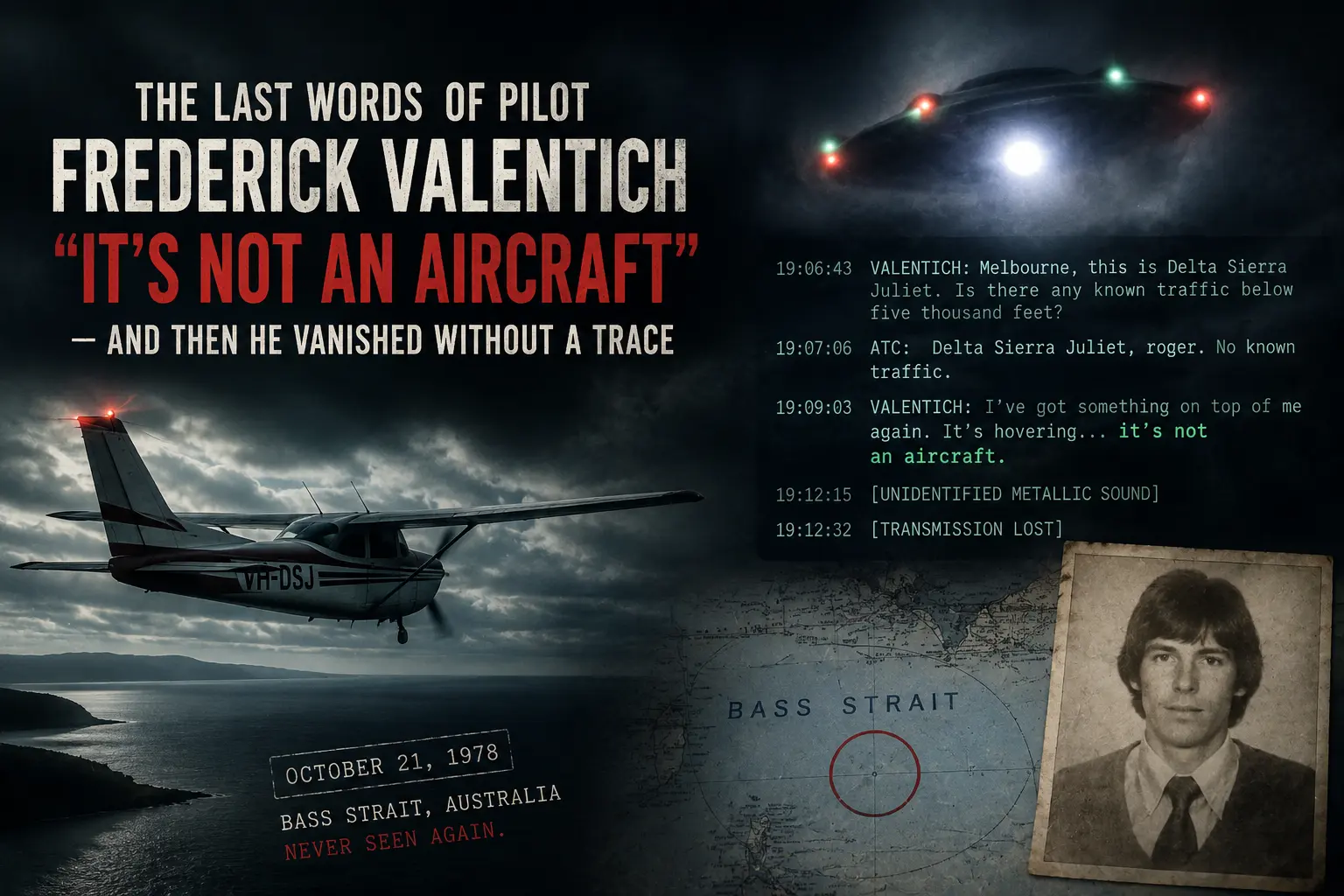
In October 1978, a young Australian pilot climbed into his plane for what should have been an ordinary evening flight. Less than two hours later, his voice would crackle across the radio with words that still send chills down the spine of aviation enthusiasts nearly half a century later.
“It’s not an aircraft.”
Minutes later, the transmission ended.
Neither Frederick Valentich nor his airplane was ever seen again.
And to this day, nobody knows exactly what happened over the waters of Bass Strait.
A Flight That Should Have Been Routine
On the evening of October 21, 1978, 20-year-old Frederick Valentich departed Moorabbin Airport near Melbourne, Australia, in a Cessna 182L light aircraft.
He wasn’t an experienced airline captain. He was a young pilot with dreams of one day flying commercially. Friends described him as quiet, ambitious, and deeply passionate about aviation. Flying wasn’t just a hobby for him—it was his future.
His destination was King Island, located roughly 150 miles south of Melbourne. The trip wasn’t unusual. Weather conditions were relatively clear, and there was nothing to suggest that the flight would become one of Australia’s greatest unsolved mysteries.
Frederick informed his family that he planned to pick up some passengers on King Island and return later that evening.
But authorities later discovered there were no passengers waiting.
The reason for his trip remains one of many unanswered questions.
Everything Changed at 7:06 PM
About an hour into the flight, Valentich contacted Melbourne Air Traffic Control.
At first, nothing seemed unusual.
Then he asked a question that puzzled the controller.
“Is there any known traffic below five thousand feet?”
The answer came back quickly.
“No known traffic.”
Valentich paused.
Then he reported seeing a large aircraft flying above him.
According to him, the object had four bright lights and appeared to be traveling at high speed.
Air traffic control repeated that there was no known aircraft in the area.
The conversation that followed would later become famous around the world.
“It’s Hovering, and It’s Not an Aircraft”
As the radio recordings continued, Valentich’s tone changed.
At first, he sounded curious.
Then confused.
And eventually, concerned.
He described the object as having a shiny metallic appearance.
It passed over him.
Then it circled.
Then it seemed to hover.
At one point he said:
“It’s a long shape. I cannot identify it.”
Moments later:
“It’s got a green light and sort of metallic. It’s all shiny on the outside.”
The controller listened carefully.
Still, radar showed nothing unusual.
Then came perhaps the most chilling words ever recorded in Australian aviation history.
“It’s hovering, and it’s not an aircraft.”
There was silence.
Then an unexplained metallic noise filled the radio.
Seventeen seconds of strange sounds.
And then…
Nothing.
Frederick Valentich was gone.
Search Teams Find Nothing
As soon as communication was lost, a massive search operation began.
Aircraft and boats combed Bass Strait, the stretch of water separating mainland Australia from Tasmania.
Search crews covered thousands of square miles.
They expected to find wreckage.
Oil slicks.
Debris.
Something.
Anything.
But they found nothing.
Not a life jacket.
Not a seat cushion.
Not a wing fragment.
Nothing belonging to Frederick Valentich or his Cessna was ever recovered.
For investigators, that absence only deepened the mystery.
Air crashes usually leave evidence.
This one seemed to leave none.
Bass Strait Has a Reputation
The area where Valentich disappeared isn’t just any body of water.
Bass Strait has long been known among Australian sailors and pilots for unpredictable weather and dangerous conditions.
Strong currents and rough seas have swallowed numerous ships and aircraft over the years.
Some have compared it to a smaller version of the Bermuda Triangle.
While experts dismiss supernatural explanations, the region has certainly earned its reputation.
Even today, wreckage lost beneath Bass Strait can remain hidden forever.
If Valentich’s plane crashed into the water, investigators believe currents and weather may have carried debris far away.
But critics argue that even then, some trace should have been discovered.
Was It Simply Pilot Error?
Official investigators considered several possibilities.
One explanation suggested that Valentich became disoriented while flying over the ocean at night.
Without visible landmarks, pilots can experience spatial disorientation—a dangerous condition that tricks the brain and causes them to misjudge their position.
Perhaps he mistakenly saw his own lights reflected in the aircraft window.
Perhaps Venus or another celestial object created an illusion.
And perhaps, while trying to understand what he was seeing, he entered a spiral dive into the sea.
Many aviation experts consider this the most likely explanation.
Yet others remain unconvinced.
Because if that were the case, what caused the strange metallic sounds heard after his final transmission?
And why was no wreckage ever found?
The UFO Theory
Almost immediately, reports of UFO involvement began spreading.
Valentich himself had a strong interest in UFOs and reportedly believed extraterrestrial life existed.
His descriptions of the object—a metallic craft with bright lights moving in ways he couldn’t understand—fueled speculation.
Years later, witnesses came forward claiming they had seen strange lights over Bass Strait that same evening.
One man even claimed he photographed an unidentified object with a small aircraft nearby.
The photograph remains controversial.
Some researchers believe it may show nothing unusual.
Others argue it deserves further analysis.
No evidence has ever conclusively linked UFOs to Valentich’s disappearance.
But for many believers, his final words continue to raise unsettling questions.
“It’s not an aircraft.”
Not “I don’t recognize it.”
Not “I think it’s another plane.”
But something entirely different.
And perhaps that’s why this mystery refuses to die.
Nearly fifty years later, nobody knows what Frederick Valentich encountered in the dark skies above Bass Strait.
Was it confusion?
A tragic accident?
An extraordinary natural phenomenon?
Or did the young pilot witness something that science still cannot explain?
Whatever the truth may be, one thing remains certain.
On an October evening in 1978, a voice crackled through the radio.
A frightened young pilot described something he could not identify.
And then, just like that, he vanished.
Leaving behind one of the greatest unsolved mysteries in aviation history.


