

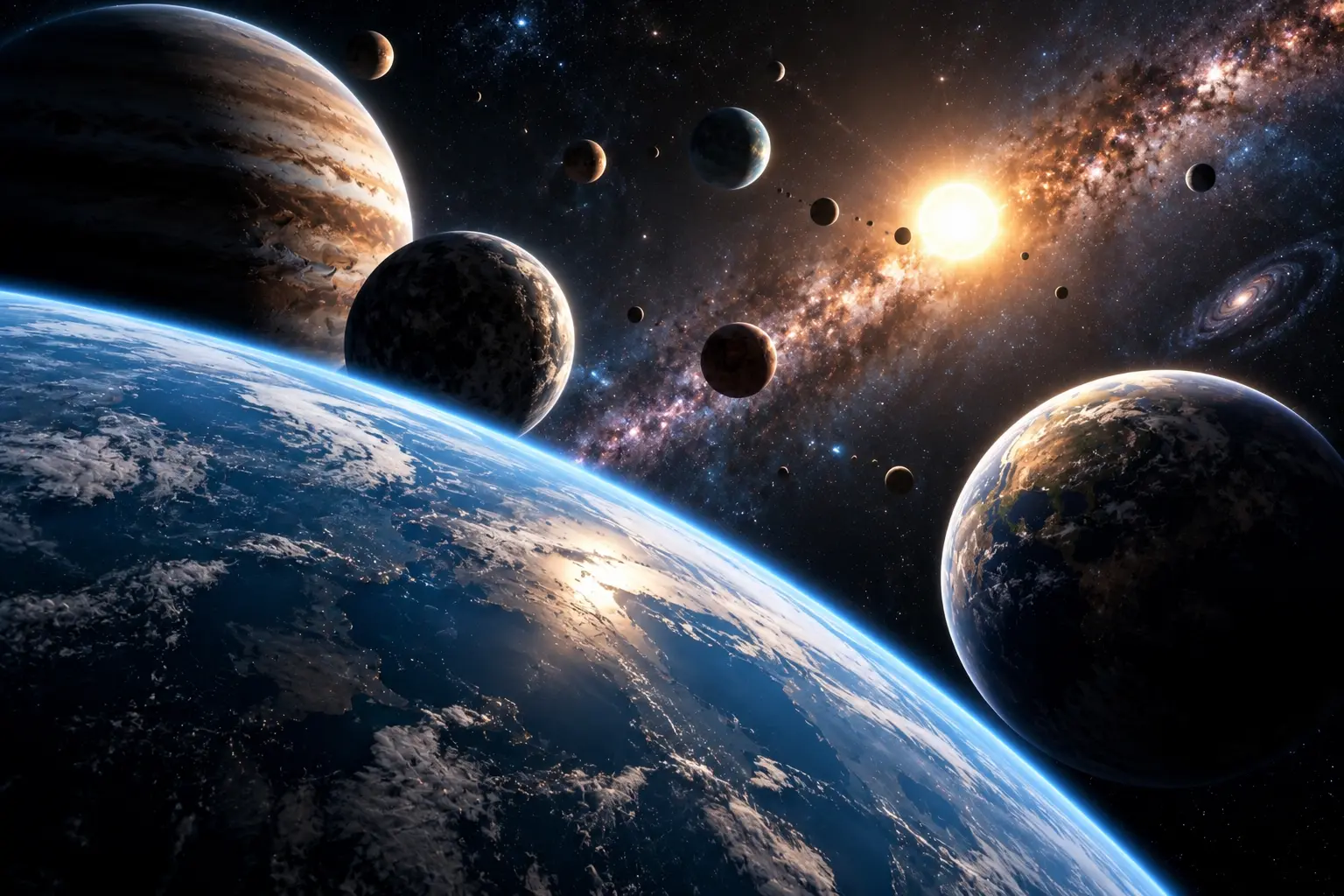
For most of human history, the night sky looked empty.
Not literally empty, of course. Ancient civilizations saw stars, planets, comets, and the pale glow of the Milky Way stretching across the darkness. But beyond those points of light, people had little reason to believe other worlds existed.
Earth seemed unique.
Then astronomy changed everything.
Today, scientists know that planets are not rare exceptions. They are a normal feature of the universe. In fact, astronomers have now confirmed thousands of exoplanets—worlds orbiting stars beyond our Sun—and the list continues to grow every year. Recent discoveries have added another 118 planets to humanity’s expanding cosmic map, further reinforcing a realization that would have seemed astonishing just a few generations ago:
The universe is filled with worlds.
And with every new discovery, one question becomes increasingly difficult to ignore:
If planets are everywhere, why haven’t we found evidence of life anywhere else?
The answer remains one of science’s greatest mysteries.
But the odds may be changing.
A Universe That Keeps Getting More Crowded
When the first confirmed exoplanet orbiting a Sun-like star was discovered in 1995, it transformed astronomy.
Before then, scientists strongly suspected planets existed around other stars, but they lacked direct evidence.
The discovery changed that overnight.
Suddenly, planetary systems were no longer theoretical possibilities. They were real.
Since then, advances in telescope technology, data analysis, and space-based observatories have accelerated the pace of discovery.
Every year brings new announcements.
Some planets are larger than Jupiter.
Others are smaller than Earth.
Some orbit two stars.
Some exist in environments so extreme that oceans of molten rock may cover their surfaces.
And occasionally, astronomers find worlds that appear surprisingly familiar.
Rocky planets.
Temperate conditions.
Potentially habitable regions.
Places where liquid water might exist.
Each discovery expands not only our catalog of planets but also our understanding of what kinds of worlds nature can create.
The latest addition of 118 newly identified worlds is another reminder that our solar system is just one small chapter in a much larger cosmic story.
The Numbers Are Becoming Difficult to Ignore
One reason exoplanet discoveries attract so much attention is that they steadily reshape the statistics surrounding life in the universe.
A century ago, scientists had exactly one known example of a life-supporting planet.
Earth.
That was the entire sample size.
Today, astronomers know of thousands of planets and estimate that our galaxy alone may contain hundreds of billions more.
The Milky Way contains roughly 100 to 400 billion stars.
Many of those stars host planets.
Many host multiple planets.
Some host planetary systems far larger than our own.
Even conservative estimates suggest there may be billions of rocky worlds scattered throughout our galaxy.
Not the universe.
Just our galaxy.
That number forces a profound shift in perspective.
If billions of planets exist in a single galaxy, and the observable universe contains hundreds of billions of galaxies, then the total number of worlds becomes almost impossible for the human mind to comprehend.
The implication is straightforward:
Earth is unlikely to be the only planet.
The harder question is whether it is the only living one.
The Habitability Puzzle
Finding a planet is not the same as finding life.
Most exoplanets discovered so far appear hostile to biology as we know it.
Some are scorched by intense stellar radiation.
Others are frozen wastelands.
Many are gas giants with no solid surface.
Life requires a complex combination of conditions.
Scientists often focus on the so-called “habitable zone”—the region around a star where temperatures may allow liquid water to exist.
Water matters because every known form of life on Earth depends on it.
But habitability involves much more than distance from a star.
Atmospheric composition, planetary chemistry, magnetic fields, geological activity, and countless other factors may influence whether life can emerge and survive.
A planet can occupy the habitable zone and still be uninhabitable.
Conversely, some researchers argue that life could potentially exist in environments far different from Earth.
The more planets astronomers discover, the more they realize nature may be capable of producing conditions we have never imagined.
Why Every Discovery Matters
It is tempting to think of another exoplanet announcement as just another number added to a growing database.
But each new world represents a data point in one of humanity’s largest scientific investigations.
Astronomers are trying to answer a question that philosophers, theologians, and dreamers have debated for centuries:
Are we alone?
The search for life beyond Earth is fundamentally a search for patterns.
Scientists need enough examples to understand what is common and what is rare.
Every newly discovered planet improves those statistics.
Every planetary system teaches researchers something new about how worlds form and evolve.
Every observation refines models of habitability.
The significance of 118 additional planets is not simply the number itself.
It is the information they provide collectively.
Patterns begin to emerge.
Assumptions are tested.
The universe becomes slightly less mysterious.
And sometimes, even more intriguing.
The Fermi Paradox Still Looms
If the universe contains so many planets, why haven’t we detected alien civilizations?
This contradiction is known as the Fermi Paradox, named after physicist Enrico Fermi.
The logic is deceptively simple.
If intelligent life is common, evidence of it should eventually become visible.
Yet despite decades of searching, humanity has found no confirmed signs of extraterrestrial civilizations.
No signals.
No spacecraft.
No undeniable evidence.
This absence has inspired countless explanations.
Perhaps intelligent life is extraordinarily rare.
Perhaps civilizations tend to destroy themselves.
Perhaps technological societies exist but remain difficult to detect.
Or perhaps the distances involved are simply too vast.
The paradox becomes more compelling every time astronomers discover new worlds.
Because each new planet strengthens one side of the equation.
The universe appears increasingly capable of supporting planetary diversity.
Yet evidence of life remains elusive.
That tension is what makes the mystery so fascinating.
A New Generation of Telescopes
The search is entering a new phase.
For years, astronomers focused primarily on discovering planets.
Now many researchers are trying to study them in greater detail.
Modern observatories can analyze portions of a planet’s atmosphere by observing starlight passing through it.
This technique allows scientists to search for chemical signatures that might indicate biological activity.
Certain combinations of gases can be particularly interesting.
On Earth, life significantly alters atmospheric chemistry.
If similar patterns are detected elsewhere, they could become potential biosignatures.
Researchers remain cautious.
Natural processes can sometimes mimic signs of life.
Extraordinary claims require extraordinary evidence.
Still, the ability to examine distant atmospheres represents a major step forward.
The search for life is gradually evolving from speculation into observational science.
The Psychological Impact of New Worlds
Exoplanet discoveries influence more than astronomy.
They affect how people think about humanity’s place in the universe.
For centuries, Earth occupied the center of many worldviews.
Science gradually altered that perspective.
We learned Earth orbits the Sun.
The Sun is one star among billions.
The Milky Way is one galaxy among countless others.
Now exoplanet research adds another layer to that transformation.
The realization that planets are abundant changes how we see ourselves.
Earth remains extraordinary.
But it may not be unique.
That distinction matters.
A universe filled with worlds feels fundamentally different from a universe where ours is the only one.
The discovery of 118 new planets may not immediately change daily life.
Yet collectively, discoveries like these continue to reshape humanity’s understanding of its cosmic context.
What If We Eventually Find Life?
This question inevitably follows every discussion of exoplanets.
What happens if scientists detect convincing evidence of life elsewhere?
The answer depends on what kind of life is found.
Microbial organisms would be revolutionary.
Even simple life would demonstrate that biology can emerge independently beyond Earth.
That alone would transform science.
Intelligent life would be even more significant.
Such a discovery would influence philosophy, religion, politics, and culture.
It would become one of the most important events in human history.
Scientists are careful not to predict outcomes.
No evidence currently confirms extraterrestrial life.
But each new planet discovery increases the number of places where life might potentially exist.
And with more places to look, opportunities for discovery expand.
The Question That Refuses to Go Away
The addition of 118 new worlds will not solve the mystery of alien life.
It will not end the debate surrounding habitability.
It will not answer the Fermi Paradox.
But it does something equally important.
It makes the question harder to dismiss.
A generation ago, scientists knew of no confirmed planets beyond our solar system.
Today, they know thousands.
Tomorrow, they will likely know thousands more.
The trend points in one direction.
The universe appears increasingly populated with worlds.
Some may be barren.
Some may be strange beyond imagination.
Some may resemble Earth more closely than anyone expects.
And somewhere among them, perhaps orbiting an ordinary star in an ordinary corner of the galaxy, a distant world may already host life looking up at its own night sky and wondering the same thing we do.
Until evidence says otherwise, we remain the only known example of life in the cosmos.
Yet with every new planet discovered, that lonely status feels a little less certain.
The universe keeps revealing more worlds.
And the possibility that one of them is alive keeps becoming harder to ignore.


