
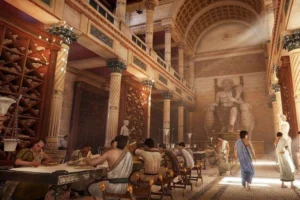
Few lost treasures capture the imagination quite like the Library of Alexandria.
For more than two thousand years, the legendary institution has occupied a unique place in human history. It has become a symbol of knowledge, curiosity, and intellectual ambition on a scale the ancient world had never seen before. Historians have described it as the greatest center of learning of its age. Writers have mourned its destruction. Dreamers have wondered what secrets may have vanished when its collections disappeared.
Yet one question continues to fascinate researchers and history enthusiasts alike:
Could some part of the Library of Alexandria still be waiting to be found?
It sounds like the premise of an adventure novel. Hidden chambers beneath the ancient city. Lost scrolls buried under centuries of rubble. Forgotten vaults untouched since antiquity.
Reality is more complicated.
The truth about the Library of Alexandria is both less dramatic and far more interesting than the popular myths. Modern historians now believe the library was not destroyed in a single catastrophic event. Instead, it likely declined over centuries through political upheaval, neglect, warfare, and changing cultural priorities.
And that raises an intriguing possibility.
If the library disappeared gradually rather than all at once, could fragments of its vast collection have survived somewhere beyond the reach of history?
The Dream of Collecting All Human Knowledge
The story begins in ancient Egypt.
After the death of Alexander the Great in 323 BCE, one of his generals, Ptolemy I Soter, took control of Egypt and established the Ptolemaic Kingdom. Seeking to make Alexandria the intellectual capital of the Mediterranean world, the Ptolemies invested heavily in scholarship, science, literature, and philosophy.
At the center of this effort stood the Library of Alexandria.
Located within a larger scholarly institution known as the Mouseion, or “Temple of the Muses,” the library was unlike anything the world had seen before. It was not merely a storage facility for books. It was a research center, university, archive, and intellectual community rolled into one. Scholars traveled from across the ancient world to study there. They received funding, housing, and access to a vast collection of texts.
The Ptolemies pursued an ambitious goal.
They wanted to collect every book they could find.
Ancient sources suggest that ships arriving in Alexandria were searched for manuscripts. If books were discovered, scribes copied them. In some accounts, the originals were retained while copies were returned to their owners. Whether every story is accurate remains debated, but there is little doubt that the rulers of Alexandria aggressively expanded the collection.
At its peak, estimates suggest the library may have housed hundreds of thousands of scrolls, though exact numbers remain uncertain.
For the ancient world, it represented something revolutionary:
A deliberate attempt to gather and preserve the entirety of human knowledge.
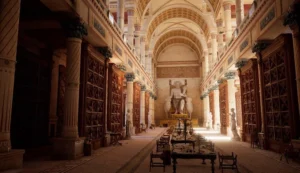
The Greatest Minds of Antiquity
The Library of Alexandria was not simply famous because of its size.
It became famous because of the people who worked there.
Some of the greatest scholars of the ancient world passed through its halls.
Mathematicians.
Astronomers.
Geographers.
Poets.
Physicians.
Philosophers.
The library became a center for breakthroughs that shaped human understanding for centuries.
The mathematician Euclid taught in Alexandria.
Eratosthenes famously calculated the circumference of the Earth with remarkable accuracy.
Astronomers studied the heavens.
Physicians compiled medical knowledge from multiple civilizations.
Librarians developed some of the earliest systems for organizing information.
In many ways, Alexandria became the world’s first great research university.
Its scholars were attempting to understand everything—from mathematics and geography to literature and medicine.
That intellectual ambition is one reason the library remains so admired today.
The Myth of the Single Great Fire
Ask most people what happened to the Library of Alexandria and they will likely give the same answer.
“It burned down.”
The image is powerful.
Towering shelves filled with priceless scrolls.
Flames consuming humanity’s accumulated knowledge.
A single tragic event erasing centuries of learning overnight.
But modern scholarship paints a different picture.
Historians increasingly agree that the library was probably not destroyed in one dramatic catastrophe. Instead, evidence suggests a long decline unfolding across centuries. Multiple events may have contributed to the loss of its collections.
One famous incident occurred during Julius Caesar’s campaign in Alexandria in 48 BCE.
Ancient accounts suggest fires connected to military operations damaged part of the city and may have destroyed some books. However, evidence indicates that scholarly activity continued afterward, suggesting the library—or at least significant portions of it—survived.
Later centuries brought additional turmoil.
Political instability.
Economic decline.
Changes in patronage.
Religious conflicts.
Urban destruction.
Natural disasters.
Each may have contributed to the gradual disappearance of the institution.
The reality appears less dramatic than the legend.
But it may also be more important.
Knowledge was not lost in a single night.
It was lost little by little.
The Knowledge We May Never Recover
One reason the Library of Alexandria continues to fascinate people is the possibility of what it contained.
Many ancient works survive only because later copies were preserved elsewhere.
Others vanished completely.
Entire books known from references in surviving texts no longer exist.
Historians know they once existed.
Nobody knows what they said.
Imagine opening a lost play by Sophocles.
A missing work by Aristotle.
An unknown scientific treatise.
A forgotten history of civilizations that disappeared long ago.
The library may have contained countless texts that never survived into the modern age.
Of course, it is important to avoid exaggeration.
Some popular accounts claim the library contained advanced technology, lost scientific revolutions, or knowledge centuries ahead of its time.
There is little evidence for such extraordinary claims.
The true tragedy is significant enough without adding myths.
The loss involved real literature, real history, real science, and real cultural memory.
Could Any Part of the Library Still Exist?
This is where the mystery becomes especially compelling.
If the library vanished gradually, what happened to its books?
Not every scroll would necessarily have been destroyed.
Some may have been copied.
Others may have been moved.
Certain collections may have been dispersed to private owners, temples, or other institutions.
Throughout history, important manuscripts often survived because someone carried them elsewhere. Libraries rise and fall, but books travel.
This possibility has inspired generations of researchers.
Could forgotten collections still exist beneath ancient ruins?
Could undiscovered papyrus caches remain hidden in Egypt’s dry climate?
Could fragments from Alexandria be sitting unnoticed in museum archives?
The answer is both encouraging and frustrating.
Small discoveries continue to occur.
Ancient manuscripts are still being uncovered in archaeological excavations. Papyrus fragments continue to provide new insights into the ancient world.
However, no confirmed discovery of a hidden Alexandrian master collection has ever been made.
The Search Beneath Modern Alexandria
Part of the challenge is geographical.
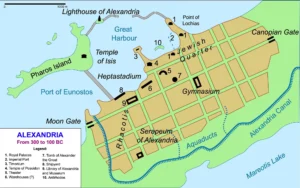
Modern Alexandria sits atop much of the ancient city.
Over two thousand years of urban development have transformed the landscape.
Buildings, roads, and neighborhoods now occupy areas where ancient structures once stood.
Adding to the difficulty, portions of ancient Alexandria have disappeared beneath the Mediterranean Sea.
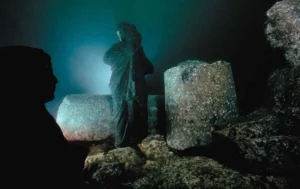
Earthquakes, subsidence, and coastal changes altered the shoreline over centuries. Archaeologists have identified submerged ruins offshore, including remains connected to the ancient royal quarter where parts of the library complex may once have stood.
Underwater archaeology has revealed remarkable discoveries.
Yet recovering intact library collections from such environments remains extraordinarily difficult.
Papyrus is fragile.
Time is relentless.
Water is rarely kind to ancient documents.
Even if hidden chambers exist, the survival of scrolls across two millennia would be unlikely.
But “unlikely” is not the same as impossible.
The Serapeum Connection
The Library of Alexandria was not a single building.
Evidence suggests that the institution expanded over time and included additional collections.
One important location was the Serapeum, a temple complex that served as a secondary repository for books. Ancient sources indicate that this “daughter library” housed substantial collections.
The fate of the Serapeum has become an important part of the broader mystery.
Some historical accounts describe the destruction of the temple during religious conflicts in the late fourth century CE. However, historians continue to debate exactly what books remained there and how extensive its collections were at that time.
The uncertainty leaves room for speculation.
Could portions of the collection have been removed beforehand?
Could manuscripts have been relocated?
No definitive evidence answers these questions.
But they remain part of the ongoing fascination surrounding Alexandria’s lost knowledge.
Why the Mystery Refuses to Die
Many historical mysteries fade as evidence accumulates.
The Library of Alexandria seems to grow more intriguing with time.
Part of its appeal comes from what it represents.
The library symbolizes humanity’s desire to preserve knowledge.
It reminds us that information can be fragile.
Civilizations rise and fall.
Institutions disappear.
Records vanish.
Ideas can be lost.
In the digital age, the lesson feels surprisingly modern.
Today, humanity stores unimaginable amounts of information.
Yet future historians may wonder how much of it survives.
Technology changes.
Formats become obsolete.
Archives require maintenance.
The challenges are different, but the underlying problem remains familiar.
The Library of Alexandria is not merely a story about the past.
It is a warning about the future.
The Discovery Everyone Dreams Of
Every archaeologist understands the excitement of an unexpected find.
A sealed tomb.
A buried city.
A forgotten manuscript cache.
History occasionally delivers astonishing surprises.
The Dead Sea Scrolls transformed biblical scholarship.
The Nag Hammadi texts revealed lost religious traditions.
Ancient papyri continue to emerge from Egyptian excavations.
Because of discoveries like these, people continue to wonder:
What if one more surprise is waiting?
What if somewhere beneath the sands of Egypt, inside a sealed chamber or forgotten archive, a collection of Alexandrian manuscripts still survives?
There is currently no evidence that such a treasure exists.
But archaeology has repeatedly shown that the past still holds secrets.
Many of history’s greatest discoveries were considered unlikely before they happened.
A Legacy That Never Truly Disappeared
Perhaps the most interesting possibility is that the Library of Alexandria was never completely lost.
Not physically.
Intellectually.
Many texts copied in Alexandria spread throughout the Mediterranean world.
Ideas developed there influenced later civilizations.
Knowledge traveled through scholars, students, translations, and manuscripts.
In that sense, part of the library survived.
Not as a building.
Not as shelves filled with scrolls.
But as ideas moving across generations.
The library’s greatest achievement may not have been the books it stored.
It may have been the knowledge it helped circulate.
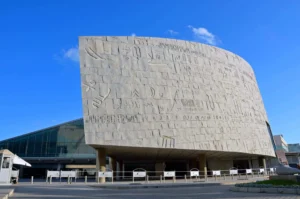
Humanity’s Greatest Missing Treasure
More than two thousand years after its founding, the Library of Alexandria remains one of history’s most captivating mysteries.
It was a place built on an extraordinary belief:
That knowledge matters.
That preserving ideas matters.
That understanding the world is worth pursuing.
Whether hidden scrolls still exist somewhere remains unknown.
Most historians consider the survival of a large undiscovered collection unlikely.
Yet fragments of the ancient world continue to emerge from deserts, ruins, caves, and forgotten archives.
History has a habit of surprising us.
For now, the Library of Alexandria remains both a real institution and a powerful symbol.
A symbol of what humanity once knew.
A reminder of what it lost.
And perhaps, just perhaps, a reminder that some of its greatest secrets may still be waiting to be found.


