
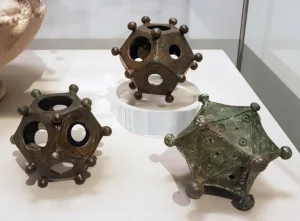
Imagine uncovering an object so unusual that, nearly 300 years after its first discovery, experts still cannot explain what it was used for.
Not because the object is damaged.
Not because it comes from an unknown civilization.
Not because there are too few examples.
In fact, archaeologists have found more than a hundred of them across Europe. They appear in Roman settlements, military sites, graves, temples, and ancient towns. They were carefully crafted by skilled metalworkers and seem to have been valuable objects.
Yet nobody knows what they were for.
These enigmatic artifacts are known as Roman dodecahedrons, and they remain one of the greatest unsolved mysteries of Roman archaeology. More than a century of research, countless academic papers, and dozens of competing theories have failed to provide a definitive answer. Even today, every new discovery raises more questions than it answers.
For archaeologists, the mystery is both frustrating and fascinating.
For the rest of us, it offers a rare glimpse into how much of the ancient world still remains unexplained.
The Ancient Object That Refuses to Explain Itself
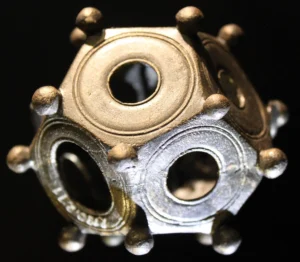
At first glance, a Roman dodecahedron looks almost like a puzzle from a modern science fiction movie.
Each object has twelve pentagonal faces arranged into a hollow geometric shape. Every face contains a circular hole, and the holes vary in size. Small rounded knobs sit at each corner. Most examples were made from copper alloy, typically bronze, and range from roughly four to eleven centimeters in diameter.
The craftsmanship is remarkable.
Creating one required advanced metalworking techniques and considerable skill. These were not simple household objects quickly assembled by local craftsmen. Their construction suggests they were intentionally designed and likely held some significance for the people who owned them.
And yet there is one extraordinary problem.
No surviving Roman text mentions them.
No Roman artwork depicts them.
No ancient writer describes how they were used.
They appear throughout archaeological sites across Europe, but they seem to have left no written trace behind.
That absence of evidence is what makes them so difficult to understand.
Found Across the Roman World—But Not Everywhere
One of the strangest aspects of Roman dodecahedrons is where they have been discovered.
Examples have been found in modern-day Britain, France, Germany, Belgium, Luxembourg, Switzerland, Austria, Hungary, and the Netherlands. However, researchers have not found confirmed examples in Italy itself, despite Italy being the heart of the Roman Empire. They are also largely absent from Spain, North Africa, and much of the Mediterranean region.
This unusual distribution has become one of the most important clues in the mystery.
Many discoveries come from regions where Roman culture interacted with Celtic populations. Because of this, some scholars suspect the objects may have had a local religious, ceremonial, or cultural purpose rather than serving a standard function throughout the empire.
The pattern suggests these were not ordinary Roman tools distributed across every province.
They may have belonged to a specific tradition that flourished in only certain regions.
More Than 100 Have Been Found
When a mysterious artifact appears only once, archaeologists often struggle because there is little evidence to study.
Roman dodecahedrons present the opposite problem.
More than 100 examples have been discovered, and some estimates place the number closer to 130. New finds continue to emerge, including a well-preserved specimen uncovered in England in recent years.
You might assume that so many examples would make the mystery easier to solve.
Instead, they have complicated it.
No two dodecahedrons are exactly alike.
Their sizes differ.
The holes vary in diameter.
Decorative patterns change from object to object.
Some are more elaborate than others.
The lack of standardization makes it difficult to argue that they served as precision measuring instruments or standardized tools.
Every discovery seems to confirm that the objects were important.
None reveal why.
Theories, Theories, and More Theories
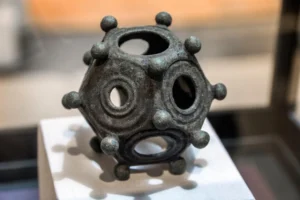
Over the years, researchers, historians, engineers, hobbyists, and amateur archaeologists have proposed dozens of explanations.
Some theories are surprisingly practical.
Others are highly imaginative.
None has achieved universal acceptance.
Theory 1: A Measuring Device
One of the most popular suggestions is that Roman dodecahedrons functioned as rangefinders or surveying instruments.
According to this idea, users could look through pairs of holes and estimate the distance or size of distant objects.
The different hole sizes may have helped create specific viewing angles.
The theory sounds plausible at first.
However, critics point out that the objects lack markings, measurements, or standard dimensions. Because each dodecahedron differs from the others, their usefulness as precision instruments is questionable.
Theory 2: A Farming Calendar
Another theory proposes that the objects helped farmers determine planting dates.
Supporters suggest that sunlight passing through specific holes at certain times of year could indicate seasonal changes, helping farmers know when to sow crops.
This explanation would fit the northern European regions where many dodecahedrons have been found.
But direct evidence remains absent.
No Roman agricultural texts mention such devices.
Theory 3: Candle Holders
Some archaeologists have noted traces of wax on a few examples.
This observation inspired the theory that dodecahedrons functioned as candle holders.
Yet this explanation also faces problems.
The elaborate design seems unnecessarily complex for a simple candle holder, and wax traces could potentially result from other activities.
Theory 4: A Knitting Tool
Perhaps the most unexpected theory emerged from the world of textile crafts.
A researcher suggested that Roman dodecahedrons might have been used to knit gloves.
The various hole sizes could theoretically correspond to different finger sizes, while the knobs might assist with yarn placement.
The idea gained widespread attention because people successfully produced glove-like items using replicas.
Unfortunately, archaeologists point out that there is little evidence for this type of knitting technology in Roman Europe. The earliest confirmed examples appear many centuries later.
Interesting?
Absolutely.
Proven?
Not even close.
The Religious Theory
As more practical explanations encountered difficulties, many researchers began exploring another possibility.
What if Roman dodecahedrons were never practical tools at all?
Several archaeologists now consider a ritual, symbolic, or religious function among the most plausible explanations. Some discoveries have occurred in graves or locations associated with ceremonial activity. The geometric form itself also carried symbolic meaning in ancient philosophical traditions.
In classical philosophy, the dodecahedron was sometimes associated with the cosmos or the structure of the universe.
Because of this connection, some researchers have suggested the objects may have served as ritual instruments, ceremonial symbols, or items connected to divination.
The religious theory has strengths.
It helps explain why the objects appear valuable.
It helps explain why they vary in design.
It helps explain why standardization may not have mattered.
But once again, definitive proof remains elusive.
The Discovery That Revived the Mystery
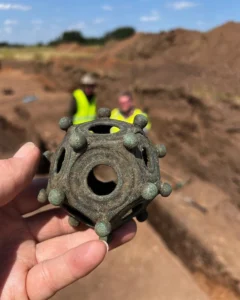
In 2023, amateur archaeologists excavating a Roman-era site in Norton Disney, England, uncovered an exceptionally preserved dodecahedron.
The discovery attracted international attention because intact examples are rare and because archaeologists hoped its context might finally provide clues about the object’s purpose.
Instead, the find reinforced the mystery.
The object displayed the familiar characteristics seen in other examples.
Twelve sides.
Different-sized holes.
Knobs at every corner.
Beautiful craftsmanship.
No explanation.
Researchers gained another valuable specimen to study.
They did not gain an answer.
Why Haven’t We Solved This Yet?
To many people, it seems surprising that modern archaeology cannot solve a puzzle involving an object found over a hundred times.
After all, we have satellites mapping ancient cities hidden beneath jungles.
We have DNA technology reconstructing family trees thousands of years old.
We have artificial intelligence analyzing ancient texts.
Why can’t we identify a small bronze object?
The answer lies in context.
Archaeology works best when multiple forms of evidence support one another.
An object is easier to understand when it appears in artwork, literature, inscriptions, or written records.
Roman dodecahedrons lack all of those advantages.
There are no instruction manuals.
No surviving descriptions.
No labels.
No illustrations showing them in use.
Researchers are attempting to solve a puzzle with several critical pieces missing.
What Makes the Mystery So Fascinating?
Most ancient mysteries eventually shrink as evidence accumulates.
Roman dodecahedrons have done the opposite.
Every new discovery confirms that these objects mattered to somebody.
Their careful construction indicates value.
Their geographic distribution suggests a pattern.
Their repeated appearance proves they were not random curiosities.
Yet the central question remains untouched.
Why were they made?
That uncertainty is rare in archaeology.
Usually, researchers can at least narrow possibilities to a handful of likely explanations.
With Roman dodecahedrons, dozens of theories remain alive because none can be conclusively eliminated.
The objects sit in a unique category.
They are not lost because we cannot find them.
They are lost because we cannot understand them.
Could the Answer Be Simpler Than We Think?
Some historians caution against assuming the explanation must be exotic.
Perhaps Roman dodecahedrons were everyday objects whose function seemed so obvious to ancient users that nobody felt the need to document them.
History offers many examples of common technologies disappearing from the written record.
People rarely write detailed descriptions of objects they interact with every day.
The challenge is that this explanation is impossible to test directly.
Without contemporary evidence, even the simplest answer remains speculation.
A Mystery That Continues to Grow
More than two centuries have passed since the first Roman dodecahedron entered the archaeological record.
Since then, countless experts have examined them.
Museums display them.
Researchers publish papers about them.
Visitors stare at them through glass cases, hoping to notice something everyone else has missed.
The mystery remains unsolved.
And perhaps that is part of their appeal.
In an age when information feels instantly accessible, Roman dodecahedrons remind us that history still contains genuine unknowns.
Not every puzzle has been solved.
Not every question has an answer.
Some artifacts survive the centuries carrying secrets that even modern science cannot unlock.
The Roman Puzzle That Refuses to Be Solved
The Roman Empire left behind roads, aqueducts, cities, inscriptions, military records, and millions of artifacts.
It is one of the best-documented civilizations in human history.
Yet somewhere between the second and fourth centuries CE, craftsmen across parts of Europe created strange twelve-sided bronze objects that continue to defy explanation.
They were carefully made.
Widely distributed.
Clearly important.
And completely mysterious.
Whether they were ritual objects, astronomical tools, status symbols, gaming devices, ceremonial instruments, or something nobody has yet imagined, Roman dodecahedrons remain among archaeology’s greatest unsolved mysteries.
Every new discovery brings renewed excitement.
Every new theory sparks debate.
And every new dodecahedron reminds us that even after centuries of research, the ancient world still knows things we do not.
Perhaps one day a forgotten manuscript, an overlooked excavation, or an unexpected discovery will finally reveal their purpose.
Until then, the Roman dodecahedron remains exactly what it has been for generations:
A beautifully crafted object that nobody can explain.


