
Picture a city where merchant ships crowded the harbors, priests carried sacred relics through temple courtyards, and traders from distant lands arrived daily with cargo from across the Mediterranean. Now imagine that entire city slowly sinking into the sea until every street, temple, statue, and marketplace vanished beneath the waves.
That is exactly what happened to Thonis-Heracleion, one of the most extraordinary archaeological discoveries of modern times.
Today, the remains of this ancient Egyptian metropolis rest beneath the waters of Abu Qir Bay near Alexandria. Hidden for more than a millennium, the city was eventually rediscovered by underwater archaeologists, revealing a remarkably preserved snapshot of a thriving world that had seemingly disappeared from history.
The story of Thonis-Heracleion combines archaeology, geology, history, and mystery. It is a tale of prosperity, religious significance, international trade, and a catastrophic natural disaster powerful enough to erase one of Egypt’s most important cities from the map.
A City That Controlled Egypt’s Maritime Gateway
Before Alexandria became the dominant port of Egypt, Thonis-Heracleion occupied a strategic position at the western edge of the Nile Delta.
Any merchant vessel entering Egypt from the Mediterranean was likely to pass through this bustling port. The city served as both a commercial hub and a customs center where taxes were collected and goods were inspected before being transported inland.
Ancient Egypt’s economy depended heavily on trade, and Thonis-Heracleion sat at the heart of that network.
Archaeological evidence suggests that merchants from Greece, Phoenicia, Cyprus, and other Mediterranean civilizations regularly visited the city. Imported ceramics, coins, anchors, and ship remains discovered underwater indicate a vibrant international trading center that connected Egypt with the wider ancient world.
For centuries, the city functioned as one of Egypt’s most important economic gateways.
Why Two Names?
One of the most intriguing aspects of the city is its dual identity.
The Egyptians called it Thonis, while Greek visitors knew it as Heracleion.
For generations, historians believed these names referred to two separate locations. Ancient Egyptian inscriptions mentioned Thonis, while Greek writers described a prosperous city called Heracleion.
The confusion lasted for centuries.
Only after the underwater excavations began did archaeologists uncover inscriptions proving that both names referred to the same city. The discovery resolved a long-standing historical mystery and confirmed that the legendary Heracleion described in Greek texts was indeed Egypt’s Thonis.
This finding became one of the most significant breakthroughs associated with the site’s rediscovery.
The Religious Heart of the City
Trade may have brought wealth to Thonis-Heracleion, but religion gave it prestige.
At the center of the city stood a massive temple dedicated to Amun, one of the most revered gods in ancient Egyptian belief.
The temple was not merely a place of worship. It played an important role in state ceremonies and religious festivals connected to Egyptian rulers.
Archaeologists have uncovered evidence showing that large processions and sacred rituals took place within the city. Religious artifacts found underwater suggest that priests and worshippers regularly traveled through a network of canals linking temples and ceremonial areas.
Ancient texts indicate that annual celebrations honoring Osiris, the god associated with resurrection and the afterlife, were among the most important events held there.
During these ceremonies, sacred boats carried religious objects through waterways in elaborate public rituals.
The city itself appears to have been designed around water, creating an environment where religion, commerce, and daily life were deeply interconnected.
The City Described by Ancient Historians
Long before modern archaeologists discovered the ruins, classical writers had already left clues about the city’s existence.
The Greek historian Herodotus described a grand temple dedicated to Heracles in a city called Heracleion. He also recorded traditions claiming that Helen of Troy and Paris stopped there before the events of the Trojan War.
Other ancient writers mentioned a prosperous settlement near the Nile Delta that matched the location of the city eventually discovered underwater.
For many years, these accounts remained difficult to verify.
Some historians suspected the descriptions had been exaggerated or distorted over time.
The discovery of Thonis-Heracleion dramatically changed that perception.
Many details described in ancient texts suddenly appeared far more credible once physical evidence emerged from beneath the Mediterranean Sea.
How an Entire City Was Lost
One of the biggest questions surrounding Thonis-Heracleion is simple:
How does an entire city disappear?
The answer appears to involve a combination of geological instability and natural disasters.
The Nile Delta consists largely of soft sediments deposited over thousands of years. While this environment supported agriculture and urban development, it also created unstable foundations.
Modern geological studies suggest that parts of the region experienced a process known as soil liquefaction.
Liquefaction occurs when water-saturated soil suddenly loses its strength during earthquakes or other geological disturbances.
Instead of behaving like solid ground, the soil temporarily acts like a liquid.
Buildings, roads, and monuments can sink rapidly when this happens.
Researchers believe earthquakes, rising sea levels, and gradual subsidence combined to destabilize the city over time.
Rather than disappearing overnight, Thonis-Heracleion likely experienced a long period of structural collapse before eventually sinking beneath the Mediterranean.
By around the eighth century AD, much of the city had vanished underwater.
The Search Beneath Abu Qir Bay
For centuries, the lost city remained hidden beneath layers of mud and sediment.
Its location became one of Egypt’s greatest archaeological mysteries.
Everything changed during the late twentieth century.
French underwater archaeologist Franck Goddio and his team began conducting detailed surveys of Abu Qir Bay using advanced technology capable of detecting structures buried beneath the seabed.
Magnetic sensors, sonar equipment, and underwater mapping systems revealed unusual features beneath the sediment.
When divers investigated the area, they encountered something extraordinary.
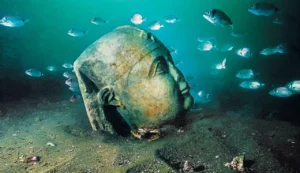
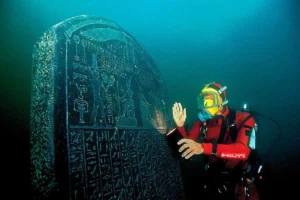
The seabed was littered with colossal statues, stone blocks, temple remains, anchors, and ancient artifacts.
In 2000, researchers officially announced the discovery of the lost city.
The announcement generated worldwide attention and transformed the study of underwater archaeology.
The Astonishing Discoveries
The underwater ruins revealed a city far larger and richer than many experts had expected.
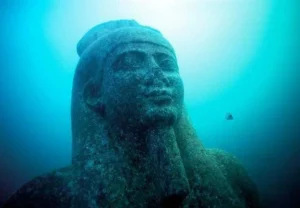
Among the most spectacular finds were gigantic statues standing more than five meters tall.
These sculptures depicted Egyptian rulers and deities and had remained underwater for centuries.
Archaeologists also uncovered:
- Massive temple ruins
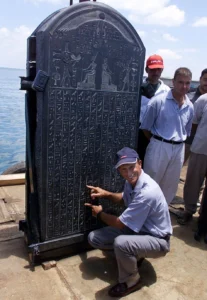
- Stone inscriptions
- Gold jewelry
- Ceremonial objects
- Coins from multiple civilizations
- Hundreds of ancient anchors
- Numerous shipwrecks
- Religious artifacts
- Granite monuments
Each discovery added another piece to the puzzle of daily life within the city.
The shipwrecks were particularly valuable because they provided evidence of extensive maritime trade and offered insights into ancient shipbuilding techniques.
Many artifacts were remarkably well preserved due to the protective layer of sediment covering the site.
What Life Was Like in Thonis-Heracleion
Although much remains unknown, archaeological evidence provides glimpses into everyday life.
The city appears to have been densely populated and economically vibrant.
Dockworkers unloaded cargo from arriving vessels. Merchants negotiated prices in busy marketplaces. Priests performed rituals in temples. Craftsmen produced goods for both local use and export.
Waterways served as major transportation routes.
Boats likely moved people and goods throughout the city in much the same way that streets and roads function in modern urban centers.
The presence of imported goods suggests residents had access to products from distant regions.
Thonis-Heracleion was not an isolated Egyptian settlement. It was part of an international trading system connecting multiple civilizations across the Mediterranean.
Why the Discovery Matters
The significance of Thonis-Heracleion extends far beyond Egypt.
The site has provided archaeologists with an unprecedented opportunity to study an ancient port city largely untouched by later development.
Many famous archaeological sites have been rebuilt, looted, or altered over centuries.
Thonis-Heracleion, by contrast, remained sealed beneath water and sediment.
As a result, researchers gained access to a unique archaeological time capsule.
The discoveries have improved understanding of:
- Ancient Egyptian trade networks
- Mediterranean commerce
- Religious practices
- Maritime technology
- Urban planning
- Geological disasters
The site has also demonstrated the importance of underwater archaeology as a scientific discipline.
Many historians now believe that significant portions of human history may still lie hidden beneath oceans, lakes, and coastal waters around the world.
The Challenges of Exploring an Underwater City
Excavating a submerged city is far more difficult than working on land.
Visibility is often poor.
Strong currents can complicate diving operations.
Artifacts must be carefully preserved after recovery because materials that survive underwater for centuries can deteriorate rapidly when exposed to air.
Every excavation requires specialized equipment, trained divers, conservation experts, and extensive planning.
For these reasons, research at Thonis-Heracleion continues slowly and methodically.
Each new season of exploration has the potential to reveal additional structures, artifacts, and clues about the city’s past.
Mysteries That Remain Unsolved
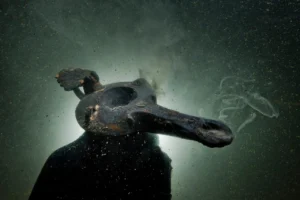
Despite decades of research, important questions remain unanswered.
How many people lived in the city at its peak?
Did residents recognize the danger before the sinking began?
Were portions of the population able to relocate elsewhere?
How much of the city still remains buried beneath sediment?
Researchers continue to investigate these mysteries using new technologies and ongoing excavations.
Future discoveries could reshape current theories about both the city and the events that led to its disappearance.
A Reminder of Nature’s Power
The story of Thonis-Heracleion is ultimately about more than archaeology.
It serves as a powerful reminder that even the most prosperous cities can be vulnerable to forces beyond human control.
For centuries, this Egyptian port stood as a gateway between civilizations, a center of commerce, religion, and culture. Its temples towered above busy waterways, and its harbor connected Egypt to the wider Mediterranean world.
Yet nature gradually reclaimed it.
The sea that once brought wealth and opportunity eventually swallowed the city whole.
Today, beneath the calm waters of Abu Qir Bay, the silent remains of Thonis-Heracleion continue to tell their story. Every statue, temple fragment, and shipwreck recovered from the seabed reveals another chapter of a civilization that refused to disappear entirely.
What was once considered legend is now one of the most remarkable archaeological discoveries ever made—a lost city reborn from the depths after more than a thousand years of silence.


