
A rose-coloured rock discovered in the Sahara Desert has turned out to be something extraordinary: a piece of Mars that formed more than 4.1 billion years ago. Named Teghaza 001, the meteorite is among the oldest Martian rocks ever recovered on Earth, preserving clues from a period when the Red Planet was still undergoing dramatic geological changes.
What makes this discovery particularly important is not simply its age. Scientists have found evidence that the rock interacted with water during Mars’ earliest history. Its minerals offer a rare opportunity to investigate what the planet was like billions of years before it became the cold, dry world we see today.
The findings could help researchers reconstruct the early evolution of Mars, understand how its crust formed and investigate when liquid water was present on its surface or beneath it.
But there is a bigger question behind this discovery: could the ancient Mars recorded inside this meteorite have once offered conditions suitable for life?
Scientists have not found evidence of life in Teghaza 001. However, the meteorite provides an unusually valuable record of the planet’s ancient environment.
The mysterious pink rock discovered in the Sahara
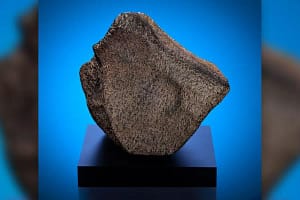
The story of Teghaza 001 began in 2022, when meteorite hunters discovered an unusual rose-coloured rock in Mali’s Sahara Desert. Weighing approximately 800 grams, the specimen was named after the Teghaza salt plain, the region where it was recovered.
At first, its extraordinary age was unknown. Researchers had to establish where it came from and what its mineral composition could reveal.
Scientists at the University of New Mexico examined the rock and identified it as Martian through its oxygen isotopes. These isotopes act like geochemical fingerprints, helping researchers distinguish material originating from different planetary bodies.
The initial identification was only the beginning.
When NASA-funded researchers examined the meteorite more closely, they noticed unusual textures and minerals that distinguished it from many previously studied Martian specimens.
The rock was eventually recognised as one of the three most ancient Martian meteorites found on Earth.
According to NASA’s Jet Propulsion Laboratory, scientists have identified roughly 435 meteorites originating from Mars. Most are considerably younger than Teghaza 001, making this specimen particularly valuable for understanding the planet’s earliest geological history.
How scientists determined that the meteorite is more than 4.1 billion years old
Determining the age of a meteorite is not as simple as examining its appearance. Scientists need to study minerals that preserve information about when a rock formed.
One of the most important discoveries inside Teghaza 001 was the presence of tiny zircon crystals.
Zircon is particularly useful in geological research because it can preserve evidence of the conditions under which a rock formed. Its chemical structure can also contain uranium, which gradually decays into lead at a predictable rate.
By measuring the proportions of uranium and lead in these crystals, scientists can estimate their age.
Researchers used uranium-lead dating to investigate the meteorite’s ancient history. Their analysis established that Teghaza 001 formed more than 4.1 billion years ago, placing it among the oldest Martian rocks ever identified on Earth.
The team also used a specialised dating approach to investigate changes that occurred within the rock after its initial formation. This helped researchers examine evidence of water-related alteration without consuming large amounts of an exceptionally rare sample.
That matters because meteorites from Mars are extremely difficult to obtain. Scientists cannot simply collect another identical specimen if an experiment destroys too much material.
The research therefore represents an important advance not only in understanding Mars but also in the techniques available for studying small samples from other planetary bodies.
The biggest discovery: Evidence of water on ancient Mars
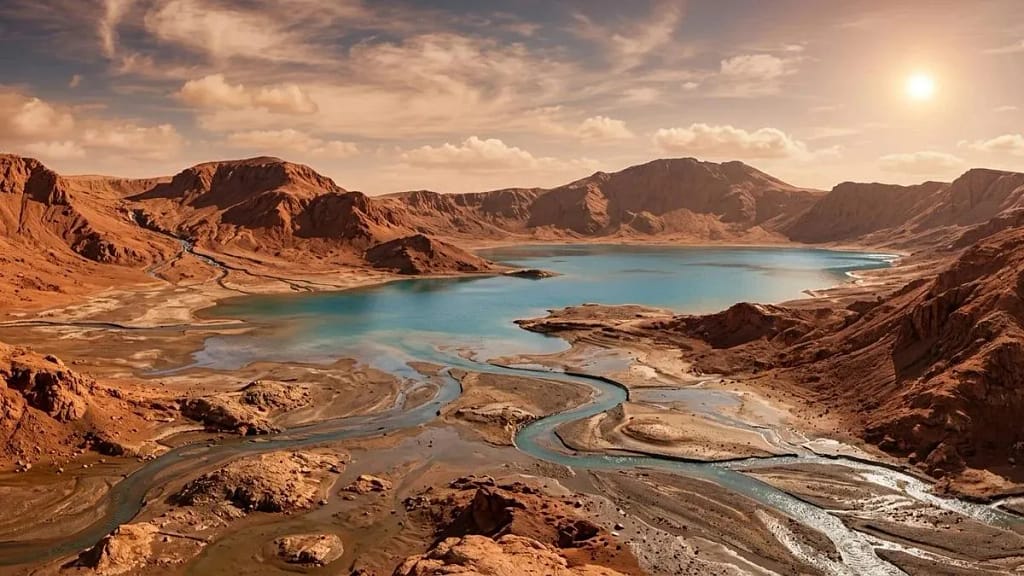
The meteorite’s age is remarkable, but the evidence of ancient water may be even more significant.
Mars today is a cold, dusty planet with a thin atmosphere. Liquid water is not stable across most of its exposed surface under present-day conditions.
However, geological features observed by orbiters and rovers have long suggested that Mars once had a very different environment.
Scientists have identified ancient river channels, minerals associated with water and geological formations that appear to have been shaped by flowing liquid.
Teghaza 001 adds another piece to this puzzle.
Researchers found evidence that the meteorite’s minerals were altered by water around 4.1 billion years ago. Its mineral composition and other chemical characteristics provide clues to interactions between water and rock during the planet’s early development.
This is important because water does more than simply flow over a planet’s surface. It can penetrate cracks, react with minerals, transport dissolved elements and gradually transform the chemical composition of rocks.
By studying these changes, scientists can reconstruct aspects of the environment in which the rock existed.
A separate study published in Science Advances in June 2026 examined the meteorite’s water-related characteristics, providing additional insight into the ancient Martian hydrosphere and the planet’s early loss of hydrogen to space.
Together, these findings suggest that water was involved in Mars’ geological history much earlier than many of the younger landscapes and deposits previously studied could reveal.
What was Mars like more than four billion years ago?
To appreciate the importance of this discovery, it helps to look back at the early history of the Red Planet.
Mars formed approximately 4.5 billion years ago. During its earliest period, the planet was undergoing intense geological activity as its interior developed and its surface gradually cooled.
Volcanic processes helped shape its crust. Impacts from asteroids and other space objects repeatedly altered the landscape. Water may also have played a significant role in changing the planet’s surface and subsurface.
Teghaza 001 provides a rare sample from this ancient chapter.
Its mixture of igneous minerals helps researchers investigate how Martian crust developed as molten material cooled and solidified. The rock also preserves evidence of subsequent alteration by water.
One particularly interesting aspect of the research is that the meteorite’s mineralogy resembles material observed in parts of Mars’ heavily cratered southern highlands.
Researchers identified 13 possible locations on Mars with mineralogical and chemical characteristics that could match Teghaza 001.
However, scientists cannot yet identify its exact original location. The meteorite was ejected from Mars by an impact, travelled through space and eventually reached Earth. Its precise launch site remains uncertain.
How did a piece of Mars reach Earth?
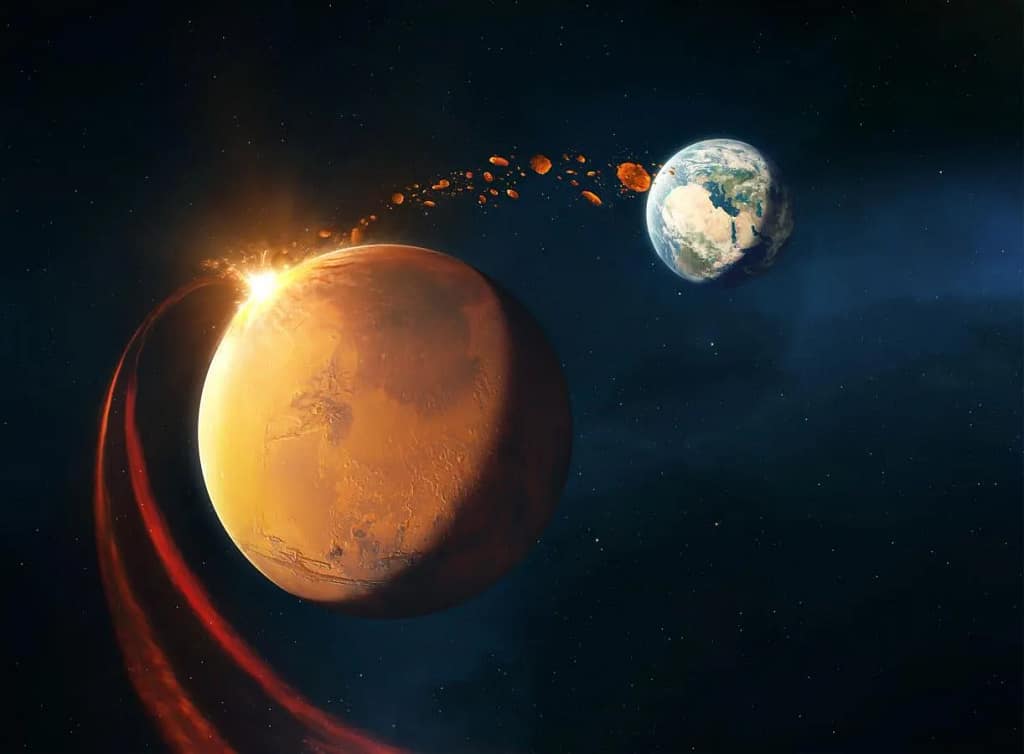
The existence of Martian meteorites on Earth may sound unusual, but the process is understood.
A sufficiently powerful asteroid or comet impact can strike the Martian surface with enormous energy. The collision can excavate rocks and launch fragments into space.
Some of these fragments escape Mars’ gravitational pull and begin travelling through the Solar System.
Their journeys can last millions of years. Eventually, a small number intersect Earth’s orbit and enter our atmosphere.
Most incoming material burns up or breaks apart. Larger fragments can survive the journey and reach the ground.
This is how scientists obtain pieces of Mars without having to send a spacecraft to collect them.
Teghaza 001 followed this extraordinary route. A rock formed during the earliest stages of Martian history was eventually blasted into space, travelled across the Solar System and landed in the Sahara Desert.
The desert environment also helped make its discovery possible. Meteorites can be easier to spot in dry, open landscapes where vegetation and weathering are limited.
What appeared to be an unusual stone to a meteorite hunter became an important scientific sample capable of revealing information about a world billions of years in the past.
Could this meteorite contain evidence of ancient Martian life?
This is perhaps the most fascinating question raised by the discovery.
If Mars had liquid water more than four billion years ago, could microbial life have existed there?
Water is considered essential for life as we understand it. On Earth, microorganisms survive in environments ranging from deep ocean floors to extremely acidic lakes and underground rock formations.
Some can live in places with little sunlight, limited nutrients and extreme temperatures.
That does not mean life existed on ancient Mars. It does, however, make the planet’s early water history an important subject for astrobiology.
Scientists are particularly interested in environments where liquid water interacted with rocks for extended periods. Such interactions can release chemical compounds and create conditions that may support microbial ecosystems.
Teghaza 001 offers evidence of ancient water-rock interaction, making it useful for investigating the planet’s past habitability.
But an important distinction must be maintained: evidence of water is not evidence of life.
The meteorite has not established that organisms lived on Mars, nor has it provided confirmed biological fossils or microbial remains.
Its value lies in preserving geological and chemical evidence from an extremely ancient period when the planet may have had environments more favourable to life than those found on its surface today.
Future studies may help determine whether the conditions recorded in the rock could have supported biological processes.
Why Teghaza 001 is different from other Martian meteorites
Scientists have studied several Martian meteorites, but many provide information about relatively recent periods in the planet’s history.
One famous example is Black Beauty, a meteorite estimated to have formed around 2.1 billion years ago. It contains fragments of different Martian rocks, offering a complicated record of geological events.
Another well-known specimen is ALH84001, an ancient Martian meteorite discovered in Antarctica. It became famous after researchers reported structures and chemical features that generated debate about possible signs of ancient microbial life. Those claims remain controversial and have not established that Martian life was present.
Teghaza 001 is important for a different reason.
It is a coherent rock type that preserves evidence of Mars’ ancient crust, volcanic processes and later interaction with water.
Its age places it among the oldest Martian meteorites recovered on Earth, giving researchers a rare opportunity to examine material from the planet’s earliest geological development.
NASA researchers have described it as an unusually valuable sample because it provides a glimpse of a part of Martian history that has been difficult to study directly.
What this discovery means for future Mars missions
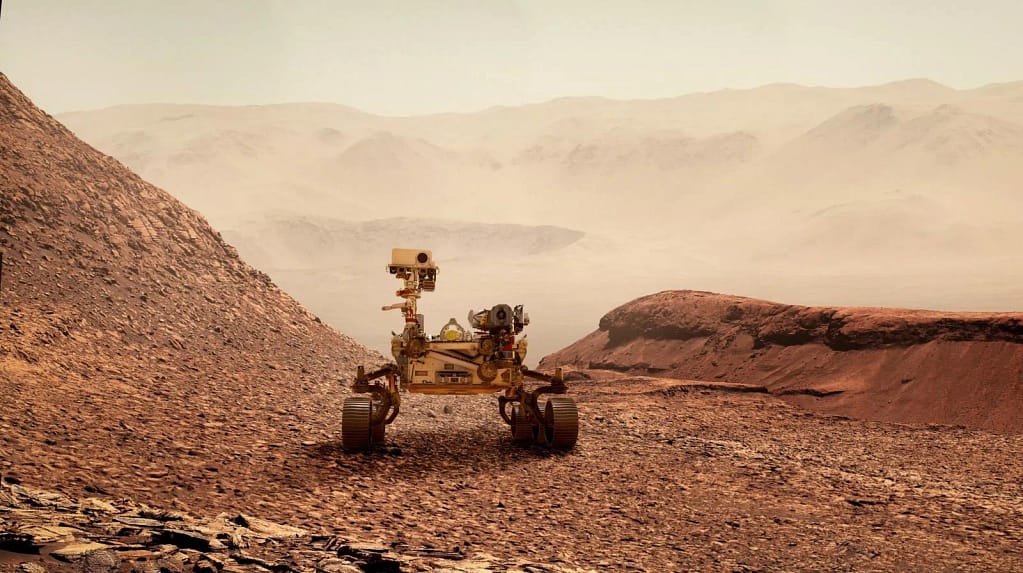
The discovery of Teghaza 001 could influence how scientists approach future Mars exploration.
Current and planned missions are interested in identifying ancient environments where water may once have existed. NASA’s Perseverance rover, for example, is investigating Jezero Crater, a region that contains geological evidence of an ancient lake and river delta.
The goal is to understand the planet’s environmental history and search for potential signs of ancient microbial life.
Meteorites such as Teghaza 001 offer an additional research opportunity. They allow scientists to examine Martian material in laboratories on Earth, where advanced instruments can analyse individual mineral grains with exceptional precision.
Researchers can compare those results with measurements taken by orbiters and rovers.
This combination of spacecraft observations and laboratory analysis is particularly powerful. A rover may identify interesting minerals on Mars, while a laboratory can investigate their detailed chemical and isotopic composition.
There is also a broader implication for future sample-return missions. The ability to date tiny mineral grains while preserving most of a sample could become valuable when scientists eventually study carefully selected material collected directly from Mars.
Teghaza 001 demonstrates how much information can be extracted from a relatively small piece of another planet.
The Sahara has preserved a message from Mars’ distant past
The discovery of Teghaza 001 is a reminder that some of the most important scientific evidence does not necessarily come from expensive spacecraft or distant observatories.
Sometimes, it can be found lying on the ground.
For billions of years, this piece of Martian rock preserved a record of volcanic activity, crust formation and interaction with water. It was eventually ejected from its home planet, crossed space and landed in the Sahara, where it remained until its discovery in 2022.
Now, scientists are using it to investigate a period of Martian history that existed long before the planet became the cold and seemingly lifeless world familiar to us.
The most exciting part is that researchers have only begun studying what it contains. Further analysis could reveal more about how Mars developed, how its water disappeared and whether ancient environments on the planet were suitable for life.
Teghaza 001 does not prove that Mars once hosted living organisms. But it provides something equally important to science: a rare, physical record of the conditions that existed when the Red Planet was still young.
And that tiny piece of ancient Mars, discovered in a vast African desert, may help answer some of the biggest questions about our neighbouring planet.




